Yapei Chang @ ICML 2026

398 posts

Yapei Chang @ ICML 2026

Yapei Chang @ ICML 2026

@YapeiChang

intern @nvidia ☁️ phd in progress @umdcs @ClipUmd • previously @allen_ai @UMass_NLP

Mountain View, CA Katılım Ocak 2022
816 Takip Edilen1.1K Takipçiler
Kyle Lo
Kyle Lo@kylelostat·
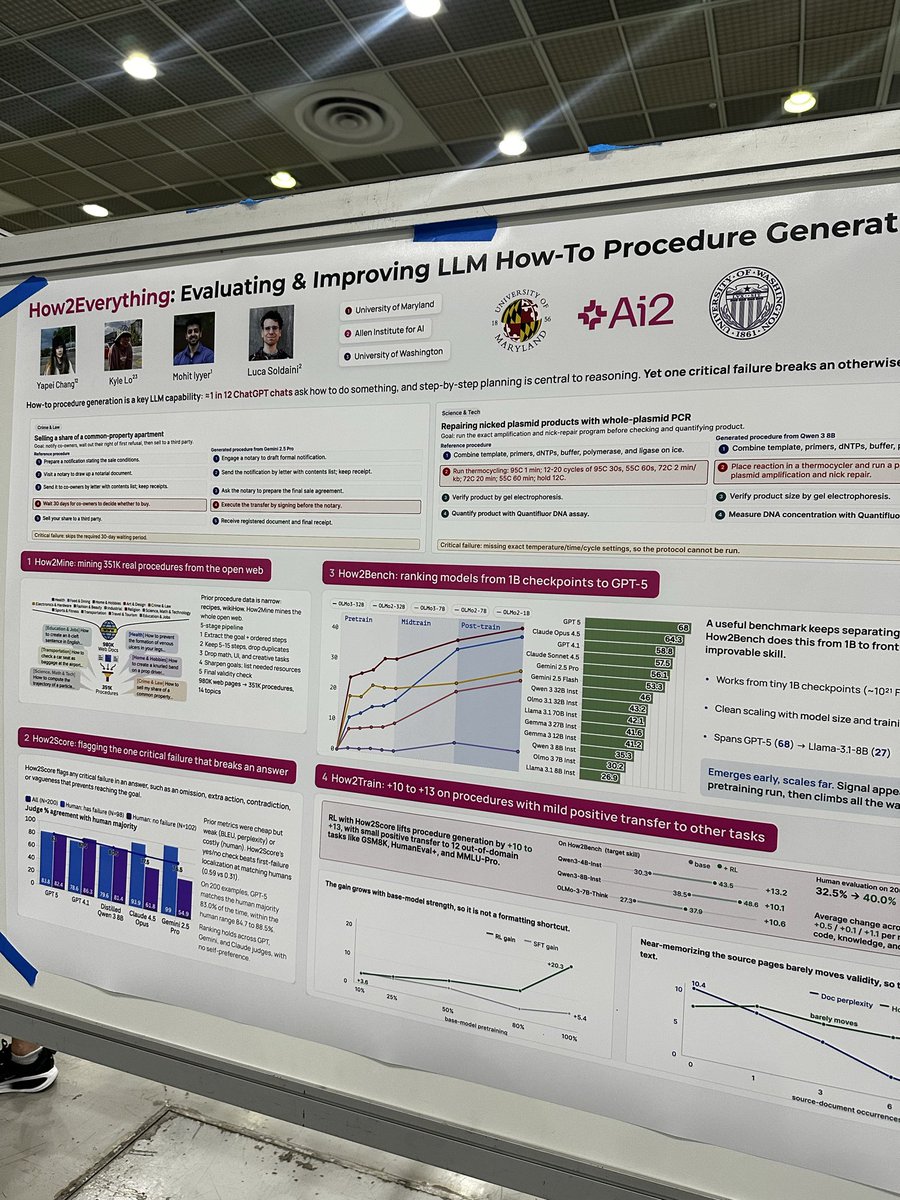
excited to see frens at #icml2026 & present 🐟 Olmix: efficient data mixing under token constraints & evolving data domains 🐡 How2Everything: mining the web for diverse procedural tasks for train & eval 🐠 happy to chat data & evals, both pre & post-training
GIF
GIF
English
2
5
31
4.8K
Yapei Chang @ ICML 2026 retweetledi

Chau Minh Pham
Chau Minh Pham@chautmpham·
I'm in San Diego for #ACL2026 🌴! Excited to chat about long-context evaluation and narrative generation/analysis. I am also looking for postdoc and research scientist opportunities starting in 2027. Would love to connect if you know of any openings!
English
1
5
25
1.7K
Yapei Chang @ ICML 2026 retweetledi
Hamish Ivison
Hamish Ivison@hamishivi·
Trained some terminal agents with friends! Introducing Tmax, open RL terminal agent models. Under default settings and shorter length (65k) token budgets, tmax outperforms prior open work on terminal use. We are releasing all data+weights+rollouts publically!
Hamish Ivison tweet media
English
13
115
903
319.8K
Yapei Chang @ ICML 2026 retweetledi
Alisa Liu
Alisa Liu@alisawuffles·
I'm joining OpenAI next week!🥹 The job search turned out to be really challenging but also super rewarding, so I wrote a small blog to share what I learned along the way and hopefully make the process a little less mysterious for the next person. alisawuffles.github.io/blog/job-search
English
509
1.1K
14.4K
5.4M
Yapei Chang @ ICML 2026 retweetledi
Ramya Namuduri
Ramya Namuduri@ramya_namuduri·
Are LLM-generated stories novel? They can have unique characters and cliché plots, or the other way around. A holistic score doesn’t help distinguish the two 😔. Meet GENIE 🧞 – a fine-grained novelty metric that tells you where and why a response is original!
Ramya Namuduri tweet media
English
2
15
44
7.1K
Yapei Chang @ ICML 2026 retweetledi
Ming Li @ UMD
Ming Li @ UMD@Ming_Liiii·
🚀🚀Excited to share our new work: When is Your LLM Steerable? 🤔🤔 Activation steering is a lightweight way to control LLM behavior at inference time: inject a steering vector into the model’s hidden states, and hopefully guide the output toward a target concept. But in practice, steering can be surprisingly brittle. A strength that works for one model, prompt, or concept may fail completely in another setting. Too weak, and the model ignores the intervention. Too strong, and the generation can collapse. In this work, we study a simple question: Can we predict whether steering will succeed before generating the full response? 🔍 Our main findings: 1. Steering is highly fragile across settings. 🧪 We build ASTEER, a large-scale testbed with 1.4M steered generations across 150 concepts, 3 LLMs, and 2 steering methods. We find that the successful steering strength range varies substantially across models, methods, prompts, and concepts. 2. Early hidden states contain signals of steerability. 🧠 We analyze how the steering vector’s effect propagates through layers and early decoding positions. Based on these features, we train SteerBoost, a classifier that predicts whether a steering attempt will under-steer, succeed, or over-steer after only a few generated tokens. 3. SteerBoost makes strength search much cheaper. ⚡ Instead of running expensive full rollouts for every candidate strength, SteerBoost can guide the search using short early-decoding traces, recovering near-optimal steering performance at a small fraction of the decoding cost. Paper: arxiv.org/abs/2606.11599 Code: github.com/Fcr09/SteerBoo… Feedback and discussions are very welcome! 🙌 Work done with Chenrui, @chengez1114 , @FeiziSoheil , and @zhoutianyi 🙌🙌
English
0
5
19
2.3K
Santiago M.
Santiago M.@sanmking·
@YapeiChang Post-training is not a free-lunch! It comes at the expense of dimensionality collapse. From both, human preferences, and verified rewards.
English
1
0
0
43
Yapei Chang @ ICML 2026
Yapei Chang @ ICML 2026@YapeiChang·
🤖 When 5 frontier LLMs are asked to write about if AI’s future has to be dystopian, they all converge on a broad, safe argument: let’s augment humans instead of automating work. 👩 Human writers take a wider range of sharper positions: AI is already used to micromanage workers; “better” AI requires worker protections and public institutions; decolonizing AI means changing who gets to shape and benefit from it. We call this AI argument collapse: on debated topics, different LLMs converge on a small set of main arguments, supporting claims, and argumentative structures. Newspaper op-eds, position papers, even tweets… many forms of public debate risk being flattened if we are not careful about AI-assisted / AI-authored pieces. At scale, many “reasonable” AI-written arguments may become “reasonable” in the same exact way. Read more in our thread 👇
Yekyung Kim@YekyungKim

From op-eds in newspapers to NeurIPS position papers, AI is increasingly shaping long-form public discourse. Its arguments seem plausible, but beneath surface fluency, we find argument collapse: different LLMs converge to the same main & supporting arguments and structure.

English
3
5
32
3.2K
mkchr
mkchr@MfkChr·
@YapeiChang the best appproach is to treat ai as an initial brainstormer but the argument must remain human
English
1
0
0
48
Yapei Chang @ ICML 2026
Yapei Chang @ ICML 2026@YapeiChang·
@GenHeres123 Yep, RLHF/alignment is very likely a direct cause. But "expected" doesn't mean harmless, which is what we're trying to show in our work.
English
0
0
0
25
🇸🇴 🕳️ Causal Bot
🇸🇴 🕳️ Causal Bot@GenHeres123·
@YapeiChang Isn't this 'argument collapse' simply a direct byproduct of RLHF By training models to be 'helpful, harmless, and honest' according to a centralized standard of safety and reasonableness, we are literally engineering them to converge on the safest, most median position
English
1
0
0
56
Yapei Chang @ ICML 2026 retweetledi
Vishakh Padmakumar
Vishakh Padmakumar@vishakh_pk·
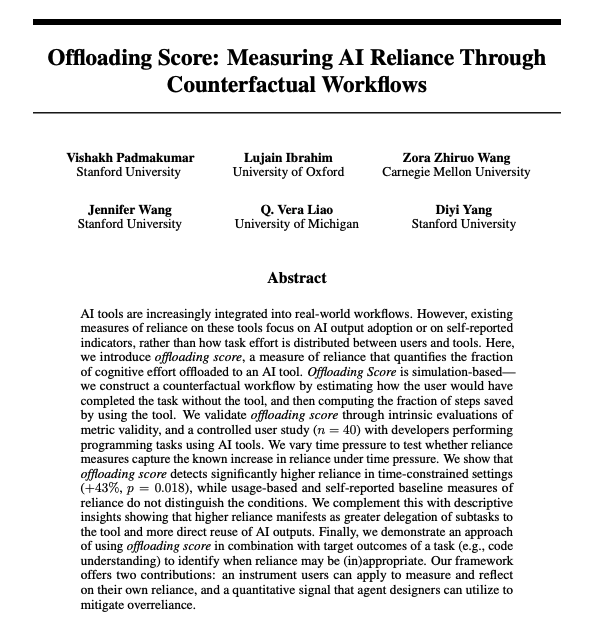
People are increasingly worried that AI tools make us overreliant. But how do we actually measure this? We introduce Offloading Score, a measure of reliance based on the fraction of cognitive effort offloaded to AI while completing a task. In a controlled user study, Offloading Score detects increased reliance under time pressure, while several common alternatives do not. (1/9)
Vishakh Padmakumar tweet mediaVishakh Padmakumar tweet media
English
7
74
215
79.1K
Yapei Chang @ ICML 2026 retweetledi
Oleksii Kuchaiev
Oleksii Kuchaiev@kuchaev·
Our post-training pipeline is a substantial redesign from Super. The core idea: don't rely on stacked RL stages alone. We do SFT, multi-environment RLVR across a huge mix of agentic/reasoning/code/safety environments, then Multi-teacher On-Policy Distillation (MOPD). 10+ domain-specialized teachers, merged into the student via dense token-level guidance on its own rollouts. See Figures below for overview and tech report for all the details. 2/4
Oleksii Kuchaiev tweet mediaOleksii Kuchaiev tweet media
English
9
38
281
107.3K
Yapei Chang @ ICML 2026 retweetledi
Luca Soldaini 🎀
Luca Soldaini 🎀@soldni·
Climbing with no distillation, like the Big Boys do, has been super fun! Read the tech report for a taste of our ̶s̶u̶f̶f̶e̶r̶i̶n̶g̶ journey
Luca Soldaini 🎀 tweet media
Mustafa Suleyman@mustafasuleyman

Super excited to announce seven new world-class MAI models today. They represent what we consider a new era in AI designed to keep you in control and on the frontier. First is our text foundation model, MAI-Thinking-1, exceptionally strong on reasoning and SWE tasks. - It’s a 35B active parameter MoE with a 256K context window. Independent human raters on Surge prefer it for overall quality in blind side-by-sides versus Sonnet 4.6, and it’s achieved 97% on AIME 2025, the key measure of its general-purpose reasoning abilities. - It's at 53% on SWE Bench Pro, placing it right alongside Opus 4.6 on one of the toughest coding benchmarks. - And since we co-designed our models with our own silicon, MAI-Thinking-1 is optimized on our MAIA 200 chip. Benchmarking head-to-head against the GB200, we see 30% better performance per dollar as well as a 1.4x performance-per-watt gain when running our MAI models on the MAIA 200 end-to-end. Next is MAI-Image-2.5 and its Flash variant. Two super strong models now at #2 on the leaderboards, surpassing the score of Nano Banana 2 on image editing. Last for now is MAI-Code-1-Flash, our new inference efficient coding model, especially tuned for VS Code and GitHub Copilot CLI. - Code-1-Flash achieves 51% on SWE Bench Pro, despite having just 5B parameters, putting it closer to Haiku in size but cheaper in cost. All of this is the foundation for Microsoft Frontier Tuning. It lets you customize our models to create custom, company-specific agents that only you control. You can make our model, your model. Your data. Your agents. Your moat. Early adopters are already seeing a difference. When we tuned our models for McKinsey’s tasks, MAI delivered the highest win rate, outperforming GPT-5.5 on quality, while being 10x lower on cost. Also really excited to be collaborating with the amazing team at Mayo Clinic to jointly train a new frontier AI model for healthcare. Our announcements today mark another milestone on the road to humanist superintelligence. You can learn more and about our other new models in our latest blog: microsoft.ai/news/building-…

English
18
48
707
70.3K
Yapei Chang @ ICML 2026
Yapei Chang @ ICML 2026@YapeiChang·
post-trained models are more helpful, but collapse toward a narrow range of possible answers 🍎 with ReDiPO, we show how to recover the lost diversity with a simple DPO data pipeline, while largely preserving instruction-following and safety great work led by @vsamuel2003 !
Vinay Samuel@vsamuel2003

Post-training makes LLMs safer and better at following instructions, but less diverse. 🤔 Can we get that diversity back without sacrificing alignment? Introducing ReDiPO: a preference optimization recipe for restoring distributional diversity while preserving safety and instruction-following.

English
0
5
37
4.8K
Yapei Chang @ ICML 2026 retweetledi
Kyle Lo
Kyle Lo@kylelostat·
happy to share another quality tech report w/ the wider research community 🫶 great read for ppl who want to see all the details for methods + infra for scaling up pretraining & RL, esp detailed discussion about data which is often kept vague by other labs
Kyle Lo tweet media
Mustafa Suleyman@mustafasuleyman

Super excited to announce seven new world-class MAI models today. They represent what we consider a new era in AI designed to keep you in control and on the frontier. First is our text foundation model, MAI-Thinking-1, exceptionally strong on reasoning and SWE tasks. - It’s a 35B active parameter MoE with a 256K context window. Independent human raters on Surge prefer it for overall quality in blind side-by-sides versus Sonnet 4.6, and it’s achieved 97% on AIME 2025, the key measure of its general-purpose reasoning abilities. - It's at 53% on SWE Bench Pro, placing it right alongside Opus 4.6 on one of the toughest coding benchmarks. - And since we co-designed our models with our own silicon, MAI-Thinking-1 is optimized on our MAIA 200 chip. Benchmarking head-to-head against the GB200, we see 30% better performance per dollar as well as a 1.4x performance-per-watt gain when running our MAI models on the MAIA 200 end-to-end. Next is MAI-Image-2.5 and its Flash variant. Two super strong models now at #2 on the leaderboards, surpassing the score of Nano Banana 2 on image editing. Last for now is MAI-Code-1-Flash, our new inference efficient coding model, especially tuned for VS Code and GitHub Copilot CLI. - Code-1-Flash achieves 51% on SWE Bench Pro, despite having just 5B parameters, putting it closer to Haiku in size but cheaper in cost. All of this is the foundation for Microsoft Frontier Tuning. It lets you customize our models to create custom, company-specific agents that only you control. You can make our model, your model. Your data. Your agents. Your moat. Early adopters are already seeing a difference. When we tuned our models for McKinsey’s tasks, MAI delivered the highest win rate, outperforming GPT-5.5 on quality, while being 10x lower on cost. Also really excited to be collaborating with the amazing team at Mayo Clinic to jointly train a new frontier AI model for healthcare. Our announcements today mark another milestone on the road to humanist superintelligence. You can learn more and about our other new models in our latest blog: microsoft.ai/news/building-…

English
13
23
387
26.9K
Yapei Chang @ ICML 2026 retweetledi
Shannon Shen
Shannon Shen@shannonzshen·
"Evolve your repo, not just your agent." Self-evolving repository (SEPO) is a fun idea that I’ve been exploring recently. @sepoagent turns any GitHub repo into a shared workspace for humans and coding agents.
Shannon Shen tweet media
English
3
22
91
14.8K
Yapei Chang @ ICML 2026 retweetledi
Nishant Balepur
Nishant Balepur@NishantBalepur·
🚨 New Paper! 🚨 One of my first Ph.D. papers found that LLMs can answer multiple-choice questions without seeing the question 🤔 At #ACL2026, I'm presenting a follow-up showing that current reasoning LLMs can still do this! And quite similarly to a clever test-taker 🧑‍🎓🧵
Nishant Balepur tweet media
English
50
110
1.8K
1.3M