

MHT retweetledi

I have stayed mostly on the sidelines in terms of having an opinion on whether the tax-exempt market, as I, and many know it, will continue to exist. Tough times (ie cutting deficits) require tough decisions, and the best tool my industry has is education for those who make the decisions.
However, when I see things shared that make great talking points, but need context, I want to contribute.
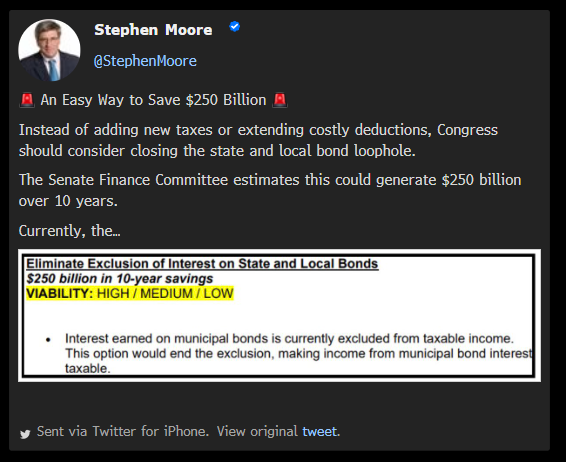
Yes, the Federal government estimates the cost of keeping the federal exemption for the municipal market at ~$250 billion over ten years. HOWEVER, they arrive at that assumed cost by concluding that investors who currently own bonds and pay no tax on that interest, would alternatively invest in corporate bonds that they would than be required to pay tax on interest. I feel that thinking to be somewhat flawed due to human nature in general. Those seeking a tax shelter will naturally drift toward other viable alternatives to keep from paying taxes.
Bondholders who focus on the municipal market want two main things: Current income that is tax free and very low credit risk. Neither of those are viable alternatives in corporates and thus make the assumption that muni bond holders will just convert, somewhat of a reach. It is also important to note that the municipal market is not driven by bond buyers in a smoky back room wearing monocles and top hats. Do rich people buy municipals? Absolutely. Are they the only buyers, not by a long shot. In fact, the rise of ETF and SMA products have reduced fees and increased access to the market, introducing municipal bonds to those across the tax spectrum.
The other issue is that in an effort to keep the current TCJA provisions in place, by eliminating the exemption, the administration could be unwittingly passing some of the largest middle class tax increases imaginable. Consider this for a moment....School District X is able to borrow for a much needed school project at a subsidized rate because of the federal tax exemption and the state and local tax exemption on their bonds, combined. If the largest component of that goes away, their bonds become much less desired and attractive, which ultimately drives up their cost of financing. Those ancillary costs are borne by tax payers across the US. While many localities have limits on how much taxes can raise, the choice becomes quite simple. Raise local taxes to the extent they are allowed or just delay much needed infrastructure and school projects that our market finances.
Maybe I am being too simplistic, but I really do like to think that a market which serves a tangible societal good helping to better neighborhoods, build roads, railways, airports, schools, hospitals, colleges, provide clean water and land conservation may just find bi-partisan support and survive another round of threats unimpaired.
English