
RFTW
347 posts




I know Jai isn't public so noone but 1.5 thousand people in the world can adequately critique it, but on Twitter the main discourse is "my monitor can't display control_message_header, so he should have named it cmsghdr"
English
@Feoramund I asked you a couple of days ago, if you will continue to use Odin. Unfortunately your older streams are lost and I can't watch them. It would be very interesting if you could post something about it (at least to me).
English


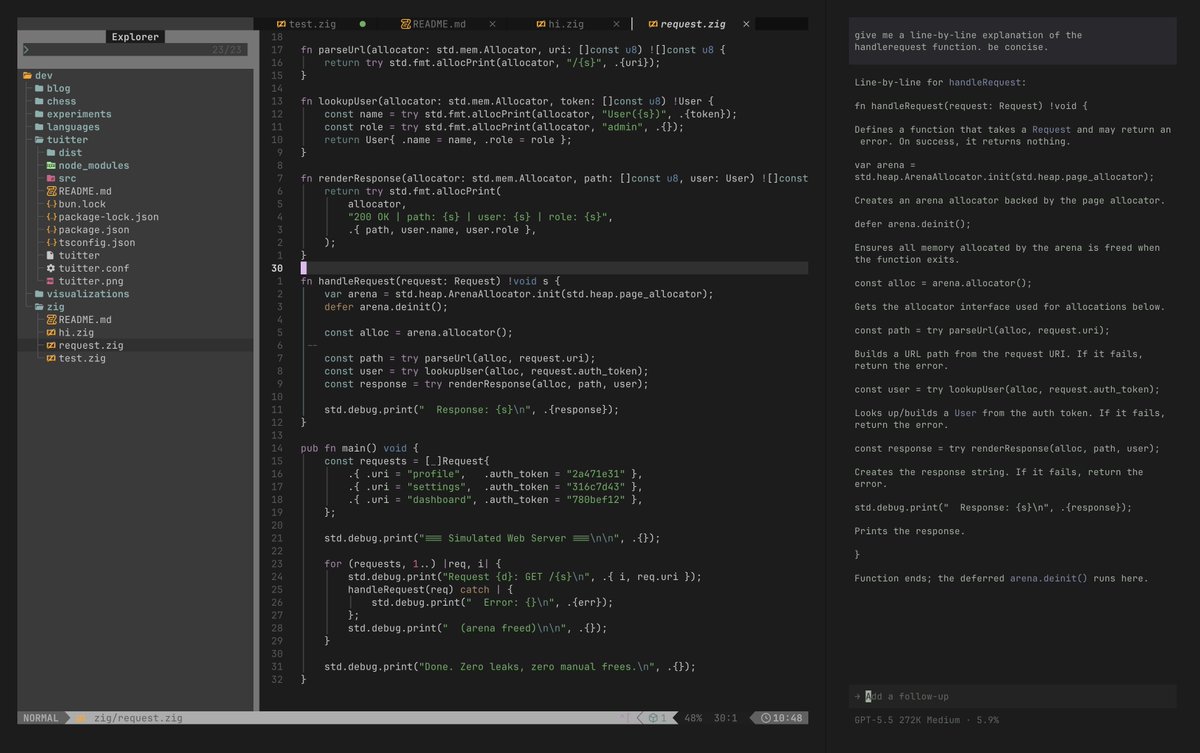
Also this is proving to be a nice coding + learning + agent setup.
Ghostty with two panes: nvim on one side, cursor-agent on the other. Zigs a new language to me, and can ask questions about functionality as I go.
English
ZIG IS SO COOL
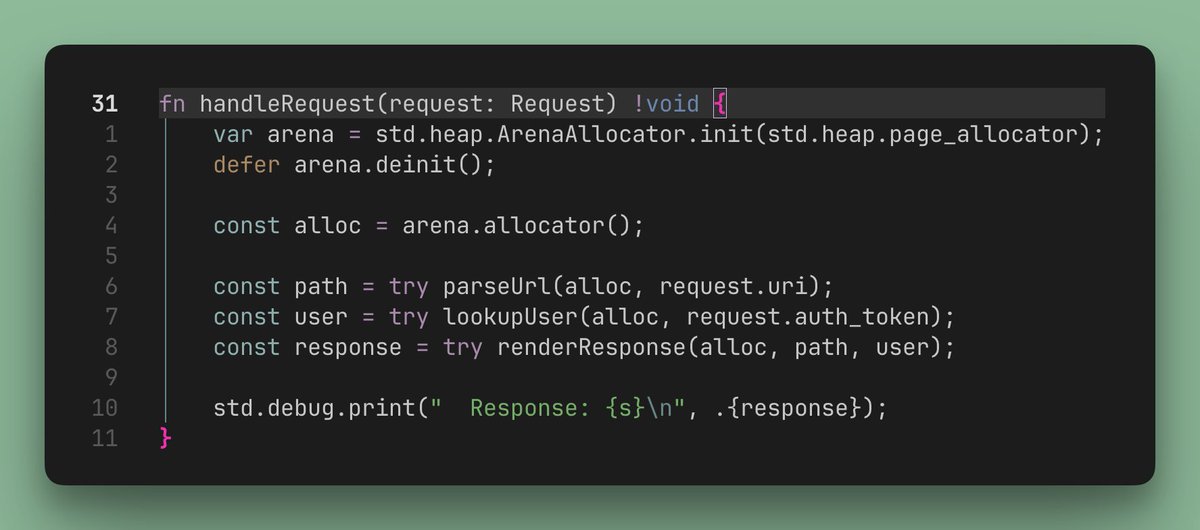
I've been learning about Zig's memory allocators, specifically ArenaAllocator are amazing.
Also love the simplicity of `defer` for guaranteeing code execution on function /scope end.
Going to stream on Zig + Philosophy of Software Design tomorrow 10am.
English


@ZH1YGD Think why it becomes verbose? Why do you have so many codepaths that have failure state in them? Could you improve them by handling errors earlier? Can you collapse error paths? Usually, in my experience, having a lot of verbose error handling everywhere is a signal to action :)
English
@ZH1YGD It boils down to intellectual masturbation vs field reality. You can add a bunch of fancy things to any programming language, but the best practice is to handle errors as early as you can, and as rigorous as you can. And most fancy PLT stuff favors passing it up for someone else
English
@valigo Interesting. I will check it out. What makes me wonder is that someone who is an expert in the language, compiler etc area, absolutely hates error handling in Go. Now I Odin and Jai use the same pattern. I am spoiled by Rust in terms of error handling and don't know 1/2
English
Both are system's programming languages. Both use similar variable declaration syntax. Both have _some_ similar semantics, but I'd say that's where similarities end. E.g. Jai has the most advanced metaprogramming and compile-time capabilities in the world (definitely among staticly-typed compiled languages, and maybe second only to LISPs), while Odin is explicitly very light on these things, because Bill is notorious LISP hater.
English

More thoughts as Eric wanders through the wilderness of possible next Linux distributions...
My core criterion has strengthened to "rolling-release, *and* must have a convincing story about rollback tools". This means, at minimum, that package installations need to automatically create restorable system states.
I also want broad repository coverage, so I don't have to do a lot of downloading and compiling. This steers me away from several niche distributions that are technically interesting but have communities too small to generate a broad range of installable packages.
I have some other criteria as well, which will become apparent as you read this list of updates.
CachyOS with Snapper integration into the package manager: still the top contender. To displace it, anything else needs to have at least as convincing a story about easy rollback.
EndeavourOS: can also be Snapper enabled. Probably okay, but CachyOS seems to have a larger and more vigorous community, and that does matter.
Omarchy: It's clever, it's doing a good thing for new Linux users, it has a strong rollback story, but. It's very opinionated, and I don't need DHH to have good taste for me, I can manage that for myself. By the time I got done customizing it, the value he added would probably be gone. So, no advantage over a friendly but less opinionated Arch reskin like CachyOS.
Vanilla Arch: now has an installation TUI, so not the ridiculous pain in the ass to set up that it used to be. Could be configured with the package installer calling snapper, yes. But if I'm going to install Arch, I don't see any reason not to use the work other people have done on making Arch a better out-of-the-box experience. Which redirects me to CachyOS, EndevourOS, and Omarchy.
Gentoo is out. It doesn't have a convincing rollback story. Also, I do not welcome long compile times - especially since Rust is becoming more popular and the Rust compiler is painfully slow.
Void Linux looks really interesting, technically, and has a good rollback story. The design of its package manager looks very thoughtful. But immature Cosmic Desktop integration is a crash landing, and I'm concerned about its repository breadth. Regretfully, no.
Debian, and the Debian derivatives such as Ubuntu and Mint and Pop!_OS, are out because I really do want rolling-release. If I hadn't decided that, I'd just stick with Pop!_OS, which has overall been pretty good to me.
NixOS might be back in contention if (as some on X allege) the gay race communists got fired late last year and have fucked off to ruin something else. Possibly the project might recover. I am investigating this.
Alas, Guix is still out. Narrow repositories and an extremely purist culture leading to annoyingly limited hardware support. I'm told people will scream at you if you even mention the distribution channels for non-free software.
Fedora: only semi-rolling. No integrated rollback tools. Nope.
OpenSUSE Tumbleweed: possible. I had Grok compare it head to head with Cachy OS and they look very similar with respect to my criteria, except that CachyOS probably has much broader repository coverage. AUR is a huge advantage that way for anything Arch-based.
I'm sure I've missed some possibilities, and I'm sure people will tell me about them in the comments.
English

IDK, I "review" compiler output all the time. A good debugger makes this cheap and easy. The disassembly is always there, and it jumps out at you when there are codegen anomalies, which happens more often than you might think in optimized builds.
solst/ICE of Astarte@IceSolst
Interesting article on treating agent output like compiler output (and why) skiplabs.io/blog/codegen_a…
English
If you want to pick up Zig, that's an outstandingly good introduction.
It is also auto-dabbed to english
youtu.be/MMtvGA1YhW4?si…

YouTube
English
X is the only platform that offers real freedom of speech, but the discussions are most of the time useless.
en.wikipedia.org/wiki/Acquired_…
x.com/valigo/status/…
Valentin Ignatev@valigo
A lot of cope around Linux userspace ABI today. Cope and argue all you want, but a graphical program that was compiled and worked 10 years ago, just wouldn't run on Linux today, unless it is win32 application. Think about it.
English
RFTW retweetledi


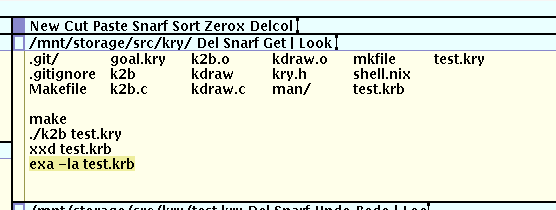
a few more days and i might be switching to acme permanently. I absolutely love that i can type anywhere, select the command and execute it with a middle click.
so convenient
English