ZahcM

4.4K posts

ZahcM

ZahcM

@ZahcM

Cholesterol and dietary fat research. Author of "Why Saturated Fat Does Not Cause Disease" - https://t.co/i1v53JeONU

Katılım Nisan 2019
1.3K Takip Edilen1.9K Takipçiler
ZahcM
ZahcM@ZahcM·
Often overlooked, but the opposite is also true. If we put a coronary artery to do the job of a vein or observe a coronary artery under lower blood pressures (anomalous arteries), atherosclerosis in the artery would be minimal or absent. @xinggang_wang
Bret Scher, MD@bschermd

Your veins and arteries carry the same blood. Same LDL. Same ApoB. Same everything. Yet veins almost never get plaque. Arteries constantly do. Maybe you've seen the recent discussions about this. It's an interesting question that provides clues in cardiovascular science, and could challenge how we think about LDL and ApoB. 🧵

English
1
2
13
726
Austin Dudzinski, PharmD, BCACP
My 💭's (even though no one cares): move away from high intensity statin, keep it moderate and add ezetimibe then other agents if possible in high risk individuals who are likely to benefit. Lean towards ezetimibe in leaner phenotype. Maybe measure some sterols, and GET MORE FREAKING WOMEN IN RCTs!!! Personalize medicine!!!🤣
English
4
0
11
433
Austin Dudzinski, PharmD, BCACP
🤔Weighing in on Ez-PAVE🤔 Finally got around to reviewing a bit… Korean multicenter RCT (n=3048) in established ASCVD comparing an LDLc target of <55 mg/dL vs <70 mg/dL over 3 years. There are a couple points I think are interesting: ☝🏻ofc open-label, ascertainment bias (which is unavoidable in treat-to-target design), but outcomes driven by soft endpoints predominantly which could be viewed as a bit meh @ZahcM
English
2
2
13
1.8K
ZahcM
ZahcM@ZahcM·
Yep. A poorly conducted trial that says nothing about LDL per se (composite endpoint as primary, nonblinded, mixing different drugs and doses with various pleiotropic effects, etc.). Also, in the fine print: 31 deaths (2%) in the intensive group vs. 29 (1.9%) in conventional.
Kansanparantaja@Kansanparantaja

@DrSamuelBHume The absolute difference was 6.6% vs 9.7%. The harder composite was 2.3% vs 3.6%. So yes, benefit in this specific secondary-prevention trial, but “the lower the LDL, the better” is still a slogan, not the full conclusion.

English
1
3
12
2K
ZahcM
ZahcM@ZahcM·
@ApoDudz Oh yeah, the sausage reference was weird 😂 He did put a lot of work into developing MR, so he may be less critical of it. I enjoyed the discussion on negative controls though, we need more of that in observational research.
English
1
0
1
31
Austin Dudzinski, PharmD, BCACP
I don’t find it surprising that he is hypercritical of FFQ/NutriEpi but assumes an LDLc change from sausages = an LDLc change from a SNP 🤣 I assume he loves his own methodology; idk I’m not MR expert but the gene environment equivalency assumption seems fine in principle but quite questionable in practice
English
1
0
1
22
ZahcM
ZahcM@ZahcM·
The (ab)use of food frequency questionnaire data in substitution modelling - nature.com/articles/s4143… "The majority of substitution modelling analyses that relied on FFQ data had not adequately addressed fundamental limitations in measurement accuracy."
ZahcM tweet mediaZahcM tweet media
English
1
3
15
669
ZahcM
ZahcM@ZahcM·
@ApoDudz Thanks! I like GDS, but I've never been convinced by his usual examples (on LDL, HDL, and vitamin E). Too much faith in MR, and lots of inconsistencies he did not mention. But nice interview overall 😁
English
1
0
1
33
Tucker Goodrich
Tucker Goodrich@TuckerGoodrich·
Pleiotropic effects of PCSK9 inhibitors? According to this they work as anti-inflammatory agents, reducing macrophage adhesion to endothelium. 🤔 ”PCSK9 Inhibitors Reduce PCSK9 and Early Atherogenic Biomarkers in Stimulated Human Coronary Artery Endothelial Cells” doi.org/10.3390/ijms24… @ZahcM
English
1
0
3
747
ZahcM
ZahcM@ZahcM·
@lowcarblefty Nice video! He apparently thinks about causality a lot (an “obsession” of his), but he never provides a definition. I knew he was up to no good ever since his apoB article series, but these recent events are truly despicable.
English
0
1
1
9
Archimandrite
Archimandrite@lowcarblefty·
@ZahcM seen this? Btw, how do feel about Attia slinging around the word "causal".
English
1
0
1
14
Archimandrite
Archimandrite@lowcarblefty·
Funny how things converge, a grifty physician and wanna-be elite influencer making his career on defending (not very well) conventional wisdom. People like PA have help build credibility for nuts like RFK. youtube.com/watch?v=THo_s3…
YouTube video
YouTube
English
1
0
1
17
ZahcM retweetledi
Chris Masterjohn
Chris Masterjohn@ChrisMasterjohn·
Are the Seed Oil Trials Confounded by Trans Fats? Part 1: The LA Veterans Administration Hospital Study
Chris Masterjohn tweet media
English
3
12
75
16K
ZahcM
ZahcM@ZahcM·
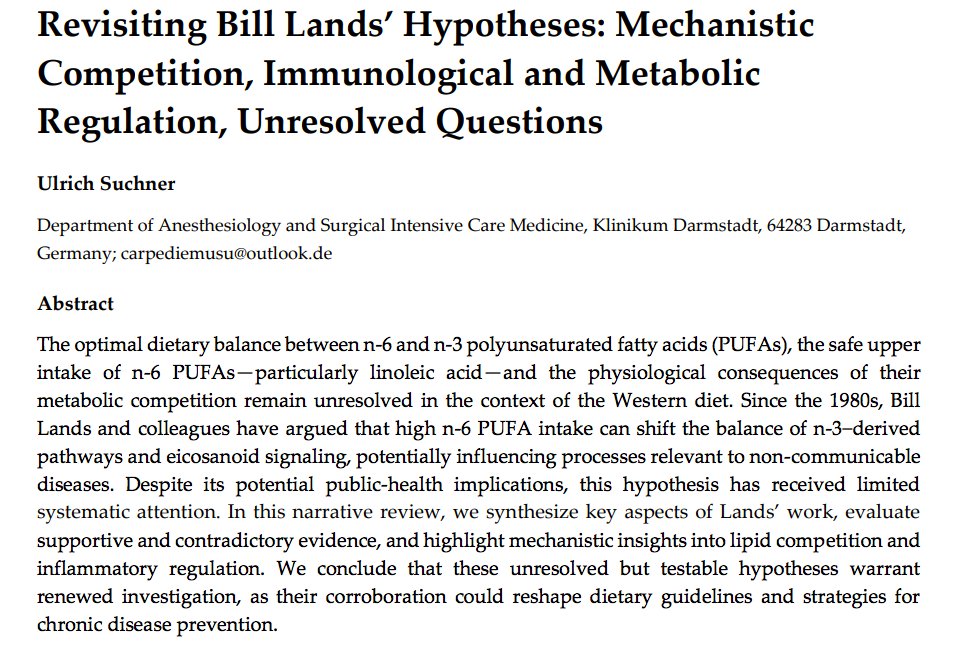
Revisiting Bill Lands’ Hypotheses: Mechanistic Competition, Immunological and Metabolic Regulation, Unresolved Questions - preprints.org/manuscript/202… "This discussion favors monitoring and limiting the n-6 PUFA supply."
ZahcM tweet media
English
1
0
4
260
ZahcM
ZahcM@ZahcM·
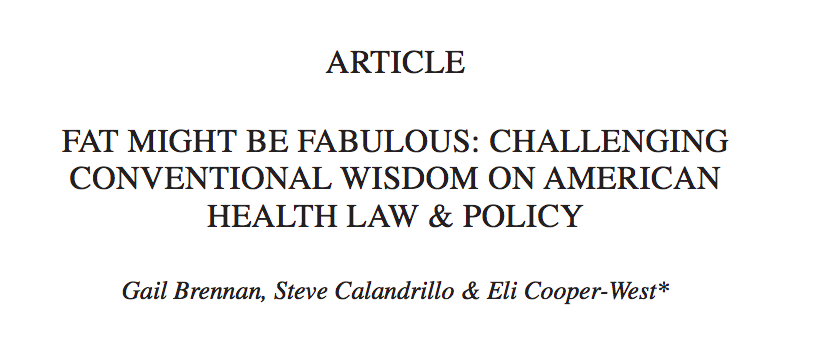
Fat Might Be Fabulous: Challenging Conventional Wisdom on American Health Law & Policy - publications.lawschool.cornell.edu/jlpp/wp-conten… "As it turns out, the vilification of saturated fat, and particularly its connection to heart disease, has never been confirmed in a careful, scientific way."
ZahcM tweet media
English
0
3
6
317
James DiNicolantonio
James DiNicolantonio@drjamesdinic·
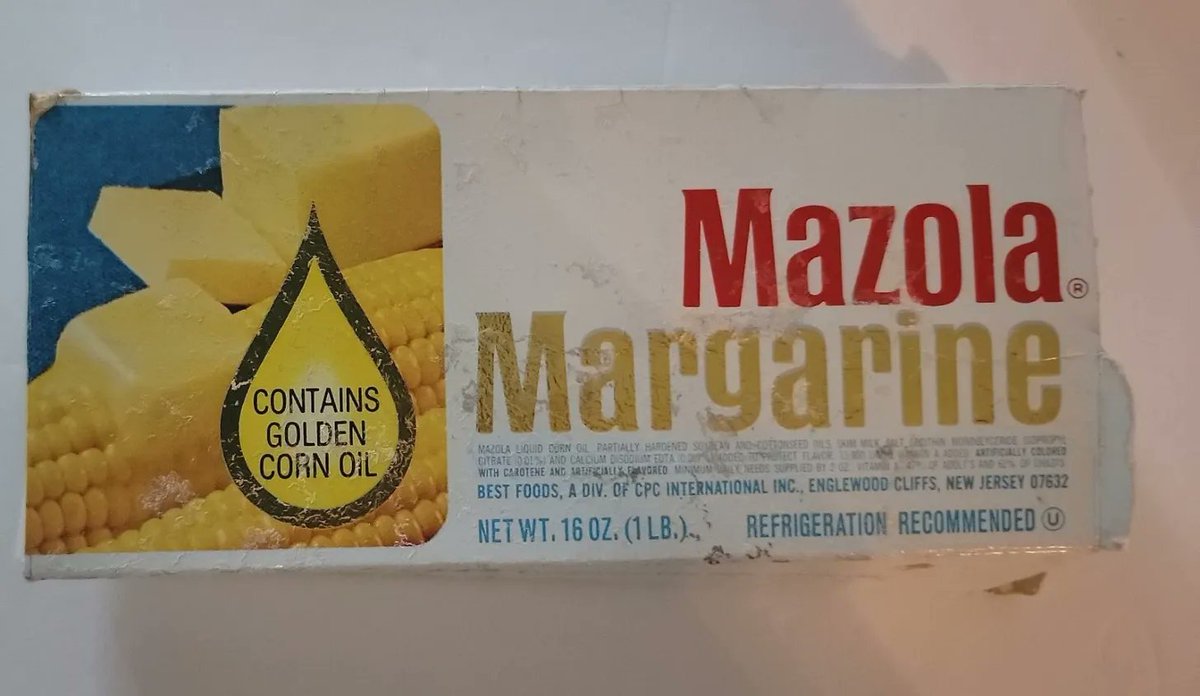
@deniseminger @TuckerGoodrich Denise it is well known that the hard stick margarines were higher in trans fats that the animal fats group were eating compared to the margarines and shortenings consumed by the seed oil group. Agree with Tucker. If the opposite were true the total cholesterol would have increased on the seed oil diets but they significantly decreased. See here - Miracle Margarine in SDHS Intervention:   - A safflower oil-based polyunsaturated margarine (high in linoleic acid, ~75% of fat content), chosen for its cholesterol-lowering PUFA:SFA ratio.   - Trans Fat Content: Not directly measured, but described as containing "small amounts" of trans fats—likely ~15% or less, as it was formulated for high PUFA content with less hydrogenation than standard margarines. (Era averages for high-PUFA margarines were lower than the 25–40% in fully hydrogenated "common" ones.) It replaced butter and common margarines, reducing overall trans intake. A Special Report on The History of Soy Oil, Soybean Meal, & Modern Soy Protein Products A Chapter from the Unpublished Manuscript, History of Soybeans and Soyfoods: 1100 B.C. to the 1980s by William Shurtleff and Akiko Aoyagi Other historic overviews — e.g. by the food-industry history group at the SoyInfoCenter — note that in standard stick-type (solid) margarines/shortenings, trans-fat often made up 30–35% of total fat, whereas “soft-tub” margarine varieties (i.e. lower-hardness, more spreadable) often had much lower trans-fat — sometimes as low as ~14% or less.  Less hydrogenation is needed to make spreadable soft margarines whereas more hydrogenation (more trans fat) is needed to make solid/stick margarines. This is well known. Trans fatty acids in margarines and shortenings marketed in Austria. M Henninger et al. Z Lebensm Unters Forsch.1996 Sep. “Diet margarines contained up to 1% TFA, while TFA concentrations in tub or stick margarines were much higher (15.7 +/- 5.8% and 21.3 +/- 5.3%, respectively).” A Special Report on The History of Soy Oil, Soybean Meal, & Modern Soy Protein Products A Chapter from the Unpublished Manuscript, History of Soybeans and Soyfoods: 1100 B.C. to the 1980s by William Shurtleff and Akiko Aoyagi The main source of trans fatty acids in most diets is hydrogenated vegetable oils; trans acids constitute roughly 30-35% of the fatty acids in stick margarine, 14% in soft-tub margarine, and 11% in soy cooking and salad oils Control Arm MCS (Higher Saturated Fat Group)**:   - Margarine Used: "Common margarines and shortenings" were key components, alongside animal fats like butter. No special low-trans products were specified.   - Trans Fat Content: These everyday products were heavily partially hydrogenated, with trans fats comprising 20–40% of fatty acids (e.g., standard stick margarines averaged 25–30%). This was a major source of industrial trans fats in 1960s diets.   - Overall Trans Exposure: *Higher* than the intervention, as the diet maintained high saturated and hydrogenated fat intake without restrictions.
Denise Minger@deniseminger

Trans fats were a confounder in pretty much all the old seed oil studies (LA Veterans Trial, Minnesota Coronary Experiment, Sydney Diet-Heart Study, etc.), and I think downplaying that fact is a mistake, but also really understandable because trans fats are super misunderstood and confusion-mired. 1. "Trans fats bad" was originally rooted in their ability to raise total and LDL cholesterol, but (at least some forms) also lower HDL, and maybe more importantly have a lot of gnarly effects completely unrelated to cholesterol. They reduce membrane fluidity when incorporated into cells due to their straight/linear shape, which then interferes with cell signaling and nutrient transport, decreases insulin sensitivity, promotes pro-inflammatory signaling, and various other things that pile up to raise cardiovascular risk (and possibly some cancers and diabetes as well). You can't detect the breadth of trans fats' harm based on their impact on cholesterol levels. 2. There's a myth that seems to trace back to the Christopher Ramsden papers/meta-analyses (the researcher who found buried data for the Minnesota Coronary Experiment) claiming that the old seed oil trial intervention groups were eating less trans fat than the control groups, due to hard margarines and shortenings being replaced by "soft" seed oil margarines. Which, if true, would give the intervention groups of that era an across-the-board advantage. But this is a complete misunderstanding of how hydrogenation and trans fat production works. Hard margarines/shortenings were created through a more complete hydrogenation process, which produces stearic acid (a saturated fat) instead of trans fat. Partial hydrogenation is where trans fats become abundant. "Soft" margarines used in the seed oil intervention groups of the 1950s - 1970s were generally a mix of liquid seed oils and horrifically high-trans-fat partially hydrogenated oils, and they replaced not only "hard margarines and shortenings" but also things like butter, lard, tallow, etc. that didn't have industrially produced trans fat. So in most cases, if not all, the old seed oil trial intervention groups suffered the most trans fat confounding. 3. Totally forgot what #3 was going to be, but will addendum this if I remember.
English
3
1
14
3.6K
ZahcM
ZahcM@ZahcM·
@TuckerGoodrich @deniseminger @ChrisMasterjohn @drjamesdinic Yes. If TFAs were higher in the experimental group, it at least showed that TFAs were not associated with CVD harm. I have long tried to make sense of the inconsistencies across these trials, and TFAs don't make sense. There are better explanations.
English
1
0
0
48
Tucker Goodrich
Tucker Goodrich@TuckerGoodrich·
They also have "hardened vegetable fats", which are likely higher in TFA. So the TFA-containing arm did better (CVD events) than the no-TFA arm. This is a confounder, indeed, but it's the inverse of what Denise suggested. TFA is protective. Which makes sense given what we now know about oxidative stress and CVD.
English
1
0
0
32
ZahcM
ZahcM@ZahcM·
@deniseminger @TuckerGoodrich Thanks. That's the one paper I do not have. Do you have a copy I can get? Would be much appreciated if so.
English
1
0
1
46
Denise Minger
Denise Minger@deniseminger·
@ZahcM @TuckerGoodrich The trial’s 1965 paper on vitamin E status states that the control diet contained “butter, but no margarine” (as part of an explanation for why the control diet had low vitamin E levels). It’s actually not mentioned one way or another in the 1962 paper.
English
1
0
1
38
Tucker Goodrich
Tucker Goodrich@TuckerGoodrich·
This is not accurate. 1. We have no data about what the actual composition of these diets was vis-a-vis trans fats. It just wasn't tracked. So any speculation about composition is just speculation. 2. We have a biomarker we can use to track TFA consumption: serum cholesterol. These were cholesterol-lowering diets. The harmful effects of seed oils are due to the same effect that lowers cholesterol. Trans fats aren't subject to this effect, hence they raise cholesterol, life some SFAs. So it's correct to say that any confounding was likely due to excess TFA in the control arms, which did better. This is not a hypothetical point. The man who designed the largest of these trials, the National Diet-Heart Study/Minnesota Coronary Survey was Ancel Keys, who discovered the cholesterol-raising effect of TFA. He would not have designed a diet that would have raised cholesterol, as he thought lowering it would be beneficial. It was the whole point of the trial. 3. The evidence for CVD risk from TFA is largely derived from mechanistic experiments in animals, and then from epidemiological evidence (Walter Willett). Other epidemiological surveys found no relationship between TFA and CVD risk. I've done a number of posts on the poor quality of Willett's science, he's paid by the industry to produce seed oil research. 4. Subsequent (and prior) research into causation of CVD has established that linoleic acid, not TFAs, are apparently essential to the process of atherosclerosis and CVD progression. I've never seen a paper showing that TFAs play a role, except via a possible general stimulation of mitochondrial dysfunction. 5. Modern animal models of CVD progression depend on linoleic acid, not TFAs. 6. The one animal model I'm aware of that compared LA to TFA found TFA to be far less harmful. Which one would expect from its inability to be subject to the oxidative process that drives CVD. 7. Any confounding is likely in the epidemiological research, due to the fact that the trans fats in question are produced from linoleic acid, by adding hydrogen. The trans fats are thus almost always consumed with linoleic acid. TFA-rich margarines are produced from linoleic-acid-rich seed oils. So there's really no basis for complaining that these trials were confounded by TFA inclusion in the intervention arms.
Denise Minger@deniseminger

Trans fats were a confounder in pretty much all the old seed oil studies (LA Veterans Trial, Minnesota Coronary Experiment, Sydney Diet-Heart Study, etc.), and I think downplaying that fact is a mistake, but also really understandable because trans fats are super misunderstood and confusion-mired. 1. "Trans fats bad" was originally rooted in their ability to raise total and LDL cholesterol, but (at least some forms) also lower HDL, and maybe more importantly have a lot of gnarly effects completely unrelated to cholesterol. They reduce membrane fluidity when incorporated into cells due to their straight/linear shape, which then interferes with cell signaling and nutrient transport, decreases insulin sensitivity, promotes pro-inflammatory signaling, and various other things that pile up to raise cardiovascular risk (and possibly some cancers and diabetes as well). You can't detect the breadth of trans fats' harm based on their impact on cholesterol levels. 2. There's a myth that seems to trace back to the Christopher Ramsden papers/meta-analyses (the researcher who found buried data for the Minnesota Coronary Experiment) claiming that the old seed oil trial intervention groups were eating less trans fat than the control groups, due to hard margarines and shortenings being replaced by "soft" seed oil margarines. Which, if true, would give the intervention groups of that era an across-the-board advantage. But this is a complete misunderstanding of how hydrogenation and trans fat production works. Hard margarines/shortenings were created through a more complete hydrogenation process, which produces stearic acid (a saturated fat) instead of trans fat. Partial hydrogenation is where trans fats become abundant. "Soft" margarines used in the seed oil intervention groups of the 1950s - 1970s were generally a mix of liquid seed oils and horrifically high-trans-fat partially hydrogenated oils, and they replaced not only "hard margarines and shortenings" but also things like butter, lard, tallow, etc. that didn't have industrially produced trans fat. So in most cases, if not all, the old seed oil trial intervention groups suffered the most trans fat confounding. 3. Totally forgot what #3 was going to be, but will addendum this if I remember.
English
3
3
30
4.1K
ZahcM
ZahcM@ZahcM·
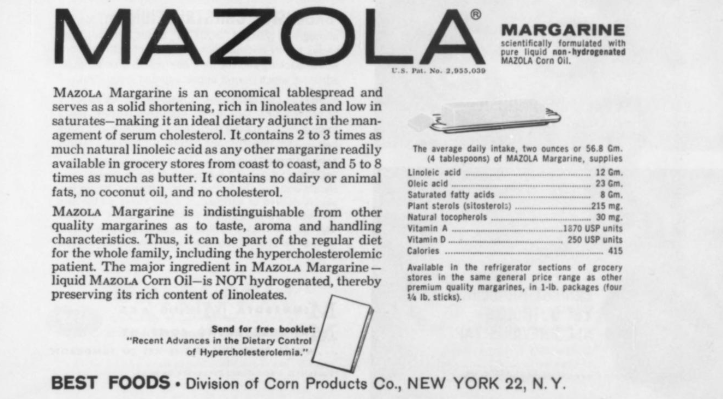
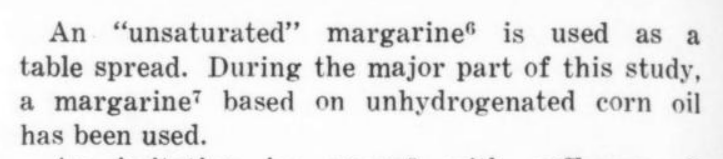
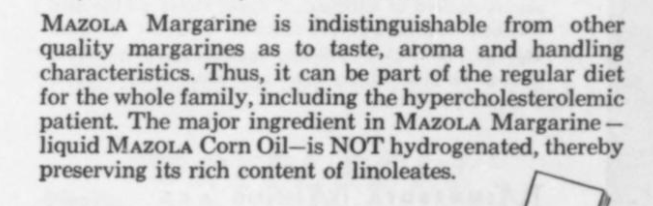
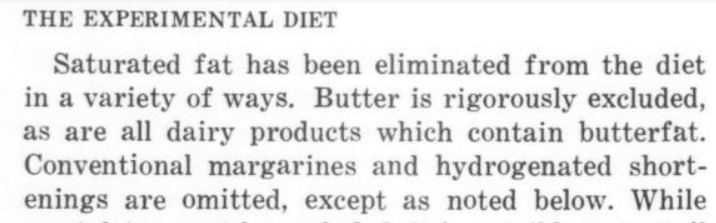
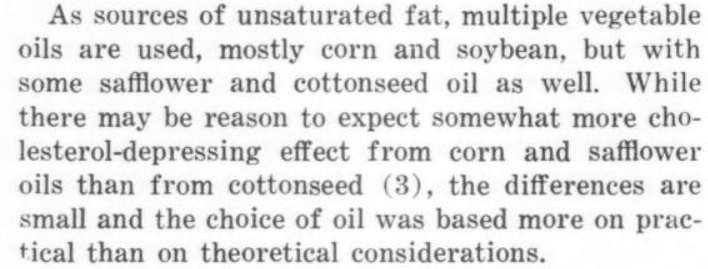
@TuckerGoodrich @deniseminger Key parts of the experimental diet in the 1962 paper: Conventional margarines and shortenings omitted. Vegetable oils used - mostly corn and soybean. A margarine based on non-hydrogenated corn oil was used.
ZahcM tweet mediaZahcM tweet mediaZahcM tweet media
English
2
0
0
77
Tucker Goodrich
Tucker Goodrich@TuckerGoodrich·
There was a 1962 paper that I don't have, where they went into more detail. HISCOCK E, DAYTON S, PEARCE ML, HASHIMOTO S. A palatable diet high in unsaturated fat. J Am Diet Assoc. 1962 May;40:427-31. PMID: 13907771 But the basic problem is we don't know exactly what they were eating (see below).
Tucker Goodrich tweet media
English
2
0
1
89
ZahcM
ZahcM@ZahcM·
@deniseminger @TuckerGoodrich "Also it turns out the control group wasn’t actually even eating margarine (just butter)" Based on what data?
English
2
0
0
65
Denise Minger
Denise Minger@deniseminger·
Increased TFA in the context of massively increased LA is still going to net a cholesterol reduction: x.com/deniseminger/s… Also it turns out the control group wasn’t actually even eating margarine (just butter), vs. the seed oil group eating 32 g of fat per day from a 25% TFA margarine. So the only TFA in the control group would have come from whatever small amount of shortening they were consuming. The seed oil group almost certainly had a higher TFA intake: x.com/deniseminger/s…
Denise Minger@deniseminger

Are you claiming a trans fat increase of about 5.5 g to 8.5 g would be enough to cancel out a linoleic acid increase of about 10.5 g to 40 g (and corresponding decrease mostly in saturated fat)? If you look at the proportional changes in fatty acid composition of the LA Veterans Trial diets, the trans fat increase would maybe slightly blunt the cholesterol-lowering effect of the massive linoleic acid increase/saturated fat decrease, but nowhere near enough to cancel it. If you have math that shows differently, I'd be happy to look at it.

English
3
0
1
191