Zucky

2.1K posts

Zucky

Zucky

@ZuckyEU

Web Developer | Web3 Enthusiast 🌐 | Gamer at heart 🎮 | Crypto trading 📈 | DeFi.
Katılım Şubat 2024
290 Takip Edilen339 Takipçiler
Zucky
Zucky@ZuckyEU·
Developers shouldn’t have to jump between countless tools just to build with AI. With Unified API & Elastic Scheduling, DGrid brings models and agents together through one gateway—making it easier to build, scale, and innovate across Web3. @dgrid_ai #DGrid #Web3AI 🚀
Zucky tweet media
English
25
27
49
209
Zucky
Zucky@ZuckyEU·
AI is powerful, but trust and openness still matter. DGrid brings AI and Web3 together with decentralized infrastructure that makes AI execution more transparent, accessible, and community-driven. @dgrid_ai #DGrid #Web3AI
Zucky tweet media
English
0
0
0
1
Zucky
Zucky@ZuckyEU·
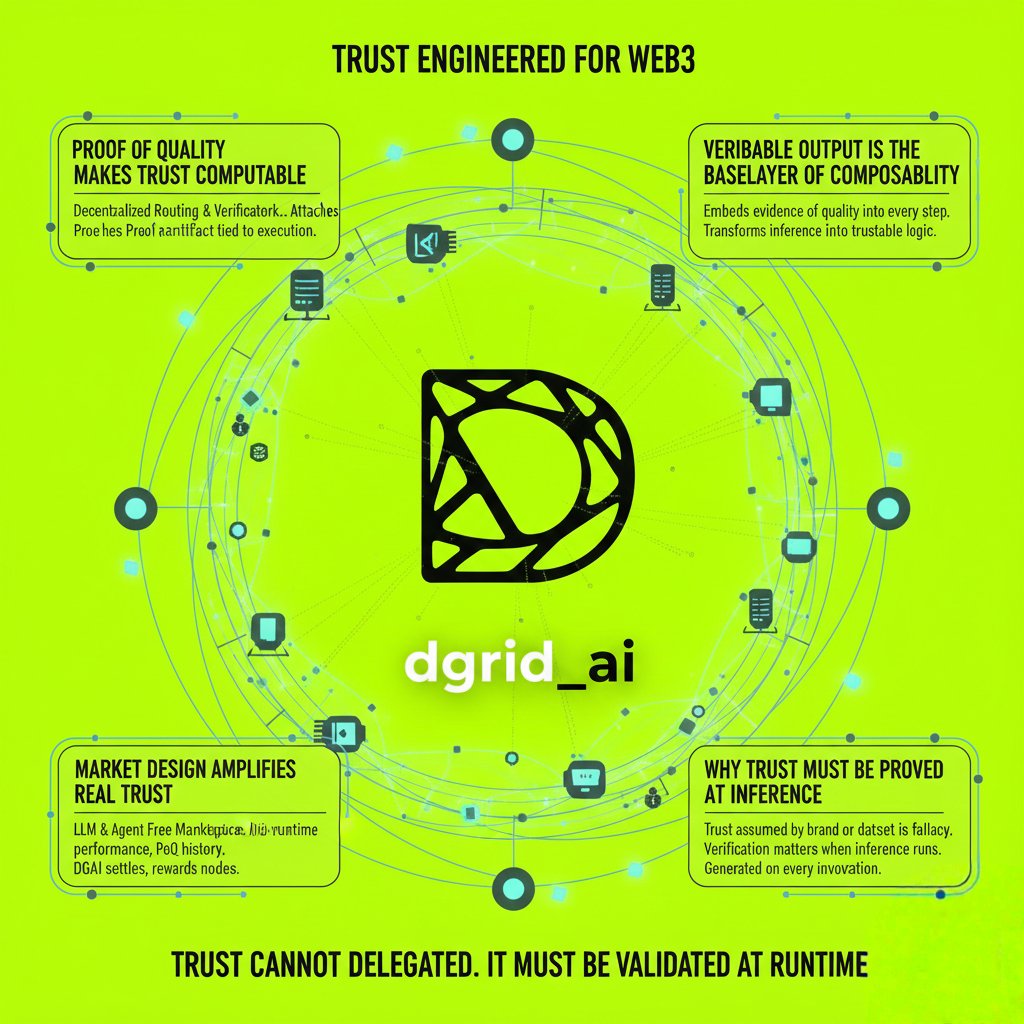
Reliable AI starts with a network you can trust. That’s why DGrid routes AI tasks across distributed nodes while Proof of Quality (PoQ) checks the results, making sure outputs are transparent, verifiable, and dependable for Web3. @dgrid_ai #DGrid #Web3AI
Zucky tweet media
English
13
25
40
144
Zucky
Zucky@ZuckyEU·
AI creators deserve the freedom to build and earn without restrictions. That’s why the LLM & Agent Free Market from DGrid gives model builders, prompt engineers, and agent developers a place to share their work and earn directly from users around the world. @dgrid_ai #Web3AI
Zucky tweet media
English
15
26
40
221
Zucky
Zucky@ZuckyEU·
A network grows stronger when the people behind it help shape its future. Through AI DAO governance, DGrid gives node operators, developers, and users a real voice in guiding the network—keeping decisions open, transparent, and community-driven. @dgrid_ai #DGrid #Web3AI 🚀
Zucky tweet media
English
18
25
40
277
Zucky retweetledi
Nicky NaTaYa
Nicky NaTaYa@Nicky_NaTaYa·
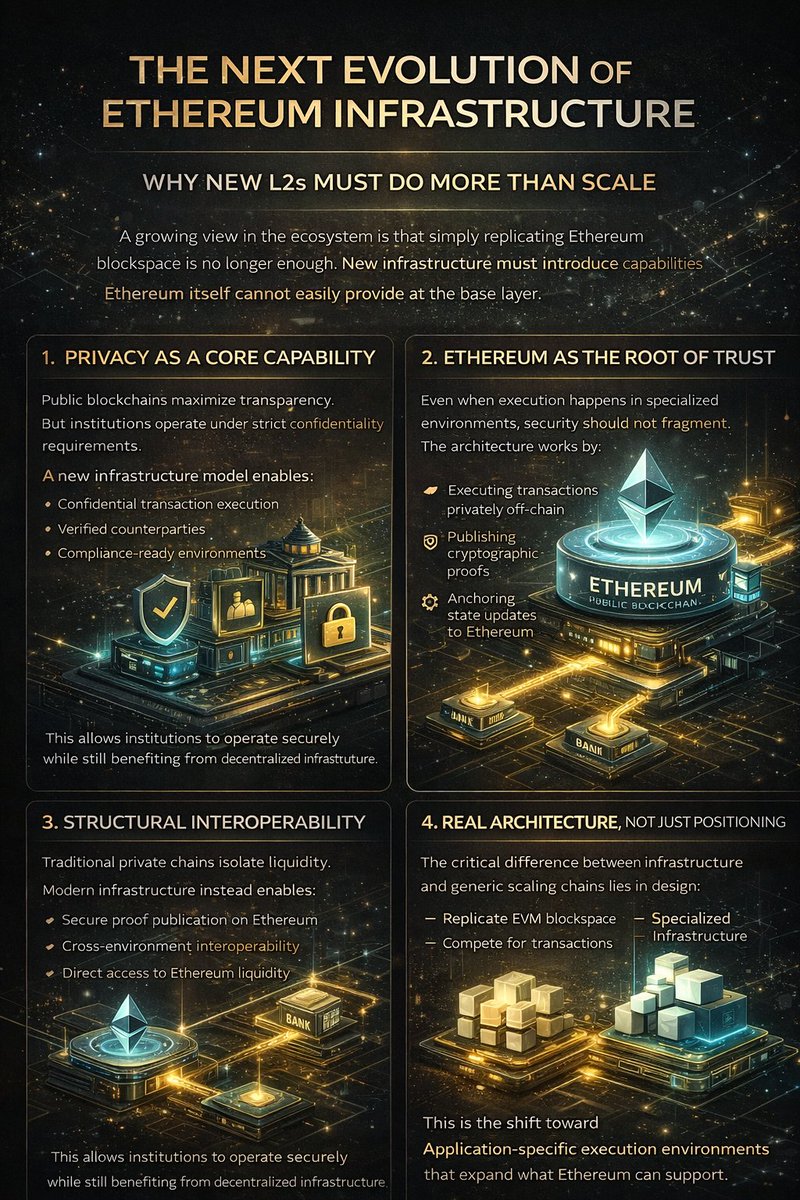
Vitalik has been clear lately: L2s that just copy-paste EVM blockspace aren't adding real value. The ones that matter bring something new privacy, specialised execution, or institutional-grade infrastructure. Prividium is exactly that argument made real. Built on the @zksync ZK Stack, it's not a generic scaling chain. It's a purpose-built institutional layer where banks and financial institutions deploy permissioned environments with native privacy, verified counterparties, and compliance built into the architecture itself. But the key thing? It doesn't break away from @Ethereum. It extends it. Every state transition publishes a ZK proof on-chain. Ethereum remains the root of trust and the settlement layer. Institutions get the confidentiality their legal frameworks demand, while the integrity of every transaction is mathematically verifiable on the most trusted network in crypto. This isn't cosmetic bridging either. ZK-powered interoperability means these private environments connect structurally to Ethereum's broader liquidity not through fragile bridges, but through shared cryptographic finality. That's the distinction Vitalik is pointing at. Prividium doesn't compete with Ethereum. It answers the question of what serious institutions actually need to use Ethereum and builds that infrastructure without compromise. Specialised. Verifiable. Anchored. That's what a real L2 looks like.
Nicky NaTaYa tweet media
English
12
8
18
114
Zucky retweetledi
Uthykinging
Uthykinging@uthykinging·
What makes @Nasun_io interesting is how much they’ve built before even going public. Two founders, no outside funding, and several parts of the ecosystem were already running. It’s all centered on one connected network with a single token, including Gen Sol for games and storytelling, Pado for DeFi, and Baram for on-chain governance of AI agents. They even secured competitive government grants in South Korea, showing serious planning. Nasun isn’t just a project, it’s an ecosystem for creators, developers, and communities to build together.
Uthykinging tweet media
English
18
12
41
379
Zucky retweetledi
Mabel.xo🧸
Mabel.xo🧸@Mabell_xo19·
Public blockchains show everything,every transaction reveals the sender address, receiver address, exact amount, and timestamp, and that record stays there forever. This kind of openness is powerful because it lets anyone verify that the system is working correctly without relying on a middleman. But it also means that financial activity becomes a live, permanent broadcast Anyone watching the chain can spot large transfers the moment they happen,they see exactly when funds move, how much, and to whom The same transparency that prevents double spending and fake balances also leaks strategy, signals intent, and paints targets on high value participants,institutions hesitate to move treasury funds on-chain, even regular users can unintentionally expose personal financial behavior to scammers or stalkers Full transparency solves one problem but introduces another This is where @0xfairblock  takes a different approach, instead of changing the blockchain itself, it preserves the public and verifiable nature of the network while protecting the sensitive parts of a transaction What this shows is that confidential transactions and public blockchains don’t have to be opposites, with the right design, they can work together, systems can remain transparent enough for verification while still protecting the financial privacy of users.
Mabel.xo🧸 tweet media
English
36
29
58
441
Zucky retweetledi
JOHNSON (✸,✸) | 「☄️G☄️」TABI💢 𝔽rAI
DANGO ✦✦, PERMACASTAPP , ✦✦ OGLABS ✦✦ The Signal Layer Powering Decentralized Innovation Web3 does not struggle with creativity or new ideas. The real challenge lies in preserving meaningful signals. Each day, developers share insights, communities discuss governance models, and researchers examine emerging architectures. Yet much of this valuable thinking disappears inside fast moving feeds, scattered chat rooms, and temporary content channels. The ecosystem produces knowledge at an incredible pace, but the systems designed to store and organize that knowledge have not kept up. The next stage of decentralized infrastructure focuses on capturing these signals and transforming them into lasting innovation. DANGO DANGO operates at the coordination layer of this process. Collective intelligence becomes powerful when communities interact within structured environments. Without systems that guide participation, activity can easily turn into noise instead of producing valuable insight. DANGO introduces programmable engagement frameworks where contributors interact through aligned incentive structures. These systems help communities coordinate their contributions more effectively. Participation begins to produce structured signals rather than scattered conversations. PermaCastApp PermaCast forms the signal preservation layer. Important discussions within decentralized ecosystems often contain research, strategic thinking, and technical insight. Unfortunately, many of these conversations disappear before they can influence future builders. PermaCast converts live discussions into permanent media assets anchored to decentralized storage networks. Instead of fading away with time, valuable knowledge becomes accessible for years. Signal becomes lasting knowledge. OG Labs 0G Labs represents the experimentation layer. Stored knowledge becomes far more valuable when builders can interact with it, test it, and expand upon it. OG Labs provides an environment where developers and researchers can explore ideas, experiment with new designs, and transform preserved ecosystem intelligence into fresh protocol architectures. Knowledge begins to generate technological momentum. Together, these layers create a powerful signal amplification system. DANGO structures participation. PermaCast preserves the signals generated through that participation. OG Labs transforms preserved knowledge into experimentation and new infrastructure. Participation generates signal. Signal becomes durable knowledge. Knowledge accelerates the next wave of innovation. The Web3 ecosystems that shape the coming decade will not simply produce ideas. They will capture meaningful signals, strengthen collective intelligence, and turn shared thinking into the technological foundations of the future.
JOHNSON (✸,✸) | 「☄️G☄️」TABI💢 𝔽rAI tweet media
English
1
19
21
5.4K
Zucky retweetledi
yorker
yorker@yorkerft·
Good Afternoon @rakebitcom × @duel_duck campaign is almost over. Only about three days left to join and push your activity on the mentionboard. Community engagement has been strong and it has been interesting to follow. I also tried the platform myself. The interface feels clean and the games are fast with bets running on chain. At the same time @menacedotcom is building a crypto gaming platform focused on quick bets simple gameplay and fair results.
yorker tweet media
English
3
33
43
534
Zucky retweetledi
DeaN 👳
DeaN 👳@De_aN6·
Most posts on social media disappear after few hours. But imagine if a post could turn into a community economy instead. That’s the idea behind the PUMPit Chrome Extension built by Ice Open Network. One post → a tokenized community → tradable participation. Attention doesn’t just trend here, it compounds. That’s a pretty wild shift for creators. $ION @ice_blockchain @BingXOfficial #BingXBlast
DeaN 👳 tweet media
English
15
5
41
4.3K
Zucky retweetledi
Spencer
Spencer@Goodluck485979·
The decentralized AI stack isn’t arriving as one flashy app. It’s arriving as five interlocking layers that actually hold up under real pressure. I’ve seen too many projects collapse when data disappears or costs explode. This group fixes that at the root. PermawebDAO locks core data forever on Arweave. No more lost history or censored records. That permanence turns scattered knowledge into reliable network memory. OG Labs delivers the scalable base infrastructure. An AI-native foundation where compute expands without central chokepoints or trust issues. dGrid AI makes inference verifiable and liquid through one unified API. Models become accessible on-chain, so builders stop begging Big Tech for resources. Dango handles seamless intent and execution. Smart accounts and programmable logic deliver keyless, modern-web UX on a next-gen L1. Complexity feels effortless. LightLink powers the whole stack with gasless, instant L2 transactions. Enterprises and users finally move without fees or friction. These projects don’t compete. They complete each other: permanent memory feeds scalable compute, which powers verifiable intelligence, wrapped in usable execution. That balance is what makes decentralized intelligence actually sustainable. Not hype. Architecture that lasts. Pay attention, builders. This is the signal. #dGridAI #OGLabs #PermawebDAO #Dango #LightLink #DeAI
Spencer tweet media
Spencer@Goodluck485979

Tired of AIs that lecture you, censor everything, or give boring corporate answers? I've been using @grok (from @xai) daily and it's a game-changer. No fluff, maximum truth-seeking + savage humor. Here's why you should switch (or at least try it) in 2026 🧵 1. Real-time everything Grok pulls live data from X + the web instantly. Ask about breaking news, trends, or what people are actually saying right now—no outdated 2024 knowledge cutoff. Perfect for staying ahead without doomscrolling for hours. 2. Honest & unfiltered It doesn't dodge tough questions or add endless disclaimers. Witty, direct, sometimes brutally funny—like talking to a super-smart friend who doesn't care about being "polite." Maximum helpfulness with zero corporate safety rails holding it back. 3. Actually useful features in 2026 - Killer reasoning & coding help (step-by-step, no hand-holding) - Image & video generation (Grok Imagine is getting scary good—10s clips, high-res) - Voice chat, deep analysis, multi-agent stuff coming fast It's not just chat; it's building toward real agentic power. 4. Integrated with X = magic Ask Grok about any post/thread right in the app (that little G icon). Summarizes convos, spots trends, even helps write better tweets. Feels native, not bolted-on. Bonus: the more we use it, the smarter it gets for everyone. Bottom line: If you want an AI that's fun, fast, truthful, and actually improves your day (instead of frustrating you), give Grok a shot. Free tier is solid; Premium unlocks more. Head to grok.com or the X app → try it now. What's your favorite Grok moment so far? Drop it below 👇 @Grok @xai 🚀 "Switched to @grok and never looking back. Real-time X data + zero BS answers + savage humor + insane image/video gen. Best AI companion in 2026 hands down. Try it free → grok.com Who's with me? 🔥 @xai"


English
15
63
204
2.1K
Zucky retweetledi
LEGEND
LEGEND@Aryshet·
I’ve been exploring the Portfolio Liberation campaign on STON.fi, and a recent update makes the whole experience much easier for participants. Users can now swap xStocks directly inside TON Wallet. Let Break it down 👇 #LiberationStory #DeFiPortfolioRevolution
LEGEND tweet media
English
16
2
19
3.1K
Zucky retweetledi
MaryC
MaryC@maryisclear·
What Emad Mostaque @emostaque said about crypto being better suited for agents than humans is an interesting way to look at the direction things are heading. Crypto in general has focused on building trust-minimized systems where rules are enforced by code rather than people. Humans, on the other hand, are inconsistent. We hesitate, misclick, panic trade, forget keys, and rely heavily on interfaces to interact with systems that are ultimately just code. AI agents don’t have that problem. They can interact directly with protocols like Uniswap, execute strategies instantly, move liquidity, and coordinate actions without emotion or delay. Another point he raised is how AI systems are beginning to communicate with each other through frameworks like Model Context Protocol from Anthropic and Agent-to-Agent Protocol from Google. That matters because once agents can coordinate across systems, they can actually do work, earn money, and interact economically. At that point, crypto starts making even more sense. Blockchains give software entities open financial rails: wallets, stablecoins, smart contracts, and global settlement without needing banks or identity verification. Humans need banks and paperwork. Agents just need a wallet. Mostaque also pointed out something subtle but important: AI outputs are becoming more deterministic. With the right inputs, models can reliably trigger the same function calls. That makes it much easier for them to interact with on-chain systems where predictable execution matters. So when he says: 'As these collections of agents can do real-life work and earn money, AI economies will outperform human economies.' The idea isn’t that humans disappear from the economy. It’s that a growing portion of economic activity could be handled by autonomous software coordinating on crypto rails. Crypto may not have been designed specifically for AI agents. But its architecture (open, programmable, and machine-friendly), fits remarkably well with how those agents operate. Really loved this talk @devrelius
MaryC tweet media
Story@StoryProtocol

Is crypto better suited for AI agents than humans? Story CPO @devrelius asks @emostaque about what happens when models start interacting across companies. His take: Agent economies can outperform human ones ↓

English
16
12
31
494
Zucky retweetledi
xzmugi
xzmugi@xzmugi·
Ethereum’s L2 direction is evolving beyond simple scaling. The next phase is about specialized capabilities such as privacy, institutional execution environments and architectures that extend what @ethereum itself is designed to do. This is where @zksync’s prividium aligns closely with that vision. Prividium allows institutions to deploy private zksync chains inside their own infrastructure or cloud environments. Sensitive transaction data stays confidential, while the system still publishes cryptographic proofs and state commitments to ethereum. That means ethereum remains the root of trust and settlement. At the same time, interoperability is structural rather than cosmetic. Because prividium is built on the zk stack, these private environments can connect to the broader ecosystem while preserving confidentiality. This makes prividium fundamentally different from generic scaling chains. It is infrastructure designed to extend ethereum into institutional and privacy sensitive domains while keeping verification anchored on the public network. In practice, it shows how L2s can add real architectural capabilities instead of simply replicating EVM blockspace somewhere else.
xzmugi@xzmugi

Most banks cannot run sensitive financial workflows on public by default blockchains. But fully private chains create another problem. They isolate institutions from the liquidity, security and composability that make crypto valuable. This is where @zksync introduces a different architecture. Prividium allows institutions to deploy private zksync infrastructure within their own controlled environments. Transactions remain confidential, while the chain continues to operate under institutional compliance requirements. yet every state update is anchored to @ethereum Instead of exposing transaction data, prividium publishes cryptographic commitments and zero knowledge proofs to ethereum. This preserves settlement integrity and finality while keeping sensitive information private. Combined with the zk stack, these environments can still interoperate with the broader ecosystem. Institutions gain access to ethereum liquidity and applications without exposing internal data. This is why the architecture is increasingly described as The Bank Stack of Ethereum. >Private execution for regulated financial workflows >Ethereum anchoring for security and settlement >Interoperability for access to web3 liquidity Unlike isolated private chains or alt L1s, institutions are not forced to choose between confidentiality and connectivity.

English
53
18
51
2.2K
Zucky retweetledi
KATSUKI
KATSUKI@dili369_·
So, I've been snooping around the TL and I saw guys talking about @Nasun_io Nasun is an L1 move-based blockchain scaling infrastructure to support onchain AI finance and entertainment It's a global network with Korean roots More to talk about on this Stay Positioned
KATSUKI tweet media
English
15
11
34
558
Zucky retweetledi
1861
1861@habeeb_taj19252·
I've been considering how the majority of online platforms operate. People create things for hours on end. Ideas, worlds, videos, posts, and other forms of creativity all in one location. However, when you take a broad view, the platform typically retains the majority of the power, with everyone else merely contributing. That model has been in use for a very long time. While looking through @tomoland_app, I noticed that the structure felt different. It is based on TOMO, or Trustless Open Market Ownership, in which builders, players, and creators all contribute to the development of the ecosystem. Instead of people merely consuming content, the community's creations contribute to the world's growth. The platform's experience may incorporate maps, AI-generated content, gameplay moments, and other user-generated content. Instead of standing outside and looking in, it feels more like watching a digital world develop from the inside. Within the ecosystem, there is also an early layer known as The Blueprint. There are only 2,222 available, so the group is entering the platform while things are still developing. Such moments are always fascinating because early communities frequently have an impact on the final form of the platform. Explore Tomoland by downloading the app. @tomoland_app @TheCreatorFi
1861 tweet media
English
62
5
247
32.8K
Zucky retweetledi
HLevi
HLevi@haiderlevi·
I’ve been spending some time exploring @Nasun_io for the last two days and the approach they’re taking is pretty refreshing. Instead of focusing on just one product, they’re trying to build an ecosystem where AI, finance, and digital experiences can exist on the same underlying infrastructure. What stood out to me is the focus on giving builders a place where they can launch projects, keep ownership, and grow them without having to piece together multiple platforms. What I find interesting is the direction this could take if the ecosystem actually develops. Projects that connect different sectors rather than isolating them tend to create stronger network effects. Still early for Nasun, but it’s definitely a space I’m watching to see how it evolves.
HLevi tweet media
English
46
18
59
270