Dead Heroes Don't Save

16K posts

Dead Heroes Don't Save banner
Dead Heroes Don't Save

Dead Heroes Don't Save

@_DHDS

if I claim to be a wise man, it surely means that I don't know. This is a former elder & seminarian's place to discuss theology & share posts from the blog

The Silent Planet Katılım Ekim 2022
584 Takip Edilen397 Takipçiler
Sabitlenmiş Tweet
Dead Heroes Don't Save
Though we debate aspects of being in Christ, think we can all agree: if anyone is in Christ, he is a new creature [having been] created in Christ Jesus to do good works [which we do with] our liberty which we have in Christ [so we] do not turn [our] freedom into an opportunity for the flesh, but through love serve one another
English
0
0
16
9.3K
Dead Heroes Don't Save
@JosephSwar86703 It is philosophy and refinements over centuries that gave us the Trinitarian formula we use today And when we translate and interpret and synthesize the Word we are doing philosophy
English
0
0
0
2
Joseph Swartz
Joseph Swartz@JosephSwar86703·
@_DHDS This is high-minded poison. We need God's word. Period. "Beware lest any man spoil you through philosophy and vain deceit, after the tradition of men, after the rudiments of the world, and not after Christ." - Colossians 2:8
English
1
0
0
4
Dead Heroes Don't Save
In the 4th century through the medieval period, Christian thinkers critically applied the metaphysical models of Plato and Aristotle to explore and articulate core Christian doctrines. That brought with it solutions to important theological questions while inviting new philosophical challenges We should not be afraid of critically exploring and articulating central Christian doctrine under different metaphysical models while preserving the essential Christian claims
Dead Heroes Don't Save tweet media
English
5
0
6
606
Dead Heroes Don't Save
@ferrismattic @John_Barach That would be a rather weak argument since it is from silence. More so given the document starts off with letters to churches It might be worth noting as an add on to a case already made using stronger premises or data points
English
1
0
0
17
Matt Ferris
Matt Ferris@ferrismattic·
@John_Barach It may be an indication of the absence of the church from the intervening events.
English
2
0
3
138
Matt Ferris
Matt Ferris@ferrismattic·
Fun fact. ἐκκλησία, (ekklesia), church, occurs 20X in the Apocalypse. Between 3:22 and 22:16, the word does not appear.
12
2
24
2K
Dead Heroes Don't Save
Jerome (epistle 15) writing of the then "unheard-of formula of three hypostases" as confusing since he understood the word to mean essence. Yet he readily affirmed "three persons (persona) subsisting" in one God I would agree with him that "[it] is a bad sign when those who mean the same thing use different words" as it can be confusing But he then argues that if we hold the same core tenets we should be free to explain it in our own words. Stretching this idea regarding words, I would think we can apply that to metaphysical models "If their belief corresponds to their explanation of it, I do not condemn them for keeping it. On the other hand, if my belief corresponds to their expressed opinions, they should allow me to set forth their meaning in my own words."
Dead Heroes Don't Save@_DHDS

In the 4th century through the medieval period, Christian thinkers critically applied the metaphysical models of Plato and Aristotle to explore and articulate core Christian doctrines. That brought with it solutions to important theological questions while inviting new philosophical challenges We should not be afraid of critically exploring and articulating central Christian doctrine under different metaphysical models while preserving the essential Christian claims

English
0
0
0
152
Dead Heroes Don't Save
Jerome (epistle 15) seems to have thought it redefined in the "unheard-of formula of three hypostases" "In the whole range of secular learning hypostasis never means anything but essence. And can any one, I ask, be so profane as to speak of three essences or substances in the Godhead?" But working towards a consistent vocabulary and defined metaphysic is important for clarity and was lacking in Nicea where ousia and hypostasis were considered synonymous As to politics, I understand it helped, through council and governing decree, unify a fractured empire, particularly East & West, still fighting post Nicea.
English
0
0
0
15
JOSHUA COOK
JOSHUA COOK@RealJoshuaCook·
@_DHDS St Basil redefined ‘hypostasis’ was a game changer for theology but also politically, agree?
English
1
0
0
22
Dead Heroes Don't Save
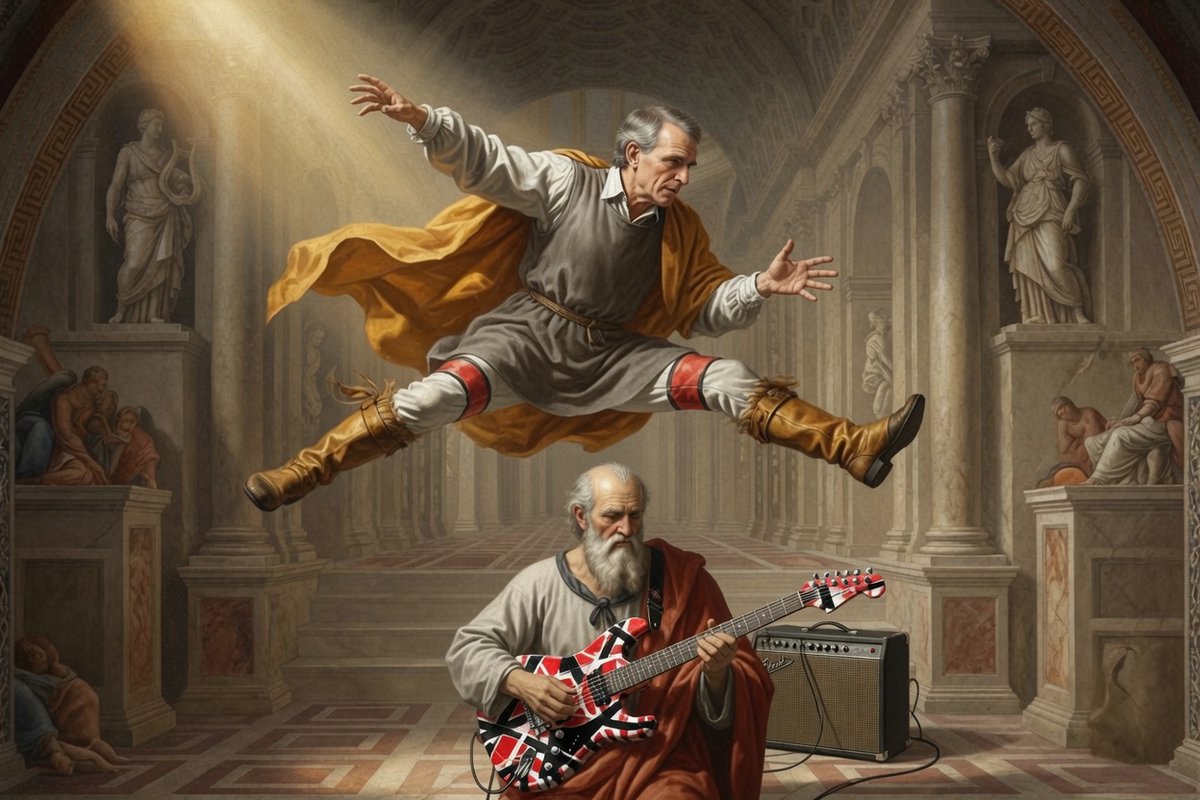
@just_keep_read Yes, it was supposed to be. That's the reference image I gave the AI image generator. Figured he was more recognizable than Peckham or Padgett 😁
English
3
0
1
69
Kismet = Calvin
Kismet = Calvin@JonKismetCalvin·
@_DHDS It’s hilarious when Reformed claim they are just following the Bible, and say things like, What does Jerusalem have to do with Athens, when Calvin agreed with Plato and rejected Aristotle (because “Nominalism”) in his Institutes.
English
1
0
1
56
Lucas U. Curcio
Lucas U. Curcio@MethodMinistry·
For those familiar with Platonic thought, question: can forms exist independently of matter? After answering, comment why or why not.
English
2
0
2
642
Jarod O'Reilly✝️
Jarod O'Reilly✝️@OJarod3315·
@_DHDS Other than that I’ve been reading Mathew Grants universal causality and free will (apparently far too dense for my current self to understand fully) and balancing all this with reformed thinkers like Van Til But mostly just looking for more with curious eyes
English
3
0
0
34
Dead Heroes Don't Save
Most scholars who offer neo-classical models of God want to affirm that God is in fact a perfect being. Where they differ from classical theists, however, is primarily in terms of how we should understand the nature of a perfect being. - Timpe
English
1
1
3
190
Dead Heroes Don't Save
I get the debates between the two main textual traditions but it has been awhile since I have explored them. I have never understood the KJVO perspective. My general view is open lots of translations and the different interlinear. I like the NET for its various notes. Wish more had these
English
1
0
1
11
Jarod O'Reilly✝️
Jarod O'Reilly✝️@OJarod3315·
@_DHDS Cause I’ll also be honest my main theological project at the moment is textual issues, translation, and transmission of the text, and its relation to the KJV only controversy
English
1
0
1
19
Dead Heroes Don't Save
Good question. I would have to look over my downloads. Most of the reading has been articles (as the books tend to add up quick) I found I tended to be asking questions regarding the way we think about God and was finding classical theistic descriptions and the Thomistic metaphysics didn't resonate. Particularly the stronger views of immutability and relation to time as well as the way "person" is understood My reading has more more topical and started with the views books on God and Time and Impassibility. Those and some reading in Plantinga's Does God have a Nature have helped solidify things From there articles by Padgett and Peckham and Mullins. I have books by each of them on the TBR and have read bits. - God, Eternity, Nature of Time (Padgett) - Divine Attributes (Peckham) As well as WLC Time & Eternity Balancing that with articles and books by Charnock, Feser & Dolezal Recently been exploring more in the realm of Trinitarian and Christological metaphysics. My reading has some articles by Crisp and Dolezal. Also on the TBR are Hasker's Metaphysics and the Tri-Personal God on the TBR and the newer Incarnation book edited by Mullins Probably not the list you were looking for 🤣
English
1
0
1
58
Dead Heroes Don't Save
@alfarojoshua3 When Mr. Bilbo Baggins of Bag End announced that he would shortly be celebrating his eleventy-first birthday with a party of special magnificence, there was much talk and excitement in Hobbiton. ...
GIF
English
0
0
1
73
Joshua Alfaro
Joshua Alfaro@alfarojoshua3·
Muse, tell me about an uncomplicated man A real straightforward guy A simple man with simple tastes An epic poem about a plain regular Joe
English
3
6
35
2.2K
Dead Heroes Don't Save
@logosofagape @Soteriology101 Yes, we seem to be. But I would venture it is not because I am not following your points. And I am at a loss as to how to make mine clearer But here goes: God is not the proximate cause and thus does not "create" particular people in the sense your question suggests See (1)
Dead Heroes Don't Save@_DHDS

Given the following - God does not meticulously decree all events - God has exhaustive FK - Knowing an event does not cause it - God desires every person to be reconciled - Every person has libertarian freedom The problem: God eternally knew a particular person would never freely respond to His love, would never enter into reconciliation with Him, and would ultimately experience eternal separation Why did God create someone whose rejection He already knew with certainty? This is a relatively common challenge that is brought up. Let's start by noting that this is a question worth considering. But we should also note that it is not the same problem under other frameworks (as is often claimed) On to some thoughts 1) the real question is what/how does God create someone. In creating volitional agents with LFW and giving them "dominion" does that include God enabling creation to "be fruitful and multiply" such that He allows children to be conceived. That doesn't remove His power to open & close wombs nor deny an active power in allowing and sustaining the people and the process. But is God intentionally giving space for LFW agents to act 2) Many might wonder if this is the "best" possible world given God creates volitional creatures with LFW. There may be no world containing free creatures in which every free creature freely responds to God 3) Nothing requires God to govern creation like the Minority Report. Whether the "future" decision of an agent is accepting Christ or commiting evil, part of allowing a world of volitional agents (LFW/agent causation) is to allow them the space to choose The question now shifts from "why did God deliberately create this individual who rejects" but "why did God actualize (and continue to sustain) a world of volitionally free agents that are permitted to generate free agents who will reject" The space required for libertarian agency is precisely the space in which some agents will use that agency to refuse God (or commit evil)

English
0
0
0
57
Dead Heroes Don't Save
Different thinkers operate with different metaphysical assumptions and definitions. They also make different "moves" as they work things out which can solve some challenges while creating others From Aquinas: God is pure act without any potential thus it is evident that it is impossible for God to be in any way changeable. Eternity has no succession, being simultaneously whole Whatever is wholly immutable can have no succession Eternity though simultaneously whole, is called by names implying time and succession In that eternal whole, Thomistic Classical Theism does allow God to distinguish events in their sequence (Caesar crossed the Rubicon before Elon Musk bought Twitter) But it would seem to prevent God, Himself, from experiencing successive moments. Something immutability and impassibility result affirm That idea does constrain how we think of God in terms of relationships in the Trinity itself and His interactions with creation. Not all of these can be easily fit into the difference lying in the creature's relation to God only
English
1
0
0
24
Kismet = Calvin
Kismet = Calvin@JonKismetCalvin·
My thoughts: Augustine was a platonist. It is interesting reading his book on the freedom of the will. He got so close, but came up short, which is why he reverted to a deterministic framework (IMO). Aquinas used Aristotle, specifically the rules of logic (Augustine denied logic applied to God) and Aristotelian causation to break the chain of determinism. Aquinas appeals to Boethius and The Consolation of Philosophy, written a century after Augustine died. I think Boethius made the connection that Augustine missed. I would point out the difference between sequence and succession. For Aquinas anyway (in SCG), succession = generation, corruption, and death, so God does not suffer succession. God does experience “sequence” because God existed prior to any matter (known by revelation), God created, and God interacts with His creation. This is where Thomistic “necessary energized attributes / accidents distinction” comes from. In my opinion, the majority of the heresies in the church today can be traced to Augustinian Classical Theism. Calvinism is obviously from On the Predestination of the Saints. Thomistic Classical Theism appears correct to me. Not entirely correct, but pretty darn close. That was a well written post.
English
1
0
1
31
Root
Root@rootcausesleuth·
God is IN time, and experiences time, according to every single description of him in the Bible. “I am the Alpha and the Omega,” says the Lord God, “who is and who was and who is to come, the Almighty.” Revelation 1:8
English
49
1
46
2.9K
Dead Heroes Don't Save
@JonKismetCalvin @rootcausesleuth Curious your thoughts...
Dead Heroes Don't Save@_DHDS

Augustine famously says time is hard to define and it has been variously understood Artistotle is generally understood to have argued time had no beginning or end, was associated with motion/change and involves a past, present and future Without arguing that he is correct or even that all agreed with him, that seems to be a reasonable and ancient view of "time" "But also in time the distinction of ‘before’ and ‘after’ must hold, for time and movement always correspond with each other. The ‘before’ and ‘after’ in motion is identical in substratum with motion yet differs from it in definition, and is not identical with motion. ... When we think of the extremes as different from the middle and the mind pronounces that the ‘nows’ are two, one before and one after, it is then that we say that there is time" - Physics 4.11 "Further, there is the same time everywhere at once, but not the same time before and after, for while the present change is one, the change which has happened and that which will happen are different. Time is not number with which we count, but the number of things which are counted, and this according as it occurs before or after is always different, for the 'nows' are different." - Physics 4.12 Augustine sees time (referring to what we now think of as space,-time) as created rather than beginningless: "You have made all time; and before all times You are, nor in any time was there not time. At no time, therefore, had Thou not made anything, because You had made time itself." - Confessions 11.13-14 And grapples with past, present and future in what is seemingly A theory "past times, which now are not, or future times, which as yet are not, who can measure them? ... Who is there who can say to me that there are not three times (as we learned when boys, and as we have taught boys), the past, present, and future, but only present, because these two are not? " - Confessions 11.16-17 The relative timeless view of God seems to take the overall notion that succession and change require some notion of time such that there is a past, present and future. An eternal God possesses an everlasting divine duration giving us a metaphysical time without beginning or end. This grounds a divine life where there is a genuine past, present, and future from God’s own perspective He is also the Creator of space-time. This has a beginning. God is outside of it and is its ground. God is "relatively timeless" with respect to the cosmos yet is not "absolutely timeless" as in classical theism

English
1
0
1
31
Kismet = Calvin
Kismet = Calvin@JonKismetCalvin·
The OP was using the modern definitions to argue against the way ancient and medieval theologians used the term. You disputed that the definitions I was using were required. I have seen plenty of people doing just that, changing the definitions and then belittling the ancient and medieval theologians who used the definitions I gave. I said I agreed the definitions I gave were not required. I pointed out what is happening far too often Open Theist / DO camps. I can even point out a recent book that does just that. Pointing out the error doesn’t mean I was accusing you of doing so.
English
1
0
0
25
Dead Heroes Don't Save
@ReformedCaio Most would affirm God is fully capable of exerting His power such that it results in truly free responses towards Him. It gets more interesting when one starts to explore what it means for God to exert His power and what a truly free choice is
English
1
0
1
86