David Fenner

5.6K posts

David Fenner banner
David Fenner

David Fenner

@_David_Fenner_

Game Designer/3D artist/Writer/Composer Founder @play_me_studio. Now working on The Simulation https://t.co/4DuHyTeYeK

Santiago, Chile Katılım Nisan 2009
1K Takip Edilen720 Takipçiler
Sabitlenmiş Tweet
David Fenner
David Fenner@_David_Fenner_·
I'd like to tell you about an ambitious independent videogame that has been quietly in development since late 2021. It began as a daring experiment: Original mechanics, a horror story, unique visuals... all of it with different, interesting layers that communicated with each other... We really fell in love with it. The experiment clearly worked. We knew we had something unique in our hands, and so did everyone who tried it. @BlumhouseGames soon joined the adventure. We’ll be showing much more soon. But for now, I’ll leave you with this: You’ll never see the sentence “The game takes no creative risks” in any review. We took all of them. You can wishlist here: store.steampowered.com/app/3394500/
Playmestudio@play_me_studio

We've been too focused making the game for maybe too long. So I feel guilty that we didn't go by the book with the "Hey you have to spend 90% of your time to market your indie game since forever!" rule since 2021. So forgive me if I start a sharing spree.

English
1
9
57
9.8K
David Fenner
David Fenner@_David_Fenner_·
Microsoft and Adobe will be studied 100 years from now as examples of when capitalism didn't work for the consumer.
English
0
0
0
32
David Fenner
David Fenner@_David_Fenner_·
Yes but: If you have something important to do, it's ok to stay a little late to finish it, as long as you don't do it often. Thing is, important things tend to make you sleep badly. Urgent things, can actually wake you up in your sleep or make you have nightmares. Psychology also matters. Try to do things in the day, of course. But if you can't and need to stay a little longer, or if you are really inspired, don't let the urgency of sleeping become stressful. Sometimes also staying up for fun can also be worthwhile... just not too late or too often. You can recover if you don't do it often. It's not a big deal. Just keep life in balance, including the obsession for routine. The body does have some tolerance for chaos... just don't abuse it. Do what Bryan says... mostly.
English
0
0
0
1K
Bryan Johnson
Bryan Johnson@bryan_johnson·
This is it. Everything learned spending millions on longevity. From: Your Immortal Unc and Auntie. To: Our Immortal nieces and nephews. 0. Sleep is the world's most powerful drug. 1. Be in your bed for 8 hours 2. Same bedtime every night, any time before midnight 3. Don’t eat right before bed 4. Calm foods for dinner 5. No screens 1 hour before bed 6. Avoid added sugar (be aware it’s in everything) 7. Avoid all things in an American convenience store 8. Avoid fried foods 9. Shoes off at the door 10. Eat whole foods, particularly veggies fruits nuts legumes berries 11. Walk a little after meals or air squats 12. Get your heart rate high routinely 13. Lift heavy things 14. Stretch daily 15. Water pik, floss, brush, tongue scrape, morning and night 16. Make an effort to drink water 17. Get sunlight when you wake up (UV is low) 18. Protect skin in midday sun 19. Stand up straight 20. See at least one friend once a week 21. Avoid plastic where you can (in all things) 22. Circulate air in rooms 23. When stressed, breathe, learn to calm your body 24. Go to the dentist 25. Avoid sitting for long times 26. Protect your hearing, the world is too loud 27. Alcohol is bad for you 28. Finish coffee before noon 29. Avoid bright lights after sunset 30. If obese, look into a GLP 31. Sleep in a cold room 32. Texting while driving is dangerous 33. Turn off all notifications 34. Limit social media use 35. Don’t smoke anything 36. If you struggle to sleep, read a physical book before bed 37. 1 hour before bed have a calm wind down routine: bath, read, light walk, listen to music 38. The body is a clock and loves routine. Have a daily morning and evening schedule. 39. Avoid long distance travel where you can 40. Baby steps first: incorporate new things slowly 41. Do less… most things don’t work. Bonus points if you get your blood checked. Start here, it will change your life.
English
1K
4.8K
43.1K
5.6M
David Fenner
David Fenner@_David_Fenner_·
Yes but: If you have something important to do, it's ok to stay a little late to finish it, as long as you don't do it often. Thing is, important things tend to make you sleep badly. Urgent things, can actually wake you up in your sleep or make you have nightmares. Psychology also matters. Try to do things in the day, of course. But if you can't and need to stay a little longer, or if you are really inspired, don't let the urgency of sleeping become stressful. Sometimes also staying up for fun can also be worthwhile... just not too late or too often. You can recover if you don't do it often. It's not a big deal. Just keep life in balance, including the obsession for routine. The body does have some tolerance for chaos... just don't abuse it. Do what Bryan says, mostly.
Bryan Johnson@bryan_johnson

This is it. Everything learned spending millions on longevity. From: Your Immortal Unc and Auntie. To: Our Immortal nieces and nephews. 0. Sleep is the world's most powerful drug. 1. Be in your bed for 8 hours 2. Same bedtime every night, any time before midnight 3. Don’t eat right before bed 4. Calm foods for dinner 5. No screens 1 hour before bed 6. Avoid added sugar (be aware it’s in everything) 7. Avoid all things in an American convenience store 8. Avoid fried foods 9. Shoes off at the door 10. Eat whole foods, particularly veggies fruits nuts legumes berries 11. Walk a little after meals or air squats 12. Get your heart rate high routinely 13. Lift heavy things 14. Stretch daily 15. Water pik, floss, brush, tongue scrape, morning and night 16. Make an effort to drink water 17. Get sunlight when you wake up (UV is low) 18. Protect skin in midday sun 19. Stand up straight 20. See at least one friend once a week 21. Avoid plastic where you can (in all things) 22. Circulate air in rooms 23. When stressed, breathe, learn to calm your body 24. Go to the dentist 25. Avoid sitting for long times 26. Protect your hearing, the world is too loud 27. Alcohol is bad for you 28. Finish coffee before noon 29. Avoid bright lights after sunset 30. If obese, look into a GLP 31. Sleep in a cold room 32. Texting while driving is dangerous 33. Turn off all notifications 34. Limit social media use 35. Don’t smoke anything 36. If you struggle to sleep, read a physical book before bed 37. 1 hour before bed have a calm wind down routine: bath, read, light walk, listen to music 38. The body is a clock and loves routine. Have a daily morning and evening schedule. 39. Avoid long distance travel where you can 40. Baby steps first: incorporate new things slowly 41. Do less… most things don’t work. Bonus points if you get your blood checked. Start here, it will change your life.

English
0
0
1
44
David Fenner retweetledi
AboutBeverages
AboutBeverages@AboutBeverages·
@_David_Fenner_ Absolutely loved this game! Played it when it first came out and still reference it on my streams to this day.
English
0
1
1
57
David Fenner
David Fenner@_David_Fenner_·
Sorry, it's Ukrainian! (Google translate said Russian 😒)
English
0
0
0
26
David Fenner
David Fenner@_David_Fenner_·
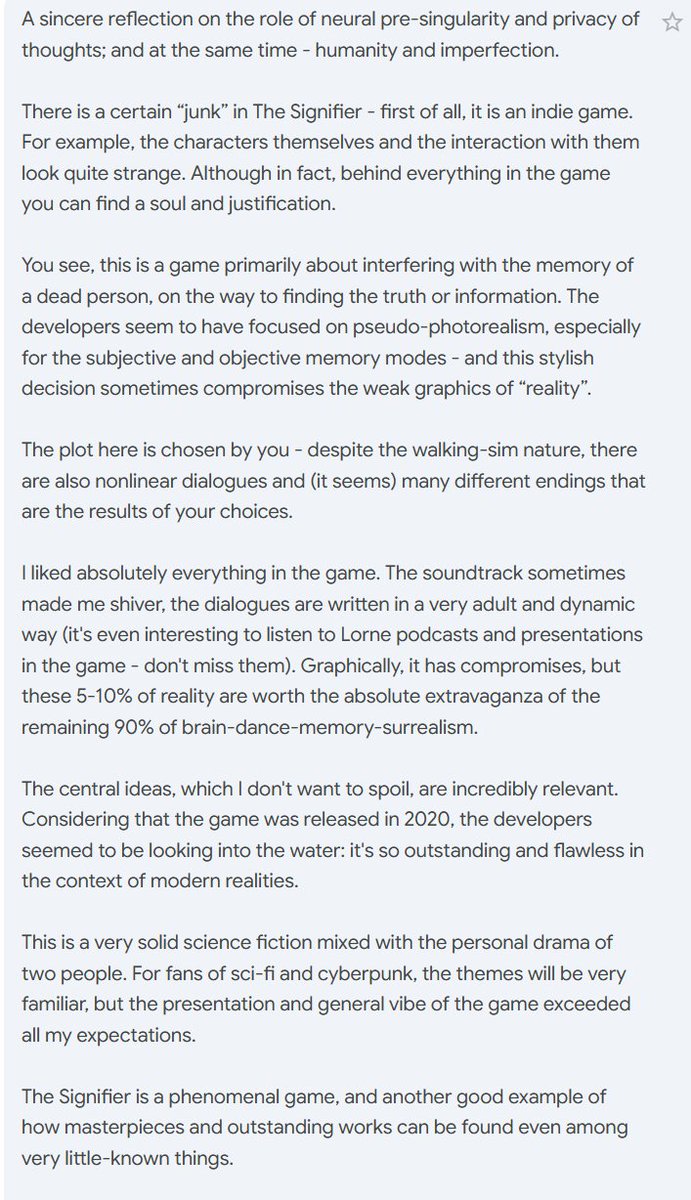
The Signifier is not a well known game, it went REALLY under the radar... but for many, it does leave a mark. People still leave reviews from time to time that really warm my heart. This one was 4 days ago. Translated from Russian. "The Signifier is a phenomenal game, and another good example of how masterpieces and outstanding works can be found even among very little-known things.
David Fenner tweet mediaDavid Fenner tweet media
English
5
1
6
499
David Fenner
David Fenner@_David_Fenner_·
@catharsis_ Oh shit. That's a very ugly mistake lol. (According to Google translate, it was Russian, that's why I thought it was so)
English
0
0
2
22
David Fenner
David Fenner@_David_Fenner_·
Pretty impressive that there is no mention about the issue of how one sided divorce goes. Marriage is scary for good reasons, starting that most women initiate divorce and most get the best of it. The issue should be there, but it's not. In fact, there are no issues listed about things that women should change or improve for men. Weird.
English
0
0
1
17
Salt Bebeee
Salt Bebeee@bonxixha·
@tricknologics @clairlemon Na usually it’s people in long term relationships with no marriage in sight. There’s no woman in a 3+ year relationship that’s happy about being unmarried. The men drag their feet when it comes to marriage. And then we wonder why the birth rates are down.
English
1
0
0
85
Claire Lehmann
Claire Lehmann@clairlemon·
Dating problems is the big one. x.com/romanhelmetguy…
Roman Helmet Guy@romanhelmetguy

I’m convinced that all these guys who come up with proposals to “fix the fertility rate” have never talked to a woman. They treat it like an economics problem they can optimize, or even worse they just tell women to have kids to “save civilization.” If you actually spend time with women who aren’t having kids, you’ll find they almost all fall into one of five buckets: 1. Dating problems. They were in some 5+ year relationship (or a series of relationships) that stole their youth and left them so jaded that they’ve given up on finding a man who could be a good father. 2. Family problems. They come from such a dysfunctional home that their own childhood holds few happy memories, and they’re terrified of recreating those conditions with their own children. 3. Health problems. A ton more women than you think have conditions like endometriosis or PCOS or other health complications that can affect fertility and make having kids more dangerous or harder to do. 4. Career goals. They’re convinced that they have something huge and unique to contribute to the world either professionally or creatively, whereas “every woman can have a kid,” and so to them, having children sounds like a waste of their potential, like giving up. 5. Lifestyle goals. They’re really into traveling and being independent and getting into “adventures,” they want to explore the world and experience everything, and the idea of giving all that up to sit at home and raise kids makes them want to die. If you really want to fix the fertility rate, and you’re not addressing at least a few of these, your solution is useless.

English
39
7
226
257.9K
David Fenner
David Fenner@_David_Fenner_·
I think you're right to be skeptical given the lack of manual lighting. However this shot could be from behind the hanging guy and pillars, so everything could look backlit with a natural rim light, which could be on purpose. Also, if done well, flat lighting can be a strategic choice (Clockwork orange comes to mind, it changes from cinematic to flat constantly - showing the duality of controlled state power and "normal life" vs chaotic no-rules Alex).
English
0
0
2
204
David Fenner
David Fenner@_David_Fenner_·
@dailybritainonx She didn't say this. She just commented on the Pope's comments. You are a disgrace. Reported for spam.
English
0
0
10
653
The Daily Britain
The Daily Britain@dailybritainonx·
🚨 NEW: Giorgia Meloni hits back after Donald Trump makes explosive remarks about Iran and nuclear war. 🇺🇸 Trump: “She’s the unacceptable one; she doesn’t care if Iran gets a nuclear weapon and blows Italy to bits in two minutes.” 🇮🇹 Meloni: “As far as I know, nine nations possess nuclear weapons, and only one has ever used them. That nation is the United States.” “Mr. Trump needs to tone it down. No one throws around nuclear threats like Washington does, and he should watch his words.” A European leader directly calling out Trump like this - in these terms - is rare.
English
577
4.2K
15.8K
724.6K
David Fenner
David Fenner@_David_Fenner_·
Me opening Quake 2 for the first time. It didn't run. The soundtrack did though, on my cd player. Rocked that for a few months. Then my dad "upgraded" the PC. It ran at 320x240 in software mode. It looked incredible. I was happy.
David Fenner tweet mediaDavid Fenner tweet media
English
1
0
4
122
The Curious Tales
The Curious Tales@thecurioustales·
Your body is running on technology that hasn't been updated in roughly 350 million years. The basic architecture of human muscle — actin and myosin protein filaments sliding past each other, triggered by calcium ions, powered by ATP — is essentially the same system that moved the first land-walking vertebrates across ancient mud. Evolution optimized it incrementally. It made it efficient. It made it resilient. It made it self-repairing in ways no engineer has ever fully replicated. But it never made it strong. Not really. Not compared to what's physically possible. A human muscle fiber generates roughly 0.3 megapascals of stress. Elite powerlifters, decades of training, perfect genetics — they're still operating within the ceiling of that ancient protein machinery. The biological actuator in your body is a magnificent piece of evolutionary engineering, but it has a hard limit baked into its chemistry. Actin-myosin can only pull so hard before the filaments themselves become the bottleneck. South Korean engineers just built something that operates at 100 times that force output. The material they developed belongs to a class called twisted and coiled actuators — fibers that contract and expand in response to thermal or electrical stimulation, mimicking the mechanical motion of muscle without using any biological components whatsoever. The specific breakthrough here involves engineering the internal geometry of the fiber so that when energy is applied, the coiled structure doesn't just shorten linearly. It torques, compresses, and amplifies the mechanical output through the geometry of the twist itself. The coil becomes a force multiplier. The architecture does the work that chemistry can't. What makes this different from previous artificial muscle research — and there's been decades of it — is the gap they closed between laboratory curiosity and functional deployment. Earlier iterations of artificial muscle were impressive on paper and useless in practice. They were slow. They fatigued catastrophically after a few thousand cycles. They required temperature swings so extreme they'd melt adjacent components. They generated force in one direction and had no elegant way to reset. Researchers kept announcing breakthroughs and engineers kept putting them back on the shelf. The South Korean approach addressed the fatigue problem structurally. By controlling the fiber's internal microarchitecture at the fabrication stage rather than trying to compensate for material weakness with external systems, the actuator maintains its force output across hundreds of thousands of cycles without significant degradation. The muscle doesn't tire the way biological tissue does, because it doesn't accumulate the metabolic debt that biological fatigue actually represents. There's no lactic acid analog. No calcium ion dysregulation. No micro-tear accumulation. The failure modes are mechanical, predictable, and engineerable — which means they can be designed around. That distinction matters enormously for what comes next. The robotics industry has been stuck in a specific kind of uncanny valley that has nothing to do with appearance. It has to do with movement. Every robot you've ever seen move and thought "that's clearly a machine" felt that way not because of how it looked but because of how it actuated. Electric servo motors produce torque in discrete, controllable increments but they don't have the continuous, fluid, variable-stiffness quality of biological muscle. Hydraulics are powerful but leaky, heavy, and acoustically violent. Pneumatics are fast but imprecise. The gap between how a human arm reaches for a glass of water and how a robotic arm performs the same task comes almost entirely down to the actuator — the artificial muscle problem. A material that contracts with 100 times human muscle force while maintaining the lightweight, flexible, scalable properties of a fiber rather than a motor changes that calculus completely. Robots built around these actuators won't move like robots. They'll move the way soft tissue moves — generating force through geometry and material behavior rather than through rigid mechanical advantage. The end effector of a robotic hand built with this technology could apply the precise grip pressure of a surgeon or the full crushing force of industrial machinery from the same physical structure, modulated in real time. The prosthetics implications are even more immediate. Current myoelectric prosthetic limbs are limited not by computational sophistication — the algorithms for interpreting nerve signals have become remarkably precise — but by the actuator that has to execute the movement. Existing artificial muscles can't match the power-to-weight ratio of biological tissue, which means prosthetic limbs are either underpowered or heavy enough to cause secondary injury to the residual limb. An actuator with 100 times the force output of human muscle tissue at comparable weight doesn't just close that gap. It inverts it entirely. A prosthetic arm built with this material could be meaningfully stronger than the biological arm it replaced, at lower mass, without external power infrastructure. Sit with the ethics of that for a moment, because the conversation is coming faster than most people realize. When prosthetics become performance upgrades rather than functional replacements, the framework for human enhancement shifts from rehabilitation to optimization. Competitive sports bodies are already struggling with the classification of athletes with prosthetic limbs — Oscar Pistorius forced that conversation in 2012 and nothing was resolved. If artificial muscle technology produces limbs that are categorically superior to biological ones in force, endurance, and precision, the question stops being "should disabled athletes compete with able-bodied ones" and becomes "at what point does augmentation create a separate category of human performance entirely." The military has been trying to answer a version of that question for thirty years through exoskeleton research. Lockheed, DARPA, and a dozen international defense programs have poured billions into powered exoskeletons that could allow soldiers to carry superhuman loads without fatigue. Every program has hit the same wall: the actuator technology required to make an exoskeleton genuinely useful without becoming a logistical liability doesn't exist yet. An exoskeleton that requires a backpack generator and weighs 50 kilograms to add 30 kilograms of carrying capacity is not an enhancement — it's a constraint with extra steps. Artificial muscle fibers that are lightweight, high-force, electrically driven, and fatigue-resistant dissolve that wall. What South Korean engineers built in a materials lab will eventually find its way into every domain where humans have ever wanted more force, more precision, or more endurance from a body-scale actuator — which turns out to be nearly every domain where humans do physical work at all. Evolution gave us the best muscle biology could produce in 350 million years of iteration. Engineering just lapped it.
All day Astronomy@forallcurious

🚨: South Korean engineers created artificial muscles one hundred times stronger than human tissue

English
32
318
3.8K
579.1K
David Fenner
David Fenner@_David_Fenner_·
The amount of low quality information on X these days is outstanding. The filtering effort is simply not worth it anymore. Back to reading a few magazines and newspapers that slowly gain trust, once in a while. I don't need realtime, all the time.
English
0
0
3
52
David Fenner
David Fenner@_David_Fenner_·
I used to be a 3D artist/Modeler. My work was to model stuff and it had to look like the reference, sometimes with my own small touches to it. I was good at it and I enjoyed it. As I grew in my career, I started having to manage other people's work as well. Eventually, my value was supervising, because many people could do 3D models, but not many had the experience. That job, managing and supervising, was a lot more taxing because of the human part, not only you dealt with the same technical issues (and still had to do 3D model when things didnt work), but it had a lot more responsability, including correcting people with egos, firing people, dealing with lazy workers, making sure everyone met deadlines. It was A LOT HARDER than modeling while listening to music (which honestly is pretty relaxing). So yeah, not defending the game (haven't played it), but you know shit about this job so shut the fuck up.
English
1
0
17
249
TimPGN
TimPGN@PGN_Tim·
@TerezaRozumkova So long story short. You do nothing valuable and call yourself a manager. Positions like this, especially given to far left extremist activists, are the reason gaming is so mediocre nowadays!
English
5
1
18
1.3K
Tereza "Teya" Rozumkova
Tereza "Teya" Rozumkova@TerezaRozumkova·
My previous post sparked questions about what “3D Character Outsource Management” means in game development - it’s not talked about much publicly, but it’s a massive part of most games nowadays (used everywhere from Riot, Epic, Blizz to Expedition 33), and I think it's good we get to talk about it, so here’s an explanation coming from my personal experience. Imagine a studio needs to ship ~70 character/mount skins in less than a year. One 3D skin can take ~50 production days to complete (depends on the game and art/tech fidelity). A small internal team physically cannot build that many assets alone in that time, so multiple external art studios work alongside the internal team. (imo, this is not ideal, and I wish game studios invested more into growing their internal teams, but this is sadly not the reality in the industry right now) Someone still needs to ensure all of that work becomes one cohesive game. That means making sure every asset: - matches the game’s 3D art style - works with rigs and technical constraints - meets quality standards at each milestone - integrates correctly in-engine - stays on schedule That means reviewing every stage of the asset, giving daily hands-on feedback on 3D models, matching art direction, doing paintovers/sculptovers, fixing broken files, fixing issues in Maya/UE5/Marmoset or the billion other softwares you need to master to create 3D assets (I could go on about this lol), troubleshooting production issues, giving feedback on concepts, coordinating with tech art/animation/design, and stepping in when vendors get stuck or timelines slip. All that and more (for up to 32 characters at once, in this case). Now, most games already have an established outsourcing pipeline, but imagine doing this while the outsourcing pipeline itself doesn’t exist yet - building documentation, workflows, onboarding, putting together quality benchmarks so vendors know what the final asset should look like, building vendor communication structure, review structure, feedback loops and integration processes while production is already underway. All that is the kind of Character Outsource Management work I did last year. At Highguard, I helped build that pipeline from zero and ship 30 skins for Season 1, 18 skins for Season 2, and a lot more for seasons that might not see the light of day. I'm honored I got to work with the amazing vendor artists who put so much hard work and time into creating all of those skins - we were lucky to work with some incredible people, and their art and passion is the main thing that should be celebrated. I was just lucky I got to help get everything shipped. I haven't gone through all my feedback on Highguard yet, but I'm attaching some examples of the feedback I did on League to enlighten just a small, more visible part of what I get to do daily.
GIF
GIF
English
76
63
694
94K