

Nabil
1.6K posts

Nabil
@_ImNH
Building the future @Cloudorithms 🔮 RHCSA, OpenShift | Mobile & Backend Dev +5 years. @KAUST_Academy BI & AI ‘25 | Download https://t.co/kvTr0aSyfN now
Jeddah Katılım Temmuz 2019
171 Takip Edilen347 Takipçiler


GIF
العربية

افضل شركة قانونية
الحمد لله خطوة جديدة Skooly! ⚖️🚀
وقعنا رسمياً مع راعينا القانوني، شكراً جزيلاً لـهم على تعاونهم معنا واهتمامهم الرائع بمشروعنا ودعمهم الكبير لنا كطلبة
Skooly@SkoolysmartAi
كل الشكر والامتنان لـ @aag_lawyers على وقفتهم ودعمهم القانوني لـفريق Skooly ⚖️💙 فخورين بشركاء نجاح يملكون رؤية ملهمة في دعم الطلاب، وتمهيد الطريق للمشاريع الناشئة لتنافس بأعلى معايير الكفاءة والحماية في مسابقة إنجاز السعودية🇸🇦 #إنجاز_السعودية #ابتكار #تقنية
العربية
Nabil retweetledi

Introducing CLOUDORITHMS.
Building AI-Powered Digital Solutions for modern businesses.
We help organizations transform ideas into intelligent products, connected systems, and measurable impact.
This is just the beginning.
Let's Build What Matters.


English


Nabil retweetledi
يعني يامستثمرين ترا حنا حقين الAGI وكذا وجهزوا نفسكم للIPO
ClaudeDevs@ClaudeDevs
As a result of a US government directive, we are suspending access to Claude Fable 5 for all users. You can continue to use all other Claude models. Here’s what this means for you: Across Claude products, new sessions will run on your selected default model or Opus 4.8, and existing Fable 5 sessions will end with an error. On the Claude Platform, requests to Fable 5 will also return an error. Please update your integrations to other Claude models. We know this is a disruption to your workflows; we appreciate your patience and support.
العربية

اما عاد
اما عااااد
قفلو Fable 5 بأمر من الحكومة الأمريكية
خبر محزن انهي فيه يومي.
ClaudeDevs@ClaudeDevs
As a result of a US government directive, we are suspending access to Claude Fable 5 for all users. You can continue to use all other Claude models. Here’s what this means for you: Across Claude products, new sessions will run on your selected default model or Opus 4.8, and existing Fable 5 sessions will end with an error. On the Claude Platform, requests to Fable 5 will also return an error. Please update your integrations to other Claude models. We know this is a disruption to your workflows; we appreciate your patience and support.
العربية


خبر ثقيل 🔥
مسودة تداول:
تتيح تحرير تريليون ريال من القروض العقارية عبر فتح المجال لتوريق الرهن العقاري وإدراج أدوات دين جديدة.
- حجم القروض العقارية في البنوك السعودية: 968 مليار ريال.
--
تحويل القروض العقارية إلى أوراق مالية متداولة.

العربية
This guy 👇🏻👇🏻👇🏻 remember his name
Sattam@SattamAltwaim
🚨 [New Paper] The Adam optimizer is a zombie algorithm... It senses and adapts the learning rate, sure. But the update rule itself? Fixed, frozen. Decided before even the training starts. It works in some regions of the loss landscape and fails in others. What if the optimizer itself was an agent, free to learn its own trajectory through the landscape and adjust its own update rule at every step? and maybe transfer its learned policy to train models on unseen datasets! Introducing: PILOT (Policy-Informed Learned OpTimizer) 📄Preprint: arxiv.org/abs/2605.24570 🧵TLDR 👇
English




ياساتر 🤯
ابو جبت قدر يحل مشكلة رياضية قديمة planar unit distance
لو عندك عدد n من النقاط، كم زوج (نقطتين مفصولين بخط واحد) تقدر تطلع من هذه النقاط؟
مثلًا لو n=4 يعني حيكون عندنا أربعة ازواج، تخيل مربّع كل نقطة (زاوية) مربوطة بالزاوية الثانية.
طيب ٤ نقاط واضحة، بس لو كان عندي 3,456 نقطة مثلًا ؟
هنا ابو جبت جاب معادلة رياضية تجيب عدد الازواج، وطريقة للتعبير عنها شكليا، والشكل هذا الان مسبّب ضجة والبعض يقولون لازم يصير الشعار الرسمي للذكاء الإصطناعي الخارق


OpenAI@OpenAI
Today, we share a breakthrough on the planar unit distance problem, a famous open question first posed by Paul Erdős in 1946. For nearly 80 years, mathematicians believed the best possible solutions looked roughly like square grids. An OpenAI model has now disproved that belief, discovering an entirely new family of constructions that performs better. This marks the first time AI has autonomously solved a prominent open problem central to a field of mathematics.
العربية

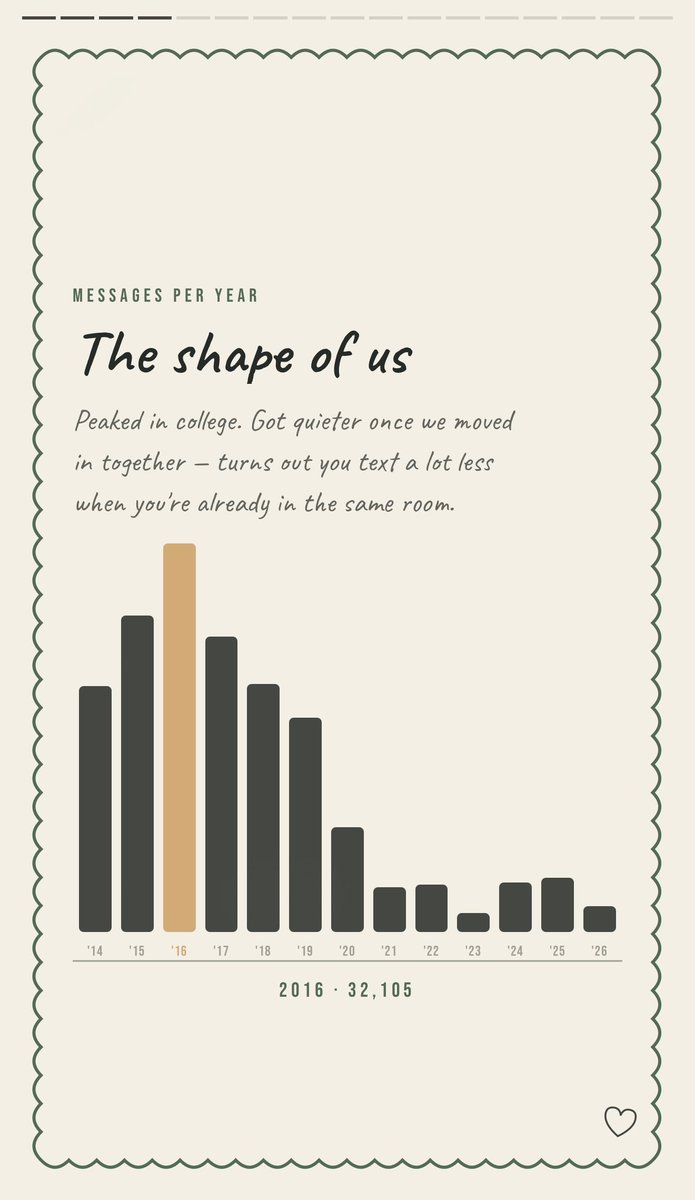
I got married this past weekend so I did what any rational @AnthropicAI employee would do and had Claude Code analyze 12 years of iMessages with my wife, then Claude Design used that data to whip up a website for our guests in just minutes.



English