Paradis Labs@ParadisLabs
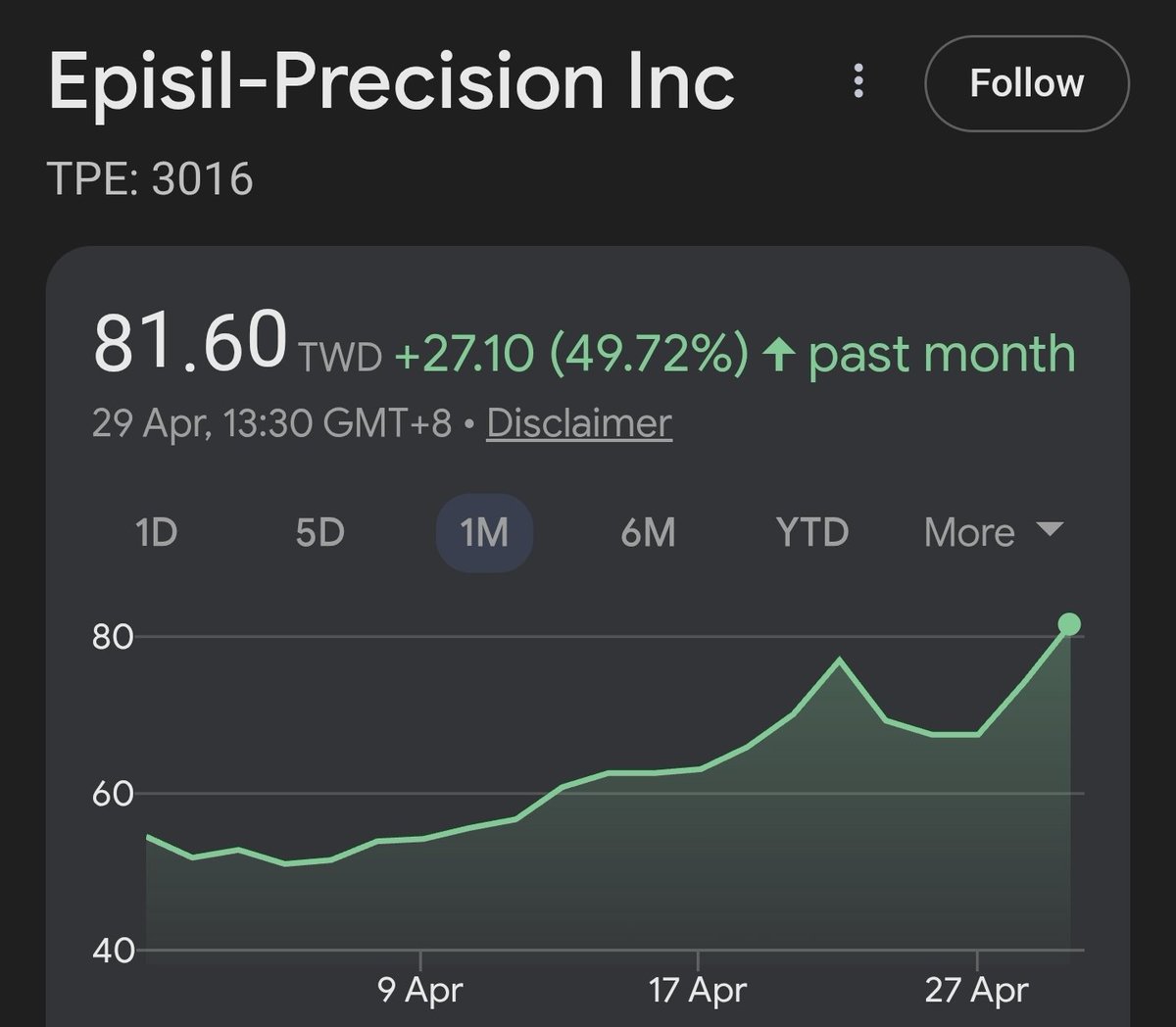
Episil-Precision. A Taiwanese pure-play supplier of epitaxial processes inside the global power bottleneck.
At less than $500M market cap?!
$TSM rely on them for high yields...
Even NASA engineers rely on them for GaN devices...
Episil-Precision are recognized as the only player in Taiwan able to mass-produce both SiC & GaN epitaxial wafers simultaneously.
Acting as a highly convenient one-stop-shop for foundries.
The AI power constraint
-----
Data centers need gigawatt-scale loads.
But modern compute clusters throw up power swings that destabilize traditional grids.
EVs demand semis that handle high voltages and temps without performance loss.
Traditional silicon has hit its physical threshold.
The solution lies in wide-bandgap (WBG) materials:
> Silicon Carbide (SiC)
> Gallium Nitride (GaN)
These operate at 600V-1,200V+ with minimal energy loss.
However, their adoption is restricted by manufacturing complexities in the initial growth phase, known as epitaxy.
This is where Episil-Precision operates as a mission-critical asset.
Episil’s position in the supply chain
-----
Episil-Precision is a pure-play supplier of epitaxial processes.
It acts as the bridge between raw material substrate vendors and device fabricators.
Instead of logic design or volume foundries, Episil handles the front-end material engineering that transforms raw wafers into active electronic platforms.
By depositing a crystal layer on a substrate, Episil defines a chip's thickness, resistivity, and dopant profiles.
Companies like $NVDA and even NASA engineers rely on Episil to de-risk their operations since this layer determines the final yield of subsequent fab steps.
Filling the epitaxial bottleneck
-----
The transition to WBG materials has created a huge supply chain bottleneck.
Growing GaN or SiC on supporting substrates produces intense mechanical stress due to lattice mismatches.
At temperatures >1,000°C, this stress causes the wafer to warp, creating cracks or current collapse.
Episil-Precision fills this bottleneck via patented nitride structures that grow alternating buffer layers to absorb mechanical stress.
Engineers track structural stress second-by-second in real-time. This ensures that after cooling, the wafer returns to a flat state free from bowing.
Without these material capabilities, downstream foundries like $TSM would face sh!t yields, stalling global electrification.
Their technological moat
-----
Episil's competitive moat is built on 25+ years of institutional process knowledge.
Epitaxy is not a commodity; recipes for gas flows and temperature gradients require years of trial and error to perfect.
The relationship with clients features high switching costs.
In sectors like automotive, qualification cycles take over a year.
Once Episil achieves IATF 16949 certification, clients are locked into the supply chain to avoid liability risks.
Episil is also the only player in Taiwan capable of mass-producing SiC and GaN epitaxial wafers simultaneously.
Competitive dynamics
-----
The market features a tier of conglomerates focused on high-volume 300mm bulk silicon for logic (e.g. SUMCO, Shin-Etsu Handotai, GlobalWafers).
However, power electronics require a high-mix, lower-volume batch profile on 150mm/200mm lines.
The massive capital structures of mega-suppliers are not geared toward mastering the localized stress bottlenecks of WBG processing.
Also vertically integrated leaders like $WOLF and STMicroelectronics are overwhelmed by AI demand.
To meet backlogs without waiting for new fab construction, these IDMs are outsourcing to independent foundries like Episil.
There are some Chinese competitors, but they have consistent defects. Not ideal when some end-clients are EVs.
Vanguard alliance is a scaling catalyst
-----
Historically, Episil’s growth was capped by capital constraints.
This changed when Vanguard International Semiconductor acquired a 13% stake in Episil for approximately $77.1M.
Vanguard provides the manufacturing scale for power management chips. Episil provides the WBG expertise.
This alliance ultimately grants Episil the gravity to secure volume contracts from Japanese giants like Renesas Electronics and Denso.
-----
Episil-Precision is a critical solution provider inside the global power bottleneck.
Power systems simply cannot rely on legacy silicon platforms.
The transition to WBG materials is non-negotiable.
Because the growth of GaN and SiC on supporting substrates produces severe mechanical stress that ruins processing yields, third-party foundries and IDMs are forced to rely heavily on advanced epitaxy specialists.
Episil-Precision directly fills this bottleneck by applying its process knowledge,designs, and real-time curvature tracking systems to produce ultra-high-yield starting materials.