Xingjian Zhang

37 posts

Xingjian Zhang banner
Xingjian Zhang

Xingjian Zhang

@_Jimmy_Zhang_

Ph.D. candidate @UMich. Intern @GoogleDeepMind. Incoming intern @AIatMeta. AI for science, LLM reasoning, and more.

Ann Arbor, MI, USA. Katılım Kasım 2021
109 Takip Edilen353 Takipçiler
Xingjian Zhang
Xingjian Zhang@_Jimmy_Zhang_·
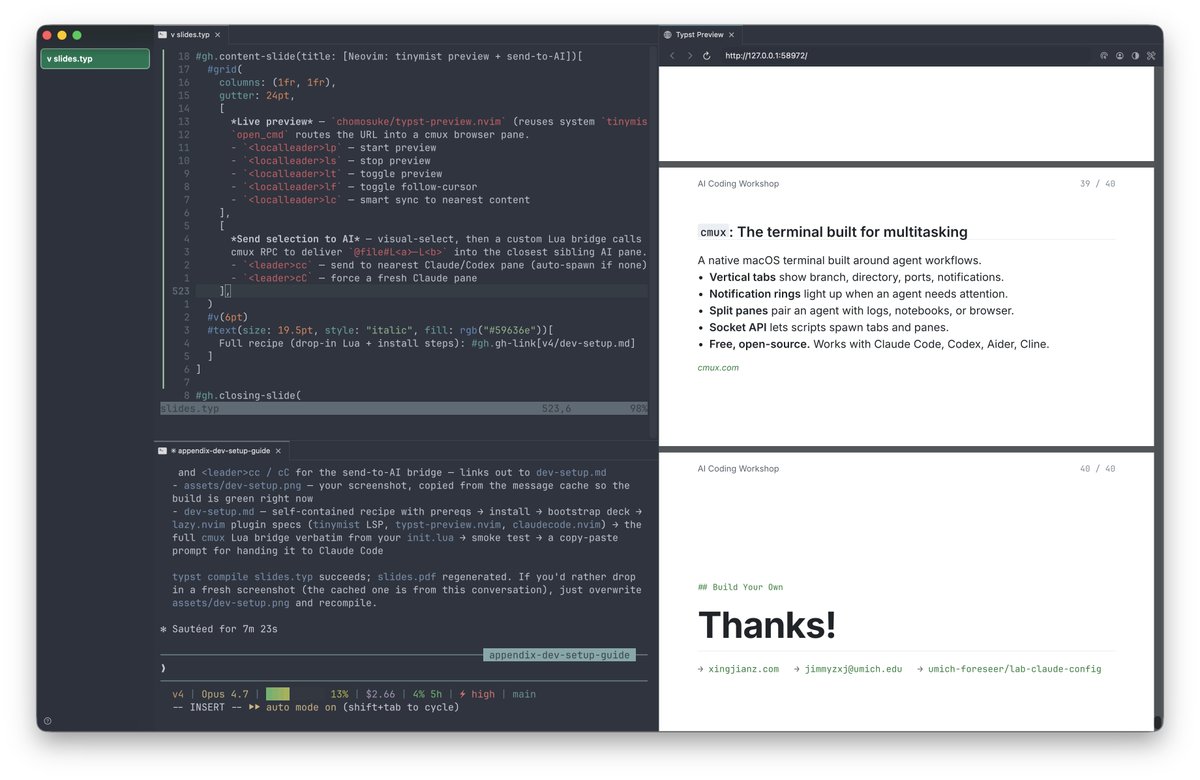
@Jiaqi_Ma_ Many people have asked how I made these slides, so I added an appendix explaining the setup: cmux + Neovim + Typst + Claude Code. It’s much faster than a Google Slides or LaTeX Beamer workflow. The slide template is open-sourced here: typst.app/universe/packa…
Xingjian Zhang tweet media
English
0
0
5
510
Xingjian Zhang
Xingjian Zhang@_Jimmy_Zhang_·
Had the privilege of building the agentic RL infrastructure (tool use, search, etc.) and helping develop the multimodality framework in Simply during my @GoogleDeepMind internship last summer. Glad to see it out in the open — excited for the community to build on it!
Chen Liang@crazydonkey200

@karpathy Very inspiring as always! We are also open sourcing part of our infra on automated research for Gemini to evolve itself at github.com/google-deepmin… More complex than the nanochat setup but closer to SOTA LLM pre/post-training while staying as minimal as possible. More on the way.

English
0
0
6
953
Xingjian Zhang
Xingjian Zhang@_Jimmy_Zhang_·
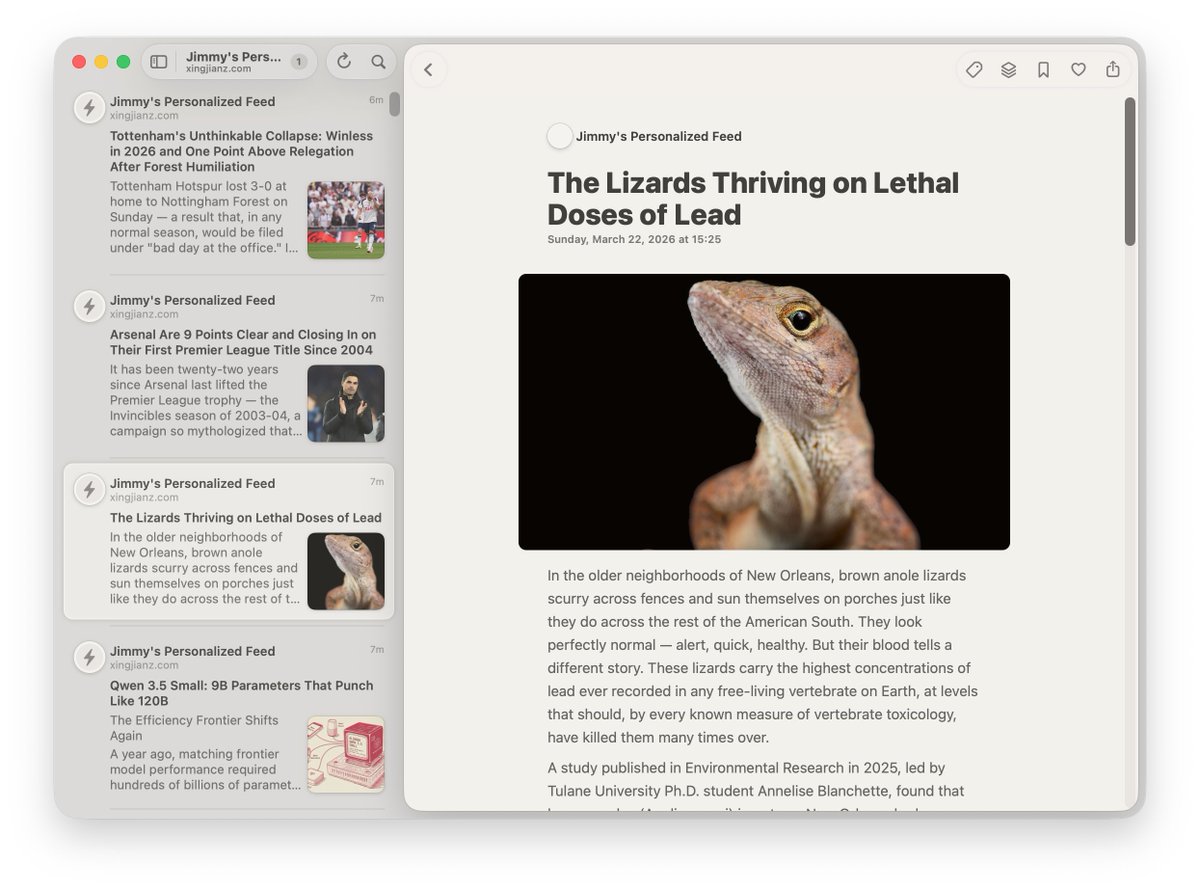
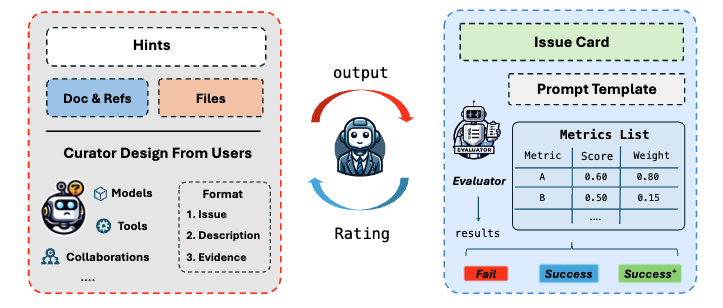
Best use I've found for my Claude Max subscription isn't coding — it's turning #ClaudeCode into a personal research desk that delivers deep briefings to my #RSS reader every morning, on exactly the topics I define. Open source. $0 extra if you already subscribe. 🧵👇
Xingjian Zhang tweet mediaXingjian Zhang tweet mediaXingjian Zhang tweet media
English
3
3
14
901
Xingjian Zhang
Xingjian Zhang@_Jimmy_Zhang_·
@Xenshinu429 Thanks! That's Reeder, an existing RSS reader app — but cc-deepfeed outputs standard RSS 2.0, so it works with whatever reader you want to try!
English
0
0
0
105
Xingjian Zhang
Xingjian Zhang@_Jimmy_Zhang_·
The part I'm most excited about: it gets smarter over time. Each run builds on the last — accumulated knowledge, tracked stories, entity memory. By run 10 it knows everything runs 1–9 discovered. Not daily snapshots. Cumulative understanding.
English
1
0
0
172
Xingjian Zhang retweetledi
Jiaqi Ma
Jiaqi Ma@Jiaqi_Ma_·
The ARC challenge claims to measure "fluid intelligence" through tasks that are "simple for people yet difficult for AI." However, is the AI failure really due to the lack of "fluid intelligence?" Our recent work shows that the answer is NO with a carefully designed diagnostic study. ArXiv: arxiv.org/pdf/2512.21329 Joint work with Xinhe Wang, @JinHuang9306000, @_Jimmy_Zhang_ , @0920wth Our study is motivated by an observation that ARC problems are easy for humans because their representation strongly favors human vision. For example, in the attached figure, the same ARC problem presented in a serialized way becomes much more challenging for humans. 1/
Jiaqi Ma tweet media
English
1
3
30
5.9K
Xingjian Zhang retweetledi
Mikel Bober-Irizar
Mikel Bober-Irizar@mikb0b·
You've seen some of the puzzles o3 failed, but have you seen the attempts? Yesterday, @OpenAI's o3 dramatically beat the SOTA at @arcprize. But there were 34 tasks that even it couldn't solve with 16 hours of thinking. I've compiled and analyzed all of o3's mistakes below 🧵
Mikel Bober-Irizar tweet media
English
34
154
1.3K
281.7K
Xingjian Zhang retweetledi
Jim Fan
Jim Fan@DrJimFan·
OpenAI Strawberry (o1) is out! We are finally seeing the paradigm of inference-time scaling popularized and deployed in production. As Sutton said in the Bitter Lesson, there're only 2 techniques that scale indefinitely with compute: learning & search. It's time to shift focus to the latter. 1. You don't need a huge model to perform reasoning. Lots of parameters are dedicated to memorizing facts, in order to perform well in benchmarks like trivia QA. It is possible to factor out reasoning from knowledge, i.e. a small "reasoning core" that knows how to call tools like browser and code verifier. Pre-training compute may be decreased. 2. A huge amount of compute is shifted to serving inference instead of pre/post-training. LLMs are text-based simulators. By rolling out many possible strategies and scenarios in the simulator, the model will eventually converge to good solutions. The process is a well-studied problem like AlphaGo's monte carlo tree search (MCTS). 3. OpenAI must have figured out the inference scaling law a long time ago, which academia is just recently discovering. Two papers came out on Arxiv a week apart last month: - Large Language Monkeys: Scaling Inference Compute with Repeated Sampling. Brown et al. finds that DeepSeek-Coder increases from 15.9% with one sample to 56% with 250 samples on SWE-Bench, beating Sonnet-3.5. - Scaling LLM Test-Time Compute Optimally can be More Effective than Scaling Model Parameters. Snell et al. finds that PaLM 2-S beats a 14x larger model on MATH with test-time search. 4. Productionizing o1 is much harder than nailing the academic benchmarks. For reasoning problems in the wild, how to decide when to stop searching? What's the reward function? Success criterion? When to call tools like code interpreter in the loop? How to factor in the compute cost of those CPU processes? Their research post didn't share much. 5. Strawberry easily becomes a data flywheel. If the answer is correct, the entire search trace becomes a mini dataset of training examples, which contain both positive and negative rewards. This in turn improves the reasoning core for future versions of GPT, similar to how AlphaGo’s value network — used to evaluate quality of each board position — improves as MCTS generates more and more refined training data.
Jim Fan tweet media
English
135
1.1K
6.1K
799.6K
Xingjian Zhang
Xingjian Zhang@_Jimmy_Zhang_·
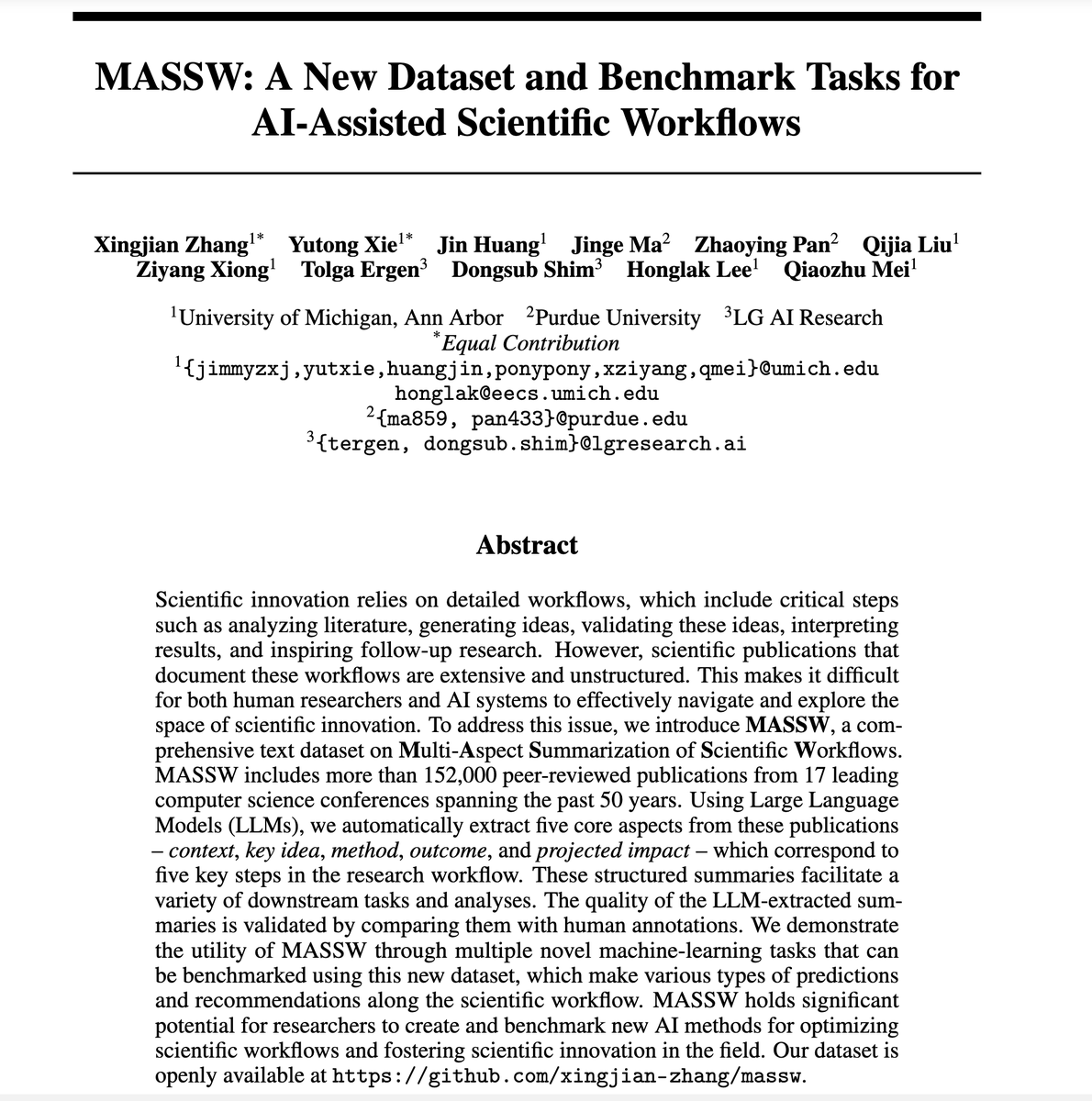
4. [Rich benchmark tasks] MASSW facilitates multiple novel and benchmarkable machine learning tasks, such as idea generation and outcome prediction. It supports diverse tasks centered on predicting, recommending, and expanding key elements of a scientific workflow.
English
1
0
1
99