
Sabitlenmiş Tweet
PLabs
1.4K posts


PLabs
@_PLabs
We build privacy 1. pERC20: https://t.co/vBATTfKcTa
https://t.me/plabs4 Katılım Temmuz 2021
99 Takip Edilen1.6K Takipçiler

The two mantras I repeat most often to founders:
1. The shortest distance between two points is a straight line. If you want to do X, just go straight to X. Don't waste your time with setup or pre-requisites or throat-clearing, just go do the thing you want to do. Launch the product. Sell to the enterprise. Make the big ask. Go do it and you'll learn by doing.
2. Optimize for the upside. Most of your expected value is in the universe where you succeed, so optimize for that universe. If you're going to fail, micro-optimizing your failures is a waste of energy. You might fail, fine--pick yourself up and do something else. But over the long run, optimizing for the upside is how you make good outcomes you will have defensible and self-compounding.
English

👇Connect your wallet and leave your PRIVATE address( 0xperc1*** )
app.plabs.online
Properly Nothing👁️👁️
English
Still seeing addresses roll in!
📢 Reminder: you can still drop your real address until 12:00PM (UTC) today — don't sleep on this ⏳
PLabs@_PLabs
👇Connect your wallet and leave your PRIVATE address( 0xperc1*** ) app.plabs.online Properly Nothing👁️👁️
English

If you're building across:
→ Tokenization
→ Stablecoins
→ Credit
→ Prediction markets
→ Institutional markets
→ Agentic commerce
...or anything amazing on Base, this is for you ↓
Base Build@buildonbase
English
“Traditional bilateral OTC agreements, ..., are vital for institutional funding and risk transfer, but private execution breeds opacity, friction, and counterparty risk. Onchain bilateral agreements transform this model by recording contract terms, collateral, and lifecycle events on a shared ledger to enable real-time transparency and programmability.”
->Parties engaging in OTC transactions tend to prefer accepting privacy risks over opting for transparency, don't they?
English



We got around 500 supporters within 48 hours.
Thanks, everyone!
The event will close at 12:00 PM (UTC) today

PLabs@_PLabs
The Trusted Setup Ceremony for pERC20 protocol is officially launching. 👉Only 1 click to join: ceremony.plabs.online This is more than the birth of a protocol — it marks the beginning of privacy's story on the EVM. For the first time, the issuance, transfer, and burning of assets can happen on the @ethereum and @monad, yet remain unseen. Transparency has defined EVM's first decade. Privacy is where its next chapter begins. To every early supporter — thank you for witnessing this moment with us.
English


what do your investors do for you?
I can tell you Haseeb spent his 4th of July weekend hopping between our 2 teams trying helping us close a deal
a truly unique "founder mode" investor
founders will be LUCKY to get him on their side
Haseeb >|<@hosseeb
Congrats to the @bloxroute team! First met these guys almost a decade ago and has been incredible to see them build this business from a fledgling network infra company into what it's now become. Congrats to @uriklarman and @eyalmarkov and to @FalconXGlobal on joining forces with an incredible team.
English
some people didn't fully read this: i'm handing the @baseapp to @cobie so i can focus fully on the @base.
building base into the blockchain for global finance is the biggest opportunity in the world
if you're building on base, this means i'm now 100% focused on you. day one.
jesse.base.eth@jessepollak
lots of conversations about base over the last week. wanted to share my candid take after a week of listening and a lot of reflection over the last 6 months. first off - in case it’s not obvious, the first quarter of 2026 was a punch in the face. I spent 2024 and 2025 making a two pronged bet to bring base to the world: (1) builders would unlock the next wave of crypto adoption; (2) adoption would be driven by new onchain-native social experiences - creators, content, messaging. imo we made the right bet on builders, but obviously the wrong bet on social. builders did drive the next wave of crypto adoption - prediction markets, perpetuals, stablecoins - but social was not at the center of it. in fact, the entire social side of the market that many of us had been building towards - farcaster, zora, miniapps, and yes, creator coins - disintegrated completely. I was wrong - whether it was timing wrong (is $ansem a creator coin?) or fully wrong, only time will tell, but regardless, i was definitively wrong. the collateral damage was pretty bad! and this year has been an exercise in eating shit. we realized how our focus on social had meant that base had fallen behind in key areas that were now increasingly critical - we had perps (shoutout avantis!) and prediction markets (shoutout limitless!), but both were well behind scaled competitors. and we had a lot of room to improve in unlocking base as a platform for tokenization and payments that really worked for enterprises. people lost confidence, and CT spectators reminded me weekly of all of my mistakes as often as they could. it felt bad man, still feels bad. but if there’s one thing i’ve learned from the last decade of building in this space, it’s that when things feel the worst, the best thing to do is just put your head down and build. so that’s what i’m doing. I refocused my time and attention back to the chain away from the app, started writing code again, shipped a bunch of stuff (azul, beryl, b20, privacy, ledgers) and questioned a bunch of my assumptions: does crypto need social to grow? does base need an app? can base be bigger than coinbase? I thought for a long time that social was the only thing that could drive the sort of viral growth to get crypto to a billion people. unsurprisingly, I now believe that’s wrong. It’s clear that better money is more than enough - we are seeing this live with stablecoins, predictions, perpetuals, tokenization and i only expect it to accelerate. I am now focused on bringing a billion people onchain just by making global finance actually work. on the app, my focus is on building base into the blockchain for global finance. to that end, i’ve handed the base app back to the coinbase mothership, where my now good friend @cobie will be taking it from here to make it the best damn app for onchain you’ve ever seen, including expanding beyond the base ecosystem in ways that tbh i won’t love as the leader of base. it’s incredibly hard to grow a decentralized network inside of a big public corporation. and i feel like much of the discourse on CT over the last week is downstream of this. the following things can be true: (1) base (and i) love memes and (2) brian probably won’t ever bullpost memes on the tl (this activity is illegal once you’re over 40 years of age). it’s weird and we’re working through it as we continue to decentralize base, which has been our commitment from the beginning. we’re going to build base into the blockchain for global finance and do everything we can to be the place that the world’s money settles over the next century. we will surely have formidable competitors (welcome robinhood and stripe!) and people may abandon our cause, but we welcome the competition and believe it’s our duty to win the respect and commitment of those who rally to our banner. in 2026, this concretely means three things: winning trading, payments, and agents. [continued in the reply]
English
@zkDragon @TachyonZcash I know more about privacy, but less about the nodes in Zcash protocol. Thanks for your clarification.
English

@_PLabs @TachyonZcash Get a node up and running without historic blocks, just state and recent blocks! Takes 11GB of snapshot data :)
English
Excited to announce Zakura! A new Zcash full node, built around scale!
We've teamed up with @TachyonZcash to make this a reality.
Our first release solves many painpoints for the ecosystem:
- Much faster sync
- Pruned nodes
- Snapshots
- Support for Zcashd wallets
🧵
Zakura@ZakuraZcash
Announcing Zakura: a new Zcash node built for scale.
English

@ship_armada take a look here
PLabs@_PLabs
We compiled @ethereum privacy discussions and designs into one living map — so anyone can see the privacy blueprint clearly: what’s being designed, why it matters, and who is behind it. Not an official roadmap. Continuously updated. 🖼 plabs4.github.io/awesome_ethpri… 📂 github.com/PLabs4/awesome… ——— Core design 1) EIP-8182 — shared private UTXO pool Problem: app-level pools split liquidity — private funds stay fragmented. Vision: one protocol-owned shared pool that wallets and apps deposit into and spend from together. How: shared note-commitment tree + nullifier set. → eips.ethereum.org/EIPS/eip-8182 2) EIP-8250 — Keyed Nonce Problem: privacy flows often share one public sender / sponsor; a single linear nonce bottlenecks throughput — one inclusion can stall every other pending private spend. Vision: concurrent, independent private spends without a shared-sender queue. How: (nonce_keys, nonce_seq); non-overlapping keys are replay-independent (e.g. nullifier-derived keys). → eips.ethereum.org/EIPS/eip-8250 3) EIP-8141 — Frame Transactions Problem: bad UX for EOA users Vision: support arbitrary user-defined definitions of validation and gas payment. How: ordered frames — verify frame · approve frame · execution frame. Example: verify client proof + one time signature · approve trustless gas payemnt + execute call to privacy pool contract → eips.ethereum.org/EIPS/eip-8141 4) ERC-8302 — pERC20 (private fungible tokens) Requirments: bank wants to launch a private-stablecoin, informed by @eth_systems's research. Vision: stablecoins, RWA, or other assets may need privacy from day one. How: a private fungible token standard with an ERC-20-shaped surface (transfer / approve / allowance / transferFrom). → github.com/ethereum/ERCs/… → ethsystems.org/approaches/app… 5) Kohaku (EF) — privacy wallet & SDK Goal: make it easy for any wallet to integrate privacy. → GitHub: github.com/ethereum/kohaku → Roadmap: @niard/KohakuRoadmap" target="_blank" rel="nofollow noopener">notes.ethereum.org/@niard/KohakuR…
6) leanVM — post-quantum proving & signatures Problem: ECDSA, BLS, and pairing SNARKs eventually break. Vision: hash-based signatures + PQ proof systems. How: leanXMSS + signature aggregation + recursive STARKs. → github.com/leanEthereum/l… 7) Privacy Core Vision: value and addresses stay shielded in private transactions. How: UTXO notes + client ZKPs; IVK scanning + one-time receive addresses. → @zcash Protocol Spec: zips.z.cash/protocol/proto… 8) Compliance • Privacy Pools / @0xbowio — deposit association sets at withdraw (ASP) → privacypools.com/whitepaper.pdf • @RAILGUN_Project — Proof of Innocence at shield vs List Provider bad-lists → docs.railgun.org/wiki/assurance… • @_PLabs — cmx association sets when spending → plabs.gitbook.io/plabs-docs/pri… 9) ETH & ERC-20 · DeFi Interaction • ETH & ERC-20 shield — @RAILGUN_Project · @0xbowio. • DeFi interaction — @RAILGUN_Project(unshield →contract call →shield ); → docs.railgun.org/wiki/learn/int… 10) Offical Scope • @VitalikButerin — simple L1 privacy roadmap → ethereum-magicians.org/t/a-maximally-… • @VitalikButerin — the Ethereum long-term trajectory → strawmap.org ——— Corrections and new links welcome. English
We compiled @ethereum privacy discussions and designs into one living map — so anyone can see the privacy blueprint clearly: what’s being designed, why it matters, and who is behind it.
Not an official roadmap. Continuously updated.
🖼 plabs4.github.io/awesome_ethpri…
📂 github.com/PLabs4/awesome…
———
Core design
1) EIP-8182 — shared private UTXO pool
Problem: app-level pools split liquidity — private funds stay fragmented.
Vision: one protocol-owned shared pool that wallets and apps deposit into and spend from together.
How: shared note-commitment tree + nullifier set.
→ eips.ethereum.org/EIPS/eip-8182
2) EIP-8250 — Keyed Nonce
Problem: privacy flows often share one public sender / sponsor; a single linear nonce bottlenecks throughput — one inclusion can stall every other pending private spend.
Vision: concurrent, independent private spends without a shared-sender queue.
How: (nonce_keys, nonce_seq); non-overlapping keys are replay-independent (e.g. nullifier-derived keys).
→ eips.ethereum.org/EIPS/eip-8250
3) EIP-8141 — Frame Transactions
Problem: bad UX for EOA users
Vision: support arbitrary user-defined definitions of validation and gas payment.
How: ordered frames — verify frame · approve frame · execution frame.
Example: verify client proof + one time signature · approve trustless gas payemnt + execute call to privacy pool contract
→ eips.ethereum.org/EIPS/eip-8141
4) ERC-8302 — pERC20 (private fungible tokens)
Requirments: bank wants to launch a private-stablecoin, informed by @eth_systems's research.
Vision: stablecoins, RWA, or other assets may need privacy from day one.
How: a private fungible token standard with an ERC-20-shaped surface (transfer / approve / allowance / transferFrom).
→ github.com/ethereum/ERCs/…
→ ethsystems.org/approaches/app…
5) Kohaku (EF) — privacy wallet & SDK
Goal: make it easy for any wallet to integrate privacy.
→ GitHub: github.com/ethereum/kohaku
→ Roadmap: @niard/KohakuRoadmap" target="_blank" rel="nofollow noopener">notes.ethereum.org/@niard/KohakuR…
6) leanVM — post-quantum proving & signatures
Problem: ECDSA, BLS, and pairing SNARKs eventually break.
Vision: hash-based signatures + PQ proof systems.
How: leanXMSS + signature aggregation + recursive STARKs.
→ github.com/leanEthereum/l…
7) Privacy Core
Vision: value and addresses stay shielded in private transactions.
How: UTXO notes + client ZKPs; IVK scanning + one-time receive addresses.
→ @zcash Protocol Spec: zips.z.cash/protocol/proto…
8) Compliance
• Privacy Pools / @0xbowio — deposit association sets at withdraw (ASP)
→ privacypools.com/whitepaper.pdf
• @RAILGUN_Project — Proof of Innocence at shield vs List Provider bad-lists
→ docs.railgun.org/wiki/assurance…
• @_PLabs — cmx association sets when spending
→ plabs.gitbook.io/plabs-docs/pri…
9) ETH & ERC-20 · DeFi Interaction
• ETH & ERC-20 shield — @RAILGUN_Project · @0xbowio.
• DeFi interaction — @RAILGUN_Project(unshield →contract call →shield );
→ docs.railgun.org/wiki/learn/int…
10) Offical Scope
• @VitalikButerin — simple L1 privacy roadmap
→ ethereum-magicians.org/t/a-maximally-…
• @VitalikButerin — the Ethereum long-term trajectory
→ strawmap.org
———
Corrections and new links welcome.

English
English

Congrats @eth_systems on the launch
Institutions want confidential systems using ethereum as the settlement layer
This launch strengthens $ETH is the future of money
👏👏👏👏👏👏
Bitmine (NYSE-BMNR) $ETH@BitMNR
Bitmine is the lead investor in the launch of @eth_systems alongside @Sharplink @ethereumJoseph EthSystems is a for-profit company building confidential and private systems for institutions. Wall Street is building rails on Ethereum and EthSystems will be a key provider. The deep ecosystem of Ethereum just got even stronger. $ETH is money @fundstrat @BitMNR $BMNR ————————— In their words from EthSystems: - What we mean by "confidential systems for institutional Ethereum" - The institutional demand we've seen up close, and why the YOLO phase of crypto is over - Who we are, from Goldman Sachs and Status to the EF's Institutional Privacy Task Force - What we shipped this past year: private bonds, private stablecoin transfers, cross-chain DvP, shielded pools, the Ethereum Privacy Map - Why a for-profit company, and what an engagement looks like - How to work with us
English
Interesting use case, @eth_systems ethsystems.org/approaches/app…
But only an on-chain dark pool (CLOB-based) can satisfy these requirements; no shield protocol could handle this case.

EthSystems@eth_systems
Today we're launching EthSystems. We build confidential systems for institutional Ethereum. Institutions want to use Ethereum, but one of the biggest problems is the lack of built-in, modular privacy tools. We were the Ethereum Foundation's Institutional Privacy Task Force (IPTF) for the past year. We had hundreds of conversations with central banks, regulators, tier-one banks, and asset managers, shipping open source work the whole time. Wall Street has found crypto as an asset class, but not yet as commercial infrastructure. Institutions want to run real flows on Ethereum: stablecoins, tokenized assets, settlement. These are businesses with billions of dollars on the line, and no bank will operate in full public view. On a public ledger, confidentiality is the hard part: each party to a transaction should see what it has a right to see, and nothing more. We have a year of proof of work: private bonds, confidential stablecoin transfers, private settlement across chains, the Ethereum Privacy Map, and more. All with protocol specs and security properties, at our website. We've spent a decade working on privacy in crypto. We know there's no silver bullet. Different use cases need different systems, each designed, specified, and hardened properly, and someone has to do that work. That's why EthSystems exists. We're an independent, for-profit company, backed by long-term Ethereum-aligned investors. This is a decade-long transition, and we aren't going anywhere. If you're an institution that wants to build on Ethereum, talk to us. We're hiring: BD in New York, protocol engineers, ops: join@ethsystems.org
English
@hosseeb @canton_loop Your email should be bound to an evm address, so they should do some complaince check.
English
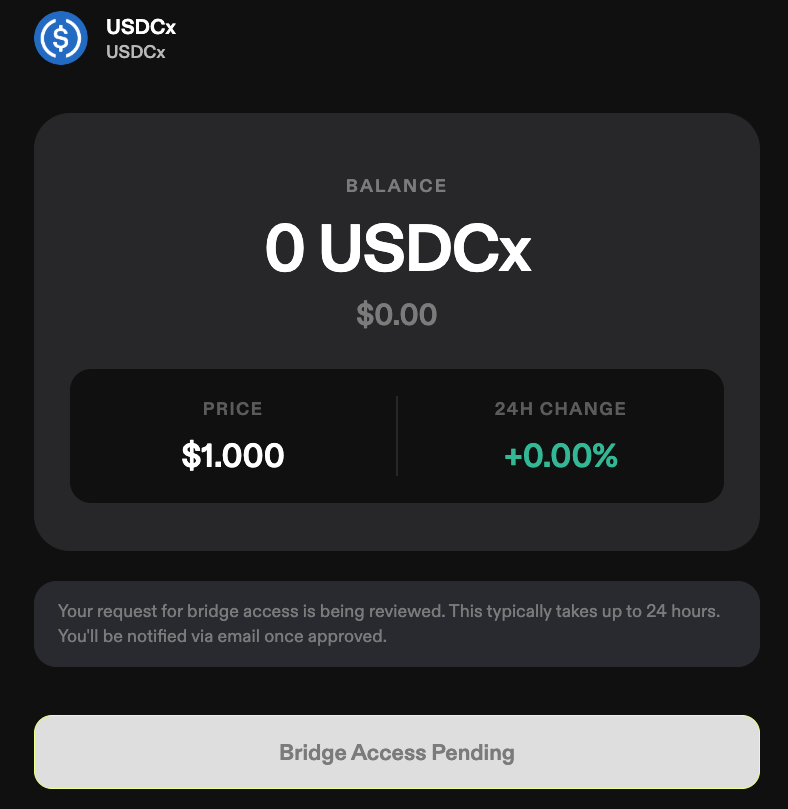
TIL: If you want to bridge USDC into Canton via @canton_loop wallet you need to apply for permission. There's a 24 hour approval SLA to know whether or not you are allowed to bridge.
It's a non-custodial wallet... they don't know anything about me besides my email.
English