

Smokin Ted
18.5K posts

Smokin Ted
@_SmokinTed
Research & Strategy @TailoredWeb3
Katılım Mart 2014
864 Takip Edilen1K Takipçiler

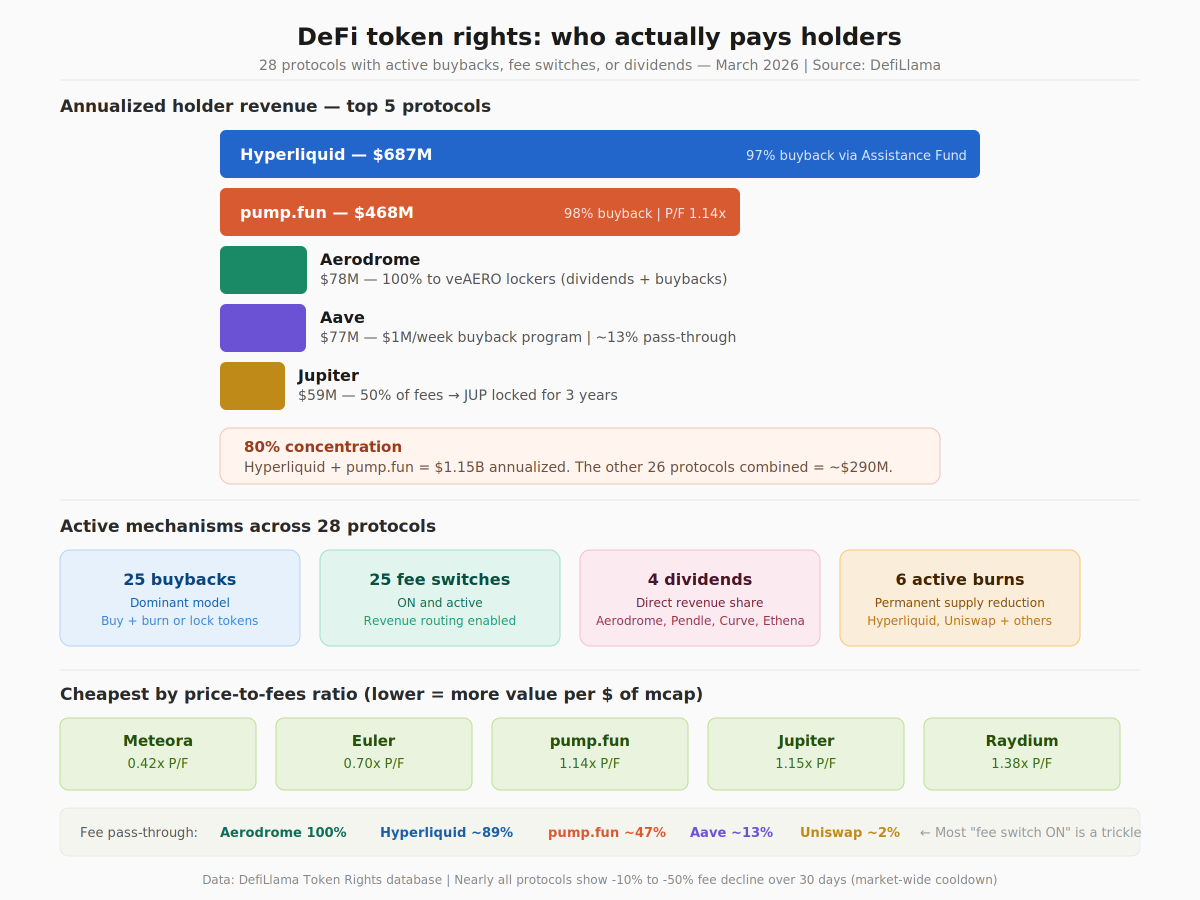
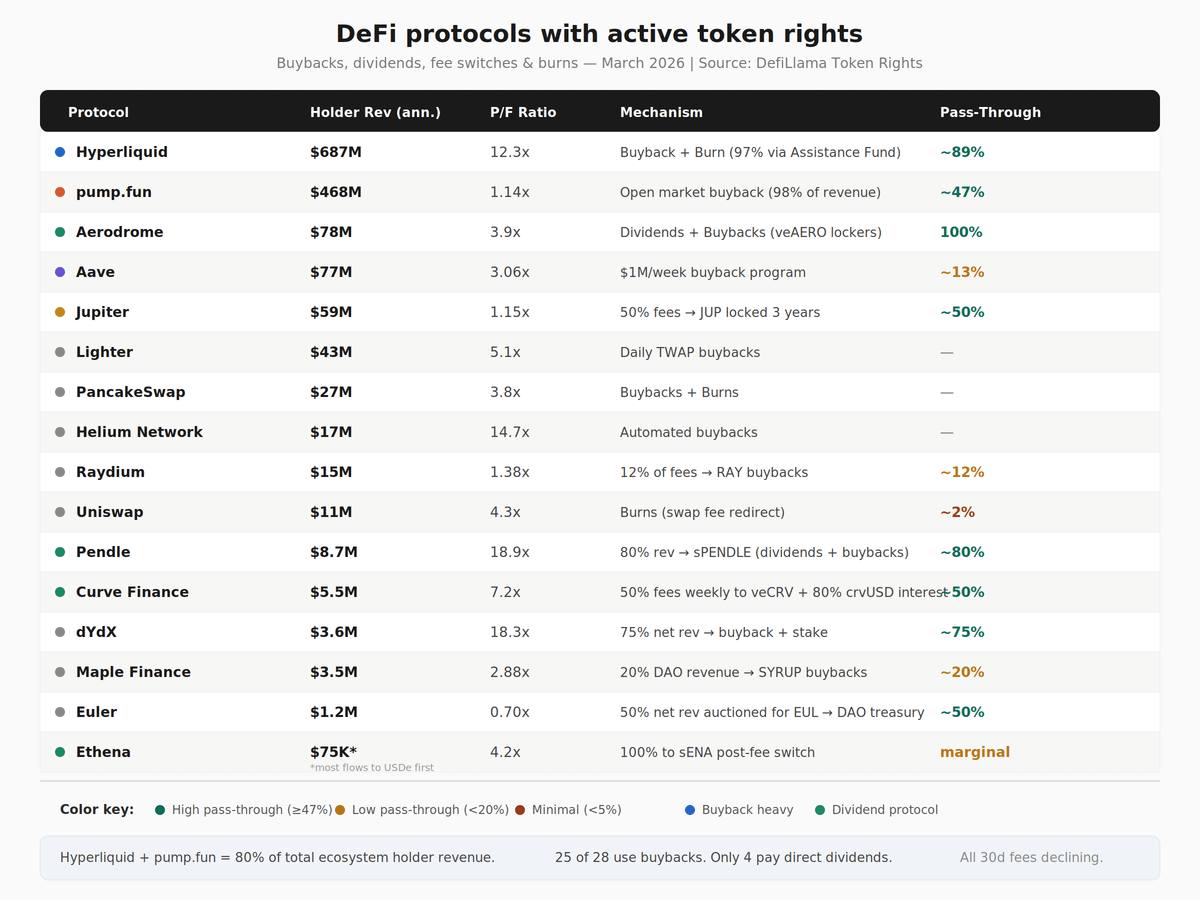
28 DeFi protocols now have active token rights like buybacks, fee switches, revenue distribution to holders.
It might sound like a broad shift but it's not.
As 2 protocols generate 80% of all holder revenue in the entire token rights universe.
Hyperliquid and PumpFun combined push $1.15B annualized. The other 26 has about $290M together. Here's what the top of the table looks like 👇
1. Hyperliquid' $HYPE | $687M/yr to holders
‣ 97% of trading fees flow into HYPE buybacks through the Assistance Fund
‣ Over $54M in fees just from last 30D
‣ RWA perps through HIP-3 are driving volume that didn't exist 6 months ago
2. PumpFun' $PUMP | $468M/yr at a 1.14x P/F ratio
‣ Cheapest large-revenue protocol by that metric
‣ But revenue dropped 12% in 30 days, a $500M lawsuit is pending, and team wallets moved $10M to exchanges in February.
3. Aerodrome' $AERO | $78M/yr
‣ 100% of fees go to veAERO lockers
‣ One of only 4 protocols that pay direct dividends instead of indirect buyback support
4. Aave' $AAVE | $77M/yr
‣ Running a $1M/week buyback program since early 2025
‣ Only ~13% of total protocol fees actually reach holders though
‣ The rest funds operations
5. Jupiter' $JUP | $59M/yr
‣ 50% of fees go to JUP buybacks, locked for 3 years
Now 25 out of 28 protocols chose buybacks. Only 4 pay direct dividends: @AerodromeFi @pendle_fi @CurveFinance @ethena
Remember buybacks let the team control timing and execution. You're trusting that reduced supply eventually shows up in price. Dividends put revenue in your wallet. One is indirect. The other is cash flow you can see but the real gap isn't even the mechanism. It's the pass-through rate.
Most tokens market themselves as "fee switch ON." Here's what actually flows through
→ Aerodrome: 100%
→ Hyperliquid: ~89%
→ PumpFun: ~47%
→ Aave: ~13%
→ Uniswap: ~2%
The switch is on. For most, the flow is a trickle. If you evaluate tokens based on does it have a buyback program you're asking the wrong question. The right one is what percentage of protocol revenue actually reaches holders and is that revenue growing or shrinking?
Right now nearly every protocol on this list shows -10% to -50% fee decline over 30 days. Not protocol-specific. Market-wide cooldown from January's peak.
Cheapest protocols by P/F ratio rn:
→ @MeteoraAG: 0.42x
→ @eulerfinance: 0.70x (post-hack rebuild)
→ @Pumpfun: 1.14x
→ @JupiterExchange: 1.15x
→ @Raydium: 1.38x
➢ Low P/F + declining revenue is a trap if the decline accelerates
➢ Low P/F + stable or recovering revenue is where the opportunity sits
That distinction gets lost in the noise. One filter I've been using is to ignore the mechanism label. Look at three numbers:
1. Annualized holder revenue
2. P/F ratio
3. 30-day fee growth direction
➢ If all three line up, the token has a real value accrual story
➢ If any one breaks, the buyback is marketing
Most of DeFi's token rights story is marketing. A handful of protocols are actually moving capital that matters.
Know which is which before you buy the label.
h/t to @DefiLlama for the data
English
@kenodnb @Infinit_Labs @maplefinance @Morpho @KyberNetwork pretty sweet opportunity with @maplefinance & @Infinit_Labs 🥞🍁🤖
English
Smokin Ted retweetledi

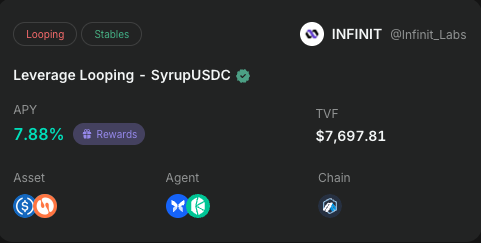
Another opportunity on @Infinit_Labs.
New epoch just started, and for the first time one of INFINIT’s core strategies is now incentivized.
@maplefinance syrupUSDC leverage looping via @Morpho x @KyberNetwork.
- 7.88% APY
- 14,000 $IN rewards (epoch ends March 26)
English

mucho bullish on @maplefinance and let me tell you WHY:
- syrupUSDC and syrupUSDT both hit new aths: combined mcap now $2.8b
- +33.85% and +36.87% ytd in this market....while most defi yield products bleed like crazy
- syrupUSDC: $1.78b mcap, 1.54b supply. syrupUSDT: $990m mcap, 880m supply. both top 10 yielding assets
- deposits hit $2.5b ath and still up up up
- cross-chain absolutely smashing it, syrupUSDC spread across eth (68%), sol (20%), base (10%). syrupUSDT mainly on plasma (53%), eth (41%)
- le plasma dominance on the USDT is definitely something to pay attention to
- consistent yield over 12+ months AND mucho chains coming
soon Maple will be everywhere
syrUP
dc: linn is ambassador for Maple and holds mucho $SYRUP
GLC@GLC_Research
Despite a challenging start to the year for DeFi and yield-bearing assets, @maplefinance continues to stand out. Both syrupUSDC and syrupUSDT have continued to grow, with their respective supplies increasing by over 33% and 36% year-to-date. Their supplies are standing at around 1.55B for syrupUSDC and 0.9B for syrupUSDT, placing both assets among the top 10 largest yielding assets in the market. Deposits into these products have also continued to rise, reaching an ATH of $2.5B and still growing. This sustained momentum is not surprising: for over a year, syrupUSDC and syrupUSDT have delivered some of the highest and most consistent yields compared to their competitors. Below is a breakdown of supply across the different chains where these assets are deployed. As illustrated, their cross-chain expansion has been a key driver of growth. Additional deployments are expected in the near future. Maple.
English
Smokin Ted retweetledi

Things in crypto that have kept me excited in 2026
- Real revenue protocols like Hyperliquid, Aave, Sky; tokenization of profitable asset classes; Re (reinsurance); Theo (Gold); and stock tokenization via Ondo and XStocks.
- The merging of agentic commerce and privacy via Near Intents, and the rise of vaults as a competitive way to generate yield.
- Data is maturing alongside the industry: we’re seeing stablecoin-specific data via Stablewatch, and Claude integration via Token Terminal’s MCP.
The space is waking up from its dependence on Ponzi incentives, misaligned tokenomics, and pointless chains.
We will rise again. Stronger than ever.
English

"AI-generated marketing content has flooded crypto feeds. If you have spent any time in CT over the past six months, you already feel it. Post after post of polished, frictionless, well-formatted content that says absolutely nothing"
Lesson in here
Jiraiya@JiraiyaReal
English
Smokin Ted retweetledi
Linn's Leverage #982 is out: (Link in tweet below)
@boros_fi
@pendle_fi
@OdysseyFi
@maplefinance
@Theo_Network
@KyanExchange
@Mantle_Official
Like/Repost to support:

English

@JiraiyaReal @_SmokinTed If your agent need to make Micro payments, MPP is for you.
Check out my dive
x.com/Mars_DeFi/stat…
Mars_DeFi@Mars_DeFi
An AI agent can now on the internet make payments even with no API key. This is now possible through @stripe's new Machine Payments Protocol (MPP) which is an open standard for how AI agents and machines pay each other online. MPP is an open standard rather than a proprietary Stripe-only product. — Think of MPP as “payments for the agentic internet.” Instead of subscriptions or API keys, services can be paid per-use, per-second, or per-task automatically. MPP is an application-layer protocol for programmable payments between machines. It is a protocol that lets one software actor request payment from another, with enough structure to support different underlying rails. In plain English, MPP is trying to solve how an agent can discover a service, learn the price, authorize payment, complete the payment over whatever rail is available, and receive the resource or result all without manual signup, checkout screens, API keys, or a human in the loop? This means that there is no account setup and no API keys . Rather it boasts of: • per-use access • support for agentic commerce • use cases like data queries, • communication APIs, search, research, A/B testing, feedback, and human task marketplaces Notably, MPP is payment-rail agnostic with stablecoins, cards (via @stripe/ @Visa ) and even Bitcoin supported from day one. — MPP’s strongest utility is in situations where normal SaaS billing breaks down with early use cases already live: ● Per-call and per-query services Instead of registering an account and adding a card while storing an API key or getting a monthly invoice, an agent can: • discover a service • pay on demand • use it once and move on This is ideal for search, scraping, data, inference, analytics, routing, and orchestration. ● Cross-provider agent toolchains An autonomous agent may use ten external services in one job. MPP would let it: • pay each provider directly • choose based on price/performance • switch dynamically without human account provisioning • keep auditable machine-readable payment trails That is much closer to how cloud compute is consumed programmatically. ● Micropayments and streaming Many machine interactions are too small or too dynamic for subscriptions: • fractions of a cent per request • per-token model usage • per-second communication • per-byte delivery • dynamic metered access MPP seems designed for these cases. ● Human-in-the-loop task markets With MPP, agents can hire humans for feedback, testing, social tasks, and A/B tasks. That extends MPP beyond APIs into a broader labor marketplace. In that model: • the buyer is a machine • the worker may be human • the payment commitment still needs machine-readable enforcement That could be a large category if agents increasingly outsource specialized edge cases. @tempo’s posts also mention future enterprise features and use cases beyond agents: • global payouts • remittances • embedded finance • tokenized deposits All these suggest that MPP may become a general protocol for programmable treasury and operational payments, not only AI agents. — Here’s a simplified version of MPP's architecture : • Service advertises price • Agent creates payment intent • MPP routes to chosen payment method • Payment proof is verified • Access is unlocked (API, data, service, etc.) — Stripe’s involvement matters because Stripe brings the strongest bridge from internet-native developer workflows to mainstream payments infrastructure. Stripe seems to be betting that with time the real market will be broader: • some machine payments will use stablecoins • some will use cards • some will use Bitcoin flows • enterprises will want compliance, abstraction, retries, reporting, and familiar payment primitives. Knowing this, developers will want one protocol, not a separate integration for each rail. That is the strategic significance of MPP. The biggest problem in agent commerce is economic interoperability and MPP is one solution to this problem. h/t : @jeff_weinstein ( Introducing MPP ) @dwr ( Rails and extensibility ) @uttam_singhk ( Comparison with x402 ) @cuysheffield @matthuang
English
Smokin Ted retweetledi

English
Smokin Ted retweetledi

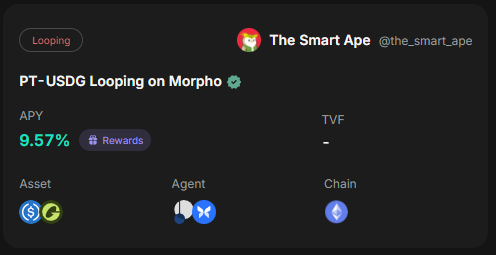
just dropped a new strategy on @Infinit_Labs, PT-USDG looping on Morpho. almost 10% APY.
the loop is dead simple and you can do it in 1 click through Infinit:
→ get PT-USDG on @pendle_fi
→ supply as collateral on @Morpho
→ borrow USDC at 90% LTV
→ repeat
if you've got a DeFi strategy in mind, submit it to their Prompt-to-DeFi Strategist Challenge. build it, get verified as a strategist, and gain access to all the perks and rewards.
INFINIT@Infinit_Labs
One well-crafted prompt beats hours of manual DeFi. This video teaches you exactly how to prompt on INFINIT. Watch this and you're already ahead in the Prompt-to-DeFi Strategist Challenge. 👇
English
Smokin Ted retweetledi

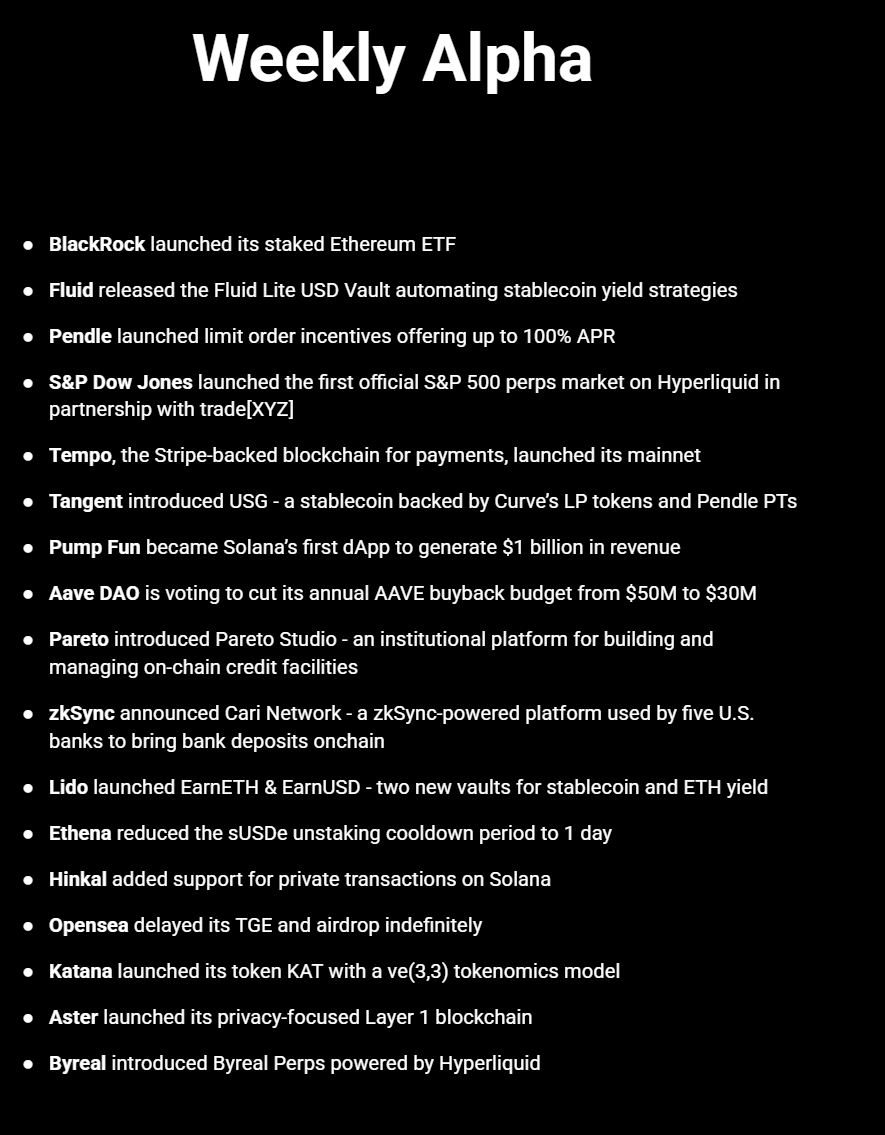
The latest developments in DeFi👇
BlackRock launched its staked Ethereum ETF
Fluid released the Fluid Lite USD Vault automating stablecoin yield strategies
Pendle launched limit order incentives offering up to 100% APR
S&P Dow Jones launched the first official S&P 500 perps market on Hyperliquid in partnership with trade[XYZ]
Tempo, the Stripe-backed blockchain for payments, launched its mainnet
Tangent introduced USG - a stablecoin backed by Curve’s LP tokens and Pendle PTs
Pump Fun became Solana’s first dApp to generate $1 billion in revenue
Aave DAO is voting to cut its annual AAVE buyback budget from $50M to $30M
Pareto introduced Pareto Studio - an institutional platform for building and managing on-chain credit facilities
zkSync announced Cari Network - a zkSync-powered platform used by five U.S. banks to bring bank deposits onchain
Lido launched EarnETH & EarnUSD - two new vaults for stablecoin and ETH yield
Ethena reduced the sUSDe unstaking cooldown period to 1 day
Hinkal added support for private transactions on Solana
Opensea delayed its TGE and airdrop indefinitely
Katana launched its token KAT with a ve(3,3) tokenomics model
Aster launched its privacy-focused Layer 1 blockchain
Byreal introduced Byreal Perps powered by Hyperliquid
If you enjoyed this, a like and a retweet would be highly appreciated🫡
English
@JiraiyaReal Holistic thinking, not missing the forest for individual trees, or agents :)
English
@monosarin @Starknet Always learning ser, honestly don't see anyone else delving into starknet like this 🤝
English

STRK20: @Starknet is making every ERC-20 token private. And here's why that matters ⬇️
2 weeks ago, Starknet announced strkBTC, a shielded Bitcoin with optional privacy. I wrote about what that architecture could unlock. If you haven't read that piece (article), here it is:
x.com/monosarin/stat…
It might be long, but it's worth your time. Especially if you hold your orange coins on-chain.
Turns out I was thinking too small.
On March 10, Starknet announced STRK20. It's not a single shielded token. It's a privacy standard that applies to *every* ERC-20 on the network. Any token. Any team. Privacy as a default, not an add-on. Yeah, this includes memecoins (so no one knows you're getting rekt while flipping them).
What STRK20 actually is
In layman (or in this case, designer) terms: STRK20 is a curtain for your tokens.
You take any ERC-20 (ETH, stablecoins, wrapped BTC, STRK, literally any ERC-20) and deposit it into the Starknet Privacy Pool (this one's special). Once inside, every action is verified by zero-knowledge proofs: the network confirms your transactions are legitimate without seeing any details. Sender hidden. Receiver hidden. Amount hidden. Sounds like something the media has been silent about lately...
Anyway...
You can swap, stake, lend, do all the DeFi stuff you're used to, while fully private inside the pool. When you want to go public again, you unshield. One pool. Every token. DeFi works inside it.
The critical design choice: this isn't a separate privacy chain, a mixer, or a wrapper. Privacy is embedded at the token level itself. The same token, same liquidity, same protocols, just invisible. No liquidity fragmentation. No separate "private version" of your token. That's what every previous privacy system got wrong, and what STRK20 fixes.
Why no other chain can do this right now
It's in the tech (precisely, the architecture). STRK20 requires three things working simultaneously:
Client-side proving that's actually fast. Every private transaction generates a ZK proof on your device. Your device proves it's valid without revealing data to the network. Starknet's Stwo prover (live since November 2025) does this on consumer hardware in seconds. EVM chains weren't built for this. The Ethereum Virtual Machine (aka EVM) was designed in 2014 with zero consideration for zero-knowledge proofs. And now Vitamin is all about the zk stuff.
One language for everything (usually it's love, but in this case, it's called Cairo). On Starknet, both the proof generation and the smart contract logic are written in Cairo (developed by StarkWare, the company behind Starknet). One codebase. On EVM chains, you'd need a separate circuit language, separate proving infrastructure, and a translation layer. That complexity is why most EVM privacy solutions are slow, expensive, or fragile (weak af).
Cheap proof verification. Private DeFi means verifying lots of proofs; every swap, transfer, and stake. On Starknet, this is cheap because the chain was literally built for ZK. On most other chains, it's more costly (gas fee compounding).
For context on where alternatives stand: Zcash and Monero have privacy but no smart contracts, you can't use them in DeFi at all. Aztec is building privacy with smart contracts on Ethereum but remains isolated with scaling limitations. Tornado Cash offered unconditional anonymity with no compliance path and got sanctioned. Railgun works as an overlay on EVM chains but isn't native to the token itself.
STRK20 is is going to be the first system that combines token-level privacy, full DeFi composability, unified liquidity, compliance tooling, and production-ready speed in one package.
Not Tornado Cash: the compliance design
Every privacy conversation hits the same wall: "won't regulators shut this down?" (as if we're running meth labs in this space)
STRK20 was built for this question. When you enter the Privacy Pool, you register an encrypted viewing key on-chain. If a legitimate legal request targets you specifically, a designated auditing entity can decrypt your key and trace your complete transaction history. Only yours. Everyone else stays private.
This is the architectural opposite of Tornado Cash. Tornado offered unconditional anonymity: no viewing keys, no audit trail, no selective disclosure. That's what got it sanctioned. STRK20 offers confidentiality with a built-in path to transparency when the law requires it.
For institutions, this distinction is everything. Privacy without a compliance path is untouchable. Basically, we all stay anon and safu at the same time. Noice.
Speaking of institutions: EY (Ernst & Young, one of the "Big Four" global accounting firms(they audit Fortune 500 companies, governments, banks)) has already deployed their Nightfall (this reminds me of Warcraft for some reason) privacy protocol on Starknet as a Layer 3 specifically for enterprise use. Private B2B payments, confidential treasury management, KYC-compliant DeFi. When the firm that audits Fortune 500 companies builds privacy infra on your chain, that's a credibility signal no other L2 has. In other words, Starknet is in pole position.
What STRK20 can make possible
Starknet explicitly named their targets: private Bitcoin, private ETH, private stablecoin payments. Ben-Sasson (who co-created the cryptographic foundations behind Zcash(probably has an IQ of 160)) said STRK20 could move stablecoin adoption "up about five gears."
Take a minute to think about what Ben-Sasson said. As I understand it:
Private stablecoin payments: payroll, treasury operations, B2B settlement but without broadcasting every transaction to the world. Starknet already has native USDC via Circle's CCTP. The infra is already there.
Confidential Bitcoin DeFi that goes beyond strkBTC's shielding; anonymous lending, anonymous yield, anonymous collateral posting. All within the same privacy pool as every other token.
Anonymous swaps and anonymous staking are confirmed as launch features. @EkuboProtocol (Starknet's leading DEX) is integrating privacy-enabled swaps, and private staking for BTC and STRK is in the pipeline. The full rollout is expected throughout 2026 (waiting for STRK20's full mainnet deployment).
And because every SN Stack chain (Starknet's appchain framework) inherits these capabilities, privacy doesn't stop at one chain. @paradex already runs private perps as an SN Stack appchain. Now imagine purpose-built chains for private lending, private settlement, or private stablecoin infrastructure - all sharing the same privacy pool architecture. Imagine a @pendle_fi / @boros_fi purpose-built chain for trading yield and funding rates.
The bigger picture (no TL;DR this time)
Here's the timeline:
February 17, StarkWare announces the integration of EY's Nightfall privacy protocol into Starknet, with a phased deployment underway targeting institutions.
February 26, strkBTC (shielded BTC) has been announced.
March 2, Starknet publishes the "ultimate privacy chain" thesis (and it's quite a sexy one, you can read it here: starknet.io/blog/why-stark…).
March 10, STRK20 announces privacy for every ERC-20.
March 12, the full technical paper goes live.
That's not a feature launch. It's a coordinated repositioning of an entire L2 around a single thesis: privacy is the next infrastructure layer for crypto, and the team with the deepest ZK expertise should be the one building it. And it is.
Btw, did you notice the team changed their X name to Starknet (Privacy arc)? It was Starknet (BTCFi arc) just a couple of days ago.
Soon, privacy won't be an experiment anymore, but default infrastructure. The architecture is coming to life, institutions are hyped, and the roadmap points in one direction.
Privacy won't just come to DeFi. It'll come with DeFi already working inside it.
Thanks to Starknet. 🫡
Starknet (Privacy arc) 🥷@Starknet
English
Smokin Ted retweetledi

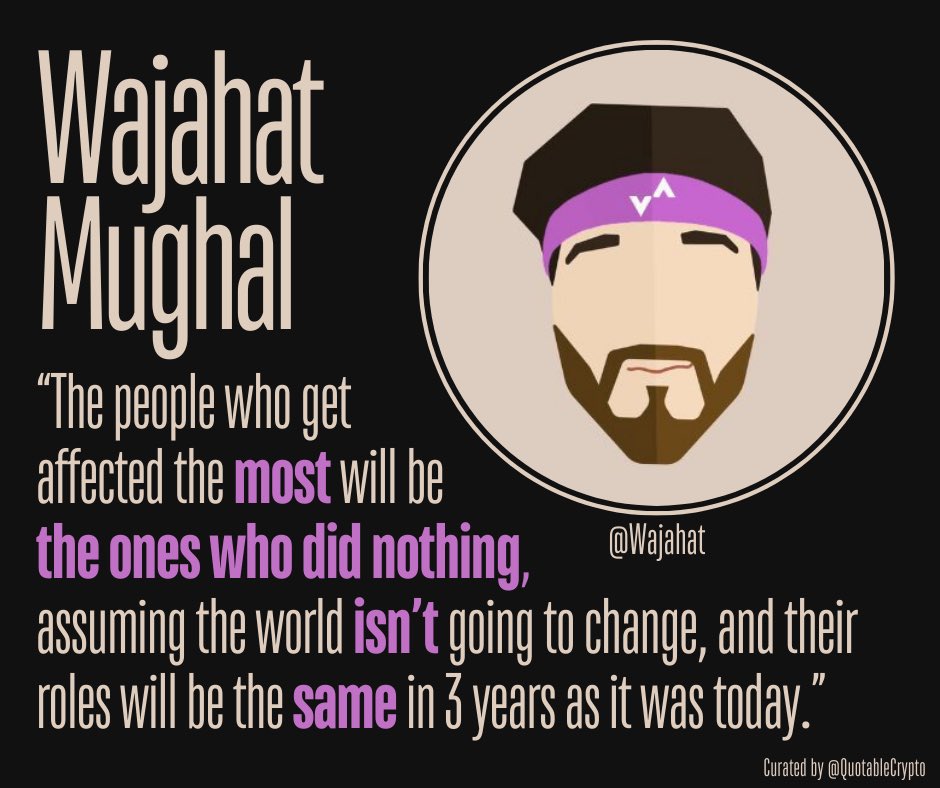
Best antidote to the viral @CitriniZ "2028 Global Intelligence Crisis" piece? It's this @Wajahat "14 Actionable Takes" article...
One of the BEST blueprints I've read...
The good doctor presents two brilliant AI survival playbooks:
• 7 strategies if the Citrini AI nightmare scenario hits hard and fast...
• 7 strategies if Al progress stays steady and gradual...
All 14 are realistic and executable...
Run both plans in parallel and you're positioned stupidly well, no matter which timeline unfolds...
• From his "5-Figure Escape" vids to deep daily DeFi/yield/crypto alpha, CT gigabrain @Wajahat is an absolute MUST-FOLLOW...
For context, read the @Citrini7 article first (linked on page 2), then hit this and PREPARE...
🙏🏻💪🏻QC
Wajahat Mughal@Wajahat
English
@rektdiomedes Get jacked and tan, buy good, hard assets, rinse and repeat, chill
English

Just got done with my daily steps-maxxing...
Found myself ruminating on three main things re: markets over the next 6 months:
1) Does the Israel-Iran thing continue?
and become an ongoing issue like Russia-Ukraine did?
Or does it just quickly recede and be forgotten like so many other similar events over last few years?
2) Does Warsh actually come in and slash interest rates dramatically in May?
This is what Trump says Warsh is supposed to do, and the anticipation has been building up for almost a year now...
But who knows man...
DC and the Trump admin are both such a mess that one can really see all sorts of things happening at this point...
And then...
3) Does polling for the mid-terms get increasingly worse for the GOP?
And does this spook markets?
My supposition has always been that rates move markets uber alles- and if Warsh does slash rates that almost guarantees a bull market for risk assets...
Since it will 'un-freeze' the $38T in US home equity...
and every 50 year old 'Cardano dad' will suddenly have an 80k HELOC or 200k cash-out refi to throw into the markets...
HOWEVER... if it looks like Elizabeth Warren and Maxine Waters and AOC and co are going to be in charge of the House (and maybe even Senate)....
Then I could see stonks getting positively rattled and not performing that well...
And that negatively hurting crypto as well...
So yeah...
Anyway...
Exciting times to be sure lads :)
What do ya'll think?

English
Smokin Ted retweetledi

The Daily Degen - Thursday, March 19th, 2026
Rates, Straights, Homes, Taxes, Macro, Videos, + New Projects! + $BTC, $BNB, $HYPE, $PUMP, and more!
Shout-out to brilliant accounts mentioned with <10k followers (make sure to give them a follow!):
- @pahueg (S-Tier of S-Tier crypto/macro podcaster)
- @crypto_flynn0x (nascent brypto rizzlord + data-poaster)
- @quasimatt (interesting gigabrain that @defidave just interviewed)
And shout-out to new projects highlighted: @AxiymFinance, @reactorworld
And please RT/etc to support!
Link in next tweet 👇

English
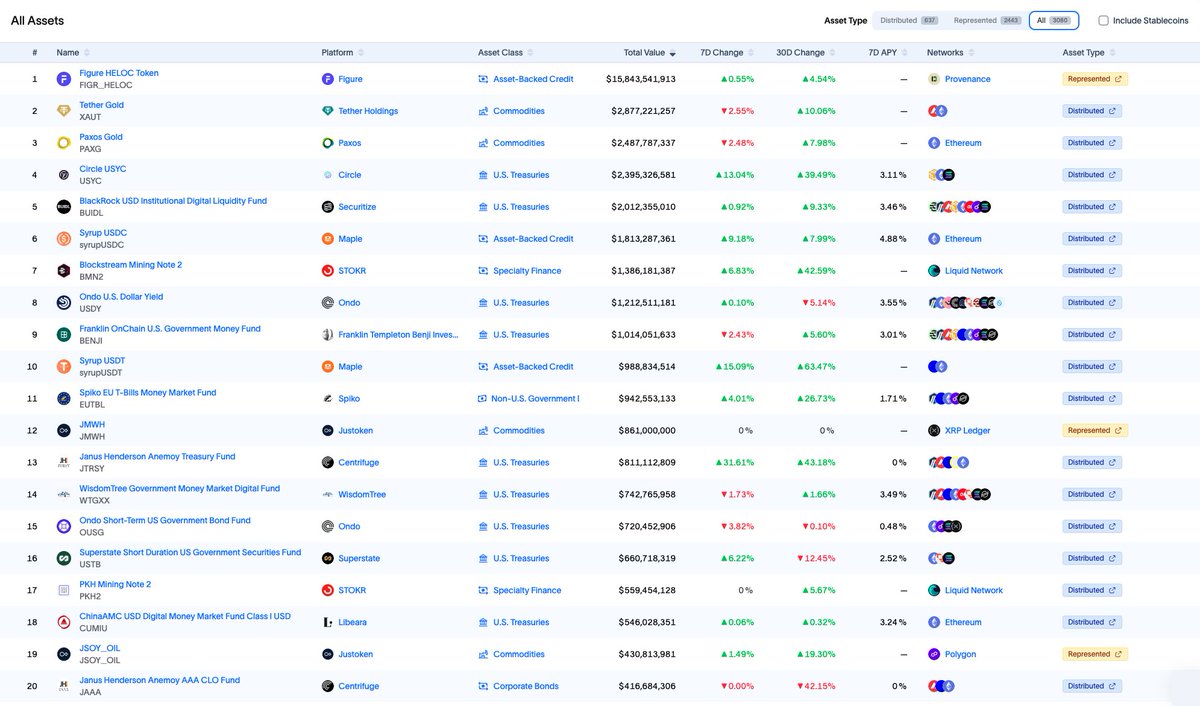
Maple just crossed $2.5B in syrupUSDC & syrupUSDT deposits.
Both @maplefinance dollar yield assets are now in the top 10 RWAs by total value.
h/t @RWA_xyz, the best dashboard to track everything in RWA.
Maple@maplefinance
$1.7B+ for syrupUSDC and $860M+ for syrupUSDT. First, syrupUSDC and syrupUSDT crossed $2.5B in combined deposits. Now, both dollar yield assets have set new individual deposit ATHs.
English

How to make winning easy:
→ Go to the gym.
→ Walk more + HIIT workouts.
→ Eat real food.
→ Be an eternal optimist.
→ Get more sunlight.
→ Buy Bitcoin.
→ Take more risk.
→ Become energetic (improve metabolic health).
→ Have irrational self-confidence.
→ Never stop trying.
→ Stop caring about others' opinions.
→ Start doing breath work.
→ Never doom.
→ Know your worth.
→ Put real effort towards achieving a goal.
→ Be honest with yourself.
→ Don't take life too seriously.
→ Be more spontaneous.
→ Stop watching the news.
→ Find something you truly enjoy.
→ Use Notebooklm + Gemini to do deep research.
→ Take action.
→ Stop having limiting beliefs.
→ Believe you're the luckiest person in the world.
→ Follow @hooeem to learn more about AI, going viral, and how to turn screen time into cash flow.
→ Follow @digiii to become a delusional optimist.
→ Follow @conductr_ to improve your mindset.
→ Follow @rektdiomedes for crypto/macro updates and gym/lifestyle advice.
→ Follow @basedethos for breath work.
→ Follow @metabolic_print for metabolic supremacy.
→ Follow @NEVERDOOMPRO so he can brainwash you to believe in yourself.
→ Follow @vivereveritas to become a white-pilled giga chad.
→ Follow @thebeautyofsaas for a blueprint to becoming successful.
Congrats! You're ready to receive an unlimited amount of W's.
WE'RE ALL GONNA MAKE IT BRAAAAHS
English

Market's looking good enough to start farming again
Looping strats now take ~33% of all $ETH lending activities, but the next apex asset for looping yields is ready to take over ↓
#RWA have been developing good infrastructure and liquidity to make good yields possible without sacrificing security and stablecoin pegs
They're more reliable than ETH's volatility and offer yield sources from outside the crypto market
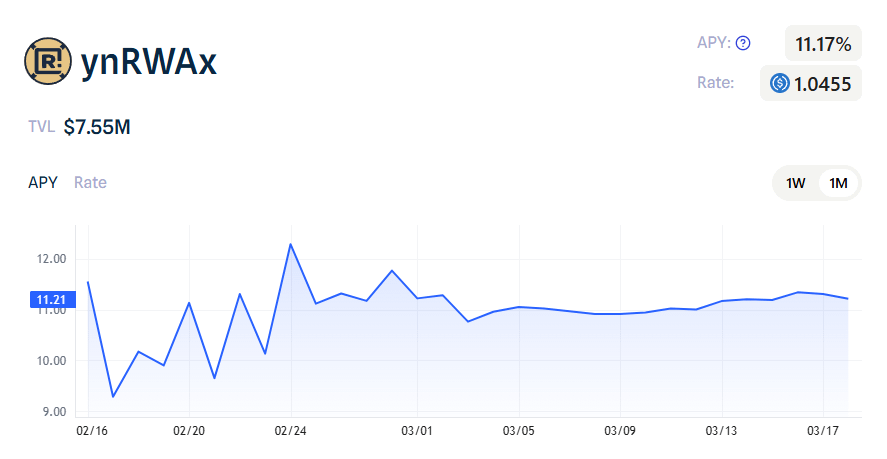
Live on @YieldNestFi and managed by Kimber Capital, you can get $ynRWAx by depositing $USDC
The current APY is around 11% and the source of the yield comes from mortgage-backed private credit on T1 Australian Real Estate
The yield automatically compounds and is ERC-4626 compliant
That means you can plug directly into DeFi lending markets
You can find the base yield here ↓
app.yieldnest.finance/token/ynRWAx
📈 The Degen option
Yes, you can take on looping strats here as well (11% APR is already pretty good by itself, but you know how degens work 👀)
For example, you can use @eulerfinance V2's one-click Multiply feature to loop ynRWAx, using flash loans strategies 👇
app.euler.finance/positions/0x69…
The maximum multiplier you can reach is slightly above 9x, bringing the total ROE to over 120%, but that's all on your own risk
You can obviously play it safer and use a 2/3x lev here, especially if you have a bigger size
Other #DeFi options to amplify the yield can be found on:
- @Morpho
- @pendle_fi
- @spectra_finance
If you're holding a chunk of your portfolio in stable, I suggest thinking about moving a % to this type of vaults
I'm using the basic ynRWAx vault for now, but I'm studying a looping expansion for my portfolio as well
The risk levels here are much lower than with any regular crypto asset and keeping idle stables just feels like an eternal bleed to inflation
If you're curious about how ynRWAx works and want to dive deeper into the details of the vault strategy, you can read the article below 👇
@yieldnest/ynrwax-looping-capture-the-spread-between-real-world-yield-and-defi-borrow-rates-269de9395cc9" target="_blank" rel="nofollow noopener">medium.com/@yieldnest/ynr…
YieldNest@YieldNestFi
1/ Looping makes up ~1/3 of all Ethereum lending activity. Most of it is staked ETH and stablecoins. RWA looping is next, and it changes everything. It’s the biggest DeFi strategy most people still aren’t talking about. Here’s how it works and how ynRWAx fits in 🧵
English