Blair Jensen

8.8K posts

Blair Jensen banner
Blair Jensen

Blair Jensen

@_TradeFollowers

Commentary on fintwit. Don't be offended if I don't agree with you because disagreement is what makes a market.

Katılım Mart 2014
679 Takip Edilen1.6K Takipçiler
Blair Jensen retweetledi
Alan Cohen
Alan Cohen@al_xdpg·
$QQQ We are oversold enough for a good bounce but this chart says we may test the Early 2025 high. The Andrews Pitchfork starts in Jan 2023. The lower tine would be as good a target for this correction as any. I don't do Macro but the bottom isn't today (no guarantees).
Alan Cohen tweet media
English
4
4
47
3K
Blair Jensen retweetledi
Alan Cohen
Alan Cohen@al_xdpg·
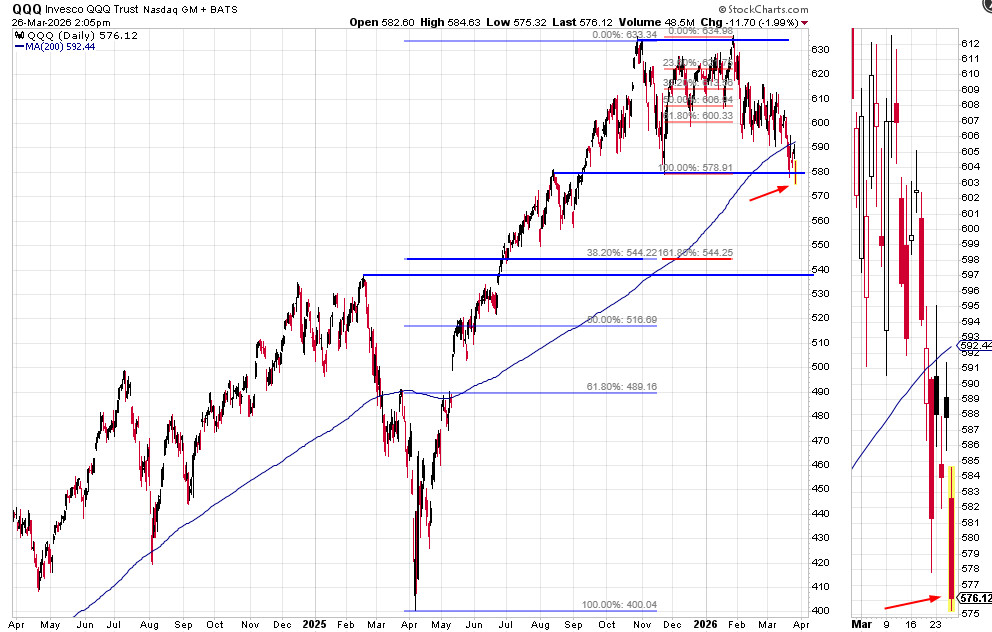
$QQQ As I've posted, I'm sitting in cash and looking for signs of a bottom. Not today. In fact, am open to much more downside action. Fib Extensions(red) and 38.2% Retracement (Blue) projections point to ~540 area or ~7% lower. The kids aren't used to this happening fast. Watch.
Alan Cohen tweet media
English
7
8
63
4.5K
Blair Jensen retweetledi
Alan Cohen
Alan Cohen@al_xdpg·
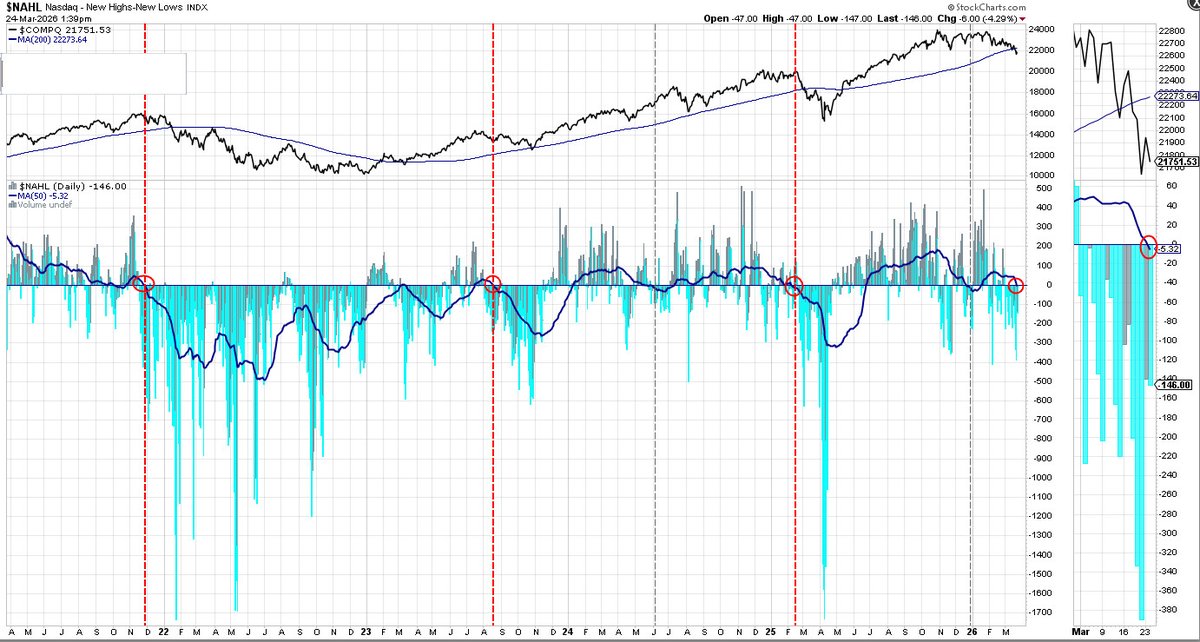
$COMPQ Ignoring the news (yah/sure!), this chart says breadth has deteriorated to a level that risks significantly more selling pressure. No predictions here. Just watching the grass grow.
Alan Cohen tweet media
English
6
6
40
1.8K
Blair Jensen retweetledi
Eddy Elfenbein
Eddy Elfenbein@EddyElfenbein·
Today is the day I’ll take something fun and ruin it with math! Who’s with me? We’re in the middle of the NCAA basketball tournament. Most brackets are scored linearly, but here’s the big secret -- basketball teams generally follow a Power Law distribution. Simply put, this means that the difference in quality of teams tends to get small the lower you go. In practical terms, this means the #1 seed is really, really good. The quality difference between #2 and #3 tends to be smaller than the difference between #1 and #2. This continues through the entire bracket. How can we see this in action? A good example is the betters favorite, the #12 vs #5 game. Despite the difference of seven places, the teams aren’t that far apart. Historically, #12 wins about 35% of the time. It’s an upset but a pretty minor one. Interestingly, that’s close to the record of #3 against #1 (36%). In other words, the implied quality difference between those two spots is about the same difference with the seven spots between #5 and #12. That’s the Power Law in action. For basketball fans, the Power Law means avoiding the #1 as long as you can, or hope they get knocked out early. Earlier I mentioned the #12 seed. They’ve made it to the Sweet Sixteen, 22 times and 20 times they’ve face off against #1. They’ve lost every single time. The Power Law means the worst seed is #8 or #9. That means you have a very hard time getting to the Sweet 16 because you face #1 in round 2. #1 has beaten #9, 92% of the time. The best seed is #11, Why? Because you avoid #1 for a long time. Assuming the higher seed wins, #11 plays #6, then #3, then #2, then #1. Here’s the most remarkable stat. #11 has made to the Final Four more than #16, #15, #14, #13, #12, #10, #9, #8 and #7. #11 is tied with #6 and since they play each other in the first round which means #6 follows the same course as #11. The NFL avoids these issues because it “reseeds” its playoffs. Personally, I prefer how March Madness does it.
English
5
7
44
5.4K
Blair Jensen
Blair Jensen@_TradeFollowers·
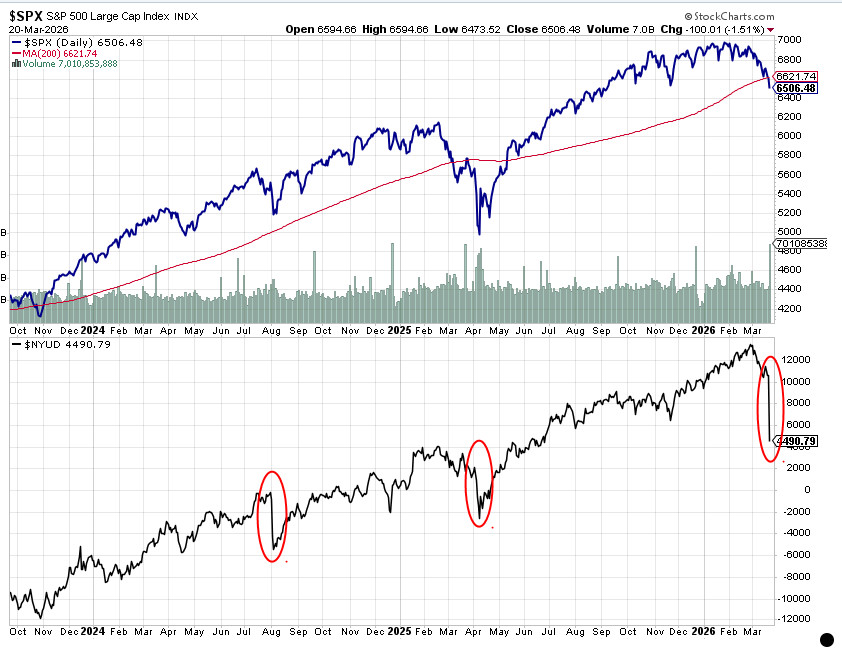
@al_xdpg Alan love your work. However, NYUD data gets adjusted the next market day. So it won't look nearly as bad a few hours into tomorrow's session.
English
1
0
2
97
Jeffrey Christian’s Wig
Jeffrey Christian’s Wig@silver207141·
St. Oliver's Prophecies that have all come true: 1987 (Black Monday): Anticipated and positioned for the stock market crash using early momentum tools. Met: Called the crash ahead of price confirmation, solidifying his methodology shift. 1993, 1995 (S&P pivots): Flagged major structural turns in equities (tops/bottoms). Met: Accurate calls on S&P momentum shifts per long-term track record. 2000 (Dot-com bubble top): Issued sell signals on Nasdaq/tech equities at the peak. Met: Momentum broke structures first; positioned bearish as the collapse began. 2000 (Commodity top): Identified momentum failures in broad commodities. Met: Aligned with end of mini-bull phase before multi-year bear. 2002 (Equity bottom): Caught S&P low post-dot-com crash. Met: Early entry signal via momentum rebuild. 2007–2008 (Financial crisis top): Warned of major equity top (paralleling 2000). Met: Internal momentum failure preceded GFC crash; bearish positioning paid off. 2008–2009 (Equity bottom): Flagged S&P low amid crisis. Met: Structural rebound signal for post-crisis bull start. 2011 (Silver top): Turned bearish post ~$50 high when annual momentum hit ceiling. Met: Signaled end of bull; silver entered multi-year bear without reclaiming highs for over a decade. 2012 (Gold top): Bearish on gold after 2011 highs blew momentum structures. Met: Preceded multi-year decline to 2015–2016 lows. 2014–2016 (Oil bottom): Caught structural low in oil post-crash from $100+. Met: Positioned for rebound in energy cycle. 2015–2016 (Gold secular low): Flagged gold bottom. Met: Early bullish signal for long-term metals bull. August 2020 (Commodity breakout): Highlighted momentum-driven commodity surge. Met: Caught post-COVID reflation rally early. September 2020 (Natural gas breakout): Called structural breakout. Met: Aligned with sharp NG rally. January/February 2022 (Stock market top): Warned of major equity top (echoing 2000/2007). Met: Preceded sharp corrections that year. September 2025: Called for silver >$100 in Q1 2026. Met: Silver crossed $100 in January 2026. November 2025: Scrapped $60–$70 year-end target; updated to $100–$200 within two quarters (by ~May 2026). Met/exceeded: Silver hit $121+ in January 2026. June 2025 (third test of ~$35 level): Called for acceleration/breakout. Met: Silver broke to $37+ in June 2025, then surged higher through year-end. August 2025 (silver ~$37): Forecast $60–$70 by end-2025. Exceeded: Silver closed 2025 ~$71–$72 (intraday near $83). Current prophecy: $300–$500 per ounce, potentially as soon as this summer. Amen
English
2
2
22
1.3K
Blair Jensen
Blair Jensen@_TradeFollowers·
@seth_fin Why not both? That's served me well the last several years.
English
0
0
0
76
Crypto Seth
Crypto Seth@seth_fin·
You get $1,000,000 in Bitcoin or Gold, but you have to hold for 10 years. What do you choose? #Bitcoin or #Gold
English
19
3
30
10.2K
Blair Jensen retweetledi
Alan Cohen
Alan Cohen@al_xdpg·
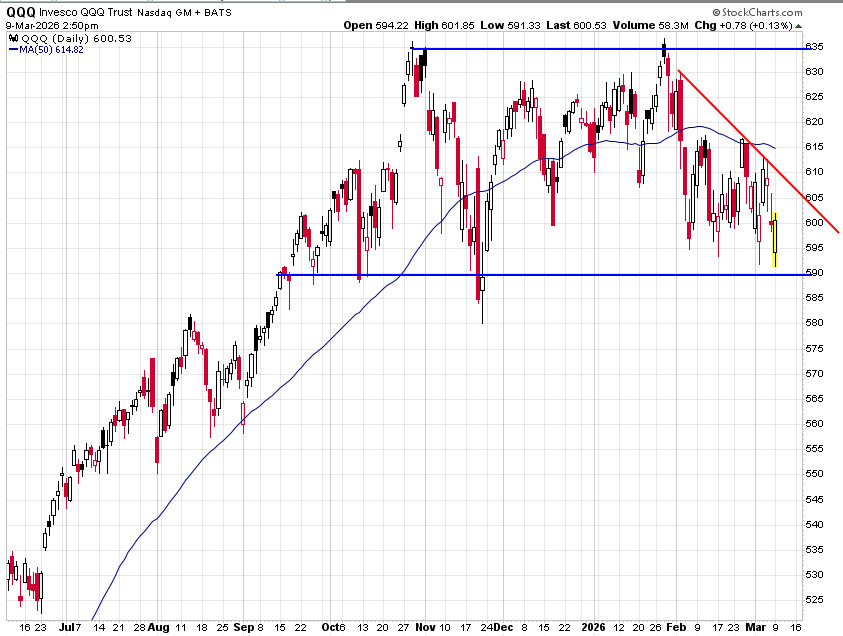
$QQQ OK, U R out so you gotta be thinking about getting back in. Right? I'm not interested in even thinking about it till the DTL is broken, then maybe more in with clearing the 50d MA & maybe the 100d MA as well. The trading range still rules in spite of the Geopolitics. Stay tuned.
Alan Cohen tweet media
English
2
4
47
6.3K
Blair Jensen retweetledi
Alan Cohen
Alan Cohen@al_xdpg·
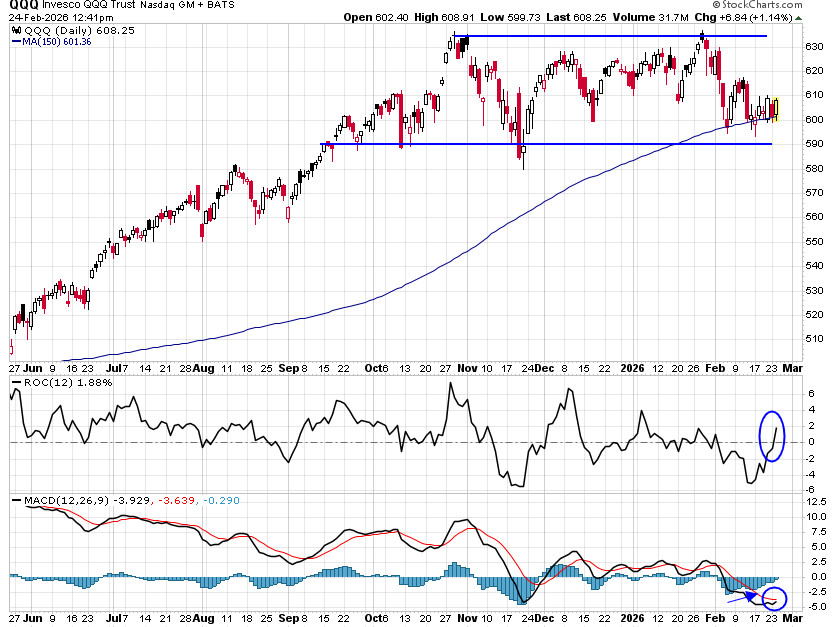
$QQQ This trading range will end when we break those blue lines with confirmation. Till then up & down. Right now we are set up for an up. Watch the ROC to stay above 0 and MACD to cross pos. Nice little divergence too (RSI too).
Alan Cohen tweet media
English
2
10
69
4.4K
Blair Jensen retweetledi
Tom McClellan
Tom McClellan@McClellanOsc·
Not necessarily. The Nasdaq has more listed stocks, but its A-D Line has such a bearish bias that it is functionally unusable on its own. You can get insights by looking at the acceleration in Nasdaq A-D data, which is what the McClellan Oscillator does.
XnO@fundandtechy

@McClellanOsc The more constituents in the pool, the more accurate the A-D line?

English
5
4
52
11.7K
Blair Jensen retweetledi
Tom McClellan
Tom McClellan@McClellanOsc·
The problem historically is that the SP500 stocks’ A-D Line does not do a very good job of showing bearish divergences when you would want that message. The NYSE A-D does better in that regard. The reason for this difference is that SP500 stocks are the varsity stars. When illiquidity starts to become a problem, it affects the weak stocks first (canary principle). So looking at a list of stocks with no canaries does not get you that message as well.
Ryan Detrick, CMT@RyanDetrick

More new highs in the S&P 500 advance/decline line suggests price will follow. They keep talking about Hindenburg, but this says continue to ignore them.

English
28
53
481
83.1K
Blair Jensen retweetledi
TheBronxViking
TheBronxViking@TheBronxViking·
Jesus Christ, how are you looking at this chart and saying the elevated put/call ratio PRECEDES a dump? 💀🤦‍♂️ He’s reading it completely backwards. Look at every circled instance: • The P/C spike happens into or right after the selloff • Those spikes line up with local lows, not tops • After each spike, SPX goes on to make higher highs So the actual sequence on this chart is: P/C spike → panic/hedging peaks → selling exhausts → SPX rebounds That’s textbook contrarian sentiment, not a topping signal. And the dealer-flow explanation is way too simplistic: • High put/call ≠ dealers automatically short puts in a way that forces selling • Hedging depends on net gamma, strikes, DTE, and vol regime • Most spikes happen because traders are buying protection after the drop, not before it Historically: • High P/C = fear = closer to bottoms • Low P/C = complacency = closer to tops If you’re looking for a bearish sentiment extreme, you don’t want everyone buying puts. You want nobody buying puts. And to be clear—I’ve seen plenty of solid data and arguments showing the market could be distributing and a sharp pullback is possible. This just isn’t one of them. This chart isn’t a warning of an imminent collapse. It’s a highlight reel of panic spikes that preceded rebounds, not tops.
Wimar.X@DefiWimar

🚨 THIS IS VERY, VERY BAD!! Look at the chart below. It's the S&P 500 vs the put/call ratio. Am I the only one who sees the same pattern? Jan 2024, P/C Ratio: 1.2 → S&P DUMP Apr 2024, P/C Ratio: 1.2 → S&P DUMP Aug 2024, P/C Ratio: 1.1 → S&P DUMP Apr 2025, P/C Ratio: 1.1 → S&P DUMP Not once. EVERY FOKIN TIME. And now the put-call ratio is back near a new high at ~1.1, but the S&P is still flat. Here's the direct connection, in simple words. When the put-call ratio jumps, it means people are buying WAY more puts than calls. And somebody has to sell those puts. That's usually dealers and market makers. So dealers get stuck SHORT puts. And when you're short puts, you hedge one way. You SELL S&P exposure. Futures. ETFs. Baskets. Whatever is liquid. So the flow is simple: More puts bought → dealers sell S&P to hedge → S&P loses support → S&P rolls over. And now the ratio is back at the HIGHEST level since the Liberation Day crash. So the setup is simple. - If the ratio stays high, the selling pressure stays on the S&P. - If the S&P slips, the hedging gets worse and it can turn into a feedback loop. I’ve studied macro for 10 years and I called almost every major market top, including the October BTC ATH. Follow and turn notifications on. I’ll post the warning BEFORE it hits the headlines.

English
38
17
285
40.2K
Blair Jensen retweetledi
Tom McClellan
Tom McClellan@McClellanOsc·
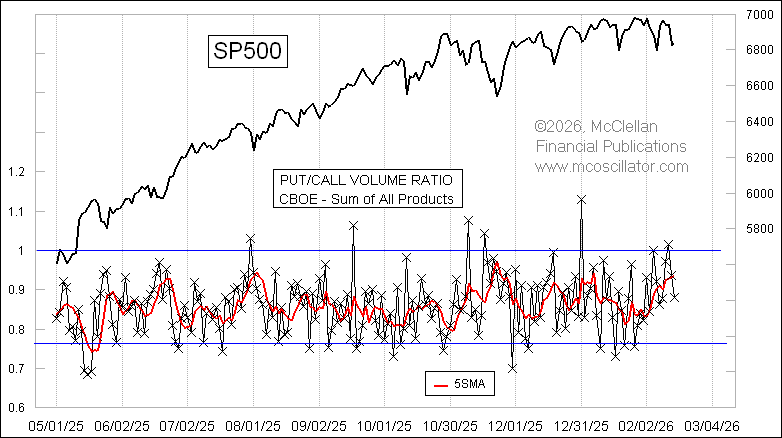
Settle down. First, the actual Put/Call Ratio did not get to 1.1, at least not in the final data. The CBOE often revises the preliminary data, which is of course very frustrating. The highest number in the final data was 1.01 on Feb. 11. Second, these high numbers are markers of price bottoms, not warnings of trouble coming. They appear when trouble is already climaxing.
Tom McClellan tweet media
Wimar.X@DefiWimar

🚨 THIS IS VERY, VERY BAD!! Look at the chart below. It's the S&P 500 vs the put/call ratio. Am I the only one who sees the same pattern? Jan 2024, P/C Ratio: 1.2 → S&P DUMP Apr 2024, P/C Ratio: 1.2 → S&P DUMP Aug 2024, P/C Ratio: 1.1 → S&P DUMP Apr 2025, P/C Ratio: 1.1 → S&P DUMP Not once. EVERY FOKIN TIME. And now the put-call ratio is back near a new high at ~1.1, but the S&P is still flat. Here's the direct connection, in simple words. When the put-call ratio jumps, it means people are buying WAY more puts than calls. And somebody has to sell those puts. That's usually dealers and market makers. So dealers get stuck SHORT puts. And when you're short puts, you hedge one way. You SELL S&P exposure. Futures. ETFs. Baskets. Whatever is liquid. So the flow is simple: More puts bought → dealers sell S&P to hedge → S&P loses support → S&P rolls over. And now the ratio is back at the HIGHEST level since the Liberation Day crash. So the setup is simple. - If the ratio stays high, the selling pressure stays on the S&P. - If the S&P slips, the hedging gets worse and it can turn into a feedback loop. I’ve studied macro for 10 years and I called almost every major market top, including the October BTC ATH. Follow and turn notifications on. I’ll post the warning BEFORE it hits the headlines.

English
40
87
623
116.3K
Blair Jensen retweetledi
₿rett
₿rett@brettmacro·
Outside of printing trillions of $ during QE in 2020, Bitcoin has never bottomed with a large unfilled wick on the weekly. The structure looks very similar to 2022 after Bitcoin broke down from the bear flag, dumped below the 2021 low, and consolidated for a few weeks.
₿rett tweet media
₿rett@brettmacro

I think the 8 months of chop in 2024, plus the 2021 cycle top(s), will provide some resistance for Bitcoin before its next move. Notice what happened during the last bear market when Bitcoin found resistance at the 2017 top.

English
23
22
137
20.7K