Syed Mehar

2.9K posts

Syed Mehar banner
Syed Mehar

Syed Mehar

@__Mehar__

Kasher Kour | Medical Student 💉 | Writer | 👀 In Search of peace☮️ | Study To Save Lives✌️

Jammu And Kashmir, India Katılım Haziran 2020
450 Takip Edilen781 Takipçiler
Syed Mehar
Syed Mehar@__Mehar__·
Pakistan Exposed. #bbvipal5 #dior #الكويت #صفارات_الإنذار
Pakistan Reality Check@PakRealityCheck

BREAKING: The street power of Imran Khan’s camp does not disappear it erupts. Violence outside Adiala Jail in Rawalpindi is yet another reminder that Pakistan’s political crisis is not cooling down, it is rotting from the inside. What we are witnessing is not just a protest. It is the collapse of state credibility. When a country jails its most powerful opposition figure, blocks access, suppresses dissent, and then acts shocked when supporters pour into the streets, it only exposes one truth: Pakistan is no longer being governed through confidence. It is being managed through fear, barricades, and force. Adiala Jail has now become more than a prison. It has become a symbol of Pakistan’s broken system where institutions are weaponised, where law is applied selectively, and where every crackdown creates even more anger. The regime wants to project control. But scenes of chaos outside the jail send the opposite message to the world: • a frightened establishment, • a restless public, and a political system surviving on coercion instead of legitimacy. This is what happens when politics is pushed into a prison cell. It does not disappear. It spills onto the roads. Pakistan today stands trapped between repression and instability. And every fresh clash outside Adiala Jail is proof that the crisis is not ending it is deepening. #Pakistan #ImranKhan #PTI #AdialaJail #Rawalpindi #PoliticalCrisis #BreakingNews

English
0
0
0
218
Syed Mehar
Syed Mehar@__Mehar__·
Exam Centric Culture. #bbvipal5 #dior #الكويت #صفارات_الإنذار
Kashmir Beyond Myths@KashmirUnfolded

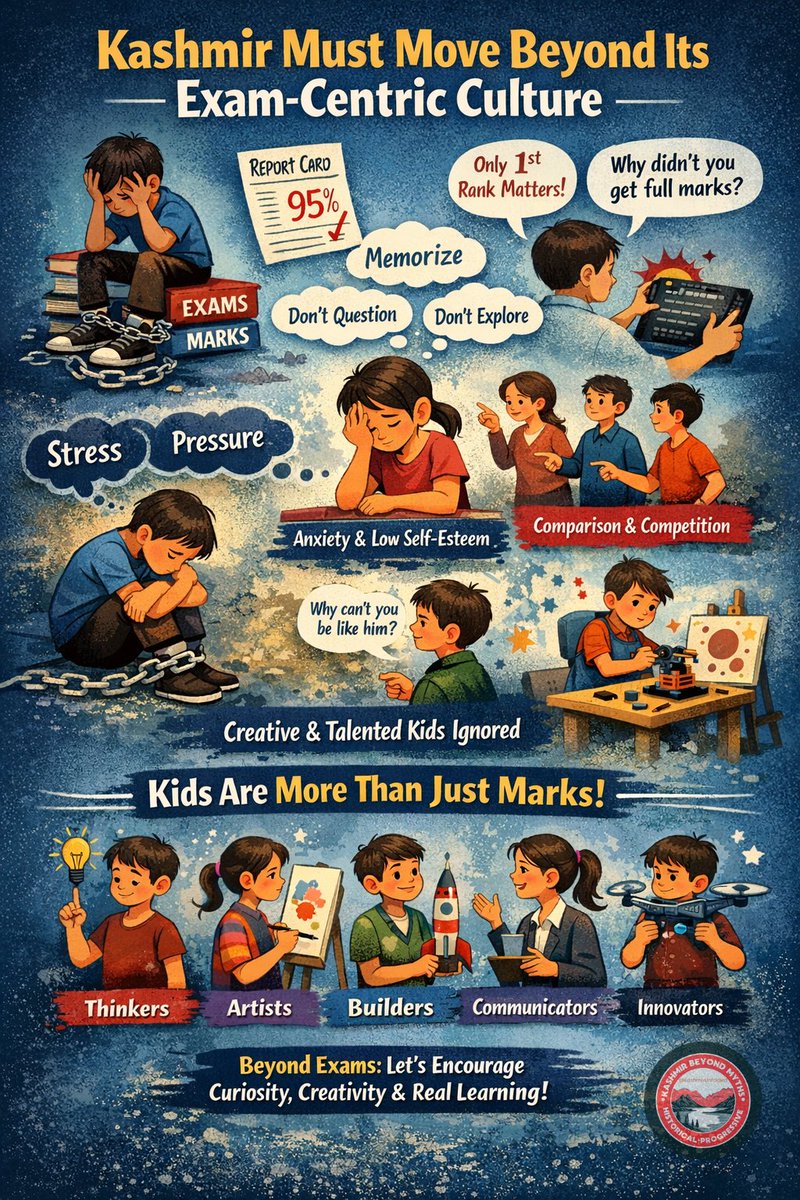
Kashmir must move beyond its exam-centric culture. For far too long, we have taught our children to believe that marks are everything, that a report card defines intelligence, and that success begins and ends with competitive exams. But this culture is not building confident minds. It is building anxious ones. An education system that rewards memorisation more than imagination slowly trains children to fear mistakes, avoid curiosity, and chase approval instead of understanding. The result is visible everywhere: bright students who can reproduce answers under pressure, but struggle to ask questions, think independently, communicate clearly, or explore talents outside textbooks. And the damage does not stop in the classroom. An exam-obsessed culture affects children emotionally, mentally, and socially. It creates constant pressure at home, comparison among relatives, fear of failure, and the dangerous belief that scoring less means being less. Many children grow up carrying silent stress, low self-worth, and the feeling that they are only valuable when they outperform someone else. Not every child is meant to shine in the same way. Some are thinkers. Some are artists. Some are builders. Some are communicators. Some are problem-solvers. Some learn slowly but deeply. Some may never top an exam, yet may go on to create, lead, invent, teach, or transform society in ways marksheets can never measure. This is why experts are now rightly calling for assessments that reward thinking, curiosity, creativity, collaboration, practical understanding, and diverse skills, not just rote recall and exam performance. Kashmir especially needs this shift. Because our children are growing up in a society that already carries emotional and social pressures. The last thing they need is an education culture that narrows their worth to percentages. We need schools that encourage discussion, confidence, innovation, and real-world learning. We need parents who ask children what they learned, not just what they scored. And we need a system that sees education as character-building, not merely rank-producing. Marks matter, but they should not become a child’s identity. A society that only celebrates toppers often ignores thousands of capable young minds who simply learn differently. When we reduce education to exams, we do not just burden children, we waste human potential. The future of Kashmir will not be built only by those who score highest in written tests. It will also be built by those who think differently, solve real problems, create opportunities, and bring new ideas to life. Our education culture must make room for all of them. Because children are not machines built to fill answer sheets. They are minds meant to grow. #Kashmir #Education #Students #ChildDevelopment #ExamPressure #LearningBeyondMarks #KashmirYouth #EducationReform #MentalHealth #FutureOfKashmir


English
0
0
0
814
Syed Mehar retweetledi
The Youth Records
The Youth Records@KmrYouthRecords·
Ep-6 THE CAPTAIN OF CHANGE @NadiyaNighat Nadiya Nighat from Rambagh, Srinagar, turned her love for football into a movement for change. From playing with boys in local Eidgahs as a child and facing social judgment, to becoming Kashmir’s first female football coach, her journey is a story of courage, persistence, and leadership. As the founder of JJ 7 Football Club and an AFC ‘C’ Licensed Coach, she has trained hundreds of girls and opened doors for a new generation of women in football. Nadiya didn’t just break barriers for herself, she created a path for others to follow. Her story is proof that one girl’s determination can inspire an entire community. #NadiyaNighat #KashmiriFootball #WomenInSports #FootballCoach #GirlsInFootball #Srinagar #KashmirRising #TheYouthRecord
English
0
3
14
1.4K
Syed Mehar retweetledi
The Lobby Watch
The Lobby Watch@KmrDiasporaLies·
What diaspora ecosystem tried to sell as the arrest of “five Kashmiri youth” in a case of so-called “state terrorism”. But in reality it was a counter-terror operation against a deep-rooted interstate Lashkar-e-Taiba module. That difference is not minor. It is the entire truth they tried to bury. This is how propaganda ecosystems operate. First, they remove the terror context. Then, they strip away the organisational linkages. Then, they repackage the accused as “innocent youth.” And finally, they market a counter-terror crackdown as proof of oppression. But facts do not disappear because a headline is written to mislead. Reports on the operation said the five arrested included Abdullah alias Abu Hureira, identified as a Pakistani terrorist who had allegedly evaded capture for 16 years, and Usman alias Khubaib, another Pakistani national. The same reporting said the crackdown uncovered interstate operational, logistical and funding linkages tied to the module. That is not a random sweep. That is not victimhood journalism. That is a terror-network investigation. So when a portal hides the LeT connection, hides the Pakistani links, hides the financing trail, and hides the interstate structure of the network, it is no longer reporting. It is editing reality for political effect. Calling such an operation “state terrorism” while conveniently omitting the terror affiliations is not journalism. It is agenda-driven framing. And that is precisely why these narratives must be challenged. Because once the terror link is erased and the propaganda label is inserted, the public is no longer being informed it is being manipulated. The real story here is not the slogan. The real story is that an LeT-linked network was busted. The real story is that the facts were selectively cropped. And the real story is that some online ecosystems continue to survive not on evidence, but on distortion. Truth first. Narrative later. Not the other way around. #Kashmir #KashmirTruth #CounterTerror #TerrorModule #LashkarETaiba #LET #NarrativeWarfare #PropagandaExposed
The Lobby Watch tweet mediaThe Lobby Watch tweet media
English
0
4
15
1.5K
Syed Mehar retweetledi
The Youth Records
The Youth Records@KmrYouthRecords·
From the hills of Pir Panjal to the halls of IIT Jammu, Faisal Javid Kasana has given Poonch a moment of real pride. Hailing from Khanetar and coming from a humble background, Faisal’s journey is a powerful reminder that talent, discipline, and perseverance can take our youth to the highest academic spaces. Being offered a PhD in English Literature at IIT Jammu as a full-time institute scholar is not just a personal milestone, it is an inspiration for the entire region. An alumnus of JNV Surankote and MAM College, with strong research credentials and meaningful work on translating tribal literature into English, Faisal represents the voice, intellect, and promise of Pir Panjal’s young scholars. Heartiest congratulations to him on this remarkable achievement. May his journey inspire many more students, especially from tribal and rural communities, to dream bigger and aim higher. #FaisalJavidKasana #IITJammu #Poonch #PirPanjal #KashmirYouth #JKYouth #EnglishLiterature #AcademicExcellence #Inspiration #YouthAchievement
The Youth Records tweet media
English
0
6
16
816
Syed Mehar retweetledi
Pakistan Reality Check
Pakistan Reality Check@PakRealityCheck·
BREAKING: The street power of Imran Khan’s camp does not disappear it erupts. Violence outside Adiala Jail in Rawalpindi is yet another reminder that Pakistan’s political crisis is not cooling down, it is rotting from the inside. What we are witnessing is not just a protest. It is the collapse of state credibility. When a country jails its most powerful opposition figure, blocks access, suppresses dissent, and then acts shocked when supporters pour into the streets, it only exposes one truth: Pakistan is no longer being governed through confidence. It is being managed through fear, barricades, and force. Adiala Jail has now become more than a prison. It has become a symbol of Pakistan’s broken system where institutions are weaponised, where law is applied selectively, and where every crackdown creates even more anger. The regime wants to project control. But scenes of chaos outside the jail send the opposite message to the world: • a frightened establishment, • a restless public, and a political system surviving on coercion instead of legitimacy. This is what happens when politics is pushed into a prison cell. It does not disappear. It spills onto the roads. Pakistan today stands trapped between repression and instability. And every fresh clash outside Adiala Jail is proof that the crisis is not ending it is deepening. #Pakistan #ImranKhan #PTI #AdialaJail #Rawalpindi #PoliticalCrisis #BreakingNews
English
1
5
23
2.4K
Syed Mehar
Syed Mehar@__Mehar__·
Peace should be appreciated But why does @MehboobaMufti always sound more eager to polish Pakistan’s image than to question its long record in the region? That instinct is not accidental. It is political @IltijaMufti_ @parawahid @buttkout @Junaid_Mattu @imrankehwah @AdvocateAhra
Siyasat-e-Sach@centerlinekmr

Mehbooba Mufti has once again shown how reflexively she reaches for political language that ends up flattering Pakistan. After the recent ceasefire around the Iran-US crisis, she welcomed the development and publicly said Pakistan’s role in securing it was “far greater than expected.” At a time when Pakistan is itself trying to project diplomatic relevance, that kind of political endorsement does not look accidental. It looks consistent with a pattern. Pakistan has in fact been reported as mediating between Washington and Tehran in the latest crisis, with Reuters and AP both noting Islamabad’s role in pushing a ceasefire framework and talks. And that is the real issue. Mehbooba Mufti never seems to miss an opportunity to frame Pakistan in a favourable light, even when caution, balance and political sobriety would have served her better. This is not the language of a leader exercising strategic restraint. It is the language of someone who appears far too eager to validate Pakistan’s relevance whenever the opportunity presents itself. The pattern is not new. In May 2025, when India and Pakistan reached a ceasefire understanding, she publicly thanked Donald Trump for intervening and also congratulated Pakistan alongside India’s leadership. On that occasion too, the instinct was revealing: instead of centring India’s security position, she moved quickly toward language that normalized praise for Pakistan. This is why her latest statement deserves scrutiny. A serious political leader from Jammu & Kashmir should understand the weight of words. Public praise for Pakistan is never politically neutral in this region. It carries symbolism. It sends signals. And it reinforces the impression that for some leaders, Pakistan must always be kept politically indulged, verbally accommodated, or emotionally reassured. That is not diplomacy. That is political conditioning. One may welcome de-escalation. One may support peace. One may even appreciate diplomacy in principle. But there is a difference between supporting peace and repeatedly finding occasions to polish Pakistan’s image. Mehbooba Mufti seems unable to recognize that difference. Or worse, she recognizes it and chooses the same line anyway. For the people of J&K, this should raise a larger question: why does she so often sound more comfortable praising Pakistan’s supposed role than holding Pakistan accountable for the instability, violence and damage its policies have inflicted on this region for decades? That is where the discomfort begins. Because when a politician repeatedly leans into narratives that elevate Pakistan, the public is entitled to ask whether this is just rhetoric or a deeper political instinct she has never truly abandoned. Peace should be welcomed. War should be avoided. But Pakistan does not need political public relations from Kashmir’s mainstream leaders. And yet, Mehbooba Mufti keeps volunteering for the role.

English
0
0
1
46
Syed Mehar retweetledi
Siyasat-e-Sach
Siyasat-e-Sach@centerlinekmr·
Mehbooba Mufti has once again shown how reflexively she reaches for political language that ends up flattering Pakistan. After the recent ceasefire around the Iran-US crisis, she welcomed the development and publicly said Pakistan’s role in securing it was “far greater than expected.” At a time when Pakistan is itself trying to project diplomatic relevance, that kind of political endorsement does not look accidental. It looks consistent with a pattern. Pakistan has in fact been reported as mediating between Washington and Tehran in the latest crisis, with Reuters and AP both noting Islamabad’s role in pushing a ceasefire framework and talks. And that is the real issue. Mehbooba Mufti never seems to miss an opportunity to frame Pakistan in a favourable light, even when caution, balance and political sobriety would have served her better. This is not the language of a leader exercising strategic restraint. It is the language of someone who appears far too eager to validate Pakistan’s relevance whenever the opportunity presents itself. The pattern is not new. In May 2025, when India and Pakistan reached a ceasefire understanding, she publicly thanked Donald Trump for intervening and also congratulated Pakistan alongside India’s leadership. On that occasion too, the instinct was revealing: instead of centring India’s security position, she moved quickly toward language that normalized praise for Pakistan. This is why her latest statement deserves scrutiny. A serious political leader from Jammu & Kashmir should understand the weight of words. Public praise for Pakistan is never politically neutral in this region. It carries symbolism. It sends signals. And it reinforces the impression that for some leaders, Pakistan must always be kept politically indulged, verbally accommodated, or emotionally reassured. That is not diplomacy. That is political conditioning. One may welcome de-escalation. One may support peace. One may even appreciate diplomacy in principle. But there is a difference between supporting peace and repeatedly finding occasions to polish Pakistan’s image. Mehbooba Mufti seems unable to recognize that difference. Or worse, she recognizes it and chooses the same line anyway. For the people of J&K, this should raise a larger question: why does she so often sound more comfortable praising Pakistan’s supposed role than holding Pakistan accountable for the instability, violence and damage its policies have inflicted on this region for decades? That is where the discomfort begins. Because when a politician repeatedly leans into narratives that elevate Pakistan, the public is entitled to ask whether this is just rhetoric or a deeper political instinct she has never truly abandoned. Peace should be welcomed. War should be avoided. But Pakistan does not need political public relations from Kashmir’s mainstream leaders. And yet, Mehbooba Mufti keeps volunteering for the role.
Siyasat-e-Sach tweet media
English
0
2
12
1.6K
Syed Mehar retweetledi
Pakistan-China Faultline Focus
PoJK is no longer just a disputed territory under Pakistan’s control, it is increasingly being seen as a hub of terror infrastructure, especially for Lashkar-e-Taiba. The UN identifies LeT as a Pakistan-based terrorist organisation, and after the 2025 Pahalgam attack, India said it struck LeT/JeM-linked sites in Pakistan and Pakistan occupied Kashmir during Operation Sindoor. Pakistan denied the allegations, but the pattern is what matters: terror networks do not keep resurfacing around PoJK by accident.
English
1
11
17
1.5K
Syed Mehar retweetledi
Kashmir Beyond Myths
Kashmir Beyond Myths@KashmirUnfolded·
Kashmir must move beyond its exam-centric culture. For far too long, we have taught our children to believe that marks are everything, that a report card defines intelligence, and that success begins and ends with competitive exams. But this culture is not building confident minds. It is building anxious ones. An education system that rewards memorisation more than imagination slowly trains children to fear mistakes, avoid curiosity, and chase approval instead of understanding. The result is visible everywhere: bright students who can reproduce answers under pressure, but struggle to ask questions, think independently, communicate clearly, or explore talents outside textbooks. And the damage does not stop in the classroom. An exam-obsessed culture affects children emotionally, mentally, and socially. It creates constant pressure at home, comparison among relatives, fear of failure, and the dangerous belief that scoring less means being less. Many children grow up carrying silent stress, low self-worth, and the feeling that they are only valuable when they outperform someone else. Not every child is meant to shine in the same way. Some are thinkers. Some are artists. Some are builders. Some are communicators. Some are problem-solvers. Some learn slowly but deeply. Some may never top an exam, yet may go on to create, lead, invent, teach, or transform society in ways marksheets can never measure. This is why experts are now rightly calling for assessments that reward thinking, curiosity, creativity, collaboration, practical understanding, and diverse skills, not just rote recall and exam performance. Kashmir especially needs this shift. Because our children are growing up in a society that already carries emotional and social pressures. The last thing they need is an education culture that narrows their worth to percentages. We need schools that encourage discussion, confidence, innovation, and real-world learning. We need parents who ask children what they learned, not just what they scored. And we need a system that sees education as character-building, not merely rank-producing. Marks matter, but they should not become a child’s identity. A society that only celebrates toppers often ignores thousands of capable young minds who simply learn differently. When we reduce education to exams, we do not just burden children, we waste human potential. The future of Kashmir will not be built only by those who score highest in written tests. It will also be built by those who think differently, solve real problems, create opportunities, and bring new ideas to life. Our education culture must make room for all of them. Because children are not machines built to fill answer sheets. They are minds meant to grow. #Kashmir #Education #Students #ChildDevelopment #ExamPressure #LearningBeyondMarks #KashmirYouth #EducationReform #MentalHealth #FutureOfKashmir
Kashmir Beyond Myths tweet media
English
0
3
15
1.3K
Ajay Krishna 🇮🇳
Ajay Krishna 🇮🇳@AjayKrishna_IND·
@ConflictStories The failure to strengthen the @BSF_India is costing us dearly. The BSF has just 270000 personnel to guard nearly 7500 km of border with both Pakistan and Bangladesh. This is grossly inadequate to counter the combined threat of terrorism from PAK and illegal immigrants from BGD.
English
1
1
3
782
Kashmir Conflict Stories
Kashmir Conflict Stories@ConflictStories·
PAK’S UNDERGROUND TERROR EMPIRE BUSTED! Security forces uncover 22 cross-border tunnels dug from Pakistan into Jammu & Kashmir—some 30m deep, 500m long, fortified with "Made in Karachi" sandbags, even equipped with oxygen supplies. Many originate directly from Pakistan Army posts, enabling terrorist infiltration, arms & narcotics smuggling, and covert intelligence gathering. #PakistanTerror #JandKSecurity #IndiaStrong #TunnelBust #BorderSecurity #NationalSecurity @conflictstorie
Kashmir Conflict Stories tweet media
English
68
1.6K
2.9K
58.7K
Syed Mehar
Syed Mehar@__Mehar__·
This is what makes such networks dangerous. They do not survive only through weapons,but through embedding, trust,money movement & social camouflage. Terror becomes harder to detect when it learns to look local @abhijitmajumder @Brahamvakya @FatimaDar_jk @IamTheStory__ @rjvraina
The Kashmir Clarity@Kashmir_Clarity

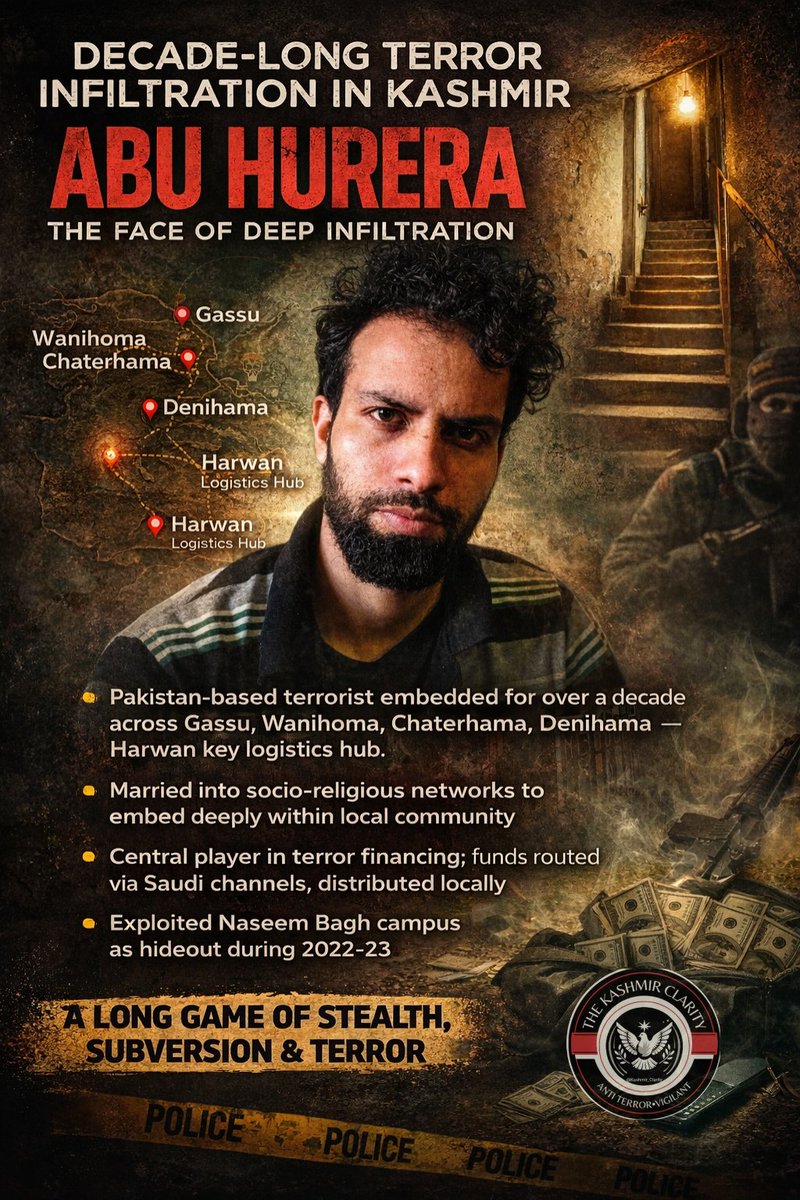
The case of Abu Hurera is a reminder that terrorism in Kashmir was never just about a man crossing a border with a weapon. It was about long-term embedding, social camouflage, financial channels, local shelter and ideological cover. If the details emerging from the investigation are accurate, this was a decade-long infiltration architecture, not a temporary hideout operation. A Pakistani terrorist enters J&K, quietly roots himself across Gassu, Wanihoma, Chaterhama and Danihama, uses Harwan as a logistics hub, builds trust through local embedding and turns residence, relationships and movement into parts of a covert support system. That alone should disturb every serious observer. Because this is how deep terror survives: not only through guns, but through invisibility. Through patience. Through deception. Through networks that look social on the outside and operational on the inside. The reported marriage link into a family associated with Jamaat-e-Islami makes the matter even more revealing. If this was indeed a calculated move to secure legitimacy, proximity and trust, then it shows how terror does not merely infiltrate geography, it tries to infiltrate community psychology. And that is the real danger. Terror stops being only an external threat when it learns to wear a local face. The picture becomes darker still if police findings regarding the network’s alleged involvement in sexual violence and repeated rapes are true. Because then this is not just a terror module. It is a moral sewer, a structure combining armed extremism with predatory criminality. That is one of the great lies of militancy in Kashmir: it was often sold as ideology, but on the ground it frequently degenerated into power abuse, coercion, exploitation and brutality. A gunman who violates women is not a mujahid. He is a criminal protected by fear. A terror network that sustains such men is not political. It is rotten from within. The financing trail is equally important. If funds were routed through Saudi Arabia-linked channels using Hajj and Umrah agents and then distributed locally to sustain operations, it shows once again that terrorism is not sustained only by slogans or indoctrination. It requires money pipelines, trusted intermediaries and logistical discipline. That is why counter-terror work cannot stop at encounters. The real battlefield is also in the shadow network: • the safe houses, • the couriers, • the facilitators, • the foreign money routes, the social legitimacy mechanisms. Even more alarming is the claim that links were cultivated inside Kashmir University, including use of the Naseem Bagh campus as a hideout during police operations. If true, that is not just a security breach. It is an attempt to exploit one of Kashmir’s intellectual spaces as cover for violent underground activity. And that brings us to the bigger truth Terrorism in Kashmir was never sustained by isolation alone. It survived through ecosystems. Homes became shelters. Relationships became cover. Pilgrimage routes became financial channels. Institutions became camouflage. And society was expected to treat all this as resistance. It was not resistance. It was infiltration turned inward. A decade-long network like this, if truly dismantled as reported, should be read as more than one operational success. It should be understood as the exposure of a method: embed locally, deceive deeply, finance quietly, exploit socially and survive invisibly. That is how terrorism tried to outlive public vigilance in Kashmir. And that is why no society can afford softness toward such networks. Because beneath the language of cause, there is often only a machinery of deceit, abuse, money movement and fear.

English
0
1
2
86
Syed Mehar retweetledi
The Kashmir Clarity
The Kashmir Clarity@Kashmir_Clarity·
The case of Abu Hurera is a reminder that terrorism in Kashmir was never just about a man crossing a border with a weapon. It was about long-term embedding, social camouflage, financial channels, local shelter and ideological cover. If the details emerging from the investigation are accurate, this was a decade-long infiltration architecture, not a temporary hideout operation. A Pakistani terrorist enters J&K, quietly roots himself across Gassu, Wanihoma, Chaterhama and Danihama, uses Harwan as a logistics hub, builds trust through local embedding and turns residence, relationships and movement into parts of a covert support system. That alone should disturb every serious observer. Because this is how deep terror survives: not only through guns, but through invisibility. Through patience. Through deception. Through networks that look social on the outside and operational on the inside. The reported marriage link into a family associated with Jamaat-e-Islami makes the matter even more revealing. If this was indeed a calculated move to secure legitimacy, proximity and trust, then it shows how terror does not merely infiltrate geography, it tries to infiltrate community psychology. And that is the real danger. Terror stops being only an external threat when it learns to wear a local face. The picture becomes darker still if police findings regarding the network’s alleged involvement in sexual violence and repeated rapes are true. Because then this is not just a terror module. It is a moral sewer, a structure combining armed extremism with predatory criminality. That is one of the great lies of militancy in Kashmir: it was often sold as ideology, but on the ground it frequently degenerated into power abuse, coercion, exploitation and brutality. A gunman who violates women is not a mujahid. He is a criminal protected by fear. A terror network that sustains such men is not political. It is rotten from within. The financing trail is equally important. If funds were routed through Saudi Arabia-linked channels using Hajj and Umrah agents and then distributed locally to sustain operations, it shows once again that terrorism is not sustained only by slogans or indoctrination. It requires money pipelines, trusted intermediaries and logistical discipline. That is why counter-terror work cannot stop at encounters. The real battlefield is also in the shadow network: • the safe houses, • the couriers, • the facilitators, • the foreign money routes, the social legitimacy mechanisms. Even more alarming is the claim that links were cultivated inside Kashmir University, including use of the Naseem Bagh campus as a hideout during police operations. If true, that is not just a security breach. It is an attempt to exploit one of Kashmir’s intellectual spaces as cover for violent underground activity. And that brings us to the bigger truth Terrorism in Kashmir was never sustained by isolation alone. It survived through ecosystems. Homes became shelters. Relationships became cover. Pilgrimage routes became financial channels. Institutions became camouflage. And society was expected to treat all this as resistance. It was not resistance. It was infiltration turned inward. A decade-long network like this, if truly dismantled as reported, should be read as more than one operational success. It should be understood as the exposure of a method: embed locally, deceive deeply, finance quietly, exploit socially and survive invisibly. That is how terrorism tried to outlive public vigilance in Kashmir. And that is why no society can afford softness toward such networks. Because beneath the language of cause, there is often only a machinery of deceit, abuse, money movement and fear.
The Kashmir Clarity tweet media
English
0
5
19
2.2K
Syed Mehar retweetledi
Pakistan-China Faultline Focus
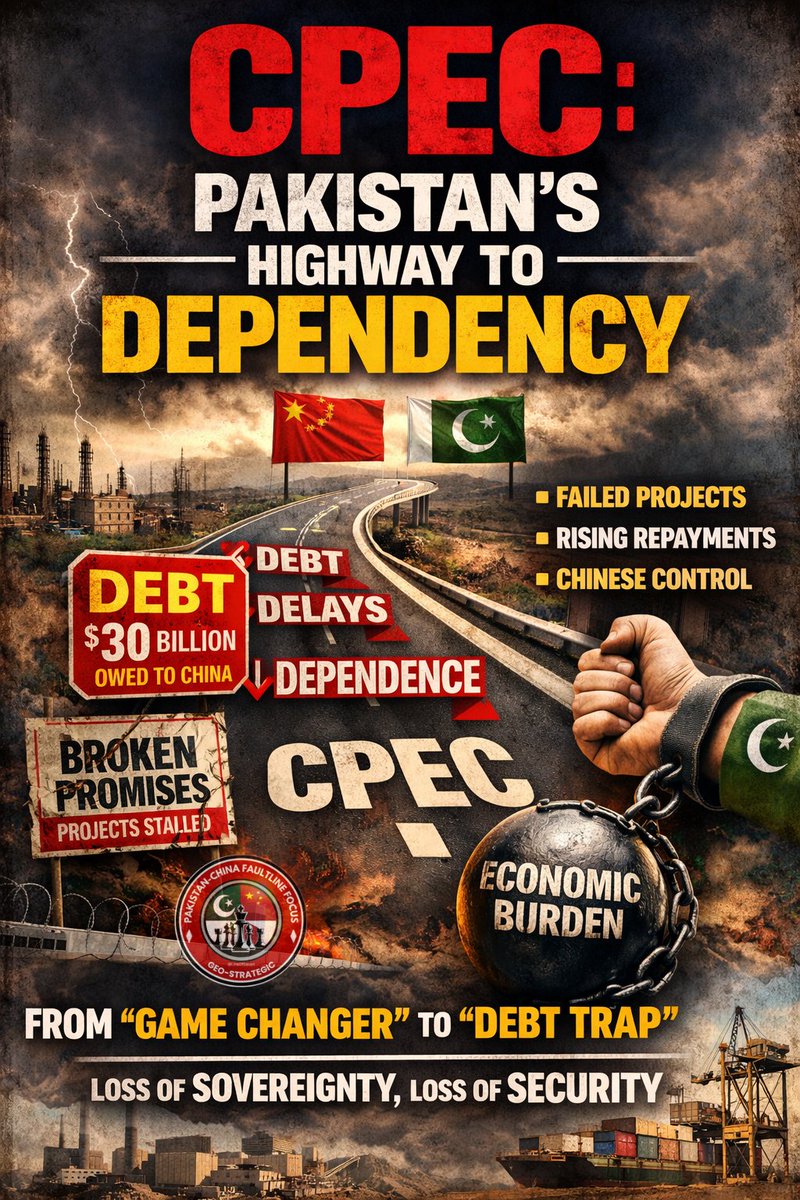
Debt, Delay, Dependence: Pakistan’s CPEC Trap Pakistan sold CPEC to its people as a “game changer.” What it delivered instead was a classic dependency trap. A decade later, Islamabad is weighed down by roughly $30 billion in debt linked to China, while large parts of the much-hyped corridor have slowed, stalled, or been put on hold. Recent Reuters reporting has also noted that much of the planned Chinese investment under CPEC had been put on hold, with security concerns repeatedly cited as a major factor. This is the real story of Pakistan’s economic weakness: It borrowed in the name of development, advertised dependency as strategy, and called geopolitical subservience “partnership.” CPEC was marketed as the road to prosperity. But where is that prosperity now? Where are the jobs at the scale promised? Where is the export boom? Where is the industrial transformation? Where is the self-sustaining growth? Instead, Pakistan is left with repayments, pressure, and shrinking room to maneuver. Even now, the country is juggling major external repayment obligations, showing how fragile its finances remain. That is Pakistan’s pattern in one line: take loans, make announcements, build narratives, then beg for rollovers. And the worst part? This was never just an economic problem. It became a sovereignty problem. Because when one country holds such a large chunk of your external obligations, funds your flagship infrastructure, and keeps pressing you on security guarantees for its personnel and projects, the relationship stops looking like equal cooperation and starts looking like strategic leverage. China has repeatedly pushed Pakistan to improve protection for Chinese workers after repeated attacks, underlining how security failure has become central to the CPEC crisis. So what did Pakistan really build? Not an economic miracle. Not a resilient state. Not an independent growth model. It built: • debt without depth • infrastructure without stability • announcements without delivery • and dependence without dignity CPEC was supposed to change Pakistan. Instead, it exposed Pakistan. It exposed an elite that prefers ribbon-cutting optics over structural reform. It exposed a state that cannot secure even its most strategic foreign projects. And it exposed an economy so weak that every “partnership” turns into another repayment headache. Pakistan wanted CPEC to be remembered as its rise. It may end up being remembered as the clearest symbol of how badly the state mismanaged its future. When a country mortgages strategy, security, and sovereignty for borrowed headlines, this is how the bill arrives. #Pakistan #CPEC #China #DebtTrap #EconomicCrisis #PakistanEconomy
Pakistan-China Faultline Focus tweet media
English
0
4
15
2.2K
Syed Mehar retweetledi
Pakistan Reality Check
Pakistan Reality Check@PakRealityCheck·
She was only 19. A new bride with dreams, hope, and a future she thought would be safe. But the danger did not come from strangers. It came from power, silence, and betrayal. In just days, her life turned into a nightmare. She cried for help. She called the name of the one meant to protect her. No one came. When she returned, she was never the same. Some wounds do not bleed. They destroy from within. And the cruelest part? Life moved on. As if nothing had happened. Some stories do not end with justice. They end in silence. The real question is not what happened to her. The real question is: how many more are buried the same way? #RealityCheck #PowerAndSilence #BrokenSystem #SpeakUp #Justice #TruthMatters #VoiceForVoiceless #ThinkAboutIt
English
1
13
27
2.9K
Syed Mehar
Syed Mehar@__Mehar__·
A slogan is not a statistic. A blended number is not evidence. Once you separate civilians, terrorists & security personnel, this manufactured claim starts collapsing under its own dishonesty. @abhijitmajumder @HBjournalist @OmarAbbasHyat @sidhant @ZahackTanvir @LevinaNeythiri
The Lobby Watch@KmrDiasporaLies

Claim: 1,059 Kashmiris were killed by Indian forces since August 5, 2019. Reality: This is not a clean fact. It is a propaganda statistic built by collapsing radically different categories into one emotional slogan. It hides the most important question, Who exactly is being counted? Because once you separate the categories, the narrative begins to fall apart. Official data placed before Parliament shows that from 2019 to 2023, J&K recorded 168 civilian deaths in terrorist-initiated incidents and encounters combined, 247 security personnel killed, and 818 terrorists killed. That alone exposes the dishonesty of sweeping slogans that try to portray the entire post-2019 fatality landscape as one story of civilians killed by Indian forces. And when the data is broken down more carefully, the distortion becomes even clearer. In a 2023 Rajya Sabha reply, civilian deaths in terrorist-initiated incidents in J&K were listed as 39 in 2019, 32 in 2020, 37 in 2021, 26 in 2022 and 10 up to July 31, 2023, a total of 144. Civilian deaths during encounters/counter-terror operations in those same periods were 5, 6, 4, 5, and 0. A total of just 20. So when propaganda accounts imply that a giant undifferentiated number reflects civilians broadly being killed by Indian forces, they are erasing the distinction between terrorist violence and counter-terror operations. Claim: The number proves a one-sided story of state violence. Reality: The conflict data does not support that simplification. SATP’s J&K fatalities table, current to April 5, 2026, records that from 2019 through 2025 there were 1,484 terror-related fatalities in J&K: 212 civilians, 285 security forces, 983 terrorists/insurgents, and 4 unspecified. In other words, the overwhelming share of those fatalities in that dataset were not civilians. They included a very large number of militants/terrorists, along with security personnel and civilians. That is the trick behind such diaspora messaging Mix civilians, terrorists and security personnel into one pool, strip away category labels, assign one political cause to the whole lot, and then market the final number as proof of a pre-written conclusion. That is not human rights accounting. That is narrative engineering. Claim: The slogan is about justice. Reality: Justice requires classification, attribution and evidence not category laundering. Every civilian death matters. Every abuse allegation deserves scrutiny. Every operation must remain open to lawful examination where required. But once a propaganda ecosystem starts blending terrorists, civilians, and security personnel into one undifferentiated political number, it is no longer documenting reality. It is manufacturing outrage. Facts matter. Categories matter. Attribution matters. And once those are removed, what remains is not truth, just a statistic weaponised for narrative effect.

English
0
0
0
33
Syed Mehar retweetledi
The Lobby Watch
The Lobby Watch@KmrDiasporaLies·
Claim: 1,059 Kashmiris were killed by Indian forces since August 5, 2019. Reality: This is not a clean fact. It is a propaganda statistic built by collapsing radically different categories into one emotional slogan. It hides the most important question, Who exactly is being counted? Because once you separate the categories, the narrative begins to fall apart. Official data placed before Parliament shows that from 2019 to 2023, J&K recorded 168 civilian deaths in terrorist-initiated incidents and encounters combined, 247 security personnel killed, and 818 terrorists killed. That alone exposes the dishonesty of sweeping slogans that try to portray the entire post-2019 fatality landscape as one story of civilians killed by Indian forces. And when the data is broken down more carefully, the distortion becomes even clearer. In a 2023 Rajya Sabha reply, civilian deaths in terrorist-initiated incidents in J&K were listed as 39 in 2019, 32 in 2020, 37 in 2021, 26 in 2022 and 10 up to July 31, 2023, a total of 144. Civilian deaths during encounters/counter-terror operations in those same periods were 5, 6, 4, 5, and 0. A total of just 20. So when propaganda accounts imply that a giant undifferentiated number reflects civilians broadly being killed by Indian forces, they are erasing the distinction between terrorist violence and counter-terror operations. Claim: The number proves a one-sided story of state violence. Reality: The conflict data does not support that simplification. SATP’s J&K fatalities table, current to April 5, 2026, records that from 2019 through 2025 there were 1,484 terror-related fatalities in J&K: 212 civilians, 285 security forces, 983 terrorists/insurgents, and 4 unspecified. In other words, the overwhelming share of those fatalities in that dataset were not civilians. They included a very large number of militants/terrorists, along with security personnel and civilians. That is the trick behind such diaspora messaging Mix civilians, terrorists and security personnel into one pool, strip away category labels, assign one political cause to the whole lot, and then market the final number as proof of a pre-written conclusion. That is not human rights accounting. That is narrative engineering. Claim: The slogan is about justice. Reality: Justice requires classification, attribution and evidence not category laundering. Every civilian death matters. Every abuse allegation deserves scrutiny. Every operation must remain open to lawful examination where required. But once a propaganda ecosystem starts blending terrorists, civilians, and security personnel into one undifferentiated political number, it is no longer documenting reality. It is manufacturing outrage. Facts matter. Categories matter. Attribution matters. And once those are removed, what remains is not truth, just a statistic weaponised for narrative effect.
The Lobby Watch tweet media
English
1
6
23
2.8K
Syed Mehar retweetledi
Siyasat-e-Sach
Siyasat-e-Sach@centerlinekmr·
59,175 Vacancies. Zero Urgency. J&K has 59,175 vacant government posts, yet youth are stuck waiting with no real recruitment momentum. Exams are delayed, hiring stays “under review,” and governance feels frozen while basic services like electricity still remain unreliable. The frustration is clear: people want jobs, accountability, and action not endless planning and excuses. #JKUnemployment #JKJobs #JKSSB #JKPSC #JammuAndKashmir #YouthOfJK #RecruitmentCrisis #VacantPosts #SystemFailure #JKGovt
English
0
4
13
1.9K