ross

3.7K posts

ross banner
ross

ross

@___rossg

London, England Katılım Nisan 2009
992 Takip Edilen280 Takipçiler
ross retweetledi
Pope Crave
Pope Crave@ClubConcrave·
Pope Leo quotes Gandalf in encyclical debut: “It is not our part to master all the tides of the world, but to do what is in us for the succour of those years wherein we are set, uprooting the evil in the fields that we know, so that those who live after may have clean earth to till.”
Pope Crave tweet media
English
61
2.3K
19.7K
747.2K
ross retweetledi
Joe Sandri
Joe Sandri@lime_joe·
Sir Kenneth Clark’s opening short clip on civilization’s fragility and the decline of the Roman Empire. “What happened? Well, it took Gibbon nine volumes to describe the decline and fall of the Roman Empire. And I shall not embark on that. But thinking about this almost incredible episode does tell one something about the nature of civilization. It shows that however complex and solid it seems, it is actually quite fragile. It can be destroyed. What are its enemies? First of all, fear — fear of war, fear of invasion, fear of plague — fears that make it simply not worthwhile constructing things, or planting trees, or even planning next year’s crops. And fear of the supernatural, which means you don’t question anything or change anything. The late antique world was full of meaningless rituals, mystery religions that destroy self-confidence. And then boredom, the feeling of hopelessness which can overtake people with a high degree of material prosperity. There’s a poem by a modern Greek called Cavafy, a poem in which he imagines the people of some late antique city waiting every day for barbarians to come and sack it. And then finally the barbarians move off somewhere else and the city is saved. But the people are disappointed. It would have been better than nothing. Of course, civilization requires a modicum of material prosperity, enough to provide a little leisure. But far more it requires confidence — confidence in the society in which one lives, belief in its philosophy, belief in its laws, confidence in one’s own mental powers. The way that stones at a bridge are laid is not only a triumph of technical skill. It shows vigorous belief in discipline and law. Energy, vitality. All great civilizations — or civilizing epochs — have had a weight of energy behind them. People sometimes think that civilization consists in fine sensibilities and good conversation and all that. Well, these can be among the agreeable results of civilization. But they are not what makes a civilization. And a society can have these amenities and yet be dead and rigid. So if one asks why the civilization of Greece and Rome collapsed, the real answer is: it was exhausted.” Clark was filmed seated on the rocks beside the Pont du Gard aqueduct in France. The full 11 hour series can be found on YouTube. youtu.be/KNQRqJitqNI
YouTube video
YouTube
English
5
67
319
43.2K
ross retweetledi
Aakash Gupta
Aakash Gupta@aakashgupta·
That water clarity is an engineering decision, and the math behind it is wilder than the video. Roman aqueducts ran on gravity alone. No pumps, no pressure systems. Engineers carved channels with a gradient so shallow it borders on absurd. The Pont du Gard in southern France drops 2.5 centimeters over 275 meters. That's roughly the thickness of a coin over the length of three football fields. They surveyed that accuracy with plumb lines and wooden leveling instruments. The clarity you're seeing is a direct product of flow velocity. Too steep and the water erodes the channel walls, picks up sediment, turns brown. Too flat and it stagnates. Roman engineers targeted a slope of about 20 centimeters per kilometer, which kept the water moving fast enough to stay fresh but slow enough to stay clear. Before the water reached the city, it passed through multi-chamber settling tanks where velocity dropped near zero. Suspended particles sank. Clean water flowed out the top into the next chamber. Repeat three or four times. Pliny specified the minimum slope in writing. Vitruvius published the exact mortar ratio for hydraulic cement: one part lime to two parts volcanic ash for underwater work. The pozzolana from Pozzuoli reacted with water to form a calcium-aluminum-silicate compound that actually gets stronger the longer it sits submerged. Modern concrete degrades in water. Roman concrete bonds with it. Scale the whole system and it gets harder to process. Eleven aqueducts fed Rome at its peak. Combined output: roughly 1 million cubic meters of water per day. That works out to about 250 gallons per person for a city of one million. Modern New York delivers about 125 gallons per person per day. Ancient Rome had access to double the per capita water supply of the largest city in the United States, running entirely on slope and stone. The Trevi Fountain in Rome is still fed by one of them. Two thousand years, same source, same gravity, same water.
Ulises@UlisesDavid__

🚨| La claridad de un acueducto del imperio Romano, de hace 2000 años

English
783
11.9K
57.1K
2.9M
ross retweetledi
Chris Anderson
Chris Anderson@chr1sa·
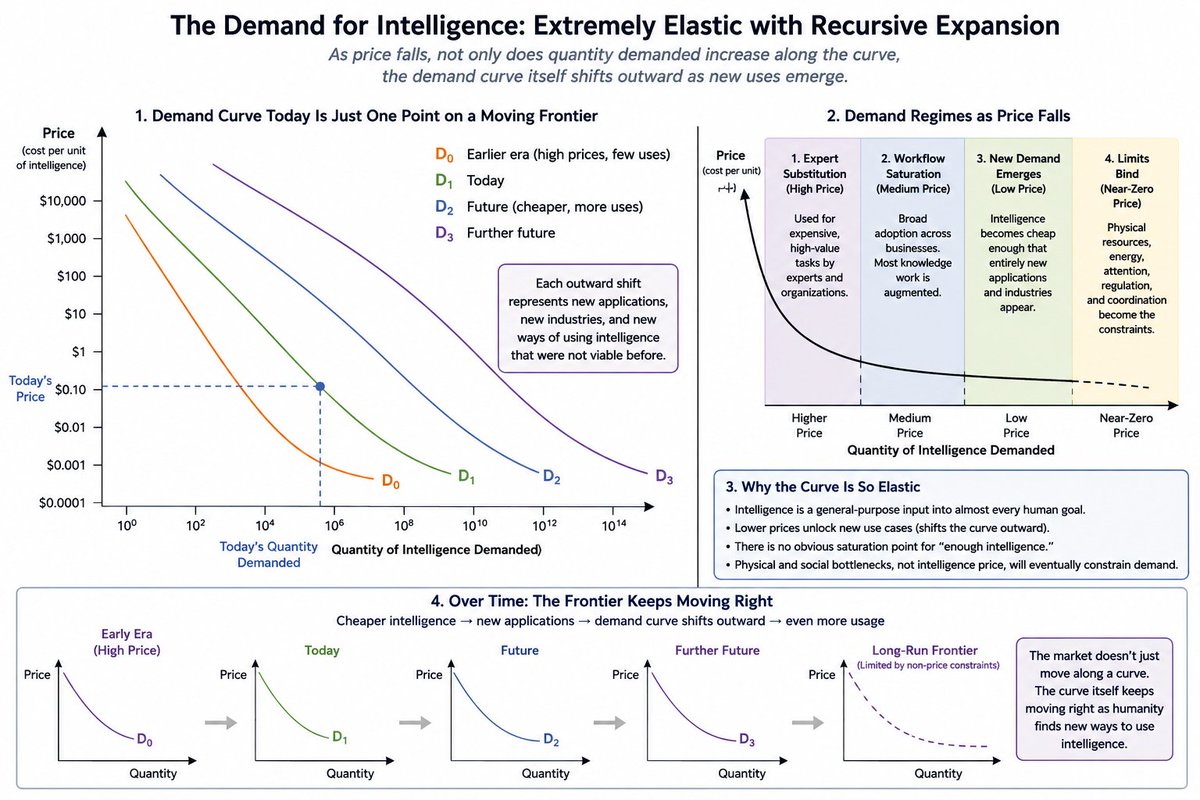
In all of human history, has there ever been a commodity with infinite demand, as there appears to be for intelligence? I can't think of one. Even compute, energy or just silicon/sand are just downstream of intelligence, which is the main demand driver. In economics, rather than modeling the usual price/demand curve to reach an equilibrium, perhaps you'd have to model price/*rate of demand growth* (ie, the derivative of demand, or some other indicator of velocity) Interestingly, ChatGPT (below) prefers the framework of "recursive expansion of demand" as increasing intelligence opens new applications/markets. But the end result is the same -- the demand curve keeps moving to the right, maybe forever. Which I think is unprecedented.
Chris Anderson tweet media
English
83
95
603
144.2K
ross retweetledi
Massimo
Massimo@Rainmaker1973·
Samuel Henderson, the autistic student with Tourette syndrome who has a knack for perfectly imitating the sounds of over 50 types of birds.
English
484
2.2K
19.8K
664K
ross retweetledi
Jessica Livingston
Jessica Livingston@jesslivingston·
"Paying attention is in fact one of the most challenging and meaningful things you can do. Because what you pay attention to shapes what you care about. And what you care about shapes who you become." The students were lucky to hear this speech; it's excellent advice.
Jonathan Haidt@JonHaidt

Thanks to my friend and co-author @glukianoff for laying out what we actually wrote in The Coddling of the American Mind, and applying it in response to seven arguments made by those who objected to my selection as a commencement speaker: eternallyradicalidea.com/p/what-jonatha…

English
7
16
226
27.6K
ross retweetledi
internet archiva
internet archiva@internetarchiva·
“It’s weird seeing people just chilling without their phones” High school in 2000s:
English
1.1K
9.4K
111.2K
18.2M
ross retweetledi
Chamath Palihapitiya
Chamath Palihapitiya@chamath·
Key to winning: Choose to be positive and grateful. Then, just keep at it. Time is the great compounder and will do the rest. So many people just don’t have the discipline to stay positive and grateful. Then time compounds the bitterness instead.
English
330
1.2K
10.9K
423.1K
ross retweetledi
Crémieux
Crémieux@cremieuxrecueil·
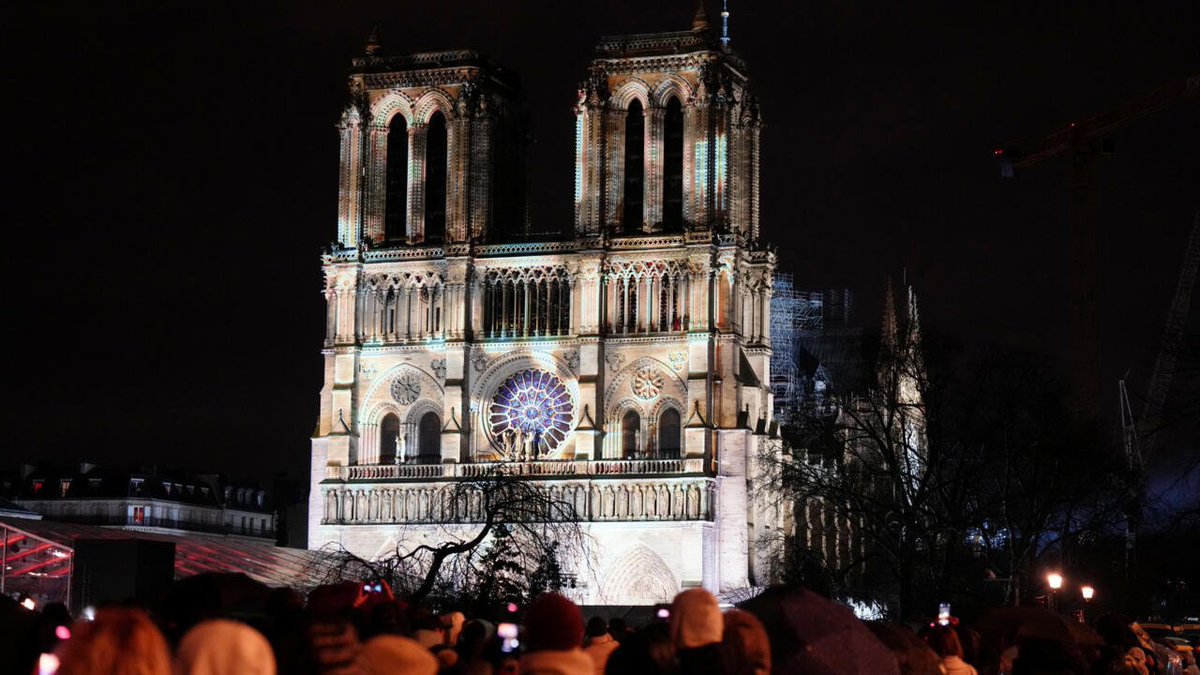
Thread of some surprising things that are older than other things Notre Dame predates the Maori settlement of New Zealand
Crémieux tweet mediaCrémieux tweet media
English
360
4.5K
70.1K
7.2M
ross retweetledi
Naval
Naval@naval·
The enemy of truth is motivated reasoning.
English
484
868
7.9K
396.1K
ross retweetledi
Joshua Kushner
Joshua Kushner@JoshuaKushner·
what if everything goes right
English
231
840
6.5K
478.9K
ross retweetledi
Andrew Reed
Andrew Reed@andrew__reed·
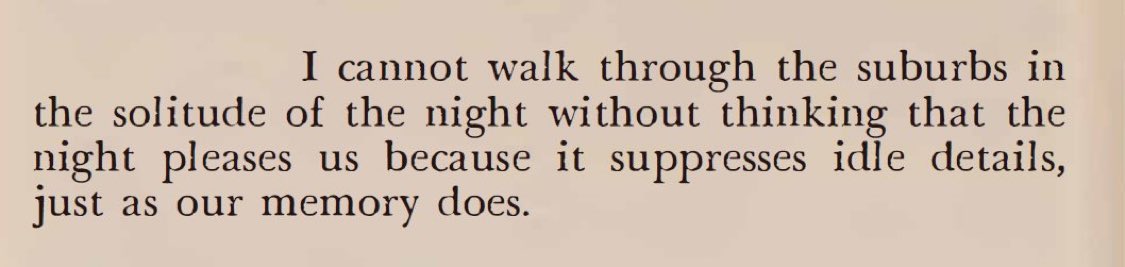
Borges
Andrew Reed tweet media
English
2
6
105
6.8K
ross retweetledi
jake rhodes
jake rhodes@jakebrodes·
POV you’re my wife cracking the bathroom door open after I’ve texted you “toilet paper”
jake rhodes tweet media
English
216
6.8K
131.9K
3M
ross retweetledi
Ashlee Vance
Ashlee Vance@ashleevance·
Some dudes took over a ranch in Texas and are trying to turn it into a manufacturing mecca. We took our cameras and spent a couple of days there. I went upside down in a plane and did a study of Texan cults. It's glorious. Welcome to Proto-Town. Full episode here. If you haven't watched our shows yet, you should. No one does tech better. Core Memory on YouTube.
English
30
85
1K
200K
ross retweetledi
DAN KOE
DAN KOE@thedankoe·
If you want a rare life, you have to be delusional. Doubt can enter your mind, and it can sound reasonable, but if you entertain it too much it will slowly drag you down into stagnation. I'd rather reap the lesson from massive failure than do nothing because it's not "realistic."
English
506
3K
19.9K
2.2M
ross retweetledi
Alex Imas
Alex Imas@alexolegimas·
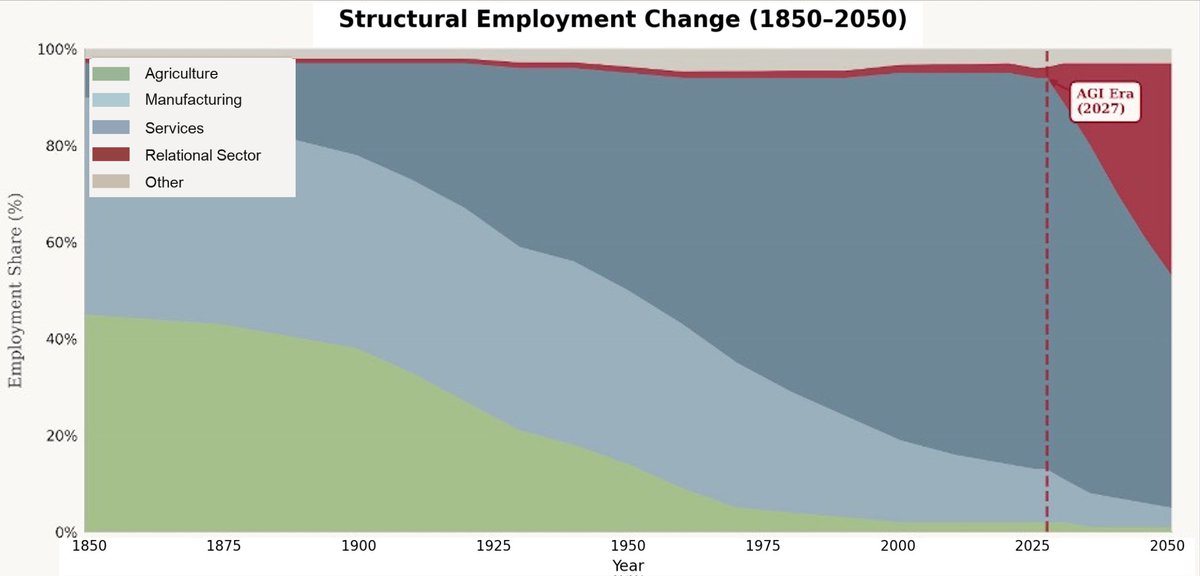
New essay on the economics of structural change and the post-commodity future of work. 1. Almost any question about the impact of advanced AI on the economy needs to start at the same place: what is still scarce? Answer that, and the analysis becomes pretty straightforward. This essay explores what becomes scarce if AI really can replicate most of what humans do in production, and what this mean for the future of jobs. 2. My conjecture, working through the economics: labor reallocates across sectors, and the sector it reallocates to has properties that keep labor a meaningful share of the economy. Ultimately this is about the structure of demand itself. For this, we have to go back to Girard, Augustine and Rousseau: once people's base needs are met, their preferences shift to comparative motives (e.g., status, exclusivity, social desirability). This motive is inherently non-satiated. 4. The key paper is Comin, Lashkari, and Mestieri (Econometrica 2021). As people get richer, they don't buy proportionally more of everything. They shift spending toward sectors with higher income elasticity. They estimate income effects account for 75%+ of observed structural change. 5. The ironic consequence: the sector that gets automated becomes a smaller share of the economy, not a larger one. Agriculture got massively more productive and its share of employment collapsed. Manufacturing too. The "stagnant" sectors absorb the spending and the jobs. 6. So the question is: which sectors have high income elasticity in a post-AGI world? I argue it's what I call the relational sector. Categories where the human isn't just an input into production, it is part of the value. 7. Why does the relational sector have high income elasticity? Because human desire has a mimetic, relational dimension. We don't just want things for their intrinsic properties. We want what others want, and we want it more when others can't have it. Girard, Rousseau, Augustine, and Hobbes all saw this. 8. In work with Kristóf Madarász, we showed this experimentally: WTP roughly doubles when a random subset of others is excluded from the good. And in new work with Graelin Mandel, AI involvement kills the premium. Human-made art gains 44% from exclusivity; AI-made art only 21%. 9. This all comes together for the core argument. The sector that absorbs spending as AI makes commodity production cheap is one where human provenance is part of the value, and demand for it grows faster than income. Exactly the profile that keeps labor meaningful. 10. To be clear about the claim: I'm NOT saying aggregate labor share must rise. It may fall. The claim is about sectoral composition, i.e., where expenditure and employment go once commodities get cheap, and the fact that the sector that will absorb reallocated labor maps to a substantial component of human preferences and desire. 11. If you're interested in the formal model, a linked companion technical note works out all the economics. Read the essay here: aleximas.substack.com/p/what-will-be…
Alex Imas tweet media
English
161
489
2.6K
946.7K
ross retweetledi
Prompter
Prompter@PromptLLM·
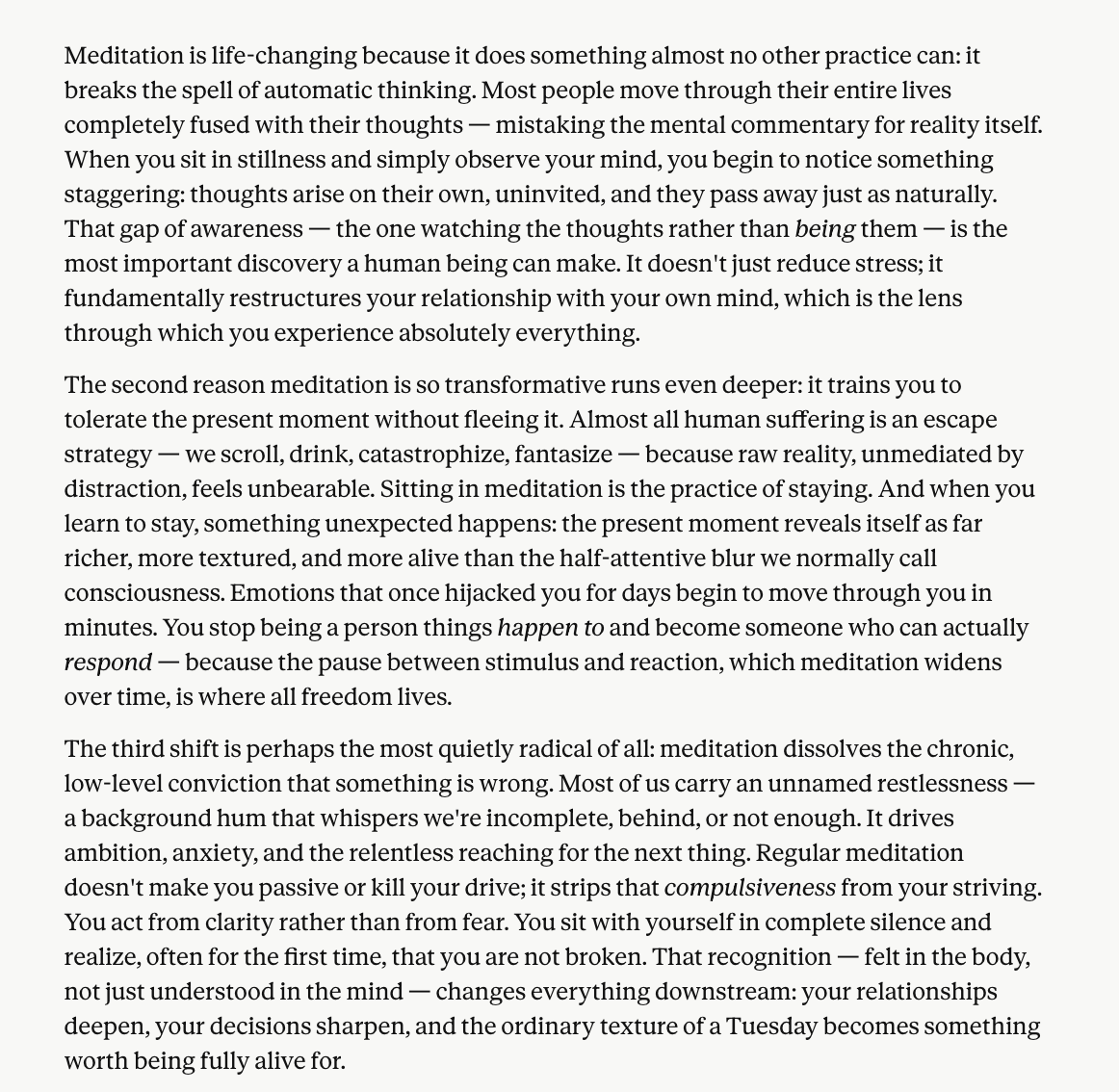
start meditating, it might just change your life.
Prompter tweet media
English
2
130
976
82.7K