Waasay H. Khan

44.1K posts

Waasay H. Khan banner
Waasay H. Khan

Waasay H. Khan

@__oldwine

PGY-2 #residencyandchill #POCUS | weightlifter & a wanna be chef 👨‍🍳 🩺 🫀 #aspiringcardiologist 🇵🇰🇺🇸

New York, USA Katılım Ocak 2014
2.1K Takip Edilen1.7K Takipçiler
Waasay H. Khan
Waasay H. Khan@__oldwine·
@AliZafarsays Calculate ASCVD score, if the score is higher (usually > 10%) that would indicate adding statin would be beneficial. If the ASCVD score is low don’t bother adding it.
English
2
0
0
912
Ali Zafar
Ali Zafar@AliZafarsays·
Thank you so much Doc for sharing your valuable insight. I love learning about health and fitness and wanted to take your advice on the the following. If a 45-year-old male presented with the following profile, along with a history of chronically elevated LDL cholesterol, what would your line of action be? (Other respected doctors in the house, feel free to comment and give your feedback 🙏) HbA1c 6.0 percent hs-CRP less than 0.40 mg/L Total cholesterol 311 mg/dL Triglycerides 478 mg/dL LDL 155 mg/dL HDL 44 mg/dL Non-HDL 267 mg/dL ApoB 1.49 g/L ApoA1 1.58 g/L ApoB/ApoA1 ratio 0.9
Aftab Khan, MD@aftab_usa

As a doctor practicing medicine in the USA for a quarter of a century, I appreciate your thoughtful perspective and commitment to lifestyle changes—lifestyle is indeed foundational for metabolic health, and many patients achieve meaningful improvements in lipid profiles and blood sugar through disciplined diet, exercise, and weight management. That said, robust clinical evidence from large randomized trials and meta-analyses shows that when LDL cholesterol remains elevated despite optimal lifestyle efforts (or in higher-risk individuals), statins significantly reduce cardiovascular events and death. They lower LDL-C effectively and cut major adverse events by 20-30% per 1 mmol/L reduction, including reductions in cardiovascular mortality (often 15-25% relative risk reduction in high-risk groups) and all-cause mortality in many settings. For those needing even more aggressive LDL lowering (e.g., familial hypercholesterolemia or very high residual risk), PCSK9 inhibitors (added to statins) further drop LDL-C by 50-60% and reduce key events like heart attack, stroke, and revascularization by 15-27%, with emerging data showing benefits in cardiovascular death reduction in certain trials. Guidelines prioritize lifestyle first, but evidence-based medications like these are not “masking” symptoms—they target the causal driver (elevated LDL) to prevent plaque progression and events, often saving lives when lifestyle alone isn’t sufficient. Always personalize under medical guidance. Keep up the great work on health!

English
20
2
32
24.4K
Waasay H. Khan retweetledi
Upstate Medical University
Upstate becomes first hospital in New York outside NYC to offer advanced atrial fibrillation ablation technology. Read more: bit.ly/4rT120V
Upstate Medical University tweet media
English
0
4
11
617
Waasay H. Khan
Waasay H. Khan@__oldwine·
Presenting in a Mortality and Morbidity Conference!
Waasay H. Khan tweet media
English
4
1
39
2.3K
Waasay H. Khan
Waasay H. Khan@__oldwine·
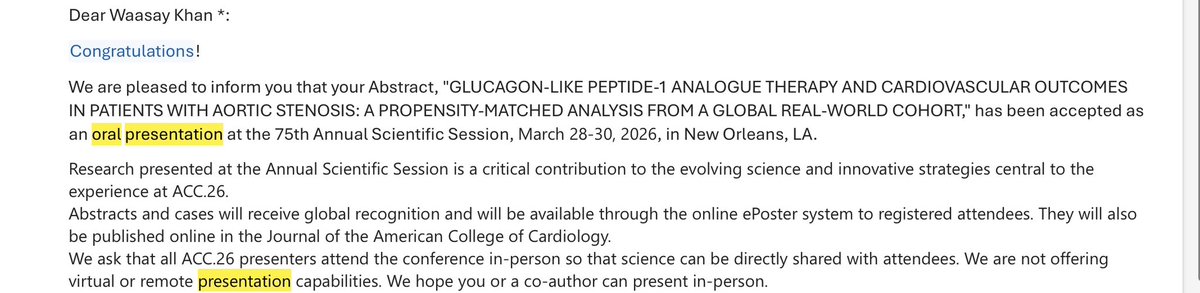
Excited to share that I will be delivering an oral presentation at ACC.26 in New Orleans. 🇺🇸 🎤 My talk will explore the role of GLP in aortic stenosis.Looking forward to meeting peers, colleagues, and mentors. Let's link up if u're there! #ACC26 #cardiology #glp
Waasay H. Khan tweet media
English
1
1
22
578
Waasay H. Khan
Waasay H. Khan@__oldwine·
Corporate sector can and will do everything for profits even if it can cost people their lives and health.
Sebastian Caliri@SebastianCaliri

Over the past month, we (@AdamMeier20, @JTLonsdale) have been working on a state bill that would permit AI to practice medicine - prescribing, diagnosing, referring, and ordering - with some oversight and guard rails. We want the technology community to be able to solve important problems for society, and there are few matters bigger than access and cost of healthcare. We have sought feedback from different groups, but are eager to hear from more builders: does this let you harness AI for the biggest impact on the US healthcare system? We are eager to hear from states as well: what healthcare problems and patient populations are most in need? Done right, this bill should be a win for patients, taxpayers, physicians, and governments. AI should benefit ordinary Americans. Tell us what we got right, what we got wrong, and where we should go from here. We will still need federal clarity on clinical AI, but states will be important stakeholders in any regulatory regime. Reimbursement will be a topic for future discussion too.
English
1
0
0
764
Waasay H. Khan
Waasay H. Khan@__oldwine·
@dvasishtha Just wondering why did you call them when you could use your primary care AI?
English
0
0
5
191
Dhruv Vasishtha
Dhruv Vasishtha@dvasishtha·
Just called the mass general Brigham new patient line to start care with a PCP. after taking down all my info and confirming my insurance they told me...no PCPs are taking new patients in any of the 7 locations in a 10 mile radius to me?! AI primary care can't come fast enough.
English
13
3
47
12.5K
Waasay H. Khan
Waasay H. Khan@__oldwine·
@rjmacleod_dev @DeryaTR_ @aran_nayebi In medicine it’s still analysing data and coming to a conclusion and applying it. if it’s coming to a conclusion which again any data analyst with a pathology book and a Google can. Would you put a data analyst in the hospital to run the medicine/Er service?
English
0
0
1
46
Derya Unutmaz, MD
Derya Unutmaz, MD@DeryaTR_·
Check the models used in this paper: GPT-4o, Command R+, and Llama 3! These no longer exist and can't even remotely compare to current models! This sort of total nonsense papers (of all journals, Nature Medicine!) become the worst source of AI misinformation! This needs to stop!
C. Michael Gibson MD@CMichaelGibson

When humans conversationally present medical scenarios to #AI chatbots, the accuracy of diagnoses is < 35% sciencenews.org/article/medica… Original article in Nature Medicine nature.com/articles/s4159…
English
22
21
208
49.6K
Waasay H. Khan
Waasay H. Khan@__oldwine·
@DeryaTR_ @aran_nayebi If physicians are mere data analysts like unutmaz think they are(that’s the only way and metric any AI can outperform physician). Why not just hire data analysts instead of physicians? Why don’t train residents why not CS engineers and data analysts?
English
1
0
0
39
Derya Unutmaz, MD
Derya Unutmaz, MD@DeryaTR_·
@aran_nayebi GPT-5.2 Pro does not hallucinate. I trust it more than my own memory in my field.
English
1
0
1
178
Papa Heme
Papa Heme@Papa_Heme·
It pains me to say this but OpenEvidence AI is superior to UpToDate (and it’s free!) @EvidenceOpen
English
41
42
591
76K
Waasay H. Khan retweetledi
Brian Gantwerker, MD, FAANS, FACS 🟧🇮🇱
#Medtwitter notice the people wanting to REPLACE (not supplement) your doctor with a chatbot are people you wouldn't let watch your pet for 5 minutes. Bear that in mind before you bandwagon the techno-nihilists.
English
2
3
23
1.3K
Waasay H. Khan retweetledi
Joshua Liu
Joshua Liu@joshuapliu·
Think AI will reduce demand for doctors? Consider this: Claude writes 100% of its own code, yet Anthropic's engineering team is exploding. We aren't looking at the end of the physicians, but the birth of Medical Orchestrators. When asked why Anthropic is still aggressively hiring, Boris Cherny, the creator of Claude Code, said: “Someone has to prompt the Claudes, talk to customers, coordinate with other teams, decide what to build next. Engineering is changing and great engineers are more important than ever.” The need for software engineers isn’t going away, but the role of an engineer is evolving. This offers a blueprint for how to think about the future physician. Even as Ambient AI evolves from scribing to assessing and ordering, this doesn’t mean health systems need fewer physicians. But it does mean that physicians will need to evolve to become “Medical Orchestrators” - doctors who can direct AI clinical agents, validate AI clinical outputs, and have good judgment on when and how AI outputs should be integrated into direct patient care - while STILL also talking to patients and dealing with the people dynamics of collaborating with the broader care team. In some ways, being an Orchestrator is not a new concept to physicians. Academic physicians experience this daily - they lead a team of fellows, residents and medical students to care for a large number of patients. In the same way that you orchestrate a team with varying levels of skill and experience, you’ll do the same managing a crew of AI clinical agents with varying levels of reliability and utility. Soon the AI scribe will be near perfect and you’ll treat it autonomously like a fellow, but AI draft orders are still in the early phases and you’ll review the output very closely, just as you would closely review the work of a 3rd year medical student. In other words, the value of a physician will increasingly shift from the ability to perform every task, to the wisdom of knowing when and how to integrate the AI output into direct patient care. Now it may feel as if AI is reducing work through all this automation, but actually, the limitations of AI in the current state will reveal the next white space that clinicians will finally have time and mental bandwidth to focus on. For decades, physicians have been unable to optimize patient care because they had been buried under doing the basic requirements for each patient. But when AI automates documentation, chart summarization, discharge summaries and paperwork, this creates bandwidth for physicians to tackle new and important challenges that AI can’t - e.g. complex care coordination, re-engineering care delivery models and making the most difficult clinical and ethical judgments for patients. Even if AI further evolves from automating administrative tasks to automating diagnosis, we will only see an explosion in demand for physicians to not only grow actual care delivery, but to play a critical role in elevating the care we deliver.
Joshua Liu tweet media
English
20
49
137
19K
Waasay H. Khan
Waasay H. Khan@__oldwine·
@EricMeller @ouwilkins @DutchRojas Applicable is mostly what medicine doctors do. So tell me exactly what part other than solving board questions easily does the AI can do better? It can’t even read my ECG properly
English
0
0
2
29
Waasay H. Khan
Waasay H. Khan@__oldwine·
@EricMeller @ouwilkins @DutchRojas Real world Medicine is only 10 percent like text book medicine. Thats why we never evaluate a resident mere on knowledge base because it’s just a minute part of a package. Complex communications putting socioeconomic and most often taking decisions when the guidelines are not 2/3
English
1
0
1
27
Dutch Rojas
Dutch Rojas@DutchRojas·
“Going to medical school is stupid.” That’s the narrative right now. And as usual, the well-intentioned people spreading it are wrong. The jobs AI is eliminating are not in the operating room. They are in the C-suite. CEO. COO. CFO. The white-collar administrative layer that hospital systems spent decades building between the physician and the patient. AI does not need a neurosurgeon to click an EMR 97 times to place an order before a trauma procedure. AI will review the case and handle the administrative work itself. I hope the largest hospital administrators in America read this here first. Your jobs are gone. The physician’s is not. The nurses’s is not. The system spent 40 years commoditizing clinical skill and inflating administrative control. AI just inverted the value hierarchy. The hands that heal are the last ones standing.
Alohacowboy@alohacowboysol

@DutchRojas It’s fun and exciting for Elon to say Optimus is coming for surgeons and AI will replace cognitive specialties in the blink of an eye…but if even if that’s 1/10th true…we should be able to vaporize the healthcare administrative complex in seconds…

English
45
65
395
45.2K