carlos g. correa retweetledi
carlos g. correa
144 posts

carlos g. correa
@_cgcorrea
postdoc with @marcelomattar, thinking about decisions
Brooklyn, NY Katılım Ekim 2019
2.6K Takip Edilen647 Takipçiler
carlos g. correa retweetledi

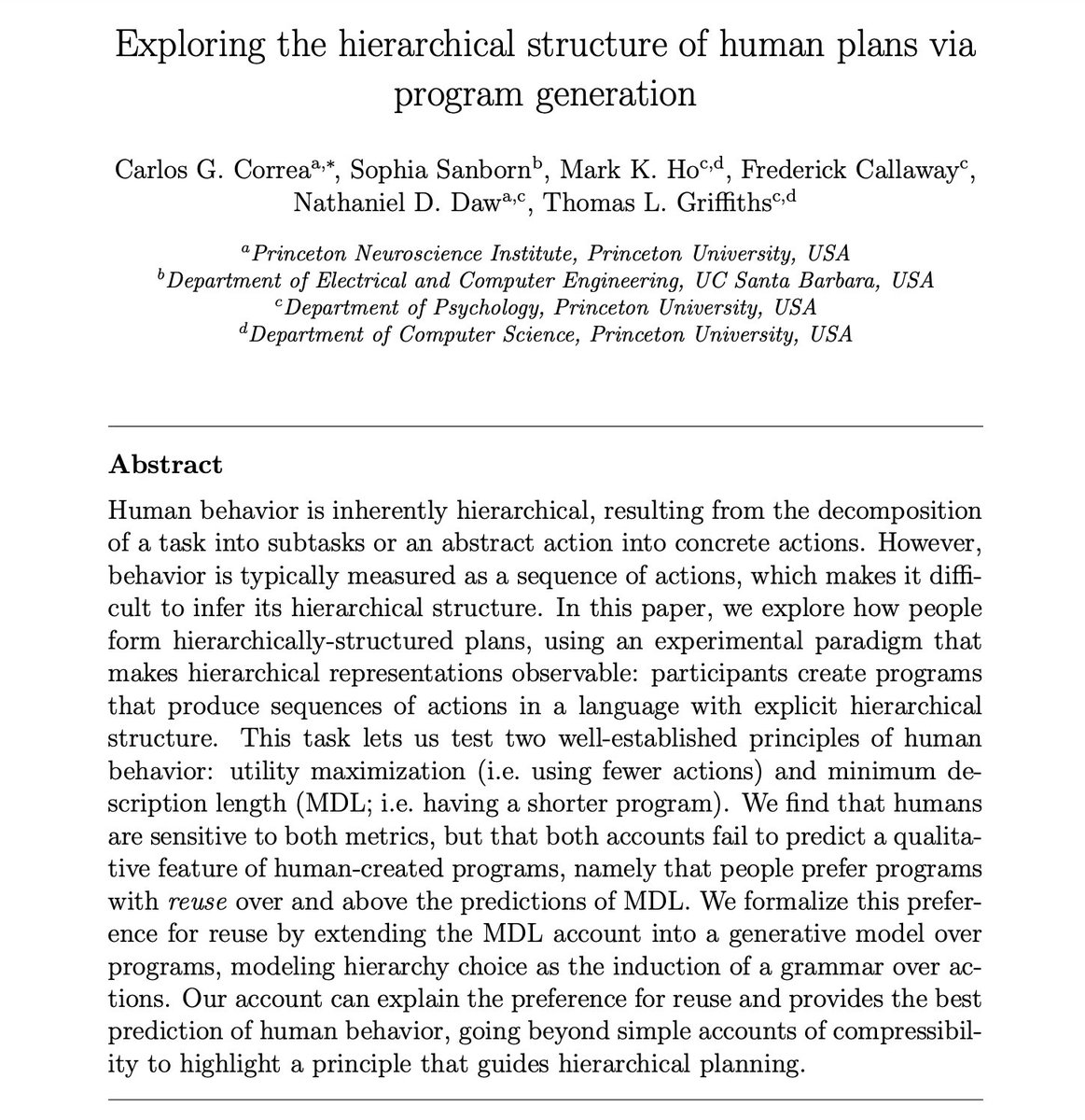
"Exploring the hierarchical structure of human plans via program generation"
📢New paper from: Carlos Correa, Sophia Sanborn, Mark Ho, Frederick Callaway, Nathaniel Daw, & Thomas Griffiths
sciencedirect.com/science/articl…
English

Shout out to my incredible co-authors: Sophia Sanborn (@naturecomputes), @mark_ho_, Fred Callaway (@callfredaway), @nathanieldaw, & Tom Griffiths (@cocosci_lab).
English

Check out our preprint thread for more details!
x.com/_cgcorrea/stat…
carlos g. correa@_cgcorrea
Human behavior is hierarchically structured. But what determines *which* hierarchies people use? In a preprint, we run an experiment where people create programs that correspond to hierarchies, finding that people prefer structures with more reuse. arxiv.org/abs/2311.18644 1/7
English

My paper on hierarchical plans is out in Cognition!🎉
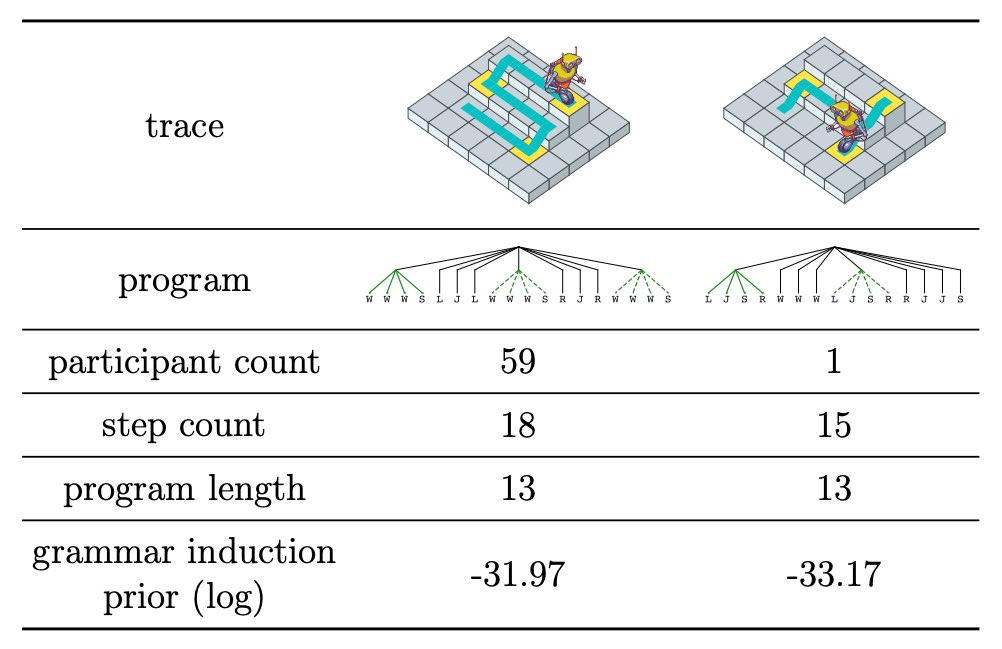
tldr: We ask participants to generate hierarchical plans in a programming game. People prefer to reuse beyond what standard accounts predict, which we formalize as induction of a grammar over actions.
authors.elsevier.com/a/1kBQr2Hx2xLNA

English
carlos g. correa retweetledi

Unacceptable decision by Princeton. Faculty need to speak out and show up now
The Daily Princetonian@princetonian
In a preemptive move, the University says that any protestors who participate in an encampment will likely be arrested and barred from campus, with further disciplinary action to follow. Reporting by Miriam Waldvogel dailyprincetonian.com/article/2024/0…
English
carlos g. correa retweetledi

I am delighted that I’ll be joining Boston University’s dept. of psychological and brain sciences as an assistant professor in July 2025!
I’ll be recruiting Ph.D. students and hiring a lab manager to start alongside me — see here for more info: katenuss.com/lab
🧠👩🔬💻
English

@cogscikid 2) a more esoteric approach could somehow compile the Python to JS, or use a JS-based Python interpreter. Don't think there's a single straightforward approach, and would likely depend on the Python being relatively simple (i.e. it would be ideal if it uses no libraries)
English

@cogscikid I think there are two broad approaches:
1) HTTP endpoints you can use for task transitions (like Sven W's linked GH issue). Could be as simple as `GET /task_transition?state={"x":0,"y":1}&action=left`, though I imagine it will take some work to translate rendering.
English
carlos g. correa retweetledi

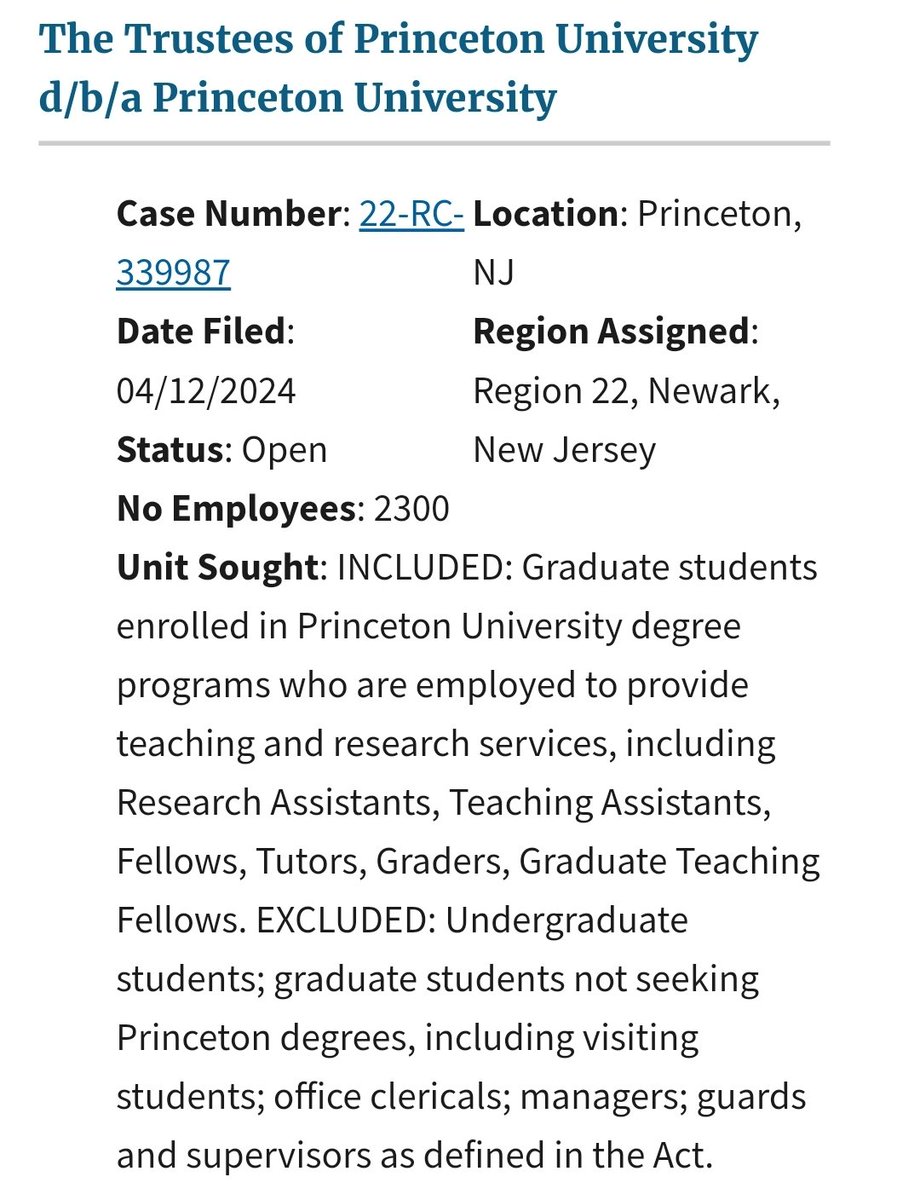
NEW: 2,300 grad workers at Princeton are forming a union as @PrincetonGSU and are joining @ueunion.
Grad workers at every Ivy League school have now moved to unionize.

English
carlos g. correa retweetledi

New preprint! @tafazolisina shows the brain builds complex tasks by compositionally combining simpler sub-task representations. By dynamically reusing neural subspaces for sensory inputs and motor actions, the brain can flexibly perform multiple tasks. 🧵 biorxiv.org/content/10.110…
English
carlos g. correa retweetledi

Happy to share the preprint for my main grad school project, with Twitterless Thomas Akam, @IlanaWitten, and @nathanieldaw! Within, we formalize a popular hypothesis about replay function (that it helps build cognitive maps) using RL, and... 1/2
bioRxiv Neuroscience@biorxiv_neursci
Prioritizing replay when future goals are unknown biorxiv.org/cgi/content/sh… #biorxiv_neursci
English

@james_juras @EliSennesh @cocosci_lab @mark_ho_ @naturecomputes @callfredaway @nathanieldaw People were able to run the program at any point, and had the goal of activating all lights in an environment. More details are in the paper. You can also check out the demo online (carlos.correa.me/cocosci-lightb…).
English

@_cgcorrea @EliSennesh @cocosci_lab @mark_ho_ @naturecomputes @callfredaway @nathanieldaw Very interesting! Did the participants have access to any metric of program “success”?
English

Human behavior is hierarchically structured. But what determines *which* hierarchies people use? In a preprint, we run an experiment where people create programs that correspond to hierarchies, finding that people prefer structures with more reuse.
arxiv.org/abs/2311.18644
1/7

English

Lightbot (@lightbotcom) was originally built by @dannyaroslavski. We build on an open-source version by @laurenthaan (github.com/haan/Lightbot).
Animation in first tweet was inspired by M. C. Escher’s Ascending and Descending and the game Monument Valley (by @ustwogames).
7/7
English

Huge thanks to my incredible co-authors: Sophia Sanborn (@naturecomputes), @mark_ho_, Fred Callaway (@callfredaway), @nathanieldaw, & Tom Griffiths (@cocosci_lab). I am incredibly grateful for their insights and support!
6/7
English

We use a process-tracing paradigm where people create hierarchical plans. Based on the educational game @lightbotcom, research participants drag and drop instructions to write programs. Lightbot follows these instructions, with the goal of activating all lights.
2/7
English