Nathaniel Daw

2.3K posts

Nathaniel Daw banner
Nathaniel Daw

Nathaniel Daw

@nathanieldaw

Princeton neuro prof. But Twitter is an absurd platform for professional communication so I strive to use it most unprofessionally.
Princeton, NJ Katılım Eylül 2010
866 Takip Edilen7K Takipçiler
Nathaniel Daw
Nathaniel Daw@nathanieldaw·
@pfau Who on earth is going to fly all these killer drones and drive the terminator robots if all the pilots are hiding in caves?
English
0
0
1
117
Matthew Yglesias
Matthew Yglesias@mattyglesias·
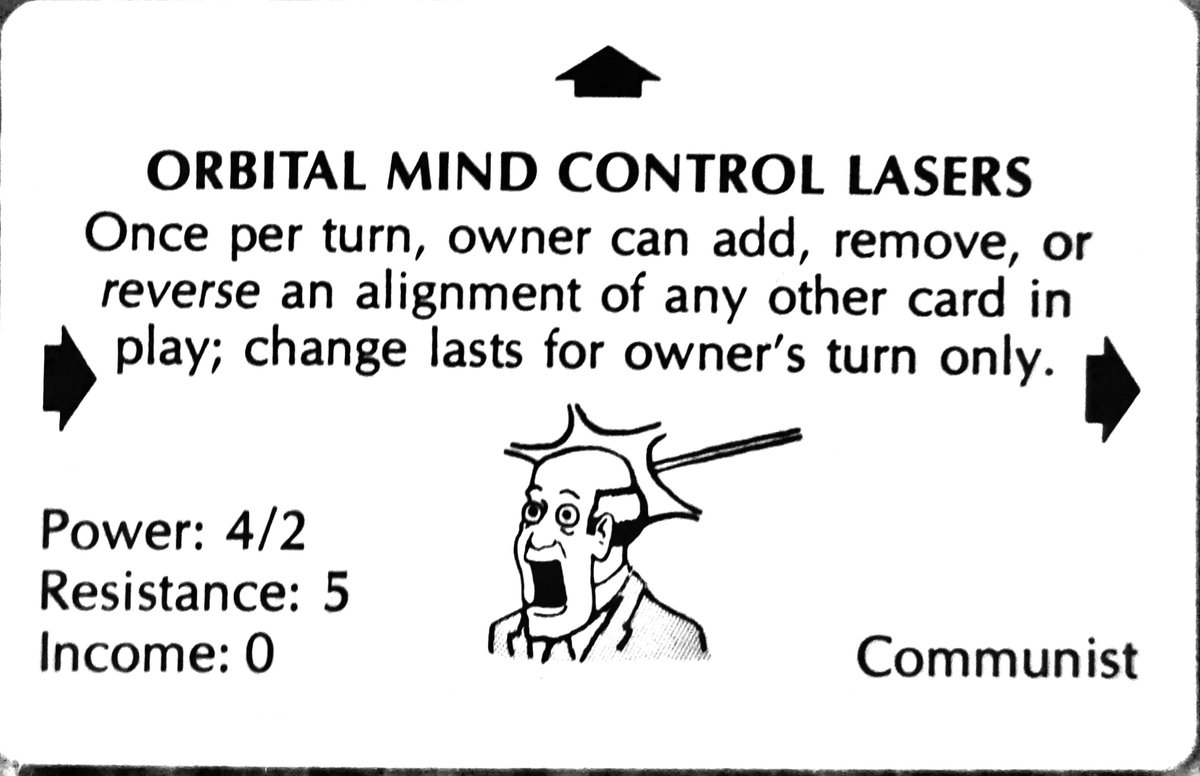
I took a class on Eastern European science fiction in college and this one is a banger
Matthew Yglesias tweet media
English
7
2
122
16.9K
Matthew Yglesias
Matthew Yglesias@mattyglesias·
Any time I read something about British politics it makes me think the underlying problem is the voters. Who cares about newts???
David Lawrence@dc_lawrence

YIMBYism promised to be the next big thing in progressive politics. But a couple of years after the PM declared himself a YIMBY, housebuilding has stalled, and YIMBYs have found themselves on the side of killing newts. Where did 'build baby build' go wrong? In my latest piece for @ArguablyMag, I argue that YIMBYs (which includes me) made three big mistakes: 🦇 1. We picked unnecessary battles we were bound to lose Attacking blockers, bats and newts is fine if you are trying to appeal to a niche Twitter audience who agree with you already. It is less smart, however, if the majority of voters are worried about more housing being built near them, and (quite rightly!) want to protect their natural areas. 🏡 2. We failed to prioritise homes where they are most needed. Hot take: not all of the UK faces a housing crisis. In fact, in most parts of Britain, a lack of connectivity is a far more binding constraint on productivity. Economically, the biggest benefits derive from densifying urban areas, and connecting these to other towns with good transport infrastructure, rather than building more satellite towns. 🤑 3. YIMBYs got into bed with big property developers. Developers prefer the kind of urban sprawl that economists, environmentalists and voters all hate: large, cookie-cutter newbuild developments, connected by roads, on greenfield sites. Instead of making YIMBYism about ordinary people who need homes, every conference event, panel and drinks reception ended up being a showcase for big developers. (NB my think tank, @BritishProgress, has never taken any money from property developers) The overall point: we failed to make Yimbyism win-win. The best argument for building more homes is that everyone can be better off: gentle density in urban centres, with good connectivity across the country, is politically popular, and the best thing Britain could do for growth. Andy Burnham should not give up on building more homes, but to succeed, YIMBYism needs a reset. Read the full piece here: arguably.uk/p/must-we-kill…

English
49
31
945
88.1K
Nathaniel Daw retweetledi
Akshay K. Jagadish
Akshay K. Jagadish@akjagadish·
1/ 🚨 New preprint: "Closing the Loop to Discover Psychological Theories with an Automated Cognitive Scientist" Co-led w/ Younes Strittmatter Co-mentored by @suyoghc and @cocosci_lab In collaboration w/ @kachergis, @norijacoby, @nathanieldaw, & @cpilab Introducing AutoCog — a fully autonomous AI system that runs the entire scientific discovery cycle in cognitive science to surface novel theories of human behavior 🧵 #CognitiveScience #AI4Science #LLMs
Akshay K. Jagadish tweet media
English
1
27
92
19.4K
Nathaniel Daw retweetledi
Noémi Éltető
Noémi Éltető@EltetoNoemi·
First paper since joining @GoogleDeepmind! We present 🌍ATLAS (Active Theory Learning for Automated Science), a pipeline that generates interpretable mechanistic models from data and optimizes experiments to test them. Thread below
GIF
English
4
27
208
28.3K
Nathaniel Daw
Nathaniel Daw@nathanieldaw·
I have been so excited about this project. In many ways the most surprising thing to me was how seemingly similar the AI-discovered models were to simple ones I thought I understood, even though they fit way better. This means we can also really get what makes them work.
Kevin Miller@kevinjmiller10

Computational models are a key part of science but discovering new ones is hard! DataDIVER discovers concise models from data, surfacing new mechanistic ideas and generating clear predictions for future experiments Preprint from @GoogleDeepMind Neuroscience Lab + collaborators


English
0
7
25
3.1K
Nathaniel Daw
Nathaniel Daw@nathanieldaw·
@mattyglesias If it's like mine it keeps track of the average age of the gas in the tank so you can improve matters just by using some and topping it off
English
0
0
0
726
D K
D K@DamarisKroeber·
@marcelomattar @nathanieldaw Beautiful paper. This reminds me of a motor cortex “planning” paper by Churchland et al where they argue that the usefulness of a motor trajectory is already stored (learned) and simply “rotated” into a task-relevant output space.
English
2
0
2
48
Nathaniel Daw retweetledi
Marcelo Mattar
Marcelo Mattar@marcelomattar·
New Annual Review with @nathanieldaw. We argue that the planning machinery of the brain is mostly used for learning from simulated experience, and that thinking prospectively at decision time is just one special case of this more general process. annualreviews.org/content/journa…
English
3
48
191
15.2K
David Pfau
David Pfau@pfau·
@bygregorr Nothing is more tiresome than people after the fact being like "well akshually this other paper did something kinda similar if you squint". Nothing is truly original, huge breakthroughs always have some precedent, stop being a pendant about it.
English
3
4
116
6K
David Pfau
David Pfau@pfau·
Oh god are we really doing this? Jeff Dean trained an n-gram model on the entire internet in 2007. Jelinek coined the term "language model" in the '70s. It's called "Claude" because Claude Shannon was estimating the entropy rate of the English language in 1951!
Aran Komatsuzaki@arankomatsuzaki

While Alec is one of the best ML researchers of all time, LLM started way before. Here's one from 2013 for non-neural architecture and one from 2016, which is afaik the first neural LLM if we define LLM as LM w/ >1B params.


English
32
82
1.3K
474.5K
Nathaniel Daw
Nathaniel Daw@nathanieldaw·
@_Aaditya_Prasad @IanOsband @a_weers @giffmana If a low prob action has high value there is a big return gain for improving policy. If I collect data under pi, some actions will be under-sampled in that data. These two things seem separate, eg I could sample a diff data distribrtion and still discover the policy improvement
English
0
0
2
30
Alex Weers
Alex Weers@a_weers·
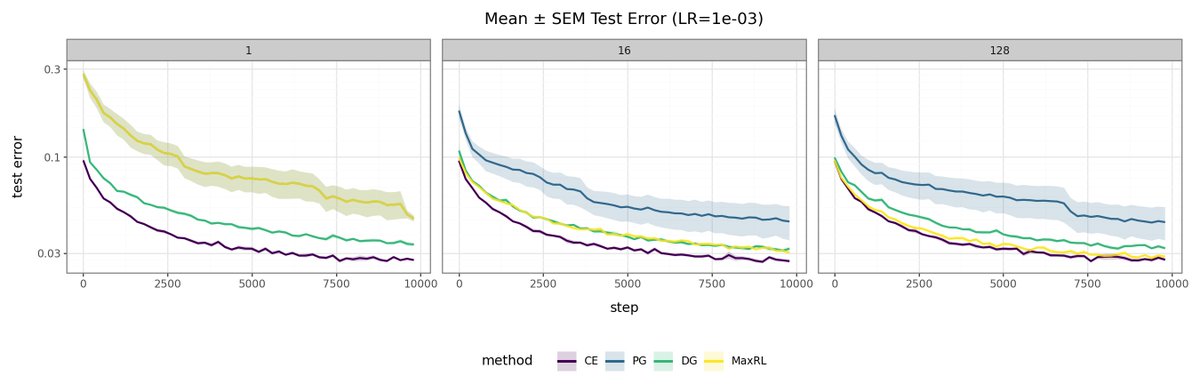
Interesting question, since both share the same motivation and try to reweigh gradients such that it is closer to CE. However, I don't think they are the same, they have different expected gradients and perform differently in practice. - MaxRL uses group statistics to counter the p factor in the expected gradient introduced by REINFORCE with w=((1-(1-p)^N)/p): one sample is PG (w=1), in the limit it becomes ML/CE (w = 1/p) - DG uses gates based on surprisal and advantage, so it works with single samples. In the special tabular case it adds a factor of sigmoid(-log p) to the expected gradient, which is a compression of gradients for high p, but a softer one. And for other (asymmetric) contexts the gradient directions rotates again The plots show the performance on MNIST for different number of rollouts per sample. DG is positioned in-between of PG and CE even for single rollouts per sample, but does not approximate CE exactly (in contrast to MaxRL).
Alex Weers tweet media
Lucas Beyer (bl16)@giffmana

My "squinted" understanding of both MaxRL and DG is they essentially reweight TP/FP/TN/FN differently, such that learning converges to the same as xent, and both have a very nice classification "toy" example to make it very clear. So I'm genuinely very curious if they are exactly the same independent finding just phrased differently, or if they have some important differences, and if so what they are. That's why i was looking for such discussion either in DG's related works section, or in the thread here :)


English
4
6
64
15K
Nathaniel Daw
Nathaniel Daw@nathanieldaw·
@IanOsband @a_weers @giffmana Low prob under current pi is useful for two reasons I think, one (your motivation?) is opportunity for policy improvement; but also these actions are poorly sampled on pi. Wonder if these are separable/which is doing the work. Anyway good to see you back at gdm!!
English
2
0
3
56
Ian Osband
Ian Osband@IanOsband·
Btw I don't think my intuition was ever "make it more like CE"... Although the paper does use that for justification. The intuition is more simple: > The best data for policy is an example doing something better than you normally do (high advantage) and low prob under current pi (high surprisal) So the idea is just to pay more attention to the most delightful data. Unlike maxRL that has nothing to do with "how many samples I take"... Make sense?
English
2
0
8
822
Nathaniel Daw
Nathaniel Daw@nathanieldaw·
@yoavgo I think many seminar courses esp in technical areas benefit from a bit of introductory lecturing to frame the questions and introduce the formalisms. I usually do a touch of this every week to set up next week's paper but a longer framing lecture at the start can be useful
English
1
0
1
417
(((ل()(ل() 'yoav))))👾
cs/ml/ai profs: do you have tips for not wasting the first class of a seminar course on purely logistics ("these are the topics, these are the papers, here is how the course works, who will present next week and what")? (this year we were graced by end of class being interrupted by incoming missile alert from Iran, but hopefully future years will be different)
English
4
2
13
4.1K
Nathaniel Daw
Nathaniel Daw@nathanieldaw·
@yoavgo @mmitchell_ai I also love the piece tbc: the point about conclusory terminology (attention, reasoning) is crucial and very widely applicable
English
0
0
1
20
Nathaniel Daw
Nathaniel Daw@nathanieldaw·
@yoavgo @mmitchell_ai Isn't a good parrot stochastic (as training objective) just bc target function is probabilistic? What I don't get is once the definition is refined to this it seems false-even old llms were instruction tuned, rlhf'd etc: not just parrots and not just due to other "ai" wrappers
English
1
0
1
23
MMitchell
MMitchell@mmitchell_ai·
"AI" is not a stochastic parrot.🦜 I wrote this piece a couple weeks ago, but it was hard for me to finish up given AI's role in society and war over the past few weeks. I should share it at some point though. Not perfect, but here it is. @margarmitchell/no-ai-is-not-a-stochastic-parrot-a99e57766bed" target="_blank" rel="nofollow noopener">medium.com/@margarmitchel
English
11
26
159
35.7K
Nathaniel Daw
Nathaniel Daw@nathanieldaw·
@TheEbonyMaw I was eating spicy noodles and my toddler toddled up and begged for a bite and I couldn't resist him and I took a tiny piece of noodle and scraped off the sauce. he put it in his mouth and gave me this soul shattering look of total shock and betrayal. Now he's 16.
English
0
0
0
219
Maw
Maw@TheEbonyMaw·
Sitting down. Drinking iced black coffee. 2yr old daughter (Twin A) walks over to me for a sip. She does this many times. I always say no. You know what? Just give her a sip. She’ll hate it, and then she’ll never ask again. I give her a sip. She likes it. Asks for another.
Maw tweet media
English
52
29
1.2K
14.6K