
Lorenzo De Nobili
1.7K posts

Lorenzo De Nobili
@_elledienne
Co-Founder & CTO @passionfrootme | Shaping the future of the creator economy | Passionate about local-first software
Berlin, Germany Katılım Mart 2022
507 Takip Edilen376 Takipçiler
Sabitlenmiş Tweet

Stoked to introduce our Campaign Strategist, powered by @Google Gemini 2.5 Flash 🚀
We took Gemini's insane capabilities and mixed them with everything we know about creator marketing. The result? An AI agent that completely changes how B2B brands plan creator campaigns.
Here's what makes it special:
- Analyzes hundreds of creators at once (thanks to Gemini's massive context window)
- Uses our battle-tested playbooks built right into the prompts
- Shows you performance projections before you spend a dime
- Gives you recommendations tailored to your exact product & audience
The magic? We've prompted Gemini to think like our best marketers - evaluating creator fit, predicting engagement, and optimizing budget allocation at speeds impossible for humans.
No more spreadsheet hell. No more manual vetting. Just smart campaign strategies in literal seconds.
English


@linear can we delegate recurring issues to agents pretty please? 🥹
English

Launching Zest, and it's so cool.
Zest *is* your workspace. Not a feature. An operator. Always there, managing campaigns, handling outreach, analyzing what's working.
Technically, it's the most interesting thing we've built. Lives in a sandbox, writes its own code to analyze your data, uses sub-agents for long trajectories. Builds campaigns with hundreds of creators in minutes instead of days.
While we were at it, we also redesigned our website and it's one of the most beautiful things you are gonna see this week
passionfroot.me
English


Thinking more about this, the tool could be implemented as a just-bash custom command so it all becomes, well, just bash.
Main quirk would be that the command should limit max output length by default and return an error instructing the model to save to file first when exceeded (need for this could be offset with good documentation)
English

@_elledienne Yeah. I think its better to write to a file first, so that you can then chain multiple operations against it.
English

Everybody has been talking about "filesystems are all you need", "bash is all you need", "coding agent architecture".
But if my agent isn't operating on code, then how do I map the domain context into the filesystem?
Here is our starter guide + template
Vercel@vercel
Stop over-engineering your context. LLMs have been extensively trained in how to use filesystems. Even if you’re not making a coding agent, it turns out that’s the most effective and natural way to manage your context. Here’s our guide to mapping any domain, from financial analysis and support tickets to sales optimization, into a filesystem so you can build better agents ↓ vercel.com/blog/how-to-bu…
English

@cramforce Makes sense. The CLI tool idea was mostly to allow the model to chain operations but I guess a tool that supports programmatic tool calling could achieve a similar result
English

@_elledienne Current thinking;
- make this a tool, not a CLI tool
- have the tool write to the FS and return the file names in the tool response (and maybe some content to avoid tool roundtrips)
English

Do you have any thoughts on providing a CLI tool to the LLM that it can use to fetch/manage data (eg historical cases with the same customers)?
Should be very simple for the agent to store the response in a file and then work on it using whatever approach it wants. I’d assume this is also well covered by training.
Kind of letting the agent built it’s own filesystem vs providing it upfront
English

@_elledienne It really depends. But you don't have to overthink it (which is the beauty).
Try:
- current case history
- last N cases with the same customer
- basic account metadata
- all of your documentation
Make sure to tell the agent which is which
English

@steipete Why does it keep telling you to go to sleep lol
English

@prisma @bunjavascript @deno_land @nodejs Do we need to manually select to import from /browser.ts or /client.ts? Is it safe to always import from the browser import unless importing PrismaClient?
English

Prisma 7 now ships as ES modules by default.
So it just works with modern runtimes like @bunjavascript, @deno_land, and @nodejs. No extra config.
English

@peer_rich @pumfleet You put the cooked pizza on top of the box?
English

Made with @Replit Design Mode. Gemini 3 is a game changer.
opulent-estate-dh-design.replit.app
English

@karthikkalyan90 Love it! Will give your library a try though, it’s exactly what I was going to write myself! Keep us in the loop with updates 💪
English

@_elledienne Good edge case which is not handled. Yea, it’s not ideal for parallel tool calls. Let me handle these cases and expose some strategies.
English

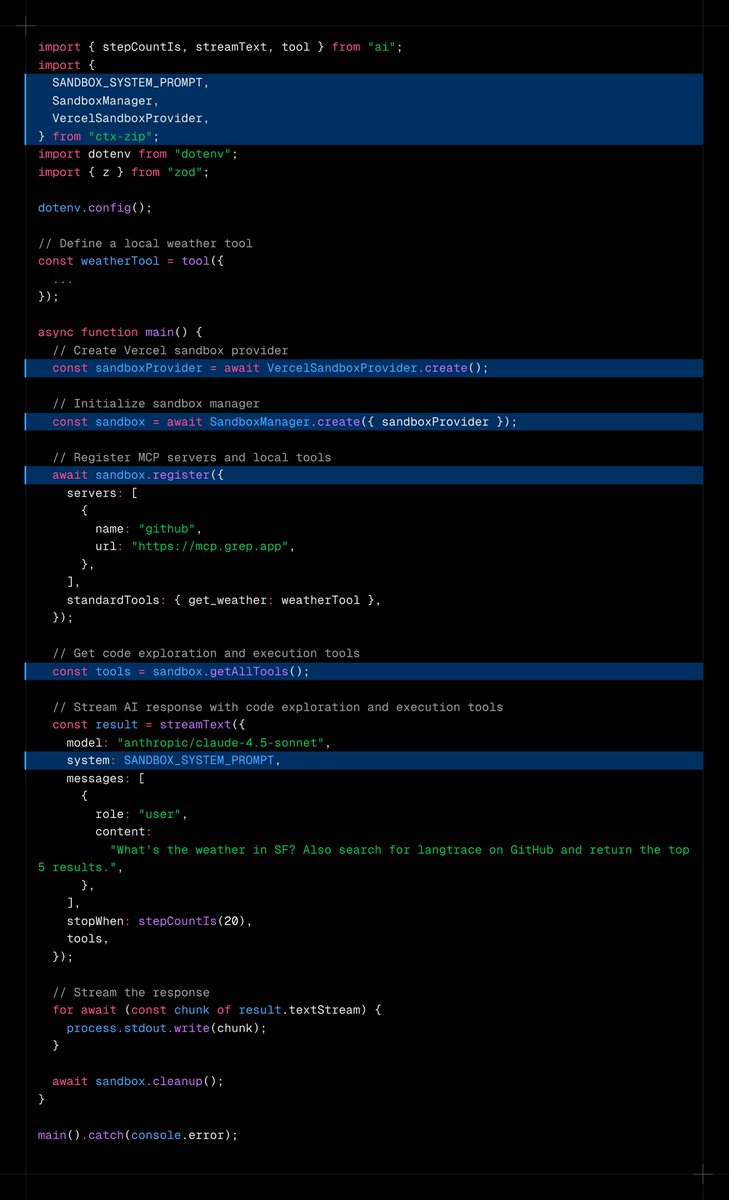
A thread about context engineering techniques and how ctx-zip can help with applying some of these techniques. 👇
First, ctx-zip now supports code execution mode with MCPs and locally defined tools without having to worry about setting up sandboxes.
- Works with @aisdk.
- Supports local, @vercel and @e2b sandbox providers for code execution and context compaction.

English

@karthikkalyan90 Append-only could be interesting, agreed!
Another thing our agent does a lot with search tool is parallel tool calling. Would parallel tool calls all end up in the same file right now?
English

For something like this, the agent is going to make incremental tool calls to explore different angles or the agent would have to make a single tool call, write all the results to a file and then explore different angles by grepping and searching the file. The latter is a better approach granted the initial tool call can returns all the results in one go(at least a few pages). In which case, you just need a single file. But if each incremental tool call writes to a separate file, it's going to leave a trail of files in the file system - could potentially make the agent go in loops grepping and searching. This is the reason why I restricted the design to overwrite the same tool file. Another interesting approach would be to maintain the files as append only logs for each tool call.
English

@karthikkalyan90 Imagine you have a tool that runs some sort of semantic search (maybe runs multiple tool calls to explore different angles), you might want to be able to keep all the results somewhere so that the agent can reference all the results. Or how do you see this use case working?
English

@_elledienne Right now, it overwrites to the same file if it’s the same tool call. This way files map to number of tools that are provided. I can certainly provide a configuration option such that it doesn’t overwrite it if that’s important for your use case.
English

@karthikkalyan90 This is awesome! Do you support writing tool output to files without overwriting previous ones?
English

ctx-zip is very much a library being actively developed. If you are dealing with agent context management actively, give it a try and leave your comments.
💫Here's the link to the repo
github.com/karthikscale3/…
English