

Gannon Hall
93 posts


Nobody is yet to find the number 👀
What number is in the box? RT
Correct answer wins $7000
Ends 50 hrs

English

This should be headline news EVERYWHERE.
A Pfizer insider who was former head of toxicology in Europe has just come out and said something that many "conspiracy theorists" suspected.
He estimates that 20 000 to 60 000 people in Germany have died from the c*vid vaccine.
This was said at a parliamentary enquiry commission in Germany.
So why isn't this massive news being reported everywhere?
Is the mainstream media that has recieved millions in funding from Bill Gates deliberately covering this up... 🤔
English
@pcshipp I do. Another unpopular opinion: co-pilot $39 sub is currently the best deal. It’s the last heavily subsidized option now that both Claude and codex usage limits have been heavily reduced.
English




I canceled Claude Code but still have to use it for 2 weeks because it was paid. OMG, it's so dumb!
You say, "Why did you do X?" And it's like: "You are right! I shouldn't have done X. I'm now doing Y!" And you're like, "ANSWER THE FUCKING QUESTION!" and it's like, "You are right to push back. I didn't think it through. Now I'm implementing solution Z!"
OMFG! If this Mythos will bring the original Claude Opus 4.4 back, it will already be a success for Anthropic.
English

@TeeDevh GitHub co-pilot $40 sub is still heavily subsidized. I think it’s the last good deal standing.
English

@rezoundous Not sure how long it will last, but GitHub co-pilot is still heavily subsidizing their $40 sub. Very generous limits. Works very well with pi coding agent.
English

I'm using my own thing: github.com/gannonh/kata
It uses Linear as the backend. Agent-driven structured planning: vertical slices ordered by risk, with dependency chains and a boundary map showing what each slice produces and consumes.
Decisions get logged in a decisions register: what was chosen, why, and whether it's reversible. Context documents capture the stuff that's easy to forget between sessions. Requirements get tracked with validation criteria so there's no ambiguity about what "done" means.
Each slice breaks down into tasks sized to fit within a single context window. Task plans have concrete must-haves: observable behaviors that must be true, and files that must exist with real implementations.
The execution engine is a Rust daemon that polls Linear and dispatches parallel agent workers to pick up tasks. Each worker implements, verifies against the must-haves, writes a summary with evidence, and advances the issue. "Desktop" has a built-in operator surface so you can start "Symphony" from the app, watch workers execute in real time, and respond to escalations when a worker needs a human call.
English


4 things I think most GenX was afraid of.
Acid Rain
Quick sand
Bermuda Triangle
Amnesia
What else?
English
@HuntGather83 @claudeai Apparently won’t work with Max: “Managed Agents is priced on consumption. Standard Claude Platform token rates apply, plus $0.08 per session-hour for active runtime.”
English

@claudeai I have a max plan this is not in my console. Can only access via the CLI
English

Introducing Claude Managed Agents: everything you need to build and deploy agents at scale.
It pairs an agent harness tuned for performance with production infrastructure, so you can go from prototype to launch in days.
Now in public beta on the Claude Platform.
English

People are freaking out that this will eat up their Max subscription. Fear not, you can’t use your Max subscription with this product.
From the blog announcement:
“Managed Agents is priced on consumption. Standard Claude Platform token rates apply, plus $0.08 per session-hour for active runtime.”
English
Build and deploy your agents through the Claude Console, Claude Code, or our new CLI: platform.claude.com/workspaces/def…
Read more on the blog: claude.com/blog/claude-ma…
English
Yesterday I shipped Kata Desktop 0.1.0, a native Electron app that brings together Kata CLI's structured planning and Symphony's autonomous orchestration in one surface. It wraps the CLI as a subprocess in JSON-RPC mode, so it inherits all CLI capabilities: multi-provider support, extensions, skills, MCP, Linear/GitHub integration, and the Kata planning methodology.
UI is still very rough, but it works end-to-end, from idea to merged PR. Pretty cool.
You start with a milestone (epic size or smaller). The agent interviews you about gray areas, conducts research, then writes a roadmap: vertical slices ordered by risk, with dependency chains and a boundary map showing what each slice produces and consumes.
Every decision gets logged in a decisions register: what was chosen, why, and whether it's reversible. Context documents capture the stuff that's easy to forget between sessions. Requirements get tracked with validation criteria so there's no ambiguity about what "done" means.
Each slice breaks down into tasks sized to fit within a single context window. Task plans have concrete must-haves: observable behaviors that must be true, and files that must exist with real implementations.
All of this is backed by Linear. Symphony alone does have a GitHub mode, where GitHub issues (and optionally Projects) serve as the backend, but I haven't brought this to Desktop or CLI yet.
I made the deliberate choice not to go with local markdown files, mainly because these tools (Linear, Jira, GitHub Issues, etc.) are purpose-built for issue and project lifecycle management. Why build a shadow system of local, fragile markdown files when that's not where the backlog lives?
Anyway... Milestones map to project milestones, slices to parent issues, tasks to sub-issues. The Desktop kanban board shows execution state live (what's in progress, what's blocked, what's done). Planning artifacts (roadmaps, decisions, context, requirements) are stored as Linear documents and update in the right-side pane as the agent works.
Symphony is the execution engine. It's a Rust daemon that polls the same Linear project and dispatches parallel agent workers to pick up tasks. It can be configured to use worktrees, cloned from local or remote repos. Each worker implements, verifies against the must-haves, writes a summary with evidence, and advances the issue. Desktop has a built-in operator surface so you can start Symphony from the app, watch workers execute in real time, and respond to escalations when a worker needs a human call.
The app bundles everything: CLI runtime, Symphony binary, Bun - so it works out of the box. Point it at a workspace and go.
github.com/gannonh/kata
English
Interesting. I find codex to be more competent (and efficient) with exacting specs, but less so with vague direction. It’s also humorless and very literal, which can be frustrating when you want to explore options more conversationally, or divert to an unplanned side quest. There is always a lot of scaffolding with my projects, but Claude seems more capable of temporarily operating free-form, and then successfully returning to a structured workflow. Codex requires a new session if you want to switch up modalities.
English

Jumped on the "try Codex instead of Claude Code" train. A few days in, my first impressions are:
1. Codex is better at making solid architectural choices in new projects I'm creating with it.
2. Claude Code is better at working in large established codebases.
(using mostly gpt-5.3-codex and claude-opus-4.6 respectively)
It's strange; I do feel Codex makes smarter architectural choices when planning new features, but it messes up broader code changes in large codebases more than I've ever seen with Claude Code.
I've seen a lot of "this is better" or "that is better", but curious on other people's nuanced takes. What models are you using? What are your takes?
English

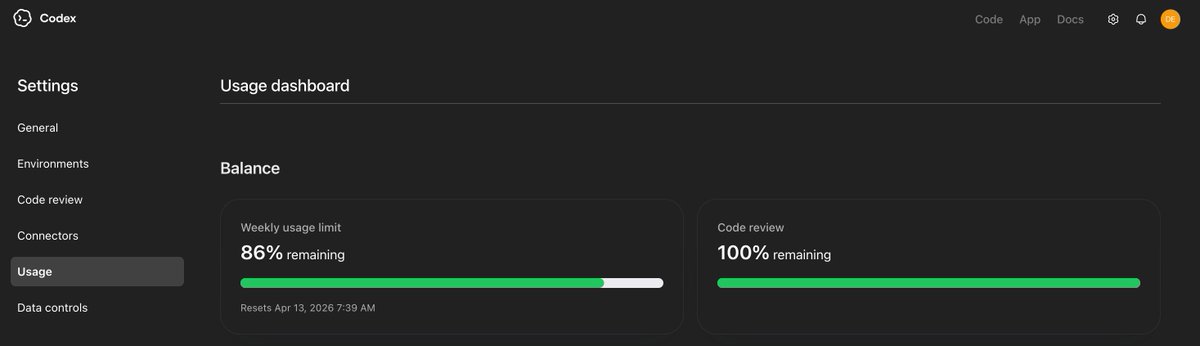
Did Codex remove the 5-hour limit? I only see the weekly limit. 👀
English
@james_xond Landline. Call waiting was a game changer when it arrived. You could chat as long as you wanted without your parents freaking out about missed calls.
English

People who were teenagers before social media existed… how did you communicate with your friends?
English
@svpino I’m having none of these issues using pi coding agent with my Max sub (although that may get me banned?).
English

@nikutaberuru Ibanez makes great guitars. And Japanese made Fenders are excellent.
English

親愛なるアメリカ兄貴たち
日本ではアメリカ製の楽器が
熱狂的に愛されています。
アメリカには日本製の楽器を
愛している人達はいるでしょうか?
日本語


@burkov I have 5x $20 plans. A little inconvenient but works, and the $20 weekly and session limits are generous.
English
If Codex had a $100/month plan, I would switch from Claude Code in a second. But since it doesn't, I pay $100/month to Amodei and $20/month to altman. I use Amodei for everything non-debugging and altman for anything debugging.
Just like before agentic coders, I used Claude for everything debugging and Gemini for everything else.
English