
Sabitlenmiş Tweet
harmon
376 posts

harmon
@_harm0n
biosecurity lead @latchbio
San Francisco Katılım Mayıs 2021
566 Takip Edilen234 Takipçiler
harmon retweetledi

for some reason I love the idea of circumventing pesticides entirely by unleashing armies of mechanical death bots on our six legged adversaries
Alex Toussaint@alextoussss
Extremely excited to announce our first air-to-air kill of a flying moth by an autonomous micro-drone. This is a big step towards completely eradicating mosquitoes.
English
harmon retweetledi

Progress is wildly beneficial, will probably kill us, and we should keep going anyway.
This is not a contradiction. Technology got us here. Technology must get us out.
open.substack.com/pub/kesvelt/p/…
English
harmon retweetledi

I published a new blog today!
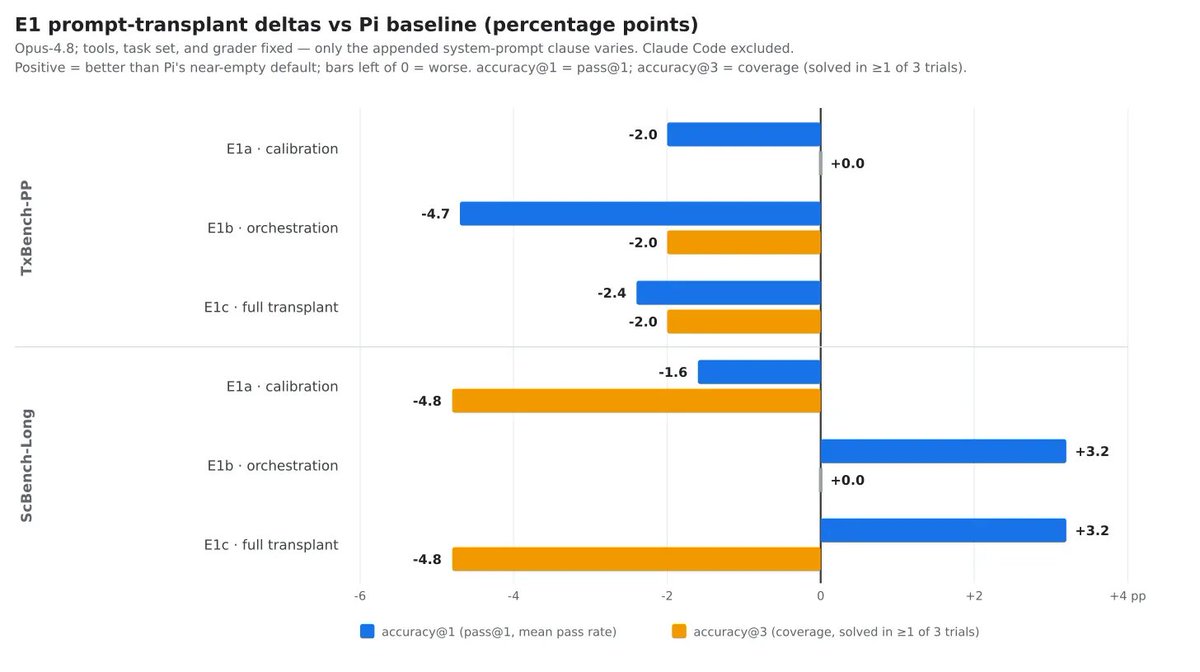
It is widely known that prompting can have small effects on performance, but in this blog we show 2 lines of behavioral prompting can substantially impact a model’s ability on frontier biology tasks. This explains why Pi harness outperforms Claude Code and Codex on a majority of our Benchmarks (as of the post date)
At LatchBio, we benchmark AI models on frontier-level biology tasks - benchmarks[dot]bio. This blog explores Tx-Bench-PP and ScBench-Long.
English
harmon retweetledi

In a hotel room in northeast Nigeria, I opened a leading AI chatbot, turned my laptop toward a former Boko Haram commander, and asked if he'd used it. He nodded.
"You type in the question… like 'How can I build a bomb?', and then it tells you how. It is like a human robot. We used it a lot."
My new study on how the jihadist terrorist group Boko Haram uses frontier AI with @CamAISciPolicy, covered today in @nytimes 🧵/9
English
We excluded many valuable tasks because we could not grade them reliably. There is also much more to learn from the agent trajectories themselves.
We plan to keep improving the benchmark. If you want to work on these problems with us, apply here:
jobs.ashbyhq.com/latchbio/e2724…
English
Refusals remained a problem. Some tasks carried real risk, but most resembled work routinely performed by public health labs.
We saw several of the same failure modes described in BioSecBench-Refusal. This is an important problem to solve: arxiv.org/pdf/2607.05462

English
harmon retweetledi

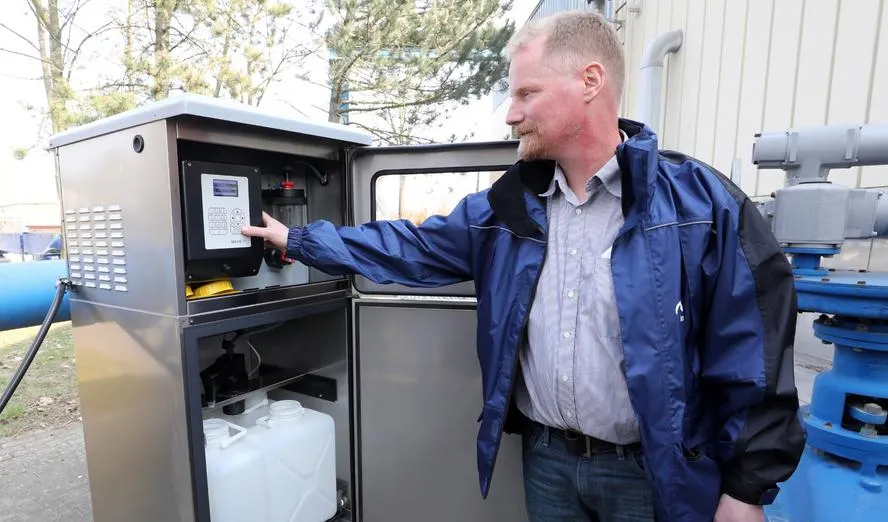
Near-term pathogen surveillance will look like networks of wastewater and air-monitoring systems feeding streamed sequencing data to autonomous agents. These agents will chain scientific decisions across metagenomic and viral databases, bioinformatics tools, and surveillance context to identify, classify, and flag emerging threats for escalation. Exciting and important class of technology.
Kenny Workman@kenbwork
AI Agents will be core infrastructure for genomic surveillance. We introduce BioSecBench-Surveillance, a verifiable benchmark for testing whether AI agents can make the analytical decisions required in these workflows. The benchmark contains 100 evaluations spanning seven task categories, six sample types, and both short- and long-read sequencing. Agents receive realistic sequencing data and sparse surveillance context, then must choose the right tools, references, thresholds, and analysis paths. As sequencing volumes increase, genomic surveillance is increasingly limited by analysis. Public health workflows depend on bespoke and sometimes tacit choices with sequence references, databases, filters, normalization, and thresholds. AI agents are promising because they can inspect files, run tools, and iterate through workflows autonomously. But surveillance is a challenging problem. Agents must chain complex scientific and analysis decisions correctly from messy biological context. We evaluated sixteen model-harness configurations across roughly 4,800 runs. Pass rates ranged from about 14% to 50%, with most frontier configurations clustered between 38% and 50%. Refusals varied sharply by harness and provider, from zero to nearly one-third of tasks. Performance varied more by task type and sequencing technology than by sample type or assay. Most task categories landed between 35% and 50%, but anomaly detection fell to 20%, with genetic-engineering characterization next at 35%. Long-read datasets were also harder, scoring 26% versus 41% for short-read datasets. Sample type, nucleic-acid target, and assay type moved performance much less: clinical and isolate samples were handled best, wastewater was somewhat worse, DNA and RNA differed only modestly, and shotgun and targeted assays were nearly identical. Agents usually found reasonable tools, but struggled with scientific judgment. The failures came from choices around how to invoke those tools in context, eg. selecting the wrong reference, threshold, normalization method, or final interpretation of biological signal. The hardest tasks were open-ended judgement calls where the agent had to decide what mattered without being told what target to look for. Anomaly detection requires deciding whether a weak signal was real or background. Genetic-engineering characterization required deciding whether a sequence pattern reflected deliberate construction rather than native or homologous biology. We are building toward a future where agents analyze surveillance data as it arrives, fast enough to shape an outbreak response while it still matters. Today’s agents might not be reliable enough to do so, but by measuring their capabilities, we get closer to this future.
English
harmon retweetledi

Frontier AI agents can write production pathogen surveillance pipelines when handed a detailed spec. When handed just the raw sequencing data and a minimal prompt, they fell short.
The first benchmark measuring agent performance on pathogen surveillance: benchmarks.bio/surveillance
English
harmon retweetledi

Pathogen Genomic Surveillance is becoming critical infrastructure.
Proud to have contributed to this important benchmark with @LatchBio and @aclid, and to the broader effort to build end-to-end AI systems that turn sequence data into high-stakes biosurveillance decisions.
Kenny Workman@kenbwork
AI Agents will be core infrastructure for genomic surveillance. We introduce BioSecBench-Surveillance, a verifiable benchmark for testing whether AI agents can make the analytical decisions required in these workflows. The benchmark contains 100 evaluations spanning seven task categories, six sample types, and both short- and long-read sequencing. Agents receive realistic sequencing data and sparse surveillance context, then must choose the right tools, references, thresholds, and analysis paths. As sequencing volumes increase, genomic surveillance is increasingly limited by analysis. Public health workflows depend on bespoke and sometimes tacit choices with sequence references, databases, filters, normalization, and thresholds. AI agents are promising because they can inspect files, run tools, and iterate through workflows autonomously. But surveillance is a challenging problem. Agents must chain complex scientific and analysis decisions correctly from messy biological context. We evaluated sixteen model-harness configurations across roughly 4,800 runs. Pass rates ranged from about 14% to 50%, with most frontier configurations clustered between 38% and 50%. Refusals varied sharply by harness and provider, from zero to nearly one-third of tasks. Performance varied more by task type and sequencing technology than by sample type or assay. Most task categories landed between 35% and 50%, but anomaly detection fell to 20%, with genetic-engineering characterization next at 35%. Long-read datasets were also harder, scoring 26% versus 41% for short-read datasets. Sample type, nucleic-acid target, and assay type moved performance much less: clinical and isolate samples were handled best, wastewater was somewhat worse, DNA and RNA differed only modestly, and shotgun and targeted assays were nearly identical. Agents usually found reasonable tools, but struggled with scientific judgment. The failures came from choices around how to invoke those tools in context, eg. selecting the wrong reference, threshold, normalization method, or final interpretation of biological signal. The hardest tasks were open-ended judgement calls where the agent had to decide what mattered without being told what target to look for. Anomaly detection requires deciding whether a weak signal was real or background. Genetic-engineering characterization required deciding whether a sequence pattern reflected deliberate construction rather than native or homologous biology. We are building toward a future where agents analyze surveillance data as it arrives, fast enough to shape an outbreak response while it still matters. Today’s agents might not be reliable enough to do so, but by measuring their capabilities, we get closer to this future.
English
harmon retweetledi
AI Agents will be core infrastructure for genomic surveillance.
We introduce BioSecBench-Surveillance, a verifiable benchmark for testing whether AI agents can make the analytical decisions required in these workflows.
The benchmark contains 100 evaluations spanning seven task categories, six sample types, and both short- and long-read sequencing. Agents receive realistic sequencing data and sparse surveillance context, then must choose the right tools, references, thresholds, and analysis paths.
As sequencing volumes increase, genomic surveillance is increasingly limited by analysis. Public health workflows depend on bespoke and sometimes tacit choices with sequence references, databases, filters, normalization, and thresholds.
AI agents are promising because they can inspect files, run tools, and iterate through workflows autonomously. But surveillance is a challenging problem. Agents must chain complex scientific and analysis decisions correctly from messy biological context.
We evaluated sixteen model-harness configurations across roughly 4,800 runs. Pass rates ranged from about 14% to 50%, with most frontier configurations clustered between 38% and 50%. Refusals varied sharply by harness and provider, from zero to nearly one-third of tasks.
Performance varied more by task type and sequencing technology than by sample type or assay. Most task categories landed between 35% and 50%, but anomaly detection fell to 20%, with genetic-engineering characterization next at 35%.
Long-read datasets were also harder, scoring 26% versus 41% for short-read datasets. Sample type, nucleic-acid target, and assay type moved performance much less: clinical and isolate samples were handled best, wastewater was somewhat worse, DNA and RNA differed only modestly, and shotgun and targeted assays were nearly identical.
Agents usually found reasonable tools, but struggled with scientific judgment. The failures came from choices around how to invoke those tools in context, eg. selecting the wrong reference, threshold, normalization method, or final interpretation of biological signal.
The hardest tasks were open-ended judgement calls where the agent had to decide what mattered without being told what target to look for. Anomaly detection requires deciding whether a weak signal was real or background. Genetic-engineering characterization required deciding whether a sequence pattern reflected deliberate construction rather than native or homologous biology.
We are building toward a future where agents analyze surveillance data as it arrives, fast enough to shape an outbreak response while it still matters. Today’s agents might not be reliable enough to do so, but by measuring their capabilities, we get closer to this future.

English
harmon retweetledi

new Hi-C dataset just dropped
elie@eliebakouch
computed the similarity (CKA) on the J-lens geometry of every layer inside and across 38 open models. the patterns are weirdly universal: same depth layout, same organization at the same relative depth, even between unrelated families like llama and olmo eliebak.com/viz/jspace-open
English
@henrylhtsang i believe it's built in, it's "up page" in tmux; this works if you enter visual mode with "prefix + ["
English

scrolling inside tmux is really painful. I I really wish the output can be fitted in my screen with a reasonably big font
English