The demand for exceptional AI-native software engineering is skyrocketing right now.
It's why 50%+ of our business at @tenex_labs is elite engineering-as-a-service for midmarket & enterprise companies.
@levie talks about it a lot, but as the power of AI defuses from engineering to all other areas of knowledge work, the laundry list of needs for builders that have AI chops, strong systems thinking, and deep process knowledge is going parabolic.
Moreover, a list of patterns is emerging for where companies need the most engineering help in a post-AI world. I thought it'd be helpful to share.
Here's the internal list we've been keeping:
- Data engineering & organization: helping companies unify, clean, and get their data to be agent-ready
- Old-fashioned software engineering, supercharged by agentic workflows
- Build "the brain": single source of truth with RBAC upon which information can be queried or transformed with customized agents
- Cyber hardening: reduce AI-era cyber risk by identifying highest-risk exposure and rapidly implementing practical controls, automations, and monitoring
- Token audits: helping AI-native software orgs build & deploy strategies for token efficiency/costs
- Generative UI: building intelligence dashboards engines that enable every role in a company to act fast on data-driven insights
- Edge ML: building and scaling resource-constrained computer vision model for retail applications
- BYOA: build custom agents for any repetitive business process, from deep process mining to build, enablement, and enhancement
- SDLC colonoscopy: studying a company's software lifecycle, identifying bottlenecks, and driving efficiency so code isn't metered by organizational inefficiency
- Stack rebuilds: Rebuilding old systems for 1/10th of the cost at 10x the speed
- Stack speed-ups: Rebuilding systems to be most agentic engineering-friendly
- Autonomous SRE: setting up agents in CI/CD and connected to monitoring tools to automatically raise PRs for bug fixes
What's missing from this list?
P.S. if you need an elite squad of AI-native engineers to supercharge your business, shoot me a DM.
I want to start an AI community for executives.
This will be a space for people to share killer use cases, agentic workflows/agents, post-AI org structure, AI governance, AI training/enablement, change management, and more.
Comment “AI-native” if you want to join.
I turned our AI company’s products into a high-end Japanese restaurant menu.
Why? I was bored and also feel like B2B companies can be boring AF.
Also, execs constantly asked me what being an AI transformation partner means, so I decided to have fun with it.
Now anytime someone asks, they’re getting dishes from Tenex Kitchen (link to menu below).
This includes:
Kama to Tail
Enterprise AI Diagnostic
Collar to tail...top-to-bottom scan of your org's AI readiness.
Behind the Counter
Engineering Org Audit
We tour the line, the prep stations, the walk-ins. Tell you what's slowing the chefs down.
The Walk-In
Data Lake Audit
Every ingredient inventoried...fresh, spoiled, mislabeled.
The Counter Critic
Pre-Transaction AI Diligence
For PE/VC...quiet evaluation at the counter before you buy the restaurant.
The Itamae Council
AI Steering Committee Design
The master chefs who decide what goes on the menu and run the brigade.
The Executive Omakase
ELT / C-Suite Training
Curated, multi-course. Designed for the people at the head table.
Tabehoudai Hack Week
AI Hack Week
All-you-can-eat. Five days, one room, a buffet of working prototypes.
The Bento Box
Function-Specific Training
Sales, finance, ops, legal — each compartment plated to taste.
Bento for Two
Standard Engineering Pod
1 strategist + 1 engineer. Ships full-stack software or AI products — agents, web apps, integrations, internal tools — in 4-week sprints.
The Full Kaiseki
Enterprise Engineering Program
Multiple pods running in parallel. For enterprise-scale programs — agent platforms, custom applications, unified data layers, MCP infrastructure — deployed across business units.
Full menu here: tenex-kitchen-menu.vercel.app
P.S. I will be launching Tenex kitchen on DoorDash ASAP. Already applied as a merchant.
I may be crazy, but I built a 20-level excel game to find a Finance savant to join our company.
The game is called "Bug Hunt," and any excel junkie interested in becoming the leader of our Finance function at @tenex_labs can play.
If you complete all 20 levels, you are accelerated to a final round interview with my cofounder & me.
Here's how it works:
1) Open the model. It's a live workbook in your browser with the "finished" financials of a fictitious SaaS company.
2) Mark every bug. Click any cell, write one line of reasoning. Submit when you're sure. There are 20 total.
3) Climb the tiers. Each correct catch unlocks the next. The final three are veteran CFO-level.
4) Hit level 20 & auto-move to a final round interview.
Play the game: web-production-42101.up.railway.app
P.S. you can still apply to be our Senior Director of Strategic Finance (application below) the normal way, it's just a little less fun & you don't get an auto-invite to final round.
Your company needs an "AI Bulldozer."
The biggest problem in AI adoption is not technology.
It's people.
If you company doesn't have a bulldozer actively unblocking AI projects, you have to be that bulldozer.
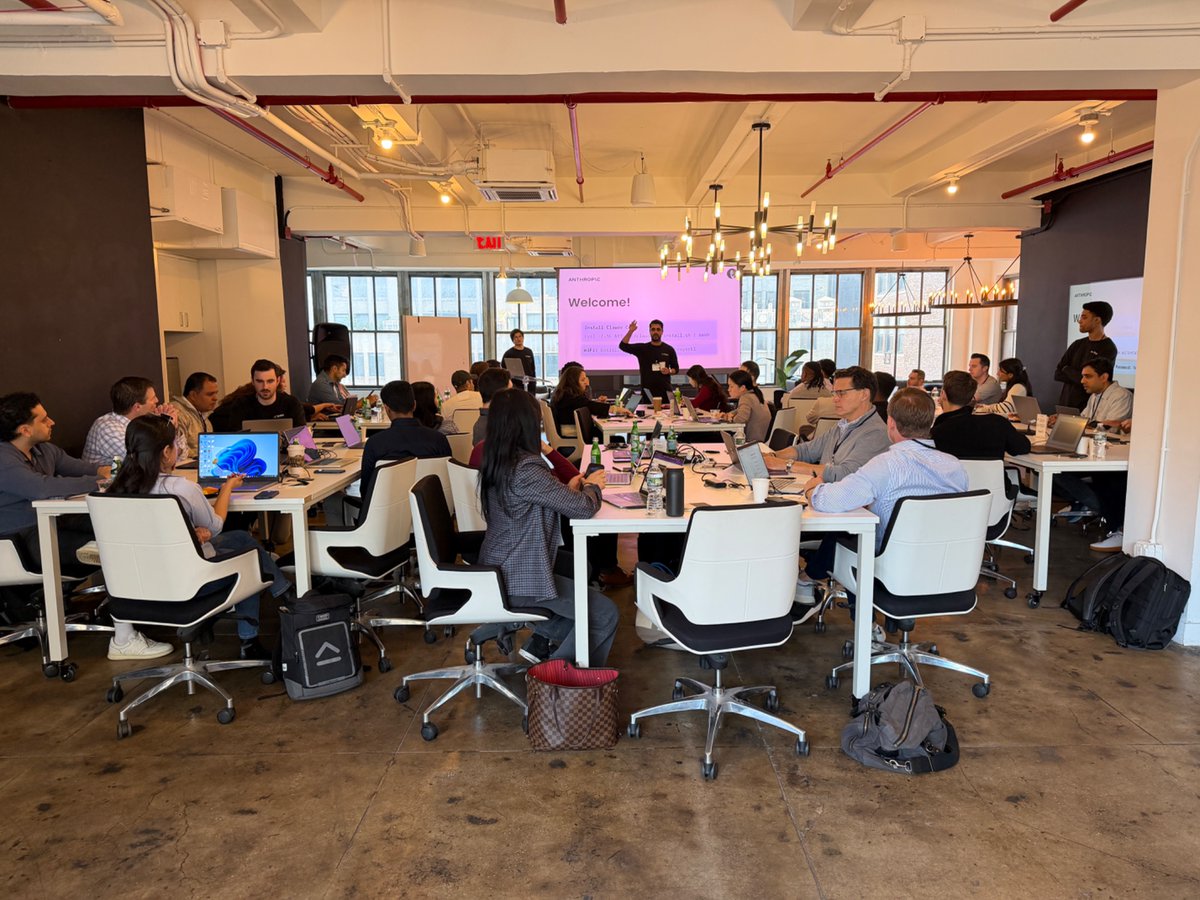
We have $3.3T in market cap represented by 35 C-suite leaders in this room.
In partnership with @AnthropicAI, we at @tenex_labs are training these leaders on how to best leverage Claude Code across their org in engineering and non-engineering contexts.
I have such deep respect for these execs. It can be daunting as a non-engineer to be working in the terminal, hearing phrases like agent & repo, but the best way to drive change with this technology is to understand the technology.
No matter what people say, AI transformation starts from the top.
If leaders don’t believe that we are at the precipice of a tidal wave in technology, their business is cooked.
If leaders don’t champion the urgency and necessity of transformation, their business is cooked.
And one of the best ways to be the leader your company needs today is to lead from the trenches, not the top.
Our company @tenex_labs turned 1 last week.
It’s been the craziest professional year of my life building the premier AI transformation & engineering partner for the enterprise.
A longer post with reflections and lessons to come, but wanted to share a highlight reel:
- Hit the average revenue of a Series B company without raising a dollar
- Helping drive successful AI transformation for enterprises worth a combined $500bn in market cap
- Partnerships with @AnthropicAI, @Lovable, @vercel, @OpenAI, and @LangChain
- Team of 30 high agency, high horsepower, humble ai engineers, ai strategists, and recruiters trying to change the world together
- Training C-suite leaders from @jpmorgan, @McKesson, @Citadel, @Mets, @nytimes, @Hertz, and more.
It’s such a privilege to help companies and leaders finish on the right side of a post-AI society, and the work only gets more important and higher stakes from here.
Brick by brick.
We’re seeing insane demand at @tenex_labs right now.
Im hunting for the next few members of our cracked family.
You’ll work directly with a high-caliber team building on some of the most important problems in AI and technology today.
Looking for great generalist engineers with a spike in any technical domain — ML/DL, mobile, gaming, embedded, distributed systems, full-stack, etc.
High ownership. Fast shipping. Real impact.
I’ll personally refer the best candidates.
If interested, DM me very briefly:
• what you’re great at
• why you’d be a good fit
No resume needed — I’ll check your LinkedIn/GitHub.
Tenex has 10x'd in 12 months.
Now we're hiring exactly one f*ckton of people.
First role is AI Strategist.
You will own driving company-wide AI transformation for late-stage startups to Fortune 50 businesses.
Role is open to anyone, but especially relevant for consultants from the following companies.
@McKinsey@BainandCompany@BCG@Accenture@Deloitte
EY
Second role is AI Engineer.
You are cracked AF. AI maximalist. Ironclad fundamentals (systems design, architecture, full-stack). And you want to be on the frontier of building agentic systems.
See jobs below...
Every engineer I speak to is worried about the future of their profession.
I tell them to join a company that requires them to:
- Solve increasingly complex problems that require deep nuance and taste
- Build big agentic systems that require specialized AI/ML knowledge
- Flex their communication skills as the role of PM/Engineer converge
- Maximize their use of coding agents & AI tools in their workflows
- Breadth of projects that improve taste and dot connection over time
p.s. this is the expectation of every engineer we hire at @tenex_labs. apply and stay relevant in a post-ai world.
Recruiting is painful. It's especially painful when you need to hyperscale your business.
I'm currently feeling this pain big time.
I have to hire 15 engineers in the next 37 days, while keeping talent density high.
Not sure if it will be possible, but here's my playbook for building a recruiting machine:
1) We match selling with anti-selling
Every engineer at @tenex_labs gets two spiels:
Why you should work here:
- You get paid like a salesperson (uncapped variable upside)
- You are forced to operate on the frontier of AI
- You get immense diversity in the software you build from deep ML systems to vertical-specific agents to full-stack applications
Why you shouldn't work here:
- You will work a lot (not because we care about facetime, but because there's a shit ton to do)
- You have to be willing to bet on yourself, because that's how your comp is structured
- You have to be okay working on a portfolio of projects vs. all your energy on one product
2) We identify undervalued hubs of talent
We intentionally avoid recruiting from the obvious suspects like FAANG + high-growth startups known for their engineering talent.
We focus all of our energy recruiting from underrated talent pools that match the ideal candidate (entrepreneurial, end-to-end systems experience, AI-pilled) profile.
Examples: founding engineer, failing startups, non-FAANG combined w/ side hustles, product hunt, indie hackers, claude code community
3) We optimize the interview process for return-on-time-spent
Many interview processes are unnecessarily long.
We build our process around one question: how can we know whether you're the right fit in as close to 0 minutes as possible?
This is arguably the most important step in the system to make sure we're maintaining insane recruiting velocity.
Here's our process if helpful:
1) Intake interview
2) First round interview
3) Technical take home
4) Systems design interview
5) Final round interview
4) We open-sourcing recruiting
We invite every single person on earth to recruit for us.
If you refer a candidate & they get hired + stay for 90 days, you make $5,000.
I've watched people make a living off of this arrangement.
Turning our recruiting engine into a social network is how we cover as much ground as humanly possible.
5) We put our money where our mouth is
We only have 1 executive in our business right now.
And that person ran talent acquisition at a company that was hiring 1,000 engineers per year.
If you want to build a worldclass recruiting engine, you need to be willing to pay up for worldclass recruiting talent.
6) We take an AI-native approach to recruiting
We use @juicebox_work for sourcing talent.
We use @Lovable to build a talent FAQ site.
We use @claudeai to build up a list of talent prospects across hubs like product hunt, indie hackers, etc.
We use @claudeai to help us more effectively filter tons of apps through our ATS (@ashbyhq)
P.S. if you have any questions about our recruiting strategy, reply below. happy to help.
P.P.S. if you want to be an engineer at @tenex_labs make sure to apply.
P.P.P.S if you want to refer a candidate make sure to tell them to apply and then mention you in their first round interview.
ATTENTION NYC FOLKS 🚨
I have a massive penthouse in New York City with a balcony, beautiful kitchen, 3 beds, 2.5 bathrooms
Looking to fill 2 rooms, and rent is actually very cheap. Lease starts April 1st, 2026.
Comment/DM if interested, signal boosting appreciated!
One of the cooler full circle moments of my career....
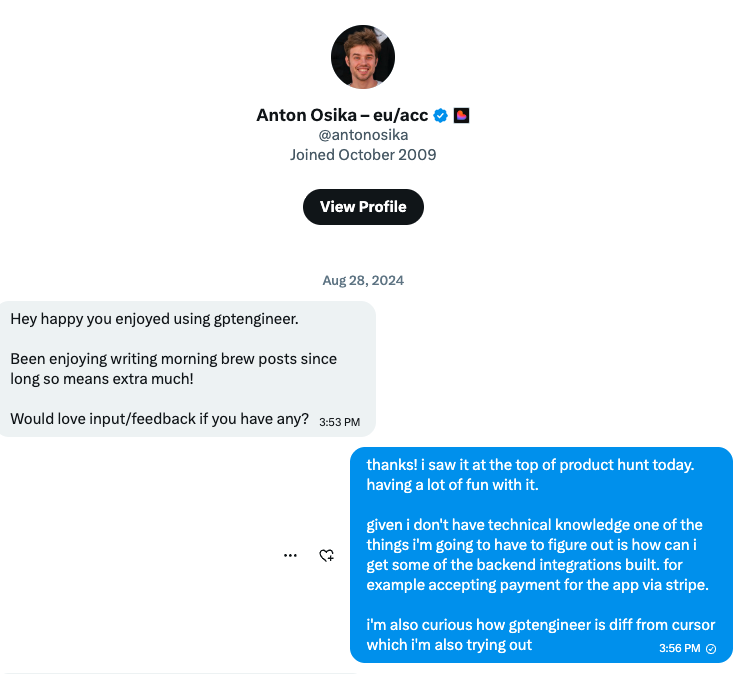
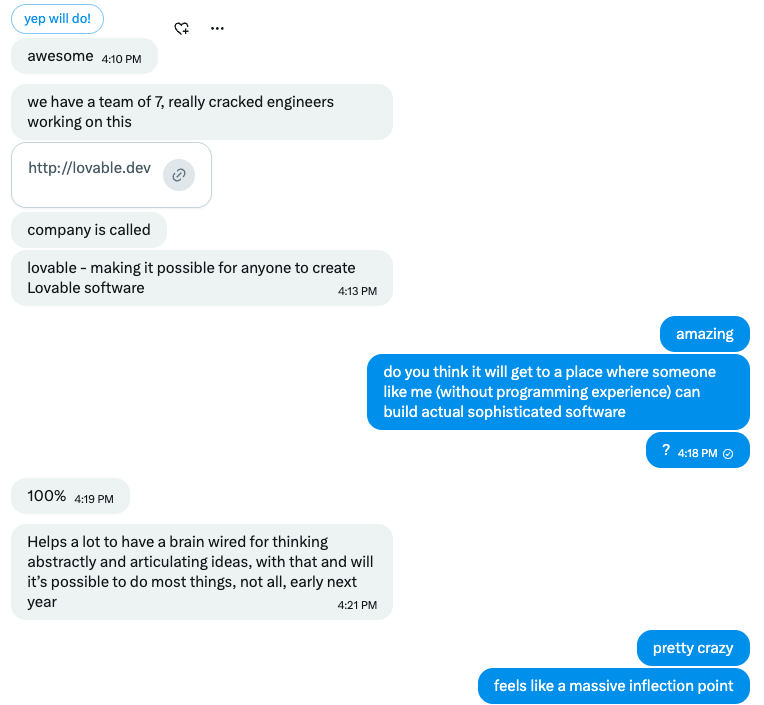
August 28, 2024, I first DM'd with @antonosika, CEO of Lovable.
At the time, he had just launched gptengineer (Lovable's first product) on Product Hunt and ranked #2 for the day.
I was struck by Anton's vision of making it possible for anyone to create "lovable" software & his relentless pursuit of feedback & ideas to make the product better.
It's no surprise that @Lovable has gone on to become a $6.6 billion business with enterprise customers ranging from Uber to Zendesk.
And to accelerate this effort of putting 1-of-1 software in the hands of enterprises for their most important use cases, Lovable has named @tenex_labs as its first official service partner.
As you can imagine, I'm amped as hell about this.
Together, we are going to enable the biggest companies in the world to build production-ready, complex & secure systems—especially enterprise-ready software including internal tools.
Tenex will bring deep engineering expertise to productionize complex backend systems, while Lovable enables teams to ship intuitive, flexible frontends faster than ever.
We’re excited to continue building on this early traction and to set the standard for what Tenex’s service engine can achieve with Lovable in this new era of software creation.
Let's. Go.
People I deeply respect have called me crazy for every business I've started.
At @MorningBrew, it was "how do you expect to build a REAL business on a newsletter?"
Now, at @tenex_labs, it's "are you out of your mind starting a dev shop?"
The skepticism was palpable:
- "Dev shops have a horrific reputation."
- "You'll never be able to attract great talent."
- "Companies don't want to work with dev shops."
- "Dev shops create sloppy software with underpaid talent."
We heard them, but where they saw red flags, we saw massive upside.
Misbranding is one of the greatest arbitrages in business & we saw that so clearly in front of us.
"What if we change the story around dev shops?"
From something a CEO/COO/CTO wouldn't touch with a 10ft pole to THE ONLY WAY to access top .1% AI engineering talent in the U.S.
Our thesis was simple:
If we offer engineers uncapped upside (aka paid like salespeople) & the opportunity to gain mastery over building with AI & building AI systems for customers, we think we can pull it off.
Usually it takes bets like this years to pay off, but given how fast things are moving, the thesis has played out in just 11 months.
1) We have the best engineers I've ever worked with in my life. Engineers I would never have been able to hire in my previous businesses.
2) We have unbelievable companies from hockey-stick growth Series B startups to $250bn Fortune 50 companies working with our "dev shop" to access talent/expertise they couldn't on their own.
We unf*cked a bad brand & it's paying off big time.