Sabitlenmiş Tweet

Culture is what we make, not what we buy




Shelby Ruth Ellis@shelbyruthellis
Culture is what we make, not what we buy
English
ꜱᴘᴀᴄᴇ ᴘᴜɴᴋ
51.5K posts

@_space_punk_
the greatest thing you'll ever learn is just to love and be loved in return
Culture is what we make, not what we buy


If Pope Leo XIV is a “Marxist” for his comments on wealth and the care we owe to the poor, then the Church Fathers are hyper-Marxists. Of course, they were not, and much of this is just evidence of how deeply corrupted by mammon our apostate society has become.

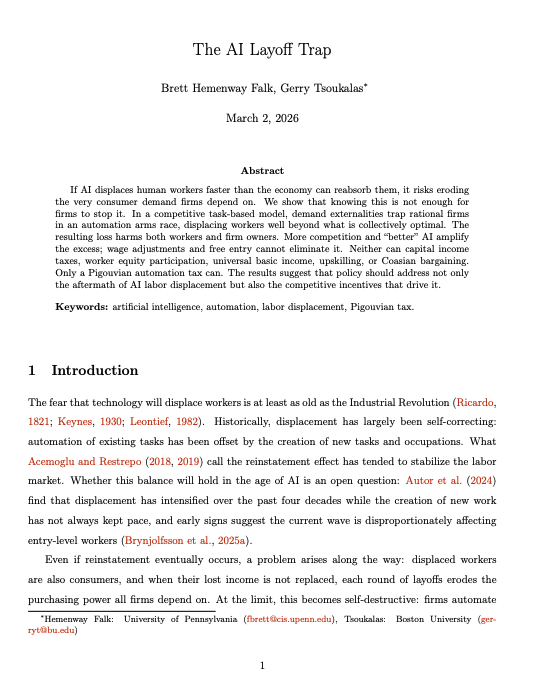
Alright, imagine a small town with 10 restaurants. Every restaurant employs local people - cooks, servers, dishwashers. Those employees eat out at each other's restaurants on their days off. The whole town's dining economy is basically a circle: restaurants pay workers, workers eat at restaurants. Now a magical cooking robot arrives. It costs half what a human cook costs and never calls in sick. Restaurant owner Maria looks at the numbers. If she replaces her three cooks with robots, she saves a fortune on wages. Yes, those three fired cooks will stop eating out around town, but that lost spending gets spread across all 10 restaurants. Maria's place only loses a tenth of it. The savings massively outweigh her tiny slice of the demand hit. So she buys the robots. Every other owner does the exact same calculation and reaches the exact same conclusion. They can all see what's coming. They even talk about it at the chamber of commerce meeting. "If we all do this, we'll have no customers left." Everyone nods gravely. Then they all go home and buy the robots anyway, because any single owner who holds back just eats the demand loss from everyone else's layoffs while also paying higher wages. You'd be the expensive restaurant in a town of unemployed people. Six months later, the town is full of incredibly efficient robot-staffed restaurants with almost nobody coming through the doors. Every owner is making *less* money than before they automated. The workers are obviously worse off too. The surplus didn't transfer from workers to owners - it just evaporated. Now the town council meets to figure out what to do. Someone suggests giving everyone a basic stipend (UBI). That helps people eat, but it doesn't change the math any restaurant owner faces. The robots are still cheaper than humans, and the demand loss from firing one more worker still gets spread across 10 restaurants. Owners keep automating at the same rate. Someone suggests taxing restaurant profits and redistributing the money. Same problem. You're taxing 30% of profits instead of 0%, but 70% of a higher number is still better than 100% of a lower number. The incentive to automate doesn't budge. Someone suggests the owners just agree to limit automation. They shake hands on it. Then Maria thinks, "If the other nine stick to the deal but I quietly add one more robot, I pocket the savings and the demand hit is negligible." Everyone thinks this simultaneously. The deal falls apart by Tuesday. Someone suggests giving workers ownership stakes in the restaurants. This helps - workers who own shares spend their dividends at other restaurants, recycling some money back. But it can't fully close the gap because workers only spend a fraction of their dividends on dining out. Some leaks away to rent and groceries and everything else. Finally, the town accountant proposes something different: a per-robot tax set exactly equal to the demand damage each robot imposes on the *other nine restaurants*. Now when Maria considers adding one more robot, the tax forces her to pay for the full demand destruction, not just her one-tenth share. The math flips. She only automates up to the point where it's genuinely efficient for the whole town. And here's the elegant part - the tax revenue funds retraining programs that help fired cooks become, say, robot maintenance technicians who earn comparable wages. As those retrained workers start spending in town again, the demand problem shrinks, which means the tax can shrink too. Eventually, if retraining works well enough, the tax approaches zero on its own. That's the whole paper. The trap is that every owner's individually rational decision is collectively suicidal, and most of the obvious policy fixes operate on the wrong part of the equation.



Hit me with the harshest reality truth.


Its sad to see people get conned and like what do you mean your "teacher" makes you give them money to speak to them? Thats not love. My teachers actually liked me and gave me tasty food and I gave them fruit and flowers. You know, like people who actually love each other act.

Women who teach anima integration to men will print. Why aren’t they doing this. Mother wound maxxing.
Sin is the root cause of the poverty If the Church of Rome could save sinners, their countries would not be so poor This is not a problem for the Calvinism


Hundreds of millions of people throughout the world are immersed in extreme poverty. Yet, disproportionate wealth remains in the hands of a few. It is an unjust scenario, in the face of which we cannot fail to question ourselves and commit to change things. There is no lack of resources at the root of disparities, but the need to address solvable problems related to a more equitable distribution of wealth, to be achieved with moral sense and honesty.