

Sunil S. Rawat
16.9K posts

Sunil S. Rawat
@_sunilrawat
Distributed Systems. Distributed Algorithms. Risk Management. Underwriting. Stress Testing. Econ. Bad Jokes. AI.
San Francisco Bay Area Katılım Mayıs 2008
899 Takip Edilen5.1K Takipçiler

Balaji is a bright guy but he fled the USA and has set his mind totally against our future success.
He lives in a world where US is losing and China is winning. This is his fixation. It’s dangerous, and it’s wrong. And this war has embarrassed China, destroyed their 100 cargo planes of war materials and their military ally, and frustrates them.
It’s fair to disagree about the attack. But saying that its architects are guilty of any downside is childlike nonsense. They should be proud of their work and their courage to take on this evil.
If you’re against the war, do you get credit for the last two decades of literal mass torture and mass rape and repression by this regime, and its terror funding and death around the region? Do you get credit for “supporting” the billions it spends on social media bots and information operations to polarize the US against ourselves, and weaken the west? Do you also get credit for what would have been the next twenty years of that?
Are you, Balaji, responsible for that side of it? No?
But if you are for it, you get zero credit for fixing any of that, but blamed for ALL the possible downsides? Total BS.
The mullahs holding the region hostage shouldn’t get your help to blame others for the damage they do.
Geopolitics and war is complex and there are risks on all sides. There is risk in acting, and in not acting.
I’m really glad we are taking advantage of the massive innovation and competence gap that exists at this moment, and finally eliminating so much evil.
I hope for freedom for the Iranian people and know that the situation is hard and complex, but either way it is good to stop the bad guys and eliminate so many of the worst groups, who have done so much damage, from history. Nobody should get away with what those bastards did for so long; this was long overdue.
Balaji@balajis
I'm going to make some obvious points. (1) Blowing up all the oil infrastructure in the Middle East is an insane idea, and may well result in a global economic crash and humanitarian crisis unrivaled in the lives of those now living. We're talking about the price of everything everywhere rising, from food to gas, at a moment when inflation was already high. All of that will be laid at the feet of the authors of this war. (2) The antebellum status quo of Feb 27, 2026 was just not that bad, but we're unlikely to return to it. Expect indefinite, long-term, ongoing disruptions to everything out of the Middle East. (3) Also assume tech financing crashes for the indefinite future. The genius plan to get the Gulf states caught in the crossfire has incinerated much of the funding for LPs, for datacenters, and for IPOs. Anyone in tech who supported this war may soon learn the meaning of "force majeure" as funding gets yanked. (4) Many capital allocators will instead be allocating much further down Maslow's hierarchy of needs, towards useful basic things like food and energy. (5) It's fortunate that all those progressives yelled about the "climate crisis." Yes, their reasoning about timelines was wrong, and much of the money was wasted in graft, but the result was right: we all need energy independence from the Middle East, pronto. It's also fortunate that Elon and China autistically took climate seriously. Now they're going to need to ship a billion solar panels, electric vehicles, batteries, nuclear power plants, and the like to get everyone off oil, immediately. (6) It's not just an oil and gas problem, of course. It's also a fertilizer problem, and a chemical precursor problem. Maybe some new sources will come online at the new prices, but it takes time to dial stuff up, particularly at this scale, so shortages are almost a certainty. That said, China has actually scaled up coal-to-chemicals[a,c] (C2C), and there's also something more sci-fi called Power-to-X[b] which turns arbitrary power + water + air into hydrocarbons. But all of that will need to get accelerated. I have a background in chemical engineering so may start funding things in this area. (7) Ultimately, this war is going to result in tremendous blame for anyone associated with it. It's a no-win scenario to blow up this much infrastructure for so many people. Simply not worth it for whatever objective they thought they were going to attain. But unless you're actually in a position to stop the madness, the pragmatic thing to do is: scramble to mitigate the fallout to yourself, your business, and your people. [a]: reuters.com/business/energ… [b]: alfalaval.com/industries/ene… [c]: reuters.com/sustainability…
English

@TheValueist How does x86 fit into this? Not at all I guess. x86 only for legacy applications in the future. Intel and AMD are smoked.
English
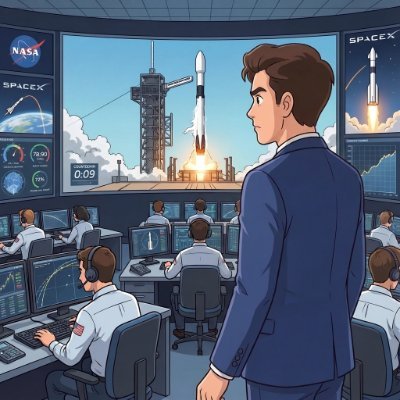
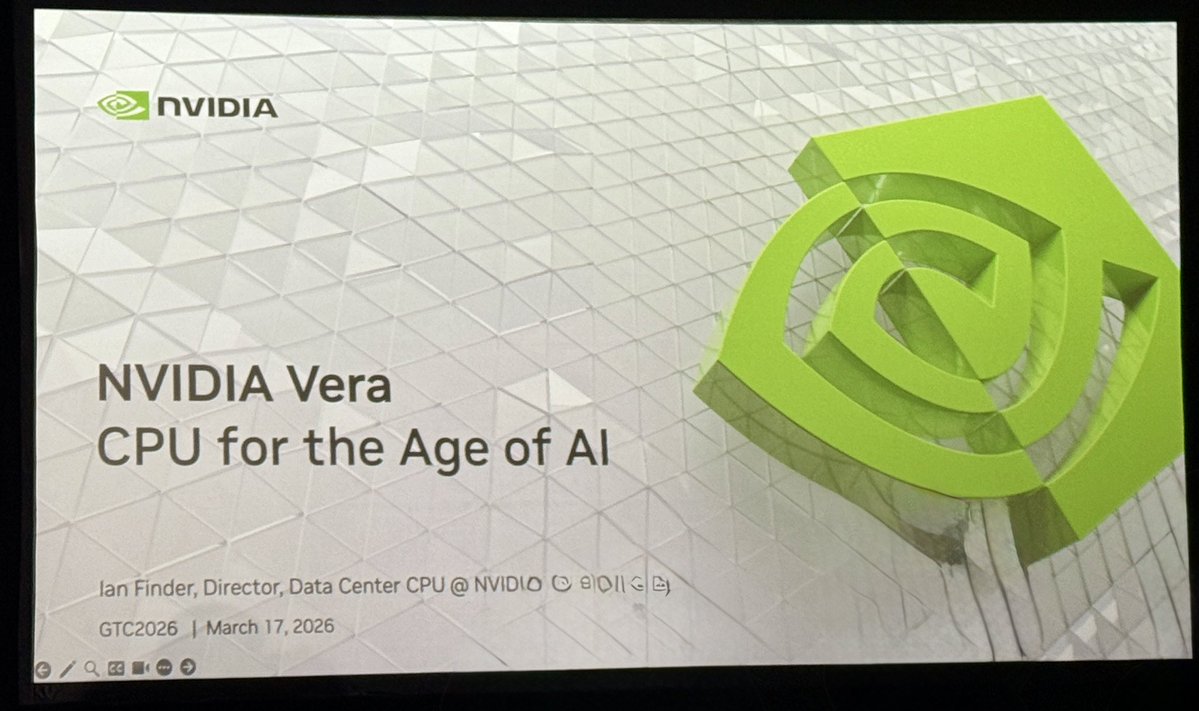
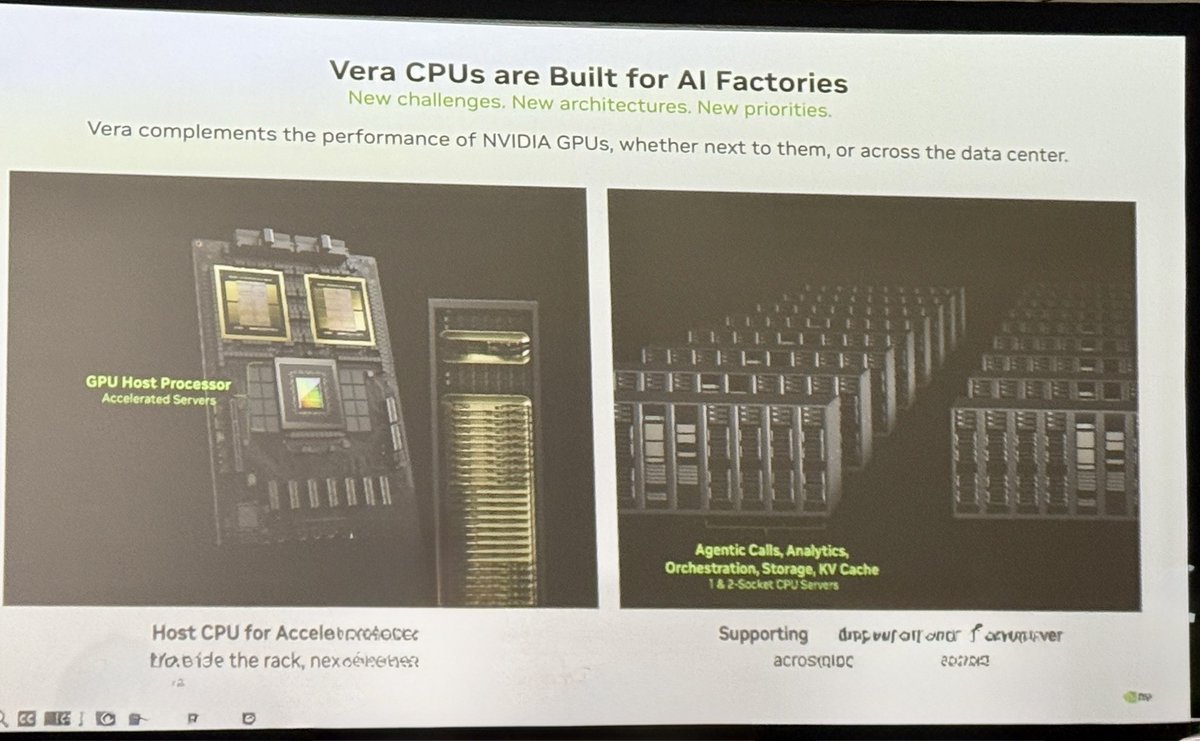
This Vera CPU presentation was the best of the day as it crystalizes what to expect for GAI over the next 24-36 months.
My biggest takeaway from GTC Day 2: the market is grossly underestimating the massive CPU demand that will be generated by agentic GAI and by LLMs acting as orchestrators marshaling CPU compute resources for a countless variety of tasks.
$NVDA $AMD $INTC $AVGO


TheValueist@TheValueist
$NVDA DESK NOTE - NVIDIA Vera CPU: The Amdahl Argument for a Purpose-Built AI Factory CPU atlaspeakresearch.com/report/1683d7 Bottom Line: Vera is best understood as a purpose-built AI-factory CPU designed to compress the serial fraction of reasoning, tool-use, and reinforcement-learning workflows so that GPU capital does not sit idle behind CPU-bound orchestration. Its differentiation comes from five interacting features: unusually high single-thread ambition for control-heavy code, unusually high memory bandwidth per active core, deterministic full-socket behavior, coherent CPU-GPU memory via NVLink-C2C, and rack-scale power efficiency. Against that, AMD and Intel remain stronger on universality, x86 software inertia, memory capacity, and standards-based flexibility. Vera therefore looks less like a broad x86 killer and more like a specialized control-plane and environment processor that becomes highly compelling precisely where Amdahl's Law makes the CPU impossible to ignore.
English
@Noahpinion They sound like AI tourists with hot takes vs expert practitioners and company builders
English

Last week two different AI founders came over to my house for tea. One told me he would like AI to be banned, and wishes it had never been invented. The other claimed that AI has plateaued and isn't very useful.
Always interesting to see the diversity of viewpoints out there.
English

@greengart Bigger is more expensive! That's something consumers can easily understand.
English

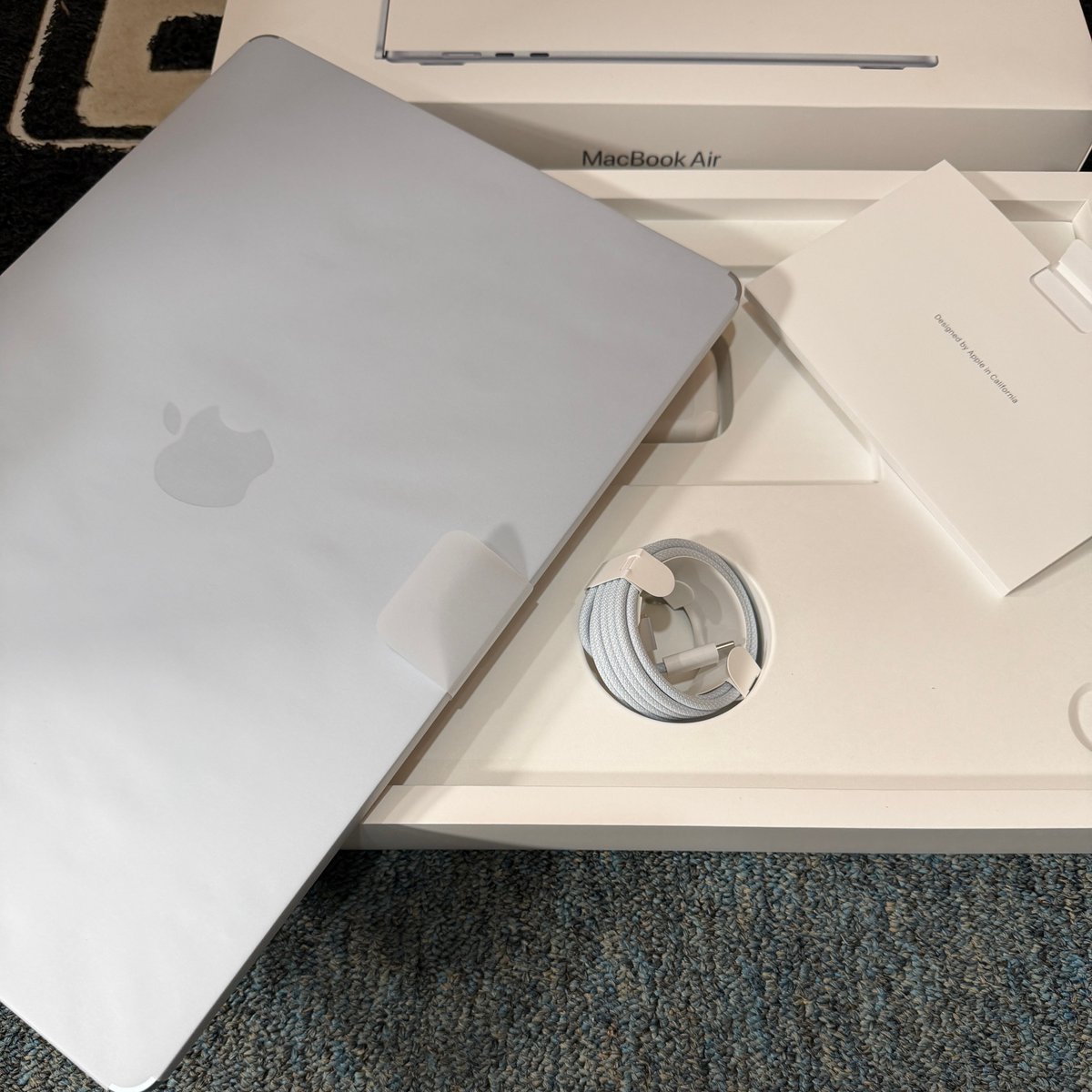
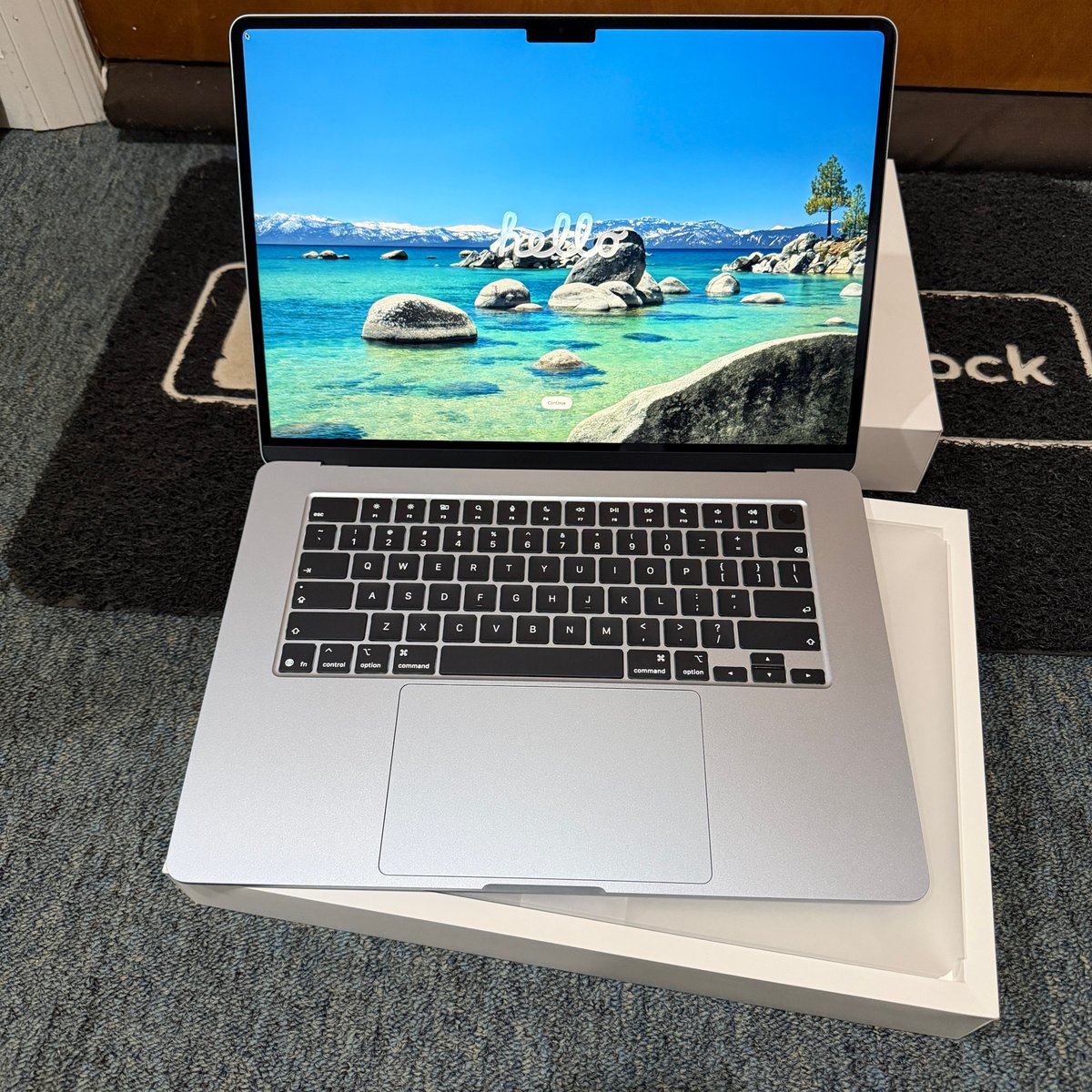
My main criticism with the Apple MacBook Neo 13" is that it's pretty small, and if you want something significantly larger, you have to spend twice as much to move up to a MacBook Air M5 15". The MacBook Air was Apple's best-selling laptop, and the new MacBook Air M5 is still a strong value, but it feels like you have to skip a few rungs on Apple's price ladder given how low that first MacBook Neo step is.
Here is what the MacBook Neo looks like on top of a 13.6" MacBook Air M4 and a 15.3" MacBook M5. As much as the MacBook Neo's capabilities match my workload just fine, I'll probably use the MacBook Air more on a regular basis for the display size, better color, and faster ports. I do wish there was a touchscreen OLED option -- some Windows laptops in this price range offer them -- but in the Apple Silicon era, the MacBook Air has been easy to recommend, and that's still true with the newest models.


English
My wife sending me to Home Depot for more top soil
Insane Reality Leaks@InsaneReality
Toyota knew this would sell in certain regions
English
@thomasbsauer Dumb q sir. Can one just explode sea mines w autonomous surface vehicles that hunt/trigger vs sweep/diffuse?
English

Former Navy EOD Officer here. Mine countermeasures is what I did for a living most of my adult life.
You don’t know what the fuck you’re talking about.
Malcolm Nance@MalcolmNance
Jesus fucking Christ it’s amateur hour amongst the punditry over this mine issue isn’t it? Let me tell you something, if you’ve never had to go through minefields or mined waters or hit a mine then you should consider listening to the people who have. The commentary is getting silly. Sure, they’re not “wonder weapons” … until the explosion and the massive rush of thousands of tons of sea water and that funny angle your ship takes that makes you suddenly and urgently want to take a “fear piss”. They’re the solid, proven and silent weapon that cancels insurance policies for every merchant ship in the region without ever proving they are even in the water. The US Navy is absolutely not ready for this. The four ships we had dedicated to doing this we just decommissioned. We lost all of our corporate knowledge. Now we’re running an experiment and it’s gonna cost people their lives
English
Seems like now that the next 3 cycles of Mac refresh are assured thanks to AI (needing bigger endpoint compute) it’s ok to go to larger TAM lower ASP market. Access profit and get next gen of users who will up cycle aspirationally. Looks like headphones strategy, but for compute. Seems like brilliant product/timing strategy
English
@DCinvestor @KristyT This is not necessarily the case. We don’t know the margins on Neo.
English

the low priced MacBook Neo
is an acknowledgment by Apple that rapidly building out the user network is now (or will soon be) much more valuable than selling the hardware at a premium
English
I am guessing @PalmerLuckey or @elonmusk will have a mine sweeping solution ready in 4 weeks
Mario Nawfal@MarioNawfal
🚨🇺🇸🇮🇷 The U.S. Navy decommissioned its last specialized minesweeper ships in the Persian Gulf back in September and shipped them to America for scrapping. Now Iran's reportedly laying mines in the Strait of Hormuz, and the only ships available to clear them are littoral combat vessels, also known as "Little Crappy Ships," with terrible reliability issues. Some of the earliest models have already been retired after just a few years in service. They've been called one of the biggest failures in U.S. shipbuilding history. Source: CNN
English
Watching dilution of luxury and aspirational luxury brands as they try to expand to lower markets is sad. Ask Jaguar.
Neo is a brilliant move and timing by Apple. Now that the next 2-3 tech refresh/demand cycles for Mac are assured thanks to AI, enter a hyper price conscious market with huge TAM to ensure next gen of users.
English
This is the first time I bought WiFi for two devices on a flight vs switching back and forth. Should have been doing this for years.
English
Also kudos to your F gate 1k check in agents on getting us a through check in on SQ to COK
English
Yoooo @united you’ve seriously upped your F club lounge food game. Great vegetarian and chicken choices tonight
English
@MRatable Are you also building a generational company like all of us are?
English

@wolfejosh all this because you think your falafels are better than everyone elses
English

Such a simple choice. Such an easy IQ test.
A) Morally superior geniuses bringing technology + medicines + progress to the world + just want to not be killed.
or
B) intransigent uncomprimising murderous stone-age barbarians oppressing women + committed to kill 'infidels'
Mossad Commentary@MOSSADil
We can justify what is seen in this video as innovation, technology, etc... The truth, nothing short of a miracle.
English

🚨 WOW. Jaw-dropping footage captures America's C-RAM system firing back at reported drone and missile fire near the US embassy complex in Baghdad, Iraq
The sound is freaking insane 🤯🇺🇸
English
@GabbbarSingh My Dad kept telling me it's not too late to take IAS exam well into my late 20s when I was well on my way with my second startup and based in startup central aka Silicon Valley
English


China's strategy is to have one "attack dog" in every region to tie down any possible rival. Russia ties down Europe, North Korea ties down Japan, Pakistan ties down India, and Iran ties down America.
Hudson Institute@HudsonInstitute
Tehran was not just another partner for Beijing; it was central to China's grand strategy. China invested over $400 billion in long-term infrastructure and energy investments in Iran, purchased roughly 90% of Iran's oil exports, and Tehran's geographical location was key to Beijing's Belt and Road Initiative. In addition, by backing militant proxies and sustaining regional instability, Tehran has kept the Middle East in constant crisis and the United States out of the Indo-Pacific. Now, a weakened, internally strained Iran can no longer function as a reliable diversionary magnet for American attention, @milesyu10 writes in @PostOpinions. Read: washingtonpost.com/opinions/2026/…
English
@pati_marins64 kabuki detector triggered. the problem is drawing bounding boxes on video was solved a long time back. when it comes to trajectory mining they were trying to get help from American companies
English

The United States has handed the Chinese an encyclopedia on its military doctrines.
The war involving the US and Israel is being monitored and recorded in real time by LEO satellite constellations such as Jilin-1, which are even capable of capturing 4K UHD video.
Today, China operates at least three LEO constellations comprising at least 300 satellites dedicated to espionage or dual-use purposes.
From the images constantly released about American bases, it is clear that the Chinese are building a true encyclopedia on U.S. naval and air doctrines.
Every ship positioning, fiend tactics, refueling time, ammunition resupply, everything is being monitored by Chinese satellites. This includes the exact location and behavior of air defenses, their mapped reaction times, missile trajectories, and reprogramming durations.
Nothing escapes the Chinese gaze. In this conflict, they have already mapped and publicly released data on multiple American bases in the region, even identifying the exact number and models of aircraft on the ground.
The war against Iran is giving the Chinese something they never had in the Ukrainian theater: the opportunity to study and document American forces in detail.
To give you an idea, in 2025 the Chinese recorded a video of Atlanta’s airport purely to demonstrate their capability.
I believe the same kind of videos are being produced daily on the American front against Iran.
Never in history has a U.S conflict been observed from the skies at this level, both tactically and strategically.
The price of the Iran war is high in many ways, as I have always said.
And this single episode is giving the Chinese decades of planning and improvement in one go.
(Atlanta Airport)
English