Yixin Chen

72 posts

Yixin Chen

Yixin Chen

@_yixinchen

Research Scientist at BIGAI, prev @UCLA, @MPI_IS, @Amazon

Katılım Mayıs 2023
232 Takip Edilen209 Takipçiler
Yixin Chen retweetledi
Ihtesham Ali
Ihtesham Ali@ihtesham2005·
A mathematician who shared an office with Claude Shannon at Bell Labs gave one lecture in 1986 that explains why some people win Nobel Prizes and other equally smart people spend their whole lives doing forgettable work. His name was Richard Hamming. He won the Turing Award. He invented error-correcting codes that made modern computing possible. And he spent 30 years at Bell Labs sitting in a cafeteria at lunch watching which scientists became legendary and which ones faded into nothing. In March 1986, he walked into a Bellcore auditorium in front of 200 researchers and told them exactly what he had seen. Here's the framework that has been quoted by every serious scientist for the last 40 years. His opening line landed like a punch. He said most scientists he worked with at Bell Labs were just as smart as the Nobel Prize winners. Just as hardworking. Just as credentialed. And yet at the end of a 40-year career, one group had changed entire fields and the other group was forgotten by the time they retired. He wanted to know what the difference actually was. And he said it wasn't luck. It wasn't IQ. It was a specific set of habits that almost nobody is willing to follow. The first habit was the one that hurts the most to hear. He said most scientists deliberately avoid the most important problem in their field because the odds of failure are too high. They pick a safe adjacent problem, solve it cleanly, publish it, and move on. And because they never swing at the hard problem, they never hit it. He said if you do not work on an important problem, it is unlikely you will do important work. That is not a motivational line. That is a logical one. The second habit was about doors. Literal doors. He noticed that the scientists at Bell Labs who kept their office doors closed got more done in the short term because they had no interruptions. But the scientists who kept their doors open got more done over a career. The open-door scientists were interrupted constantly. They also absorbed every new idea passing through the hallway. Ten years in, they were working on problems the closed-door scientists did not even know existed. The third habit was inversion. When Bell Labs refused to give him the team of programmers he wanted, Hamming sat with the rejection for weeks. Then he flipped the question. Instead of asking for programmers to write the programs, he asked why machines could not write the programs themselves. That single inversion pushed him into the frontier of computer science. He said the pattern repeats everywhere. What looks like a defect, if you flip it correctly, becomes the exact thing that pushes you ahead of everyone else. The fourth habit was the one that hit me the hardest. He said knowledge and productivity compound like interest. Someone who works 10 percent harder than you does not produce 10 percent more over a career. They produce twice as much. The gap doesn't add. It multiplies. And it compounds silently for years before anyone notices. He finished the lecture with a line I have never been able to shake. He said Pasteur's famous quote is right. Luck favors the prepared mind. But he meant it literally. You don't hope for luck. You engineer the conditions where luck can land on you. Open doors. Important problems. Inverted questions. Compounded hours. Those are not traits. Those are choices you make every single day. The transcript has been sitting on the University of Virginia's computer science website for almost 30 years. The video is free on YouTube. Stripe Press reprinted the full lectures as a book in 2020 and Bret Victor wrote the foreword. Hamming died in 1998. He gave his final lecture a few weeks before. He was 82. The lecture that explains why some careers become legendary and others disappear is still free. Most people who could benefit from it will never open it.

Ihtesham Ali tweet media
English
146
1.9K
8.2K
1.2M
Yixin Chen retweetledi
Hangxin Liu
Hangxin Liu@HangxinLiu·
Check out our new paper: Cross-Robot Behavior Adaptation through Intention Alignment We enable skill generalization across different embodiments and tasks by encoding both intention descriptions and robot motion generators into a shared latent space.
Science Robotics@SciRobotics

A new Science #Robotics study demonstrates that robots can reproduce movements demonstrated by peers by aligning their abilities with the task’s objective, instead of just copying motor movements directly. scim.ag/4skRP2d

English
0
1
1
213
Michael Black
Michael Black@Michael_J_Black·
Tomorrow, I start a new full-time position as VP Digital Human Research at Epic Games. (And no, this isn’t an April Fools’ joke.) Today, I’m taking early retirement from Max Planck and will become an Emeritus Director. As an Emeritus Director, I will continue to supervise my remaining students, oversee ongoing projects, and wind down my department over the next couple of years, which is a normal process when a director retires. Being a Max Planck director is the best academic job in the world and it has been my great honor to co-found and help build the Max Planck Institute for Intelligent Systems. I love the institute deeply. But my statutory retirement age was looming and I’m not done yet. I’ve been working on capturing and modeling human movement for 30 years and it has gone from a fringe topic to something that works robustly and has immense potential. With AI today, scale matters, and achieving that scale increasingly requires industry. In particular, digital humans are moving from research prototypes to foundational technology across industries. At this point in my career, I want to get this technology into the hands of millions of users, while pushing the frontier of digital humans. I know that this is a challenging time for the games industry. Such times are precisely when people get creative, the industry is open to change, and real innovation can take root. Epic Games is the ideal place for this. The talent is deep, there is a compelling vision for how games will evolve, and the commitment is clear. I’m excited to join them and the rest of the Meshcapade team. There is no good way to express on social media the depth of my gratitude to the Max Planck Society, my co-directors, students, post docs, and staff. It has been an amazing 15-year journey because of you. Thank you.
English
55
45
1K
65.2K
Yixin Chen retweetledi
Siyuan Huang
Siyuan Huang@siyuanhuang95·
You might have seen the WuBOT performing at the 2026 Spring Festival Gala; however, most high-dynamic extreme motions you see are executed by overfitted tracking policies. Until now, training a unified policy capable of performing various extreme motions with a high success rate remained an unsolved challenge. We spent an entire year digging into the barrier between general tracking and extreme physical behaviors. After burning through dozens of G1 robots, we finally identified the bottleneck of learning and physical executability. With these discoveries, we developed OmniXtreme: the first general policy that can execute diverse extreme motions, including consecutive flips, extreme balancing, and even breakdancing with rapid contact switches! This capability is achieved by pre-training a flow-based generative control policy and then post-training with actuation-aware residual RL for complex physical dynamics—a step we found critical for successful real-world transfer. This work is a joint collaboration with @UnitreeRobotics. Together, we are pushing the physical limits of humanoid robots. It is incredibly exciting to see a general "robot gymnast" and "robot breakdancer" come to life! It was also our first time publishing a paper with XingXing, which was an enlightening experience. The model checkpoints are now released—we welcome you to play with them! 📦 📄 Paper: arxiv.org/abs/2602.23843 🌐 Project: extreme-humanoid.github.io 💻 Code: github.com/Perkins729/Omn…
English
33
149
755
105.9K
Michael Black
Michael Black@Michael_J_Black·
Science is a team sport. I’ve been fortunate to play on some great teams with outstanding researchers. Today, I am honored to be admitted to the National Academy of Engineering. I would not have received this recognition, however, without the dedication and brilliance of my students, postdocs, interns, collaborators, data team, software team, administrators, funding agencies, and government supporters. It is through the collective effort of many, with the support of the society at large, that science and engineering make progress. Ultimately, I am grateful to the taxpayer who gives their hard-earned money to support the advancement of knowledge. As a taxpayer myself, I think a lot about my responsibility to society. I will continue to work to deserve your support. #NAEMember, @maxplanckpress, @mpi_is, @theNAEng, @PerceivingSys nae.edu/345149/NAENewC…
English
18
4
151
9.2K
Shashank Tripathi
Shashank Tripathi@sha2nk_t·
🎓 Last week, I successfully defended my PhD summa cum laude! Huge thanks to my advisor @Michael_J_Black, my collaborators, friends, and family who made this journey possible. It’s been an incredible chapter, and I can’t wait to share what’s coming next! #phdlife
Shashank Tripathi tweet media
English
12
1
71
18.9K
Yixin Chen retweetledi
RoboPapers
RoboPapers@RoboPapers·
Robots need to be able to apply pressure and make contact with objects as needed in order to accomplish their tasks. From compliance to working safely around humans to whole-body manipulation of heavy objects, combining force and position control can dramatically expand the capabilities of robots. This is especially true for legged robots, which have so much ability to exert forces on the world around them. But how do we train robots which can do this? @BaoxiongJ tells us more in our discussion of his team’s recent, Best Paper Award winning work on learning a unified policy for position and force control, called UniFP. To learn more, watch Episode #49 of RoboPapers, hosted by @micoolcho and @chris_j_paxton.
English
0
11
56
44.8K
Yixin Chen retweetledi
Dmytro Mishkin 🇺🇦
Dmytro Mishkin 🇺🇦@ducha_aiki·
Colmap-vs-VGGT, reposting for better discussion visibility
Dmytro Mishkin 🇺🇦@ducha_aiki

@gabriberton 1) Colmap is widely used and still will be widely used, because for decent captures it just works. You don't need to have anything better 2) With modern local features like ALIKED+LightGlue, colmap scales way better than VGGT, and also is faaar more precise (mAP@1degree, 5cm) 1/

English
1
4
72
11.3K
Liang Qiu
Liang Qiu@liangqiu_1994·
Packing my brain (and my laptop) for #ICML2025. See you in Vancouver!
English
2
0
12
1.1K
Yixin Chen
Yixin Chen@_yixinchen·
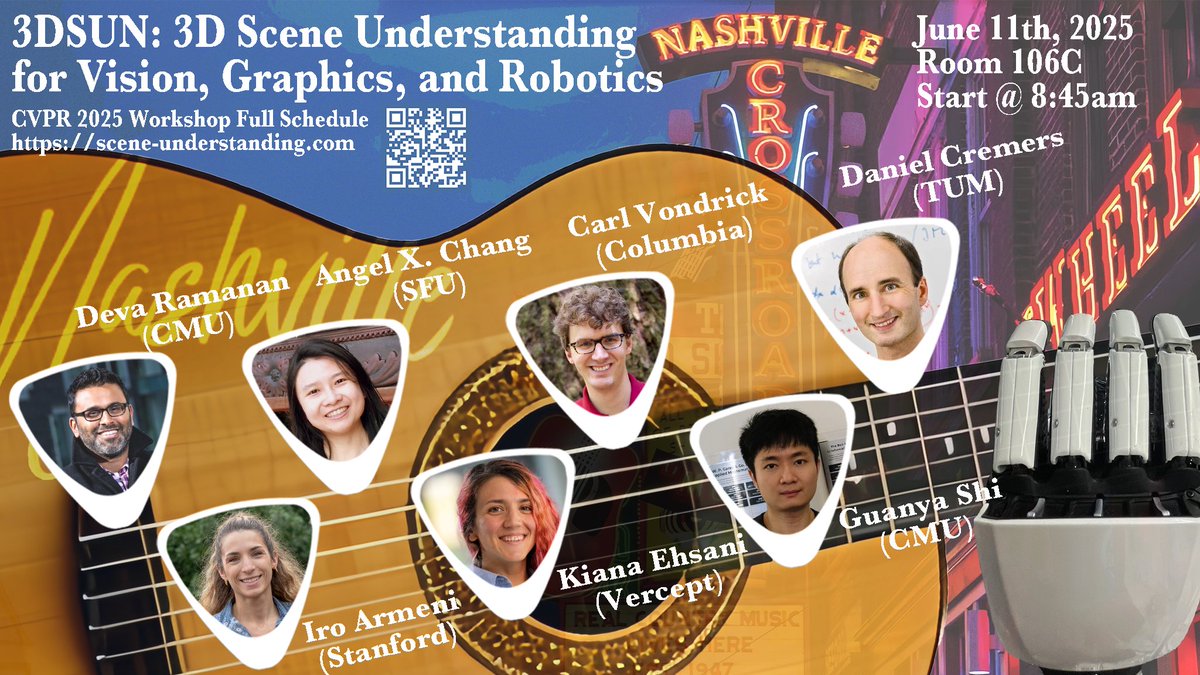
#CVPR2025 is just around the corner!🔥🔥 Join us for the exciting roster of distinguished speakers at the 5th Workshop on 3D Scene Understanding for Vision, Graphics, and Robotics. #3DSUN Mark: June 11th, starting from 8:45 AM in Room 106C! @CVPR scene-understanding.com
Yixin Chen tweet media
English
0
7
34
2.6K
Yixin Chen retweetledi
Peyman Milanfar
Peyman Milanfar@docmilanfar·
You should be so lucky to have people throughout your research career that you can openly bounce ideas to and from - especially if they complement your strengths in your areas of weakness - it is a rare and precious gift.
Peyman Milanfar tweet media
English
15
97
731
63.4K
Yixin Chen
Yixin Chen@_yixinchen·
@jon_barron Wow, thanks for sharing, and it really helps to clear minds about 2D and 3D. Such an enjoyment to watch, and it hypes when the cost vs num_frames line points to infinity.
English
0
0
1
378
Jon Barron
Jon Barron@jon_barron·
Here's my 3DV talk, in chapters: 1) Intro / NeRF boilerplate. 2) Recent reconstruction work. 3) Recent generative work. 4) Radiance fields as a field. 5) Why generative video has bitter-lessoned 3D. 6) Why generative video hasn't bitter-lessoned 3D. 5 & 6 are my favorites.
Jon Barron tweet media
English
39
104
813
118.1K
Yixin Chen retweetledi
Hangxin Liu
Hangxin Liu@HangxinLiu·
5 km run, zero mistakes. 🏃‍♂️🤖 Warming up for the Beijing Robot Half Marathon. #RobotMarathon
English
2
25
118
59.8K
Yixin Chen
Yixin Chen@_yixinchen·
@jon_barron Great threads! It's always nice to hear your keynotes, especially loving those figures! Would it be possible to post more about your keynote slides?
English
0
0
2
675
Jon Barron
Jon Barron@jon_barron·
A thread of thoughts on radiance fields, from my keynote at 3DV: Radiance fields have had 3 distinct generations. First was NeRF: just posenc and a tiny MLP. This was slow to train but worked really well, and it was unusually compressed --- The NeRF was smaller than the images.
Jon Barron tweet media
English
10
79
641
104K
Yixin Chen retweetledi
Siyuan Huang
Siyuan Huang@siyuanhuang95·
📢📢📢 Excited to release ManipTrans: Efficient Dexterous Bimanual Manipulation Transfer via Residual Learning (CVPR25). 🤏🤙✌️With ManipTrans, we can transfer dexterous manipulation skills into robotic hands in simulation and deploy them on a real robot, using a residual policy learned for dex manipulation. 🤖🤖🤖The video below illustrates how the MoCap data can be transferred to Inspire, Shadow, Xhand, Allegro, and Mano. With ManipTrans, we can scale up dex manip data greatly with minimal effort. For more details, please check our -webpage: maniptrans.github.io -code: github.com/ManipTrans/Man… -huggingface: huggingface.co/LiKailin/Manip…
English
1
45
200
20.9K
Yixin Chen
Yixin Chen@_yixinchen·
We hope this can provide some insights on how to design diffusion-based NVS methods to improve their consistency and plausibility! 🧩💻🗂️ All code, data, & checkpoints are released! 🔗 Learn more: jason-aplp.github.io/MOVIS/ (6/6)
English
0
0
0
156
Yixin Chen
Yixin Chen@_yixinchen·
🚀How to preserve object consistency in NVS, ensuring correct position, orientation, plausible geometry, and appearance? This is especially critical for image/video generative models and world models. 🎉Check out our #CVPR2025 paper: MOVIS (jason-aplp.github.io/MOVIS) 👇 (1/6)
Yixin Chen tweet media
English
5
14
73
7.9K