

Anderson Oliveira
1.5K posts

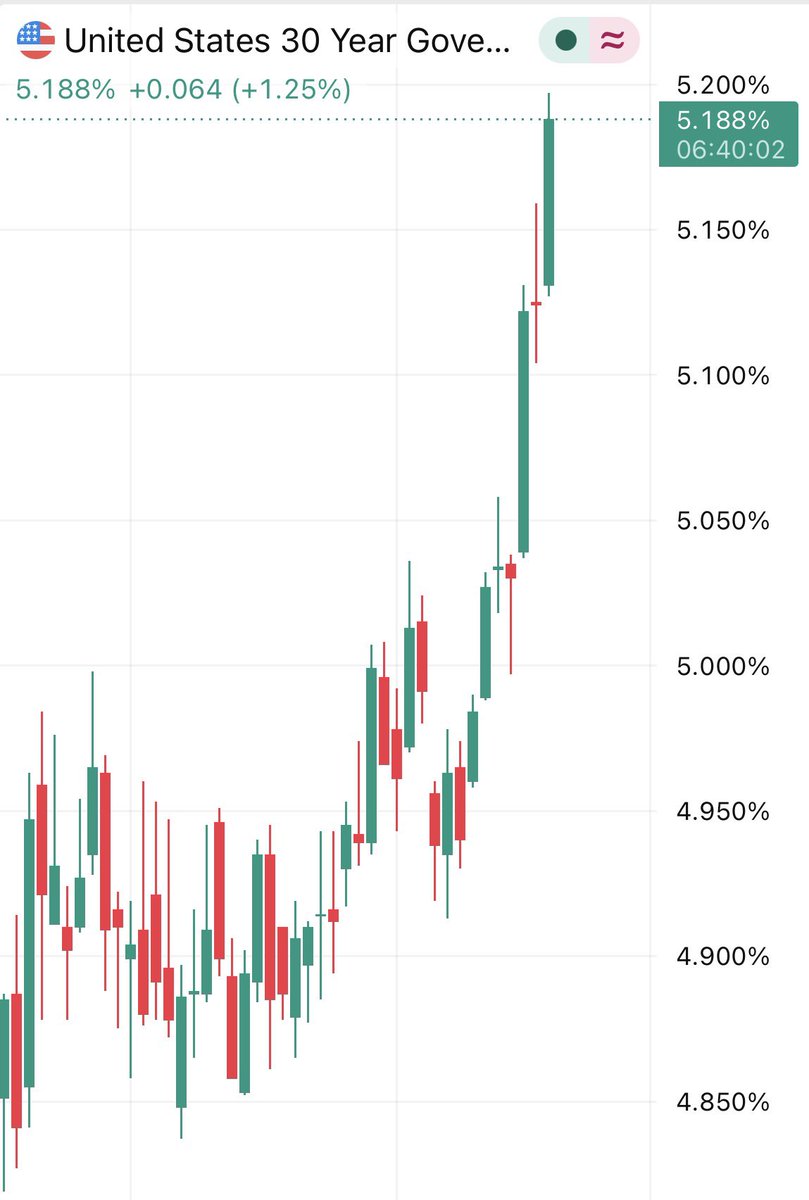
⚡️The U.S. 30Y at ~5.18% is the market beginning to price fiscal dominance.
Before policymakers are willing to admit fiscal dominance exists.
This is the long end saying the old deal is gone.
For years, Washington could run deficits, inflate asset prices, expand entitlement obligations, fund wars, subsidize industry, push reshoring, support housing, and assume the bond market would eventually cooperate because inflation would fade and the Fed could cut.
Now the market is asking for a real price to finance the regime.
That is why this matters. The 30Y is not just another rate. It is the market’s judgment on long-term trust: inflation credibility, fiscal trajectory, Treasury supply, foreign demand, currency stability, and whether buyers believe they are being compensated for holding U.S. promises across decades.
At 5%+, the long bond starts changing behavior everywhere.
Housing cannot clear normally. CRE refinancing gets uglier. Private credit gets more fragile. Long-duration equities lose air. AI capex gets a higher hurdle rate. Federal interest expense gets louder. Banks, pensions, insurers, and leveraged investors have to respect duration again. The discount rate stops being background noise and becomes the central constraint.
The deeper problem is that the U.S. political system still wants a cheap-money world. It wants strong asset prices, lower mortgage rates, industrial policy, defense spending, AI infrastructure, tariff leverage, fiscal expansion, and consumer resilience. The bond market is saying those promises now compete for scarce capital.
That is the fracture.
This goes toward intervention. The system will not calmly accept a long-term free-market repricing of sovereign duration. Too much breaks. The likely path is pressure first, then disguised control: more bill-heavy issuance, buybacks, QT changes, liquidity tools, regulatory incentives for banks to hold Treasuries, and eventually deeper Treasury-Fed coordination.
They will not call it yield curve control.
The function will rhyme.
The Kobeissi Letter@KobeissiLetter
BREAKING: The US 30Y Note Yield rises to 5.18%, its highest level since July 2007.
English

There's over $100 TRILLION in wealth sitting in global sovereign debt.
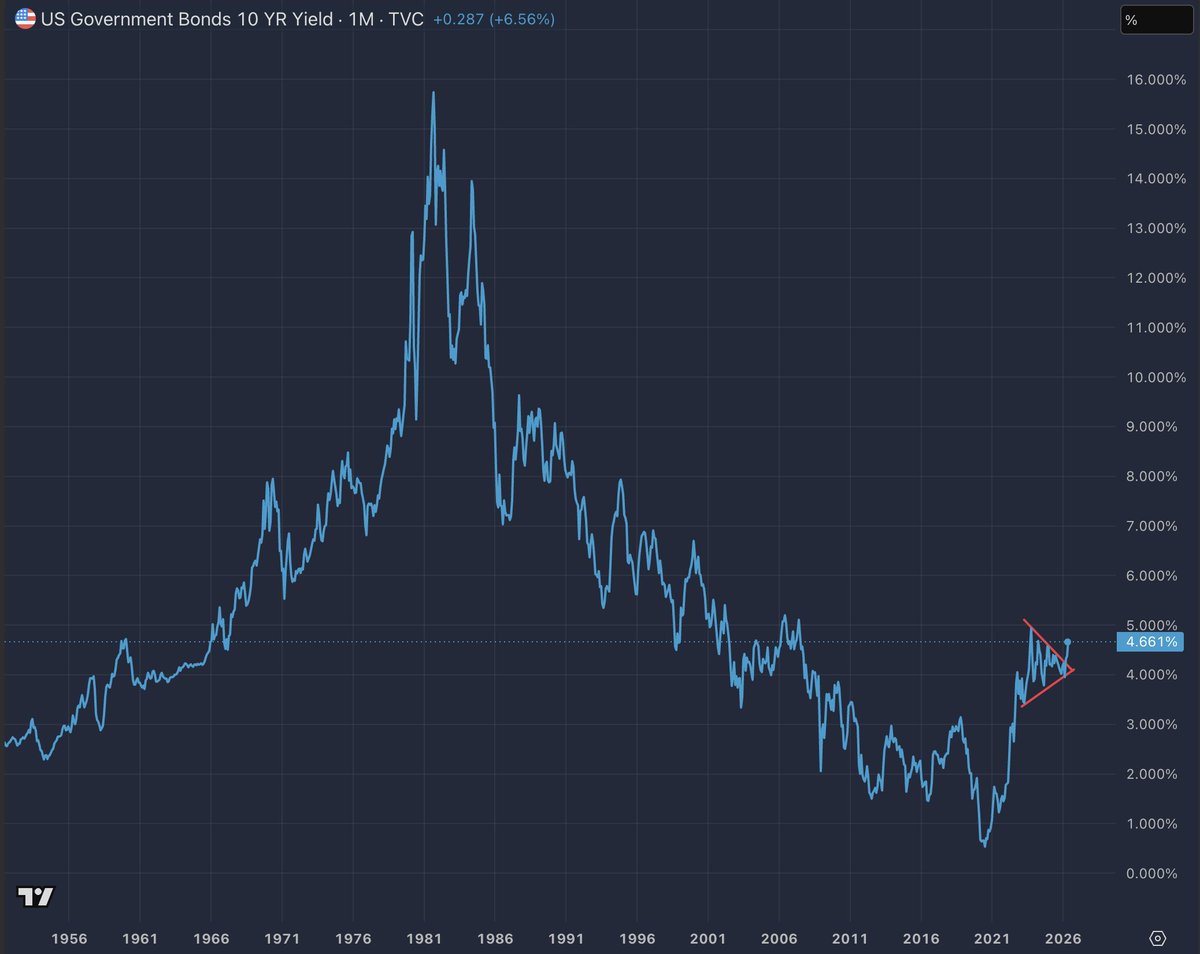
And the US 10 year yield is breaking out of a bull pennant to the upside.
But before you panic... Consider that the 10 year yield was already at this level two years ago.
And the Nasdaq is up 66% since then.
I used to think bond yields going higher would break everything
But now I'm realizing something...
Government debt is garbage. That's not a secret.
Yields are going higher because the math makes it inevitable.
You can't run multi-trillion dollar deficits and have interest expense be the second highest expenditure and expect yields to go down.
But that just means a good portion of ~$100T in wealth needs to squeeze itself into different assets.
And what assets offer incredible long-term prospects?
How about equity in businesses with fortress balance sheets, funding the next economic revolution with cashflows drawn from all over the globe?
We live in a world with a handful of mega-corporations that with FAR better financial prospects than governments.
Google. Microsoft. Amazon. Meta. Nvidia.
Companies at the center of the AI and robotics revolutions.
These companies hold more in interest-earning securities than most countries hold in reserves.
They're actually earning more on their cash piles as yields go higher.
Most of these companies have user bases that are bigger than any one nation state's population.
These are quasi-sovereign entities with better demographics than the sovereigns issuing the debt people are fleeing.
So there's one simple question every investor needs to be asking:
As we look out 10, 20, 30 years...
What would you rather hold?
A bond that's basically guaranteed to lose value in real terms, or a part of a company that's positioned to take advantage of the biggest economic revolution in our species history?
Once you arrive at the obvious conclusion, the only answer is to go long the future and stay long through the volatility.
English

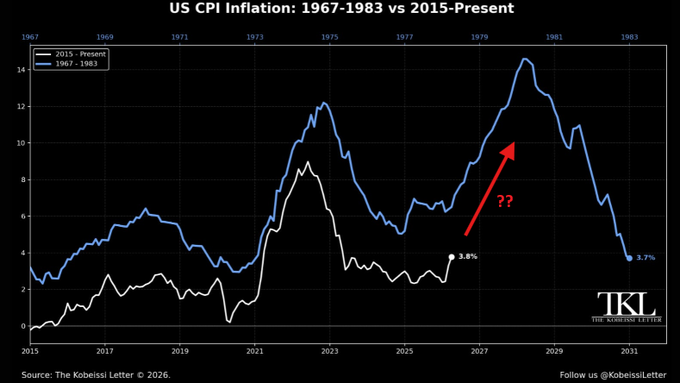
American consumers are now facing 7%+ mortgage rates, 4%+ inflation, and a 30% loss in the purchasing power of the US Dollar since 2020.
The second half of 2026 is going to be interesting to say the least.
The Kobeissi Letter@KobeissiLetter
Bond markets are flashing red. Today, the US 30Y Note Yield officially hit its highest level since July 2007, at 5.19%. This will soon become Americans’ biggest problem, yet the vast majority do not even know it is happening. What is happening? Let us explain. (a thread)
English

@NoLimitGains I know exactly what it means
Intervention incoming from the Federal Reserve and US Treasury.
English


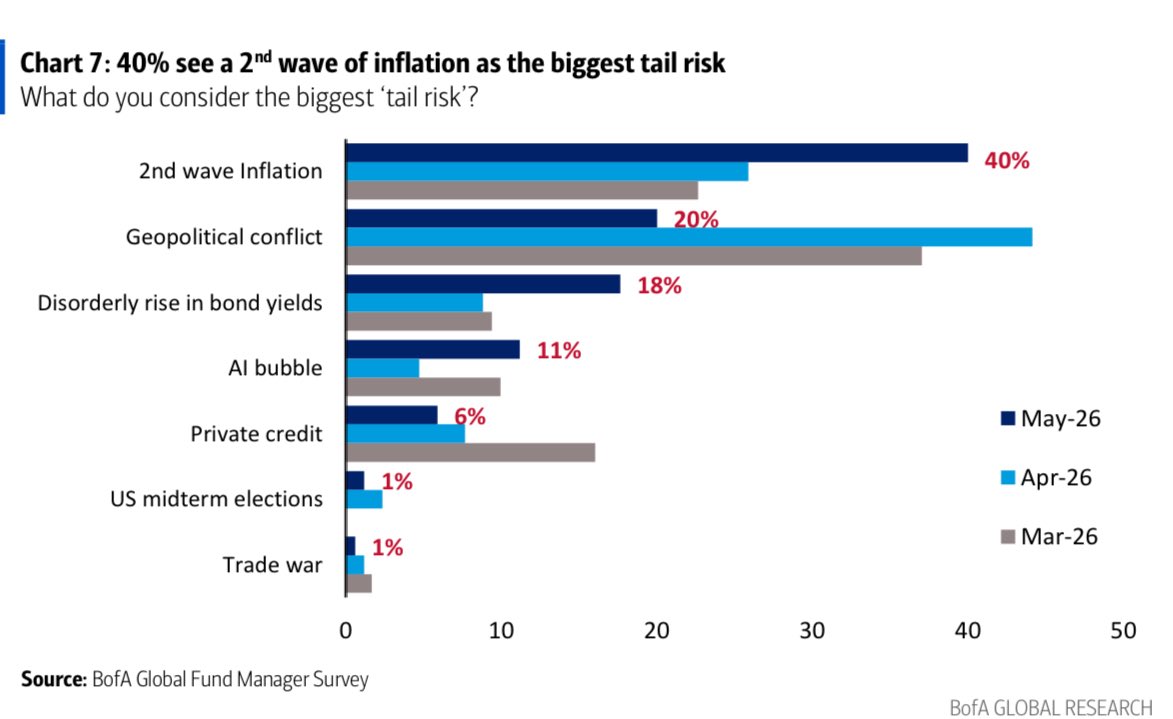
Two takeaways from May’s BofA fund manager survey: first, equity allocations surged by a record amount on the month, and second, 40% of respondents see a second wave of inflation as the biggest tail risk. The two ideas are connected: stocks are increasingly seen as an inflation hedge

English
@biancoresearch @_robertomotta Bitcoin is the only real scarce asset in the world. And is cheap!
English

As pointed out below, “stocks are increasingly seen as an inflation hedge,” so fund managers are piling in.
The idea that stocks are a hedge against inflation is not new and has not worked for over a century.
BofA’s Michael Hartnett’s latest “Flow Show” from Friday:
* above 4% on CPI where risk assets get twitchy…
past 100 years once CPI crosses 4% on average SPX -4% next three months, -7% next six months.”
Note that year-over-year CPI inflation was 3.8% through April.
Warren Buffett warned about this almost 50 years ago:
Fortune, May 1, 1977
Buffett: How inflation swindles the equity investor
“For many years, the conventional wisdom insisted that stocks were a hedge against inflation. The proposition was rooted in the fact that stocks are not claims against dollars, as bonds are, but represent ownership of companies with productive facilities. These, investors believed, would retain their value in real terms, let the politicians print money as they might.”
He goes on to describe when this belief peaked: “This heaven-on-earth situation finally was ‘discovered’ in the mid-1960s by many major investing institutions. But just as these financial elephants began trampling on one another in their rush to equities, we entered an era of accelerating inflation and higher interest rates.”
Finally, note that fund managers’ top three tail risks are in the chart on the right:
* Second wave inflation (40%)
* Geopolitical conflict (20%)
* Disorderly rise in bond yields (18%)
These three risks total 78%, and they could be argued to be variations on the same theme – the war will continue to drive crude oil prices higher, creating a second wave of inflation and higher bond yields.
----
“Those who cannot remember the past are condemned to repeat it.”
– George Santayana, from The Life of Reason (1905)
Lisa Abramowicz@lisaabramowicz1
Two takeaways from May’s BofA fund manager survey: first, equity allocations surged by a record amount on the month, and second, 40% of respondents see a second wave of inflation as the biggest tail risk. The two ideas are connected: stocks are increasingly seen as an inflation hedge
English

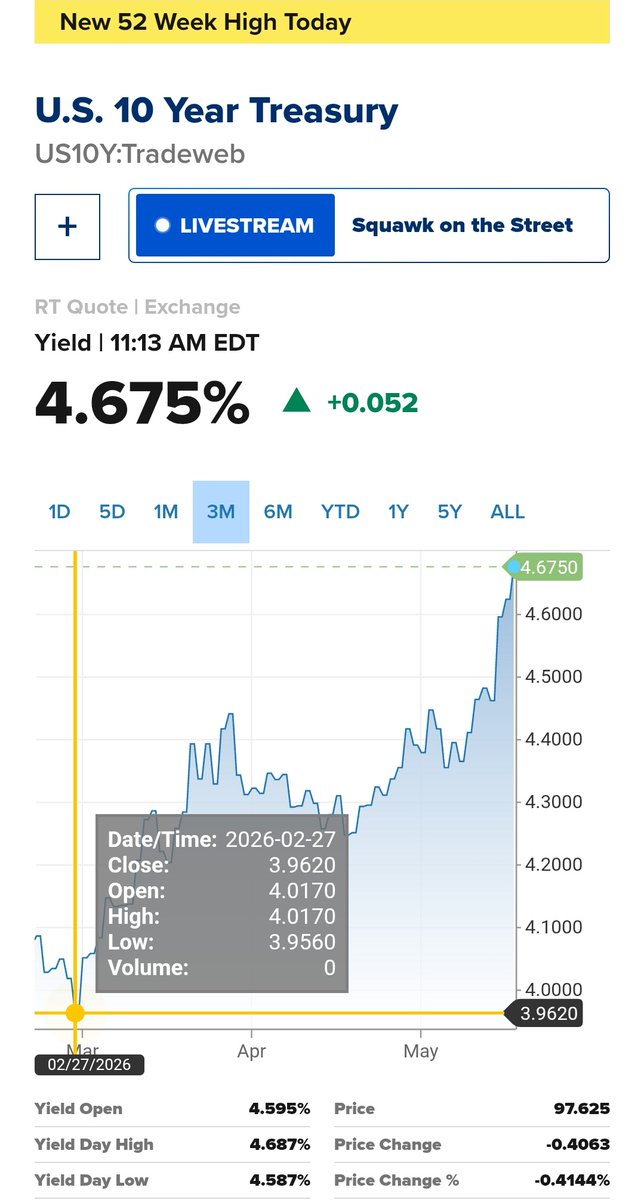
10y Treasury yield is up ~70bps since Iran war start
If it drops back to prewar levels today, yield rises will cost USG ~$50B in higher debt service by 2036
If it stays here for one year, then reverts: ~$200B
If the shift is permanent: ~$2T
War is the grift that keeps giving
English

Iran’s shadow banking system facilitates the illicit transfer of funding for terrorist purposes. As Treasury systematically dismantles Tehran’s shadow banking system and shadow fleet under Economic Fury, financial institutions must be alert to how the regime manipulates the international financial system to wreak havoc.
Treasury Department@USTreasury
Today, as a part of Economic Fury, Treasury’s Office of Foreign Assets Control designated a prominent Iranian foreign currency exchange house and associated front companies that oversee hundreds of millions of dollars in transactions on behalf of sanctioned Iranian banks. Collectively, Iranian exchange houses facilitate billions of dollars in foreign currency transactions each year, enabling the regime and its armed forces to evade sanctions, access the international financial system, and move funds derived from oil and petrochemical sales.
English

Good morning.
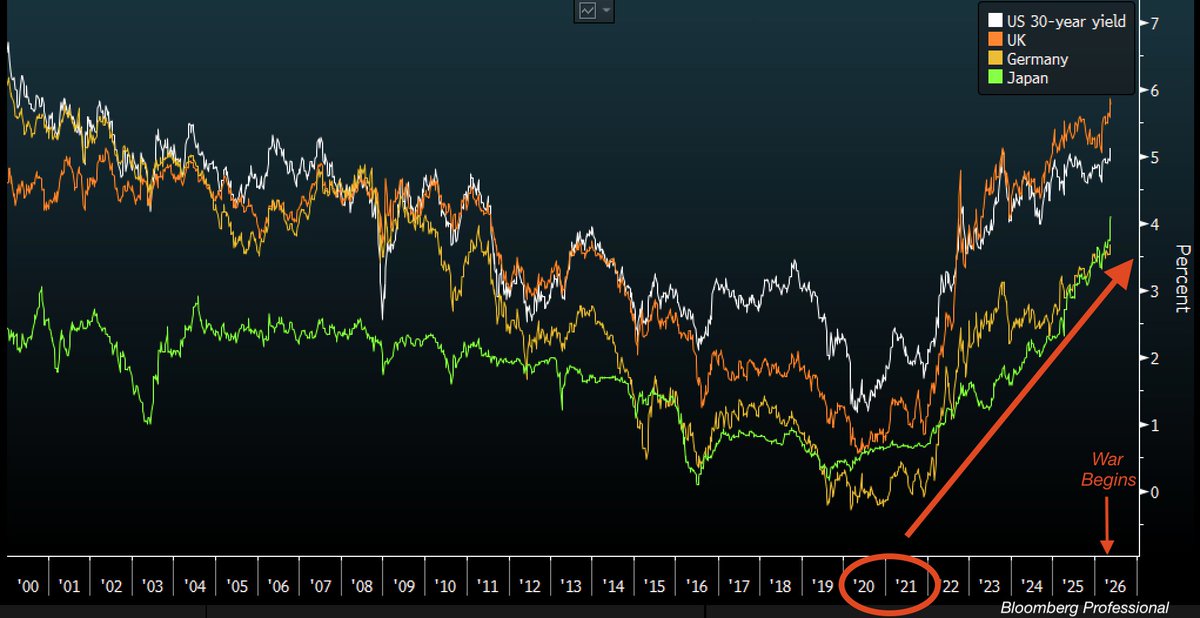
Yields on government bonds did not start rising 'because of the War'. They, in fact, began to skyrocket higher after massive central bank money printing in 2020/2021 and continue higher because of relentless government (deficit) spending.
Have a great day.
English

Treasuries are breaking down. The 10-year yield is now above 4.5%, trading at 4.52%. The 30-year yield is up to 5.06%. Gold & silver are selling off, but a bond market crash is the most bullish thing that can happen for precious metals. Traders just haven't figured that out yet!
English

Senate Banking will markup the Clarity Act today, and CCI will be there. A lot of hard work and leadership went into this process from the full Committee and staff.
This is an important step that will put the U.S. on a path to a durable federal framework for regulating digital assets with robust consumer protections and clear protections for developers.
We respectfully urge the Committee to advance the bill.
Watch: banking.senate.gov/hearings/05/08…
English


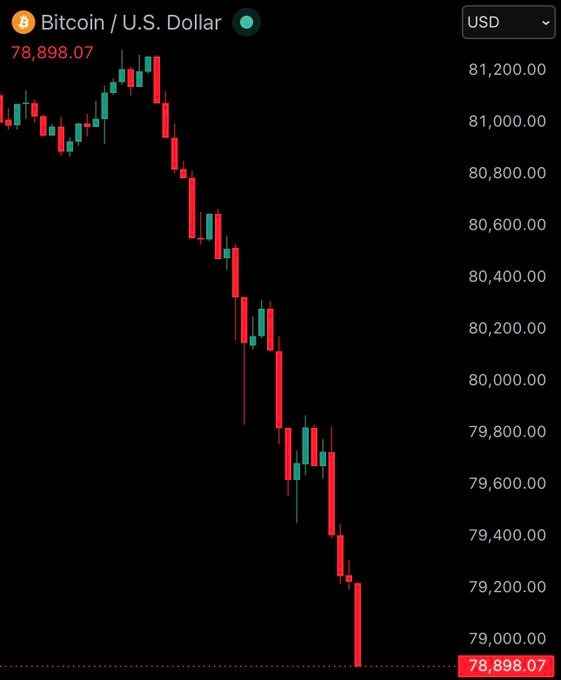
Bitcoin's been on a total rollercoaster these days, pumping hard one minute, then crashing back the next.
Whelp, here we are again, below $79K
English

Fidelity commends the Senate Banking Committee for advancing the CLARITY Act. The bill provides a balanced approach and, if passed, will offer statutory clarity to digital asset markets, benefiting American investors and helping ensure the U.S. remains a global leader in digital assets.
English
@ducavendish @Strategy Com qual % de probabilidade você acredita nessa valorização em 5 anos ($1mm/BTC)?
Português

Estamos vivendo uma das maiores revoluções da história em produtos financeiros com a invenção do crédito digital pela @Strategy, a $STRC.
No artigo abaixo tento explicar as implicações dessa inovação e como afetará o Bitcoin. 👊🚀
E. Cavendish@ducavendish
Português

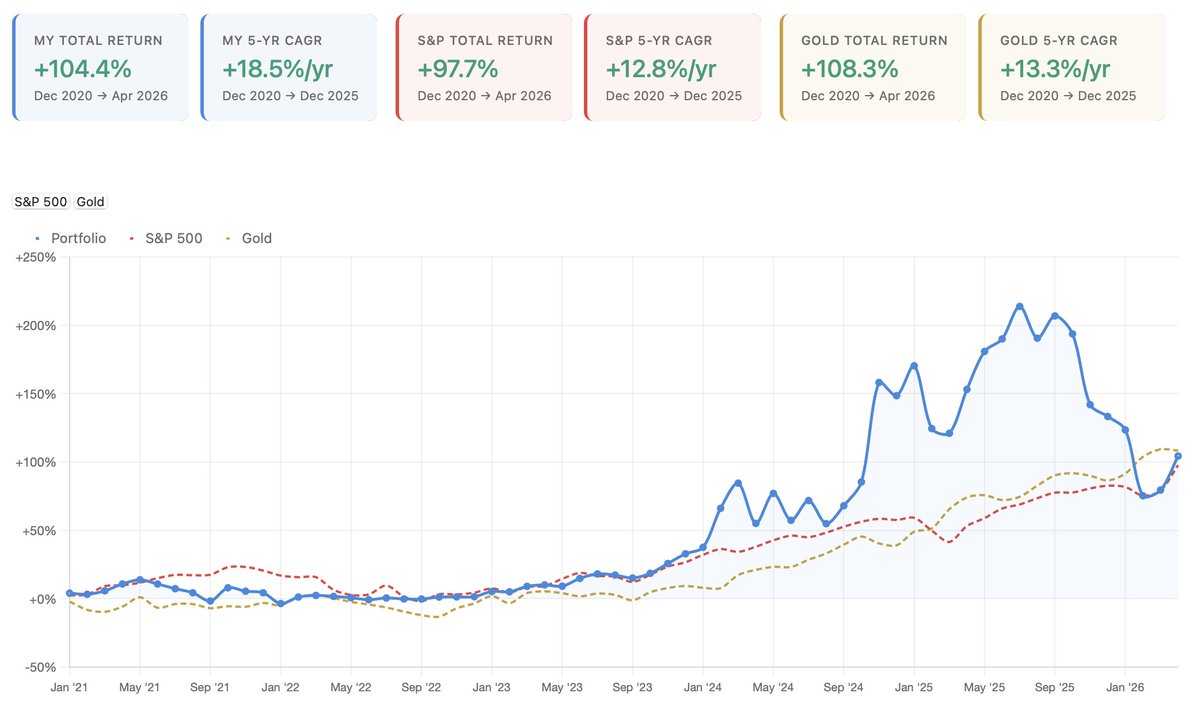
Two years ago, I sold every stock and ETF I owned and moved 100% into Bitcoin.
Update: Bitcoin is in a drawdown.
“See? You should’ve diversified.” 😂
Here’s the breakdown:
My portfolio: +104% total
18.5% annual CAGR
S&P 500: +98% total
12.8% CAGR
Gold: +108% total
13.3% CAGR
You can see everything converging toward a single point on the graph. Keep in mind, Bitcoin is still over 30% below its all-time high from last year, while gold and the S&P are near record highs. Yet Bitcoin is still showing total returns similar to gold and the S&P. Amazing!
I started getting serious about Bitcoin in 2021. Back then, I put 5% of my investment account into it. Cautious. Skeptical. Over the next three years, I steadily increased that allocation as conviction replaced doubt.
When the Bitcoin ETFs launched in early 2024, that was my signal. I went 100%. I saw Bitcoin as the clear winner in this space, and with Wall Street getting serious, so was I.
I provide more details here:
jeffswanson.beehiiv.com/p/why-i-sold-e…
I’m not telling you to go all in on Bitcoin. I’m simply showing you what I’m doing. I do recommend studying Bitcoin carefully and making your own decision.
English
Mais um dia de fortes saídas.
Olho nisso, pessoal.
o Zé, do Clube do Pai Rico@clubedopairico
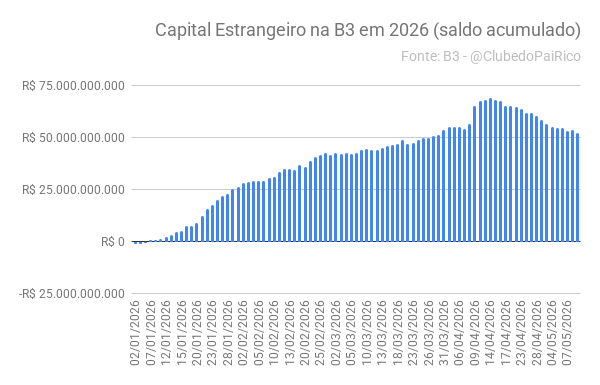
💸 Não ... Não acabou não. Capital Externo na Bolsa: Dia 11 de maio de 2026: Saída de R$1,127 bilhão Acumulado do mês de maio de 2026 (até o dia 11): – R$4,319 bilhões No ano de 2026, o saldo está positivo em R$52,224 bilhões. clubedopairico.com.br/capital-extern… via @clubedopairico
Português

💸 Não ... Não acabou não.
Capital Externo na Bolsa:
Dia 11 de maio de 2026:
Saída de R$1,127 bilhão
Acumulado do mês de maio de 2026 (até o dia 11):
– R$4,319 bilhões
No ano de 2026, o saldo está positivo em R$52,224 bilhões.
clubedopairico.com.br/capital-extern… via @clubedopairico
Português

Let’s GO! 💪
U.S. Senate Banking Committee GOP@BankingGOP
The Senate Banking Committee’s CLARITY Act is the result of more than ten months of good-faith, bipartisan negotiations and has benefited from consultation with industry participants, legal and academic experts, and key stakeholders. Here are the facts: banking.senate.gov/newsroom/major…
English