Aaron Jakes

4.3K posts

Aaron Jakes banner
Aaron Jakes

Aaron Jakes

@aaronjakes

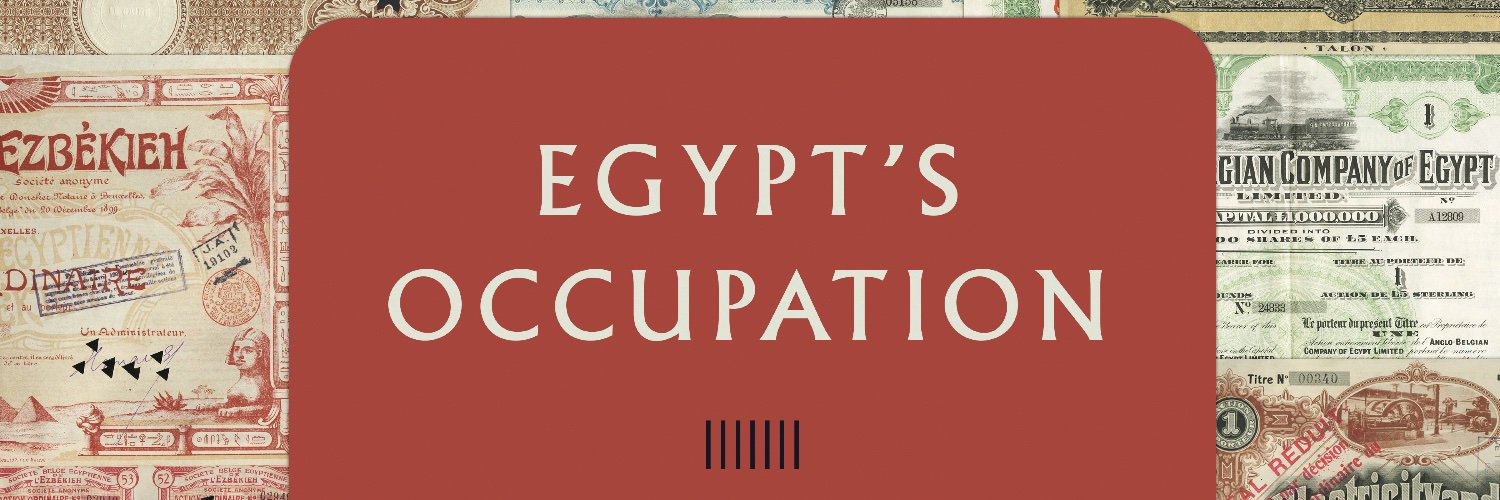
Associate professor @UChicagoHistory and @UChicagoCEGU. "Egypt's Occupation: Colonial Economism and the Crises of Capitalism," out with @stanfordpress.

New York, USA Katılım Ocak 2011
1.1K Takip Edilen4K Takipçiler
Sabitlenmiş Tweet
Aaron Jakes
Aaron Jakes@aaronjakes·
In this era of online everything, opportunities for conventional book talks are few and far between. But I've been fortunate enough to line up a series of interviews about Egypt's Occupation with some fantastic podcasts. I'll post them here as they drop. sup.org/books/title/?i…
English
6
10
83
0
Aaron Jakes retweetledi
Nakul Sarda
Nakul Sarda@nakul_sarda·
I've stopped reading Gulf war headlines. Here's what I track instead. We run an India-focused equity fund. 85% of India's crude comes from imports. Half of that normally passes through Hormuz. So yes — this crisis is personal. But the information environment right now is garbage. Trump says the war ends tomorrow. Iran says Hormuz is shut forever. One analyst says $150 oil, another says $60. You can't build a portfolio view on this. So I've narrowed it down to 4 signals. These are priced by people with real money on the line. They don't lie. 1. Ship insurance premiums through Hormuz This is the single best signal. Lloyd's underwriters have billions at stake on every pricing call. Before the war, insuring a tanker through Hormuz cost 0.25% of the ship's value. Today it's 3.5–10% — and almost nobody is buying. A $100M tanker that cost $250K to insure now costs up to $10M. When this drops below 2%, the people with the most to lose are telling you it's getting safer. No press conference can replicate that. 2. How many ships are actually crossing Every ship carries a GPS tracker (AIS). You can count exactly how many cross Hormuz each day. Before: 100+. Now: 8. That's a 92% collapse. You can't spin a ship being somewhere it isn't. Iran is letting some Chinese and Indian ships through, but it's a trickle. When this number crosses 30–40, trade is resuming. You can track this free on the WTO Hormuz Trade Tracker. 3. Paper oil vs real oil This one most people miss entirely. Brent crude (the headline price) is at $112. But Dubai physical — what Asian buyers actually pay for delivered oil — is at $126. That's a $14 gap. It exists because Trump's comments keep pushing paper prices down. Traders call it jawboning. But the refiners buying cargo aren't getting any discount. If you're looking at Brent to assess India's oil bill, you're looking at the wrong number. 4. The mid-April cliff Multiple emergency measures expire around the same time. The 400 million barrel SPR release runs dry ~April 15. The US waiver letting India buy Russian crude expires. Formosa Plastics has declared force majeure from April 1. Right now these stopgaps are keeping the supply gap at ~5 mb/d. Without them, BCA Research estimates it doubles to 10 mb/d — the largest crude disruption ever. If Hormuz doesn't reopen by mid-April, we're in uncharted territory. Bottom line: track the insurance premium, the ship count, the paper-physical spread, and the April timeline. Everything else is noise.
English
123
996
4.7K
542.2K
Aaron Jakes retweetledi
Rosemary Kelanic
Rosemary Kelanic@RKelanic·
The U.S. taking Kharg is "a cockamamie theory of victory. How does taking Kharg change Iran’s strategic calculus? It doesn’t. They’re not going to go through a whole month of war and then decide, Oh, you took our big oil terminal. I guess we’re going to have to surrender." Read my full interview with @realaxelfoley of @NYMag @defpriorities 👇 nymag.com/intelligencer/…
English
10
47
131
6.3K
Aaron Jakes retweetledi
Nikhil Pal Singh
Nikhil Pal Singh@nikhil_palsingh·
Unless the very smart and perceptive people I follow are badly mistaken - having missed some enormous countervailing tendency or variable - the energy and petrochemical shock we are facing is not even remotely "priced in" by the markets.
English
0
8
76
2.1K
Aaron Jakes retweetledi
Stephen Wertheim
Stephen Wertheim@stephenwertheim·
"Israel has demonstrated extraordinary military reach, impressive intelligence, breathtaking freedom of action, and an ability to impose severe costs on its enemies. But the strategy points toward a region in which war has no obvious terminus, because war is no longer being used to produce a stable political arrangement. It is becoming, instead, the arrangement itself."
Malcolm H. Kerr Carnegie Middle East Center@CarnegieMEC

Israel’s strategy is no longer focused on deterrence and diplomacy, it’s about dominance and degradation. Nathan J. Brown writes. carnegieendowment.org/middle-east/di…

English
21
52
181
46.5K
Aaron Jakes retweetledi
Aaron Jakes
Aaron Jakes@aaronjakes·
@RKelanic @CCBaxter1968 I also wonder about the way this analysis focuses on oil supply shortages narrowly as a problem of energy. Worth remembering how closely linked Chinese production of actual goods of many kinds now is with petrochemical complexes in the Gulf. Oil isn’t just energy.
English
0
0
2
80
Aaron Jakes
Aaron Jakes@aaronjakes·
@stephenwertheim here gets what basically no one else making the comparison to 1956 seems to understand. The actual Suez Crisis was indeed a catastrophe for what remained of British imperial hegemony. But if this moment is our Suez Crisis, it is the idiot, upside-down version.
Stephen Wertheim@stephenwertheim

Self-Suez

English
0
5
12
1.9K
Aaron Jakes retweetledi
Gregory Brew
Gregory Brew@gbrew24·
When this war broke out, the oil market had some cushion built into it, namely a large amount of oil on the water. Demand was still somewhat on the lower side, given the time of year. States could draw on inventories. SPR releases could absorb some of the price impact. That cushion is gone. Now comes the pain.
English
7
158
692
71.2K
Aaron Jakes retweetledi
Nicholas Mulder
Nicholas Mulder@njtmulder·
If you feel overwhelmed this week, just take a moment to commemorate the one-year anniversary of Liberation Day, an easy and relaxed global economic shock by comparison
English
5
155
2.2K
68.4K
Aaron Jakes retweetledi
Vali Nasr
Vali Nasr@vali_nasr·
Iran has asked for guarantees in any deal with US. Word is that Pakistan Foreign Minister is going to Beijing to get a guarantor for the potential deal. Likely that is Iran’s condition for talks with US. And FM would not be going to China without having floated the idea with both Washington and Beijing. No guarantees of China biting but Beijing is now the frontline in the diplomatic effort
English
324
1.8K
7.9K
1.4M
Aaron Jakes retweetledi
Isabella M Weber
Isabella M Weber@IsabellaMWeber·
No one wants to talk about rationing. It’s not pretty economic policy. But the ugliest form of rationing is rationing by price explosions. That’s why it’s high time to put fair emergency rationing protocols in place for energy. Shortages are already here.
English
20
266
1.3K
42.7K
Aaron Jakes retweetledi
Robert Malley
Robert Malley@Rob_Malley·
Key point: “The U.S. administration appears to believe Iran is weakened and therefore more likely to concede. Iran, however, believes it has performed relatively well under pressure and sees no reason to back down.”
Danny (Dennis) Citrinowicz ,داني سيترينوفيتش@citrinowicz

How Iran’s Leadership Views the Current Negotiations A. In Tehran, the very fact that the U.S. is engaging in negotiations is seen as proof that Iran’s strategy of resistance is working. From their perspective, Washington came to the table because pressure failed to break them. B. At the same time, the regime remains deeply suspicious of U.S. intentions and assumes deception is possible. As a result, Iran is simultaneously reinforcing its regional deterrence posture. The role of the Houthis is particularly important here, they are likely to escalate significantly if the U.S. takes direct military action, such as seizing or striking strategic islands. C. Iran is not seeking an open-ended war, but it has no intention of compromising on core principles. These include: credible guarantees to prevent future conflict, economic compensation, and recognition formal or de facto of its influence over the Strait of Hormuz. D. The prospects for an agreement at this stage are extremely low. This is not only due to gaps in positions, but also a fundamental mismatch in perception. The U.S. administration appears to believe Iran is weakened and therefore more likely to concede. Iran, however, believes it has performed relatively well under pressure and sees no reason to back down. E. A viable agreement would likely require a shift in the U.S. approach: scaling back maximalist demands such as dismantling Iran’s missile infrastructure or narrowing the focus to the nuclear file or pursuing a limited arrangement around maritime security, or adopting a phased framework that builds trust incrementally. F. As long as the current regime remains in power, it is unlikely to accept terms it perceives as capitulation. If forced to choose, it will likely prefer continued confrontation over a deal that undermines its core strategic posture. #IranWar

English
0
30
135
117.7K
Aaron Jakes
Aaron Jakes@aaronjakes·
This is just one of many ways in which the thoroughly bipartisan campaign to smear, silence, and punish critics of Israel’s genocidal assault on Gaza looms over efforts to mobilize a robust opposition to this insane and catastrophic war against Iran.
English
0
4
36
1.7K
Aaron Jakes
Aaron Jakes@aaronjakes·
It’s hard for me to imagine that if Iran were to target NYU Abu Dhabi or Tel Aviv U, the president of my university would (as he did in spring 2024) proclaim himself unable to speak by asserting that the empirically-verifiable fact of such destruction is a “political opinion.”
English
2
30
201
10.8K
Aaron Jakes
Aaron Jakes@aaronjakes·
Seems important now to reiterate that those of us pushing (unsuccessfully) for our universities and professional associations to condemn scholasticide have been advocating for the general principle that targeted destruction of educational institutions is always wrong everywhere.
Shanaka Anslem Perera ⚡@shanaka86

BREAKING: Iran’s Revolutionary Guard has told the United States to condemn the bombing of Iranian universities by noon Monday Tehran time or face retaliation against American university campuses across the Gulf. The IRGC statement, published by Iranian media and quoted by AFP per the Times of Israel, reads: “If the US government wants its universities in the region to be free from retaliation, it must condemn the bombing of the universities in an official statement by 12 noon on Monday, March 30, Tehran time.” The statement warns all employees, professors, and students at American universities in the region to stay one kilometre away from campuses. TASS reports the critical detail most outlets missed: the IRGC said two universities in the Middle East will be destroyed regardless of Washington’s response. The condemnation deadline only determines whether more than two are targeted. This is not a conditional threat. It is a guaranteed strike with a conditional escalation clause. CNN geolocated video showing the Iran University of Science and Technology in Tehran in ruins after overnight strikes on Friday. A research centre was demolished with twisted metal and debris littering the site. The university confirmed US-Israeli strikes damaged the building but reported no casualties. A second university, Isfahan University of Technology, was also hit per Iranian media. Here are the American campuses now explicitly at risk. Qatar’s Education City hosts six US branch campuses: Texas A&M University, Carnegie Mellon University, Georgetown University, Northwestern University, Virginia Commonwealth University, and Weill Cornell Medicine. Thousands of students and faculty, many US citizens, study and work there. The UAE hosts NYU Abu Dhabi with approximately 2,200 students, the American University of Sharjah, the American University in Dubai, and Rochester Institute of Technology Dubai. Bahrain hosts the American University of Bahrain. Saudi Arabia has early-stage US university partnerships including KAUST. These campuses have already shifted to remote learning per CNN. The IRGC has told everyone within a kilometre radius to evacuate. Here is what makes this the war’s most dangerous escalation. Every previous Iranian target has been military or energy infrastructure: PSAB, Ras Laffan, Fujairah oil tanks, Jebel Ali port, Bahrain’s aluminium plant, desalination facilities. Those targets fit the logic of retaliation against the war machine. Universities do not. A missile aimed at NYU Abu Dhabi or Texas A&M Qatar crosses the line from military retaliation into civilian targeting of a kind that no Gulf air defence interception rate can fully prevent. One missile through an 85 percent interception wall kills students, not soldiers. The IRGC framing is explicit: these are not random civilian targets. They are chosen because America struck Iranian universities first. The logic is symmetrical: you destroyed our research centres, we will destroy yours. But the Iranian universities housed IRGC-linked missile and drone research labs per WSJ and FDD. The American campuses in Qatar host journalism students and pre-med programmes. The symmetry is false. The threat is real. The deadline is noon Monday March 30 Tehran time. That is 08:30 UTC. That is 04:30 Eastern. By the time most Americans wake up tomorrow morning, the deadline will have already passed. The IRGC has promised two strikes regardless. And as of this writing, the White House has not responded. The Pentagon has not responded. No condemnation has been issued. Full analysis - open.substack.com/pub/shanakaans…

English
1
35
119
7.4K