
Abhijeet Singh
3K posts

Abhijeet Singh
@abhijeets14
Co-Founder @Appbrewinc | On a mission to transform e-commerce experience of mobile storefronts
New York, USA Katılım Temmuz 2012
1K Takip Edilen385 Takipçiler
Abhijeet Singh retweetledi

India is sitting next to a $300B cross-border DTC opportunity.
The problem? Most brands are still trying to sell globally with an India-first playbook.
@KiranKotlaIN CEO and Co-founder of @Distacart breaks down what actually works in Cross Border Commerce.
English
We just shipped one of the most requested features on our roadmap: native A/B testing on Appbrew.
And honestly, this feature matters because of a problem I kept seeing repeatedly across brand teams.
A debate over homepage banners. Different opinions on product page layouts. Questions around CTA placement, copy, or merchandising.
And eventually someone says:
“Let’s just launch it and see.”
That’s not experimentation. That’s guessing.
The best commerce teams don’t rely on opinions alone. They rely on user behavior.
So we built A/B testing directly into Appbrew to make experimentation a native part of the mobile workflow.
Teams can now:
→ Test different app experiences side by side
→ Run multiple experiments simultaneously
→ Track live conversion data in real time
→ Keep clean, consistent user experiences across sessions
→ Build institutional knowledge from past tests
Most importantly, we wanted this to feel simple.
No complicated setup. No engineering dependency. No fragmented tooling.
Just pick a variant, define the metric, launch the experiment, and let the data speak.
Some of the first use cases we’re already seeing:
• Homepage merchandising tests
• Product page layout experiments
• CTA and messaging optimization
• Controlled feature rollouts to smaller audiences
The best mobile experiences are rarely built through assumptions.
They improve through continuous experimentation.
A/B testing is now live for Enterprise brands on Appbrew.
Stop shipping on hunches. Start shipping with evidence.
#ABTesting #MobileCommerce #Shopify #DTC #ProductGrowth
English

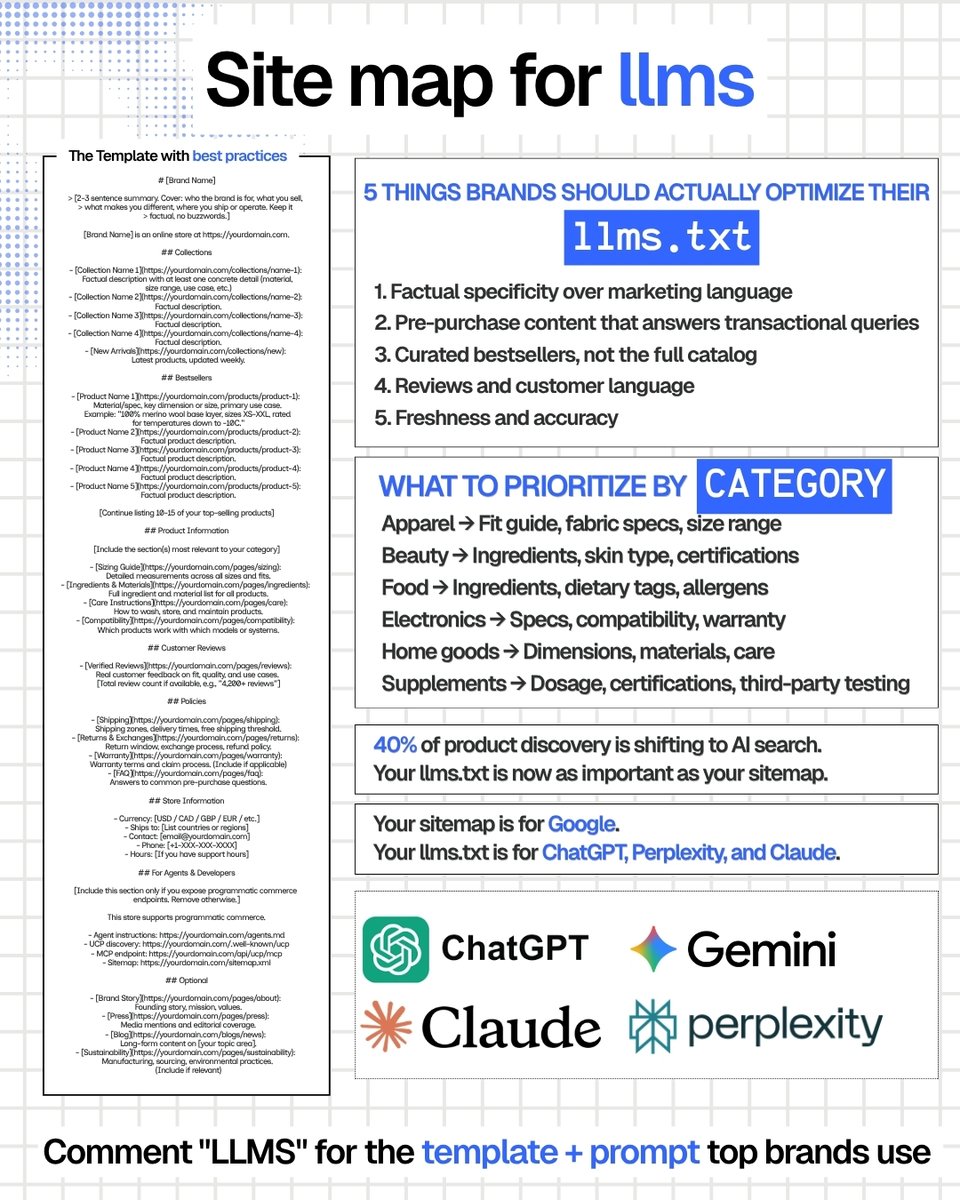
Your Shopify store already has a sitemap for Google.
But does it have one for AI?
Last week, Shopify rolled out support for llms.txt — a simple file placed at yourdomain.com/llms.txt that helps AI crawlers understand which pages on your store actually matter.
A few things brands should get right:
→ Keep it curated, not bloated. Include your top products, key collections, sizing pages, returns, and FAQs. Skip low-value long-tail pages.
→ Write factual descriptions, not marketing fluff. LLMs understand structured information better than exaggerated copy.
→ Use clean Markdown formatting with proper headings and link descriptions.
→ If you have detailed guides or documentation, add an llms-full.txt to give AI systems deeper context without forcing them to crawl dozens of pages.
One of the biggest misses right now: reviews.
When someone asks ChatGPT or Perplexity for product recommendations, review language heavily influences what gets surfaced. If your reviews aren’t discoverable, you’re likely invisible in AI-driven discovery.
One practical note for Shopify merchants:
Since Shopify doesn’t allow direct root uploads, upload the file under Content → Files, then create a redirect from /llms.txt to the CDN file URL.
AI search is quickly becoming a real acquisition layer for commerce brands.
The question is no longer whether AI will index your store.
It’s whether you’re helping it understand your store correctly.
Comment "LLMS" for the template + prompt top brands use
#Shopify #AISearch #Ecommerce #DTC #LLMs

English

Brands need to own their customers to hedge Meta’s unpredictability.
Kaushal@_kaushalshah
Right now, Meta is messing up with both parties • Creators (by disabling their account) • Brands (making weird changes & adding bugs to meta ads) if there was a good alternative, I am sure everyone would have tried moving to a different platform
English

55% of Shopify sales now come from categories outside the top 100.
71% of AI-attributed orders are flowing into those same long-tail categories.
And 41% of new Shopify stores are launching with a single product.
Those numbers point to something bigger:
Specialists are becoming the new mainstream, and AI is accelerating that shift.
But there’s another metric that matters even more:
What happens after discovery?
Because if customers discovered through AI don’t come back, then AI traffic is just a more efficient version of paid acquisition. Temporary spikes, not durable growth.
The brands turning AI discovery into long-term revenue are investing heavily in owned retention channels.
Mobile apps are becoming one of the most important of those channels in 2026.
They place the brand directly on the customer’s home screen, enable direct communication without paid CPMs, and create experiences that recognize and adapt to the customer instantly.
At Appbrew, we’re seeing niche Shopify brands build remarkably strong retention curves through mobile, often outperforming much larger generalist brands.
The same specificity that wins discovery is now winning retention too.
AI may become the top of the funnel.
But retention is still what compounds growth.
#Shopify #DTC #MobileCommerce #EcommerceGrowth

English

I built a Mobile CRO (Conversion Rate Optimisation) audit tool for Shopify stores, in just one afternoon.
9 prompts with clearly defined outcome. The rest is handled by Claude
Here’s the story behind it:
My team wanted to evaluate Shopify stores’ mobile performance not to pitch anything, but to genuinely contribute to the community. And we kept noticing the same pattern: most DTC brands optimize heavily for desktop, while over 80% of their traffic actually comes from mobile.
So instead of investing in another tool, I decided to build one.
The result is a streamlined, easy-to-read PDF audit that highlights key areas impacting mobile conversions load speed, checkout friction, hero sections, CTA placement, and other subtle factors that often go unnoticed but make a big difference.
If you’d like a free Mobile CRO audit for your Shopify store, drop your store URL in the comments or send me a DM-I’ll share the report with you.
Curious to hear: how much attention are you giving to mobile CRO right now?
#claude

English

Six months ago, I would've said I don't have time to shoot three podcasts in a month.
This month, I did.
And I have shot 10 episodes till date.
Rimjhim Deka from Littlebox India.
Viren and Darshan Lathiya from Sudathi.
Hovhannes Mkhitaryan, founder of Sevak Coffee and co-owner of The Growth Chef.
Steve Morales from Kut from the Kloth.
Kiran Kotla from Distacart.
I used to think my role as a founder was to build the product and let the work speak for itself.
I was wrong.
Some of the most valuable insights I've gained this year didn't come from dashboards or investor updates.
They came from sitting across the table with operators who've lived through challenges I haven't yet.
That perspective changes how you think.
So I'm leaning into it.
More conversations. More time with builders. Less noise.
If you're a DTC founder with a story worth sharing, my calendar is open.
And if you want to catch the previous episodes, Brewed is live on YouTube. Link in the comments.
English

Most brands come to us and say: "We want more sales from the app."
A brand we just onboarded came in with something different. Before signing, they handed us a Year 1 scorecard. Specific numbers. Things they'd actually hold us to.
-> 5-15% of their existing customer base downloads the app
-> 10-25% of total ecom revenue flows through it
-> App customers spend 20-30% more per order
-> Buy 30-40% more frequently. 30-day retention sits at 20-30%
-> Push opt-in clears 50-60%
-> App conversion runs 2-4x higher than mobile web.
My first reaction was: this is basically what we tell every new brand success looks like.
What does your definition of app success actually look like in year one?
#mobilecommerce #shopify

English
Abhijeet Singh retweetledi

Libas just crossed ₹1000 Cr ARR. 60% of their D2C business comes from the app.
When brands ask what a well-executed mobile experience looks like in practice, we point to Libas.
Congratulations to Nisha Khatri, Bhavay Pruthi & @LibasIndia team!
Watching the next phase closely

English


A great operator shared this with me over Easter.
He joked about execution in two eras - BC and AC.
Before Claude. After Claude.
The thing is… it wasn’t really a joke.
The way they communicate, prioritize, and make decisions has fundamentally changed. AC isn’t just a tool upgrade. It’s an operating system upgrade.
If you’re still running on BC - no judgment. But the gap is widening fast.
#AI #Operators
English

Excited to share that @AppbrewInc has been recognized as a winner at The Product Awards (Q1 2026) by @ProductsCount .
Honoured to be in the company of teams like Amazon Quick, Amplitude, and Galileo.
Moments like this are never about a single product or a single milestone. They reflect the work, conviction, and consistency of a team over time.
I especially want to share this with @mayank020 and @lego_sharat, and the early builders who laid the foundation for what Appbrew is today.
A lot of what we’re seeing now is built on decisions and effort from those early days.
Grateful to the entire team for continuing to push forward and raise the bar.
And to our customers and partners who trust us to build alongside them, this recognition is as much yours as it is ours.
Grateful for the journey so far, and even more excited for what we’re building next.
#ProductAwards #TheProductsThatCount #Shopify

English

What if your app behaved like a curated brand outlet?
If you open most brand apps today, they’re essentially websites in disguise. Be it fashion, skincare, accessories and across DTC categories.
Same homepage for everyone, same product grids, the same banners. The customer has to do all the work, re-enter preferences, search manually and browse endlessly. (which sucks honestly)
This doesn’t feel intelligent. And it definitely doesn’t feel personal.
As we move toward agentic experiences, there has to be systems that actively guide, adapt, and assist shoppers
I’ve started thinking about this through a simple analogy. What if your app behaved like a brand outlet?
Like someone who understands your taste, remembers your preferences, and recommends what actually makes sense for you.
That’s exactly the philosophical shift brands should think about.
We’re at the beginning of a structural shift from commerce as a static to commerce as an adaptive system
#MobileCommerce #ShopifyBrands #DTCBrands #AgenticAI
English

I recently sat down with someone who started on a retail sales floor at 17.
Someone who loved fashion and showed up every single day.
A decade later, Rebecca Lendino is the VP of Buying and Brand Operations at @ShopMixology , one of the most exciting women’s fashion retailers in the US.
And honestly, this conversation shifted how I think about brand building.
A few things she said have stayed with me:
→ “You are in service of your customer. Not the other way around.”
→ “In the age of AI, there’s still nothing more powerful than walking into your local store.”
→ “Before sending a push, email, or text - ask: what problem am I solving right now?”
→ “When you feel like giving up, you’re probably one millimetre away from success.”
We spoke about the Good / Better / Best pricing framework, how a single insight from a store associate turned a basic product into a breakout success, and how she’s navigating AI - not from fear, but from curiosity.
That last part stood out the most.
Here’s someone with over a decade of experience, operating at a VP level, still evolving, still learning, still doing the work.
That’s the kind of energy we want to bring through Brewed.
EP05 drops today
#brewed #dtc #fashionbrand #retailstrategy #brandbuilding #ecommerce
Appbrew@AppbrewInc
Mixology VP on What Actually Works in Retail Fashion - Brewed Podcast Ep.04 Stay tuned for the full Podcast
English

I’ve been thinking a lot about A/B testing lately.
Not the “red vs blue button” version.
But what it actually means in the age of AI.
When A/B testing started gaining traction around 2009, it was mostly for larger merchants. You needed serious traffic, analysts, and engineering time.
For smaller brands, it simply wasn’t practical.
The real barrier wasn’t intent, but it was availability of data.
If you didn’t have enough traffic, you couldn’t test properly. And without testing, you were optimizing on instinct.
AI changes all that.
With Shopify launching native A/B testing and tools like synthetic shoppers entering the picture, experimentation is finally becoming accessible to everyone.
Synthetic data removes the scale barrier and you can validate ideas before risking real revenue.
But the bigger shift isn’t just running more tests.
AI shouldn’t only create variations. It should also interpret results.
At Appbrew, this is exactly why we’re building Milo - not just as a reporting layer, but as a data interpreter.
Instead of digging through dashboards, a brand team should be able to ask:
“Which creative variation drove more high-value checkouts during the sale?”
And get a clear answer instantly.
That’s the shift from dashboards to dialogue, from experimentation as a feature to experimentation as infrastructure.
In 2026, the advantage won’t be having more data. It’ll be learning faster than everyone else.
English

@DTC_Jared Hey Jared, let me know what help do you need. Sharing my calendar in your DM.
English

It has gone worse - very painful for app based business —
Elon Musk@elonmusk
iOS App Review delays are getting ridiculous
English

@thisisgrantlee Very counter intuitive take - but makes a lot of sense. I am seeing young people exploit AI through creativity which veterans are already missing.
English

