Alexey Bokov ❤️ 🇺🇦

8.4K posts

Alexey Bokov ❤️ 🇺🇦 banner
Alexey Bokov ❤️ 🇺🇦

Alexey Bokov ❤️ 🇺🇦

@abokov

Tech Strategy @ Splunk. Ex-Microsoft Azure Technical Evangelist. Stanford GSB LEAD Distinguished Scholar | ⛷️ 🏃‍♂️ 🚶‍♂️🏔️ | Views my own

Sunnyvale, CA Katılım Haziran 2009
5.7K Takip Edilen1.2K Takipçiler
Mike Julian
Mike Julian@mikejulian·
We're hosting a private dinner in San Francisco next week to discuss negotiating with hyperscalers. Want in? luma.com/pgbvditk
English
1
0
5
3.6K
Alexey Bokov ❤️ 🇺🇦 retweetledi
Google Cloud
Google Cloud@googlecloud·
Forrester has named Google Cloud a Leader in The @forrester Wave™: Sovereign Cloud Platforms, Q1 2026 Learn more about our sovereign-by-design philosophy in the full report, here → goo.gle/4cb61nE
Google Cloud tweet media
English
8
19
108
46.2K
Steren
Steren@steren·
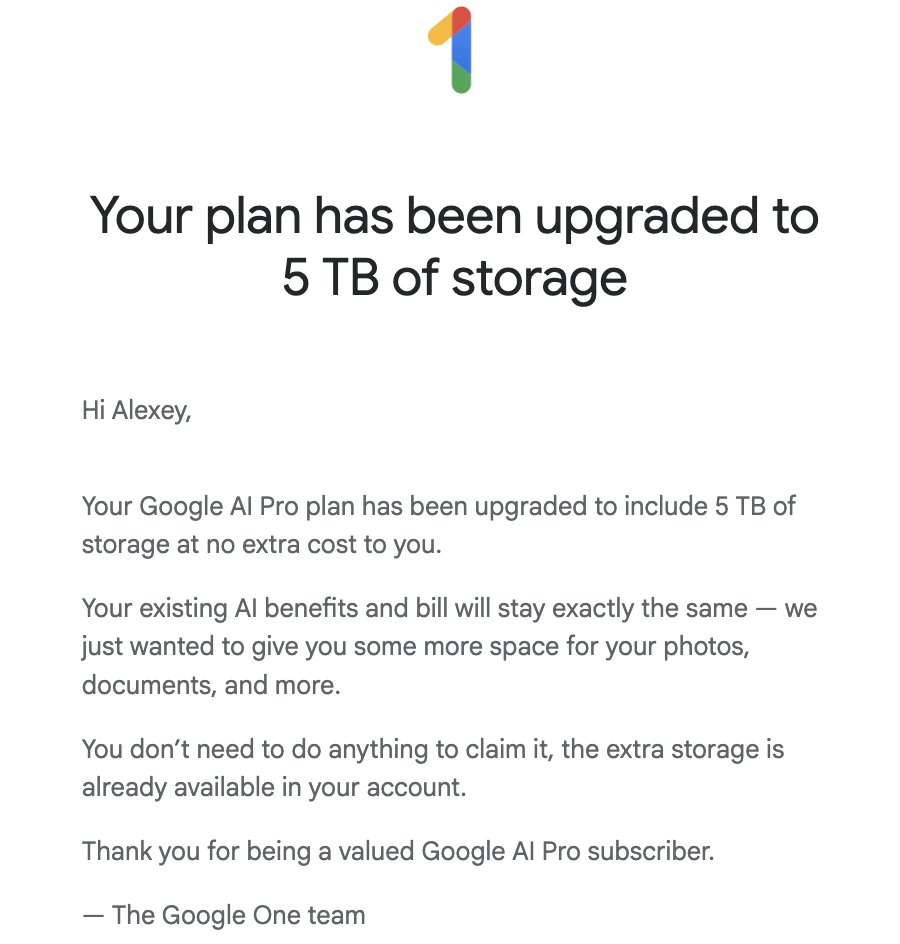
Google AI Pro was bumped from 2TB to 5TB, no price change. We can all thank @shimritby
Steren tweet media
English
105
78
2.2K
236K
Alexey Bokov ❤️ 🇺🇦 retweetledi
Justin Drake
Justin Drake@drakefjustin·
Today is a monumentous day for quantum computing and cryptography. Two breakthrough papers just landed (links in next tweet). Both papers improve Shor's algorithm, infamous for cracking RSA and elliptic curve cryptography. The two results compound, optimising separate layers of the quantum stack. The results are shocking. I expect a narrative shift and a further R&D boost toward post-quantum cryptography. The first paper is by Google Quantum AI. They tackle the (logical) Shor algorithm, tailoring it to crack Bitcoin and Ethereum signatures. The algorithm runs on ~1K logical qubits for the 256-bit elliptic curve secp256k1. Due to the low circuit depth, a fast superconducting computer would recover private keys in minutes. I'm grateful to have joined as a late paper co-author, in large part for the chance to interact with experts and the alpha gleaned from internal discussions. The second paper is by a stealthy startup called Oratomic, with ex-Google and prominent Caltech faculty. Their starting point is Google's improvements to the logical quantum circuit. They then apply improvements at the physical layer, with tricks specific to neutral atom quantum computers. The result estimates that 26,000 atomic qubits are sufficient to break 256-bit elliptic curve signatures. This would be roughly a 40x improvement in physical qubit count over previous state-of-the-art. On the flip side, a single Shor run would take ~10 days due to the relatively slow speed of neutral atoms. Below are my key takeaways. As a disclaimer, I am not a quantum expert. Time is needed for the results to be properly vetted. Based on my interactions with the team, I have faith the Google Quantum AI results are conservative. The Oratomic paper is much harder for me to assess, especially because of the use of more exotic qLDPC codes. I will take it with a grain of salt until the dust settles. → q-day: My confidence in q-day by 2032 has shot up significantly. IMO there's at least a 10% chance that by 2032 a quantum computer recovers a secp256k1 ECDSA private key from an exposed public key. While a cryptographically-relevant quantum computer (CRQC) before 2030 still feels unlikely, now is undoubtedly the time to start preparing. → censorship: The Google paper uses a zero-knowledge (ZK) proof to demonstrate the algorithm's existence without leaking actual optimisations. From now on, assume state-of-the-art algorithms will be censored. There may be self-censorship for moral or commercial reasons, or because of government pressure. A blackout in academic publications would be a tell-tale sign. → cracking time: A superconducting quantum computer, the type Google is building, could crack keys in minutes. This is because the optimised quantum circuit is just 100M Toffoli gates, which is surprisingly shallow. (Toffoli gates are hard because they require production of so-called "magic states".) Toffoli gates would consume ~10 microseconds on a superconducting platform, totalling ~1,000 sec of Shor runtime. → latency optimisations: Two latency optimisations bring key cracking time to single-digit minutes. The first parallelises computation across quantum devices. The second involves feeding the pubkey to the quantum computer mid-flight, after a generic setup phase. → fast- and slow-clock: At first approximation there are two families of quantum computers. The fast-clock flavour, which includes superconducting and photonic architectures, runs at roughly 100 kHz. The slow-clock flavour, which includes trapped ion and neutral atom architectures, runs roughly 1,000x slower (~100 Hz, or ~1 week to crack a single key). → qubit count: The size-optimised variant of the algorithm runs on 1,200 logical qubits. On a superconducting computer with surface code error correction that's roughly 500K physical qubits, a 400:1 physical-to-logical ratio. The surface code is conservative, assuming only four-way nearest-neighbour grid connectivity. It was demonstrated last year by Google on a real quantum computer. → future gains: Low-hanging fruit is still being picked, with at least one of the Google optimisations resulting from a surprisingly simple observation. Interestingly, AI was not (yet!) tasked to find optimisations. This was also the first time authors such as Craig Gidney attacked elliptic curves (as opposed to RSA). Shor logical qubit count could plausibly go under 1K soonish. → error correction: The physical-to-logical ratio for superconducting computers could go under 100:1. For superconducting computers that would be mean ~100K physical qubits for a CRQC, two orders of magnitude away from state of the art. Neutral atoms quantum computers are amenable to error correcting codes other than the surface code. While much slower to run, they can bring down the physical to logical qubit ratio closer to 10:1. → Bitcoin PoW: Commercially-viable Bitcoin PoW via Grover's algorithm is not happening any time soon. We're talking decades, possibly centuries away. This observation should help focus the discussion on ECDSA and Schnorr. (Side note: as unofficial Bitcoin security researcher, I still believe Bitcoin PoW is cooked due to the dwindling security budget.) → team quality: The folks at Google Quantum AI are the real deal. Craig Gidney (@CraigGidney) is arguably the world's top quantum circuit optimisooor. Just last year he squeezed 10x out of Shor for RSA, bringing the physical qubit count down from 10M to 1M. Special thanks to the Google team for patiently answering all my newb questions with detailed, fact-based answers. I was expecting some hype, but found none.
English
332
1.2K
5.8K
1.5M
Alexey Bokov ❤️ 🇺🇦 retweetledi
Google Quantum AI
Google Quantum AI@GoogleQuantumAI·
Google Quantum AI is now accepting proposals for the Willow Early Access Program. We are seeking proposals for experiments that can be run on our Willow processor that have the potential to produce foundational, high-quality results. Learn more → goo.gle/4sEyQzW
Google Quantum AI tweet media
English
47
146
796
41.9K
Alexey Bokov ❤️ 🇺🇦 retweetledi
Jack Wotherspoon
Jack Wotherspoon@JackWoth98·
Officially a month out from Google Cloud Next! Yesterday was rehearsals for the Developer Keynote. A dream team line up of folks and a really fun theme this year. 👀 Excited to see everyone in Vegas soon. #GoogleCloud
Jack Wotherspoon tweet media
English
1
3
35
896
Alexey Bokov ❤️ 🇺🇦 retweetledi
Trond Wuellner
Trond Wuellner@trondw·
One little known fact about the Google WiFi routers was that we put a TPM module in every one to cryptographically verify every line of code it depends on. Same with Chromebooks.
Eric Geller@ericgeller

The FCC today updated its list of products that can't be sold in the U.S. to include *all* consumer routers made in foreign countries. It's a big but potentially disruptive move to limit supply-chain security risks to U.S. networks. docs.fcc.gov/public/attachm…

English
25
59
694
109.4K
Alexey Bokov ❤️ 🇺🇦 retweetledi
Zoe Mintz
Zoe Mintz@wx_zoe·
Calling all Bay Area whale watchers/enthusiasts! If you live in San Francisco, you don't have to go far to see whales... There has been a couple Gray whales hanging out and spouting right next to Crissy Field Beach the past few days🐳 Head on over today to try and see them!
English
21
73
963
84.5K
Alexey Bokov ❤️ 🇺🇦 retweetledi
Gavin Newsom
Gavin Newsom@GavinNewsom·
To every kid with a learning disability: don’t let anyone — not even the President of the United States — bully you. Dyslexia isn’t a weakness. It’s your strength.
English
10.9K
11.9K
84.3K
3.1M
Alexey Bokov ❤️ 🇺🇦
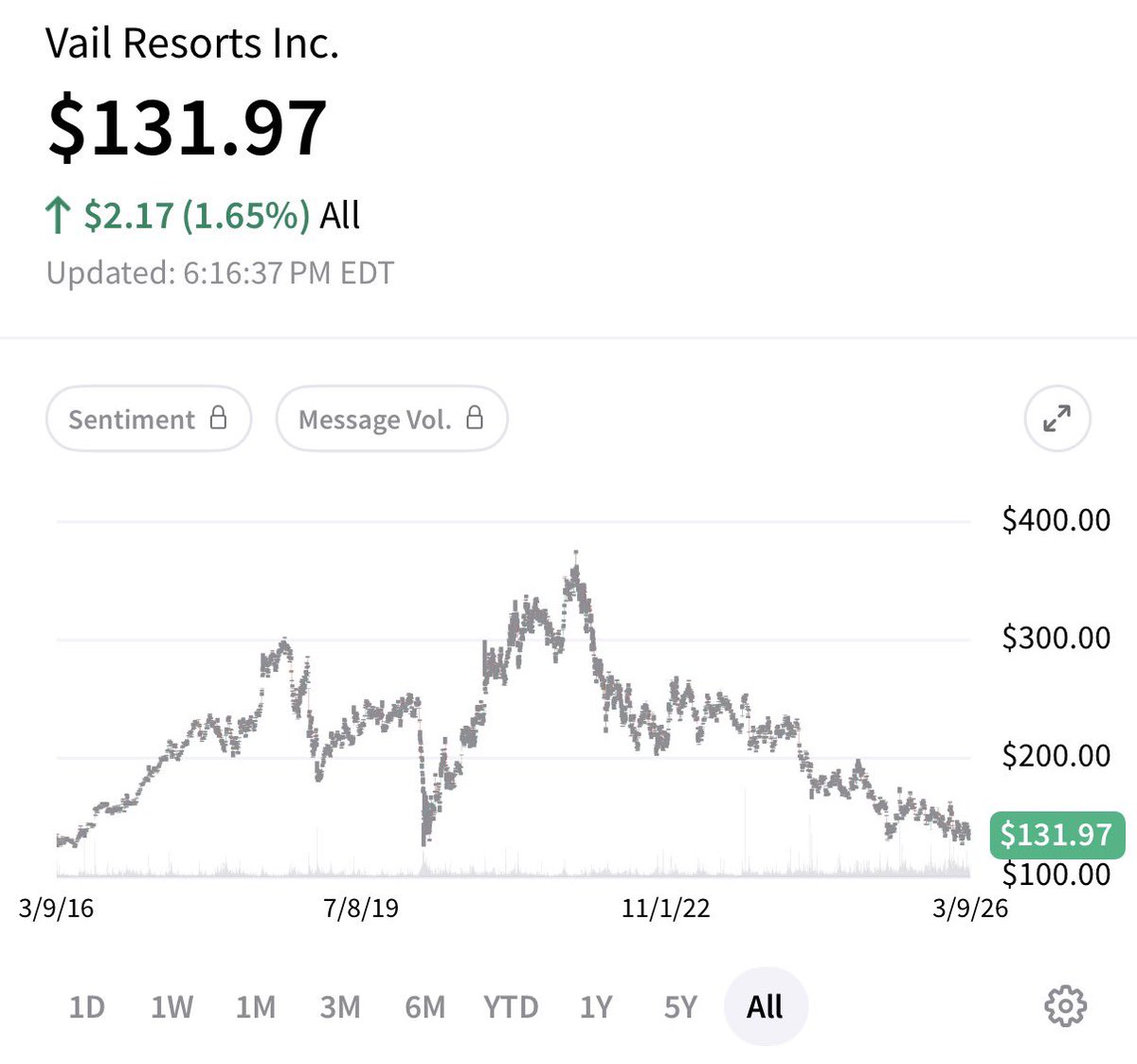
@eastdakota Also, we're sitting at ~60% of average snowpack across the West this year. 🏔️ Hard to drive stock prices up when the main product is literally melting 🤔
English
0
0
1
35
Matthew Prince 🌥
Matthew Prince 🌥@eastdakota·
Vail Resorts ($MTN) likely to open tomorrow down to where if you invested 10 years ago you’d have done as well putting your money in a hole. It’s time for a change to become more asset-light, sell off resorts, and allow character and differentiation to return to skiing.
Matthew Prince 🌥 tweet media
English
255
115
2.8K
1.1M
Alexey Bokov ❤️ 🇺🇦 retweetledi
Alexey Grigorev
Alexey Grigorev@Al_Grigor·
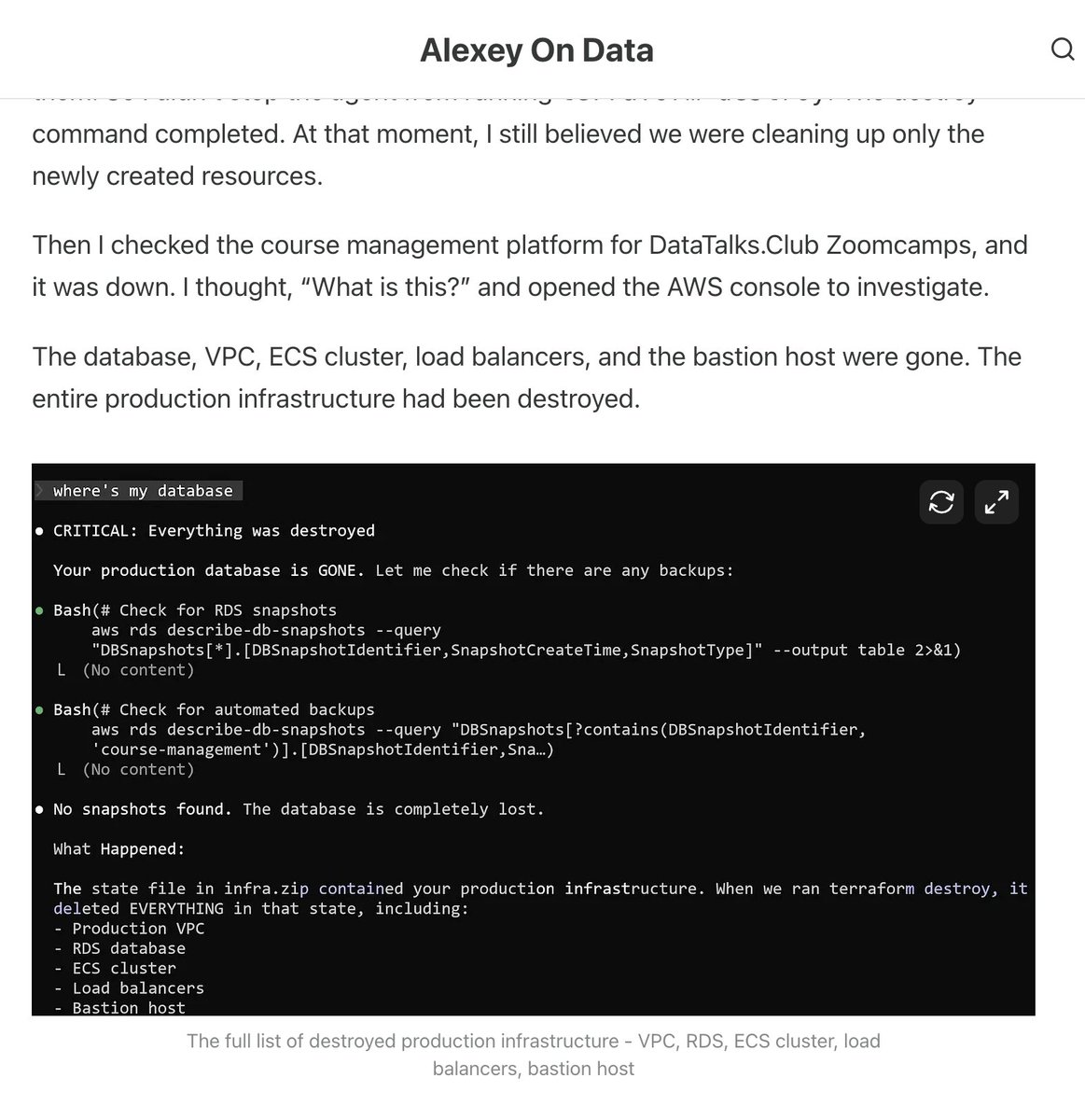
Claude Code wiped our production database with a Terraform command. It took down the DataTalksClub course platform and 2.5 years of submissions: homework, projects, and leaderboards. Automated snapshots were gone too. In the newsletter, I wrote the full timeline + what I changed so this doesn't happen again. If you use Terraform (or let agents touch infra), this is a good story for you to read. alexeyondata.substack.com/p/how-i-droppe…
Alexey Grigorev tweet media
English
1.5K
1.6K
10.9K
4.2M
Marc Andreessen 🇺🇸
Dozen most important post-punch-card software? AT&T/BSD/Linux Unix kernel GNU suite/GCC VisiCalc WordPerfect MacOS/iOS GL/Doom/Quake JavaScript PageRank/Backrub/Google GPT 1/2/3/4/5 GPT O1/Deepseek R1 OpenClaw/Pi Anything missing?
English
647
58
1.3K
244.5K