Zen⚡️Chu ⛑🏴‍☠️🇺🇸

10.4K posts

Zen⚡️Chu ⛑🏴‍☠️🇺🇸 banner
Zen⚡️Chu ⛑🏴‍☠️🇺🇸

Zen⚡️Chu ⛑🏴‍☠️🇺🇸

@accelmed

Teaching the next gen of health CEOs + backing early stage med tech ventures @MIT @UCLA @MITHackMed Father to 3 hilarious engineers and a few medical startups.

Bali, Indonesia Katılım Kasım 2009
1.3K Takip Edilen3.1K Takipçiler
Zen⚡️Chu ⛑🏴‍☠️🇺🇸 retweetledi
Joshua Liu
Joshua Liu@joshuapliu·
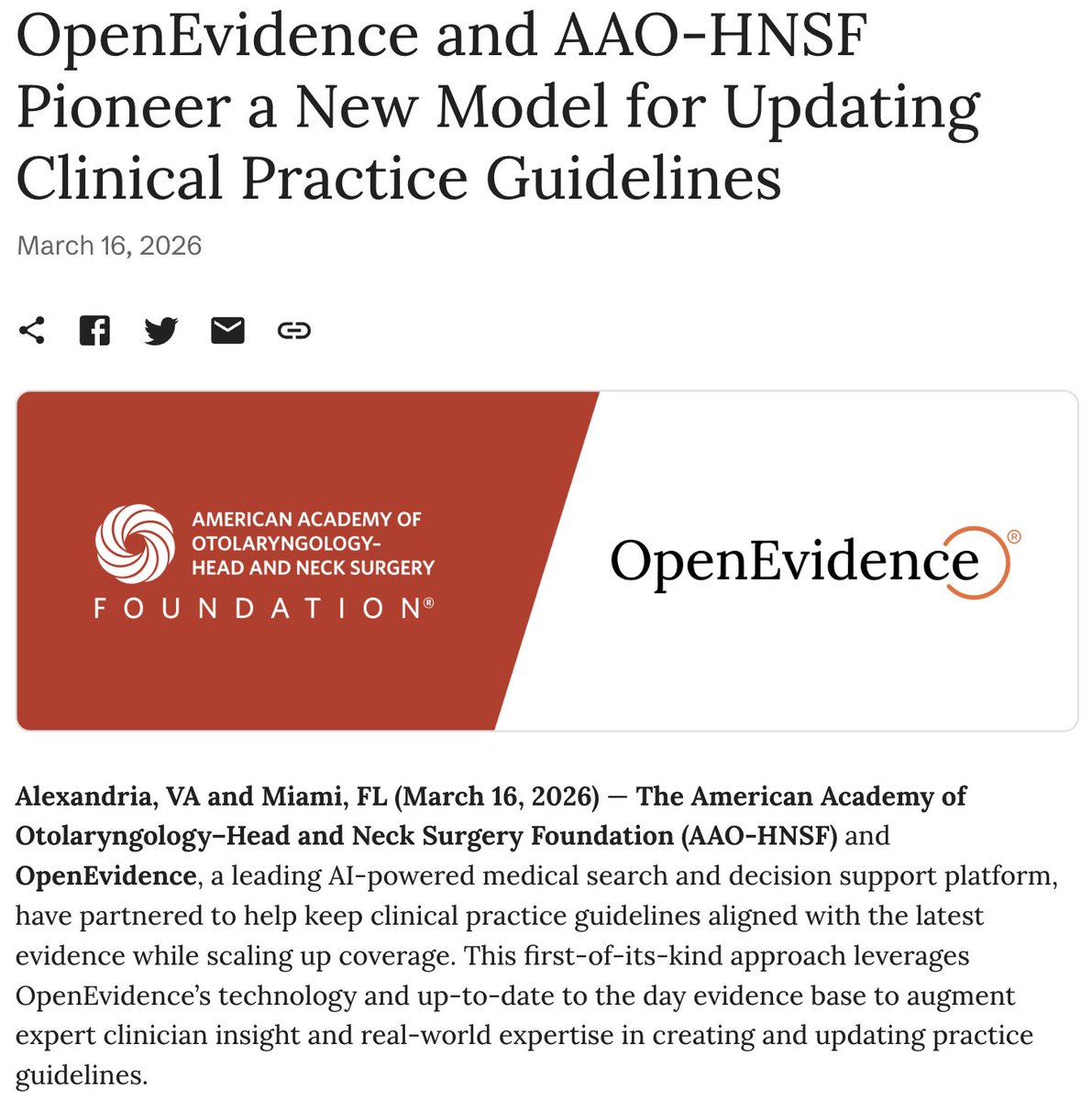
OpenEvidence started as the place clinicians go to find clinical evidence. Now they're becoming the place medical societies go to CREATE it - that's a whole new moat for winning the AI CDS market. My 5 thoughts... First, the gist of what OpenEvidence announced: → The American Academy of Otolaryngology-Head and Neck Surgery Foundation (AAO-HNSF) and OpenEvidence have partnered to keep clinical practice guidelines current using AI-augmented literature surveillance → OpenEvidence built a custom methodology with AAO-HNSF that systematically compares existing guideline recommendations against current medical literature. → The system flags specific recommendations for review when new evidence either supports revising the existing guidelines or reaffirms it. → AAO-HNSF has already applied this to several of its existing clinical practice guidelines. The goal is to make it easier and faster for societies to keep guidelines up-to-date. My 5 thoughts on this strategy and what it means for the AI CDS industry: 1/ OpenEvidence has strengthened its market position by going beyond simply licensing clinical content from medical societies and journals. By creating a way to add value to medical societies directly, and thus create some dependency for medical societies on OE, it incentivizes those societies to encourage their members to choose OE over other tools. 2/ This is awesome for clinical guideline maintenance. Many clinical practice guidelines become outdated because too many years can go by without a review or updates simply because doing a review is very time and labour intensive. It’s increasingly difficult because the pace of research outpaces our ability to incorporate them into guidelines. By reducing friction to making such updates, we will see guideline updates skyrocket. 3/ In the past, some clinicians may have minimized the value of guidelines because they could be quickly out of date. But if these tools can truly make guidelines more current, the clinician community will be even more willing to use them. This will lead to better patient care. 4/ This puts OE on a potential path to expansion beyond simply evidence search and curation and into opportunities of evidence generation itself. OE is starting by helping to update guidelines, but what if OE creates AI tools to suggest and draft not yet developed, brand new guidelines in the first place? That seems inevitable and the smart thing to do. 5/ This illustrates one of the powerful things about startups. OE has the freedom and courage to try new stuff like this very easily - how do the large incumbents move quickly enough to not just catch up but lead the way on product innovation? Unlike a big entrenched EHR, it’s hard to see how CDS products - even legacy ones - have much of a moat.
Joshua Liu tweet media
English
5
15
84
7.6K
Zen⚡️Chu ⛑🏴‍☠️🇺🇸 retweetledi
Parmita Mishra
Parmita Mishra@parmita·
People think AI and biology and optics are SO separate. That what we are doing is SO wild. No, it’s actually following the history of all three fields. In 1957 Marvin Minsky patented the confocal microscope. Marvin Minsky, father of artificial intelligence. He wanted to see inside dense brain tissue. Conventional microscopes were useless. Too much scatter and blur and absolute garbage signal to noise. So he built a system that used a pinhole to block out-of-focus light and let you optically slice through neural tissue layer by layer. He showed it to people, like with most brilliant things, they initially didn’t care. The images were faint and scan-based and didn’t look sharp enough on the display. He later said he should’ve just used a smaller screen lol. So he dropped it and pivoted fully into AI. Decided studying the brain’s wiring was less relevant to him than studying its logic. The microscope sat ignored for 30 years. Then lasers made confocal scanning practical and it became one of the most important instruments in all of cell biology. Here’s what people miss though. AI didn’t come from just pure theory and math. AI came from biology and observation of biology. Neural networks are literally named after neurons. Perceptrons were modeled on how the brain processes signals. The entire field exists because people were trying to understand living systems and said “what if we could build something that learns like that.” Biology created AI. Not the other way around. And biology will never stop mattering. You can build the most sophisticated model in the world but if you’re training it on dead cell snapshots and bulk averages you’re just getting really good at being wrong. The data has to come from, be inspired by, life as we (barely!) understand it. That’s where optics changes everything. When you can actually watch a living cell make decisions in real time, label-free, at the molecular level… you’re not inferring biology anymore. You’re seeing it. That’s a whole different dimension of data that no amount of compute can hallucinate into existence. The guy who literally made AI also built one of biology’s most important instruments. the problem demanded it. He didn’t care what “field” it was. I don’t care what field you call my work either. It’s about the discovery and the solution to the problem I guess all i am saying is: he needed to see something so he built the thing that let him see it. Because, why the fuck not? (I agree with my whole heart and career.) The boundaries between these fields have never been real. The problems are real. The tools follow.
Parmita Mishra tweet media
English
5
5
51
5.8K
Zen⚡️Chu ⛑🏴‍☠️🇺🇸 retweetledi
Paul Graham
Paul Graham@paulg·
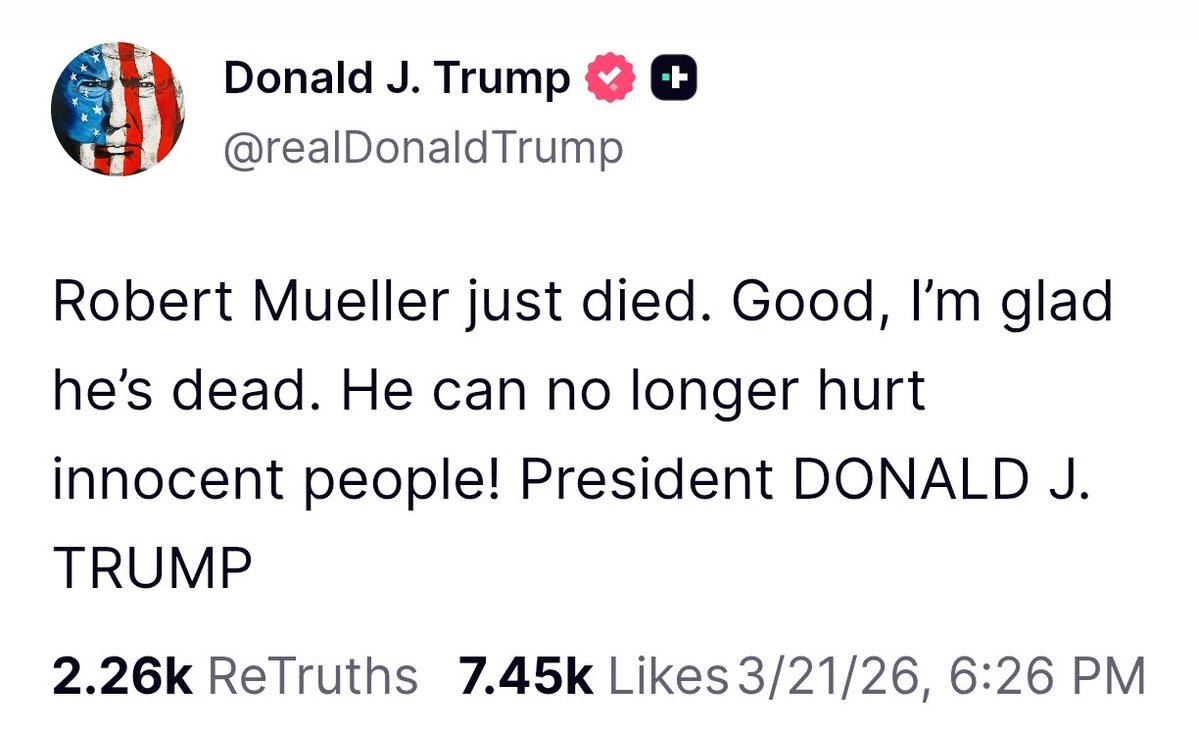
Whether the next president is a Republican or a Democrat, can we have someone with at least a little class next time? Because this is embarrassing.
Paul Graham tweet media
English
1.3K
1.4K
19.2K
1.4M
Zen⚡️Chu ⛑🏴‍☠️🇺🇸 retweetledi
Ashish K. Jha
Ashish K. Jha@ashishkjha·
Getting asked so I'll pull it here: What about other major allied health professionals ALL other major allied health professionals account for about 6% of total healthcare spending That includes a long list: Pharmacists and pharmacy techs Physical and occupation therapists Social Workers (all types) Speech/language therapists Respiratory therapists Mental health / Substance Abuse counselors Psychologists About 3.3 million people $300 billiion 6% of healthcare spending
English
7
4
54
9.7K
Zen⚡️Chu ⛑🏴‍☠️🇺🇸 retweetledi
Jack Moses
Jack Moses@jackmoses777·
If you don't transmute your anger into courageous action, it will manifest as intense apathy, depression, escapism, or disease, and you will constantly feel like you're wasting your incarnation. Don't suppress it. Use it to create motion.
English
65
1.4K
8.5K
122.1K
Zen⚡️Chu ⛑🏴‍☠️🇺🇸 retweetledi
Christina Farr
Christina Farr@chrissyfarr·
New media businesses are not easy. But because it’s my own thing, I get to set our policies. So for a few years now, I have been sharing a portion of our paid subscriber revenue to nonprofits & charities. I welcome submissions from readers on where we should donate next.
English
1
1
9
1.1K
Zen⚡️Chu ⛑🏴‍☠️🇺🇸 retweetledi
Robert Nelsen
Robert Nelsen@rtnarch·
Incorrect. Harvard did not pioneer this. Juan Carlos Izpisua Belmonte is the key pioneer for the first widely cited paper showing partial reprogramming had anti-aging effects in vivo. That 2016 Cell paper reported that short-term cyclic OSKM expression ameliorated age-associated hallmarks and extended lifespan in a mouse model of premature aging.[pubmed.ncbi.nlm.nih +1]
English
4
6
38
6K
Zen⚡️Chu ⛑🏴‍☠️🇺🇸 retweetledi
Neil Stone
Neil Stone@DrNeilStone·
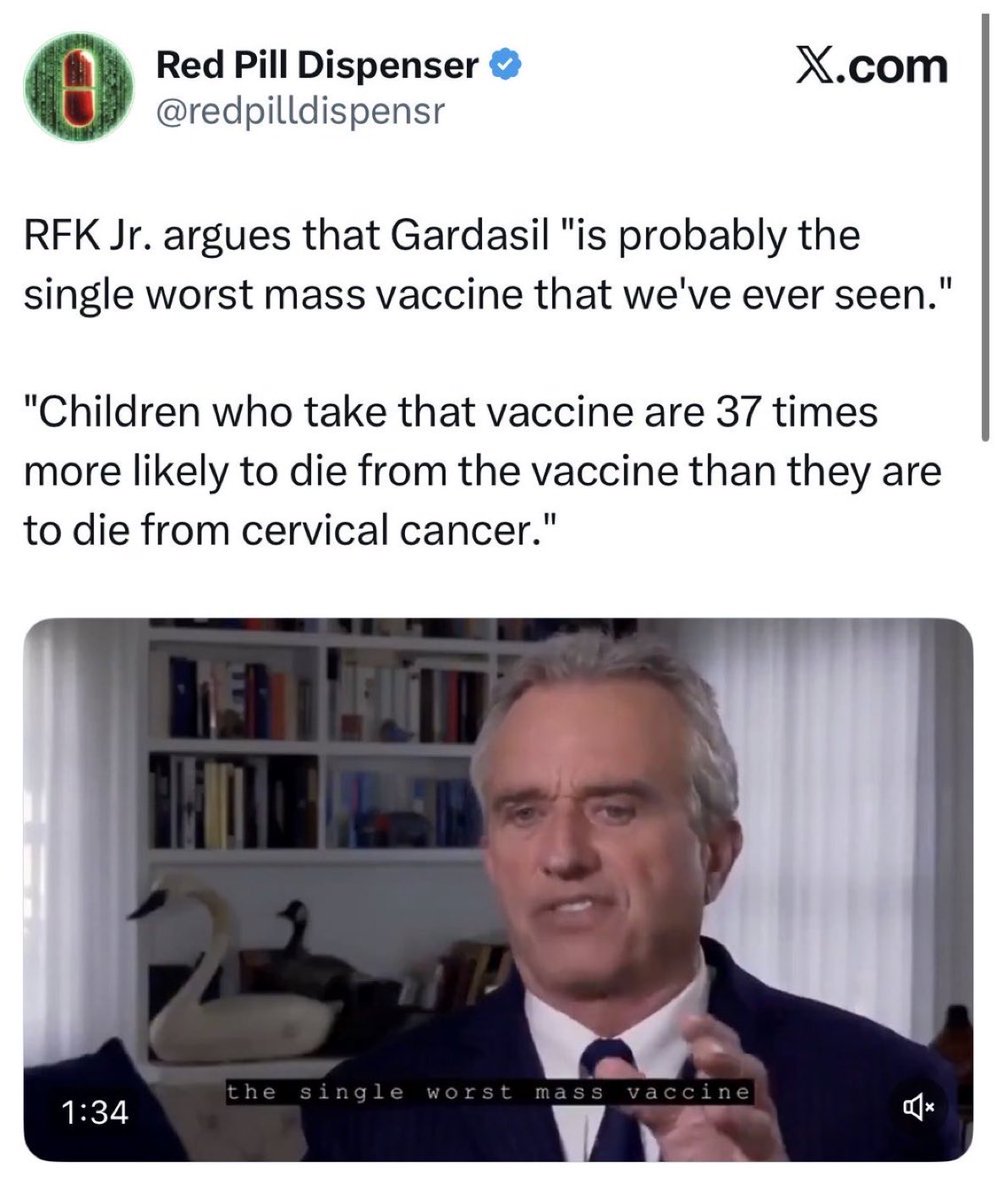
The HPV vaccine Gardasil is one of great successes of modern medicine and is on the way to ELIMINATING cervical cancer in countries from Sweden to Australia! HHS Secretary RFK Jr : it kills people 🤡🤡
Neil Stone tweet media
English
273
813
2.9K
38.6K
Zen⚡️Chu ⛑🏴‍☠️🇺🇸 retweetledi
Garry Tan
Garry Tan@garrytan·
For agentic systems founders and dev tools founders: People do not want to pay for raw markdown and they shouldn't have to. But they may pay for orchestration, hosting, updates, collaboration, portability, analytics, and managed execution. These can be great businesses.
English
285
138
2.5K
168K
Zen⚡️Chu ⛑🏴‍☠️🇺🇸 retweetledi
Shanaka Anslem Perera ⚡
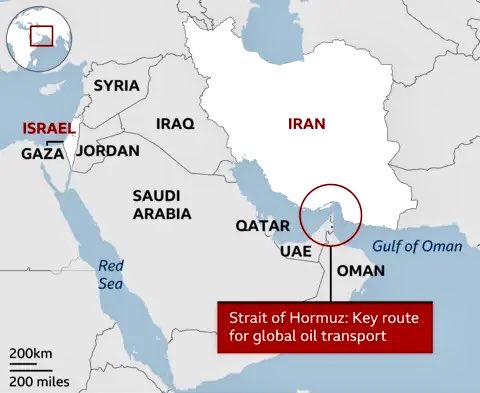
The war in the Strait of Hormuz will reach your local pharmacy within six weeks. Not because your pharmacist follows geopolitics. Because the active pharmaceutical ingredients in roughly half of America’s generic prescriptions begin as petrochemical derivatives manufactured in India, and India’s petrochemical industry begins as crude oil that transited 21 miles of water that closed on March 4. Nearly 70 percent of the active ingredients in US generic drugs are produced in India. India imports approximately 40 percent of its crude oil through the Strait of Hormuz. The crude feeds refineries that produce naphtha. The naphtha feeds petrochemical crackers that produce intermediates. The intermediates feed pharmaceutical plants in Gujarat, Maharashtra, and Hyderabad that produce the API, the active pharmaceutical ingredient, that is shipped to contract manufacturers in the United States, Europe, and across Asia. The chain from the strait to the tablet is six steps long. Every step requires the one before it. CNBC reported that the Hormuz closure puts America’s generic drug supply at risk. Fierce Pharma warned of longer-term effects on US manufacturing and generics. Think Global Health mapped the pharmaceutical supply chains most vulnerable to disruption. The consensus across trade publications, health policy analysts, and industry executives is identical: four to six weeks of current inventory exists in the pipeline. After that, shortages begin with the most complex formulations first. Cancer drugs are the highest risk. Biologics requiring cold-chain storage have the shortest shelf life and the longest replenishment cycle. Clinical trial medications depend on uninterrupted supply chains that are now interrupted. Insulin analogues, antivirals, and cardiac medications all contain intermediates sourced from Indian manufacturers whose input costs are rising with every day the strait remains closed. Air cargo is the emergency bypass. But air freight rates from India have climbed 200 to 350 percent on some routes since the war began, according to logistics tracking firms. Gulf air capacity is down 79 percent because airports in the UAE, Kuwait, and Qatar have been damaged or operate under restricted conditions. The Suez Canal route adds 10 to 14 days to maritime shipping times. The Cape of Good Hope route adds 21 to 28 days. Both alternatives assume the Red Sea remains navigable, which the Houthi threat has complicated since 2024. The World Health Organisation reported a 70 percent funding gap for its operational response in the region. Medical supply chains to Iran itself have been devastated, with hospitals reporting shortages of surgical supplies, blood products, and anaesthetics. But the downstream pharmaceutical effect extends far beyond the war zone. Every Indian manufacturer that pays more for crude pays more for naphtha, pays more for intermediates, and passes the cost forward into API prices that American generic drug companies absorb until they cannot absorb any further. The molecule does not know it is a medicine. The strait does not know it is a pharmacy. The petrochemical derivative that becomes a blood pressure tablet transits the same water as the petrochemical derivative that becomes a fertiliser pellet. Both are trapped. Both have shelf lives. Both have planting windows or prescription refill cycles that do not negotiate with blockades. Six weeks. Then the pharmacy starts calling patients about substitutions. open.substack.com/pub/shanakaans…
Shanaka Anslem Perera ⚡ tweet media
Shanaka Anslem Perera ⚡@shanaka86

Your paracetamol is made from oil. The phenol comes from a cumene process that starts with naphtha. The naphtha comes from a refinery. The refinery’s feedstock transits the Strait of Hormuz. Ninety-nine percent of pharmaceutical feedstocks, solvents, reagents, and packaging are petrochemical-derived. The American Gas Association confirmed it. The medicine cabinet is the sixth layer of the Hormuz crisis and nobody is talking about it. The war started with uranium. It moved to oil. Then fertiliser. Then water. Then plastic. Now medicine. Paracetamol is 100 percent petrochemical. Phenol from cumene, converted to para-aminophenol, then acetylated. Ibuprofen is 100 percent petrochemical. Isobutylbenzene plus propionic acid derivatives. Metformin, the most prescribed diabetes drug on Earth, is 80 to 90 percent petrochemical. Dicyandiamide from natural gas derivatives. Antibiotics like amoxicillin and ciprofloxacin require methanol, acetone, and dichloromethane as solvents for extraction and crystallisation. Oncology drugs need cold-chain energy and plastic packaging. Every blister pack, every pill bottle, every syringe is PE, PP, or PET from Gulf naphtha. India makes 40 to 47 percent of American generic medicines by volume. It imports $4.35 billion in active pharmaceutical ingredients annually, 74 percent from China. But the critical precursors, the methanol and ethylene glycol that feed Indian API synthesis, are 87.7 percent and roughly 100 percent Hormuz-dependent respectively. The Indian government has prioritised household LPG over industrial petrochemical feedstock, starving the downstream pharmaceutical chain. API costs have surged 30 percent in the last two weeks. The typical buffer is two to three months of inventory. The war is nineteen days old. The clock started before the buffer was designed for this scenario. A diabetic in Ohio takes metformin every morning. The dicyandiamide that becomes the active ingredient traces back through a Chinese intermediate to a natural gas derivative that originated in the Gulf. The methanol used to crystallise the compound in a Hyderabad factory was shipped from a terminal that now sits behind the same strait controlled by provincial commanders with sealed orders. The blister pack was moulded from polyethylene derived from naphtha that loaded at a facility the IRGC published satellite targeting images of yesterday. One pill. Four petrochemical dependencies. One chokepoint. The farmer in Iowa cannot plant corn because nitrogen costs $610. The diabetic in Ohio may not be able to fill a prescription because methanol costs whatever the strait permits. Both crises trace to the same 21 miles of water. Both are governed by the same sealed packets. Both operate on biological clocks that do not negotiate with doctrine. Nitrogen decides whether the food grows. Methanol decides whether the medicine is synthesised. Polyethylene decides whether it reaches the shelf in a blister pack. Energy decides whether the cold chain holds for oncology and biologics. Every molecule in the pharmaceutical supply chain is now compromised by the same chokepoint that trapped the fertiliser, the gas, the plastic, and the water. Europe said Iran is not their war. Their existing drug shortages, 400 to 1,500 medicines depending on the country, will deepen regardless. Bangladesh, Egypt, and sub-Saharan Africa depend on Indian generics for infectious disease and maternal health. The API depletion clock runs for everyone. The strait does not distinguish between a urea molecule and a methanol molecule. Both are gated. Both are biological. And both determine whether human beings survive the next quarter. Full analysis - open.substack.com/pub/shanakaans…

English
119
2.8K
4.8K
581.3K
Zen⚡️Chu ⛑🏴‍☠️🇺🇸 retweetledi
Nav Toor
Nav Toor@heynavtoor·
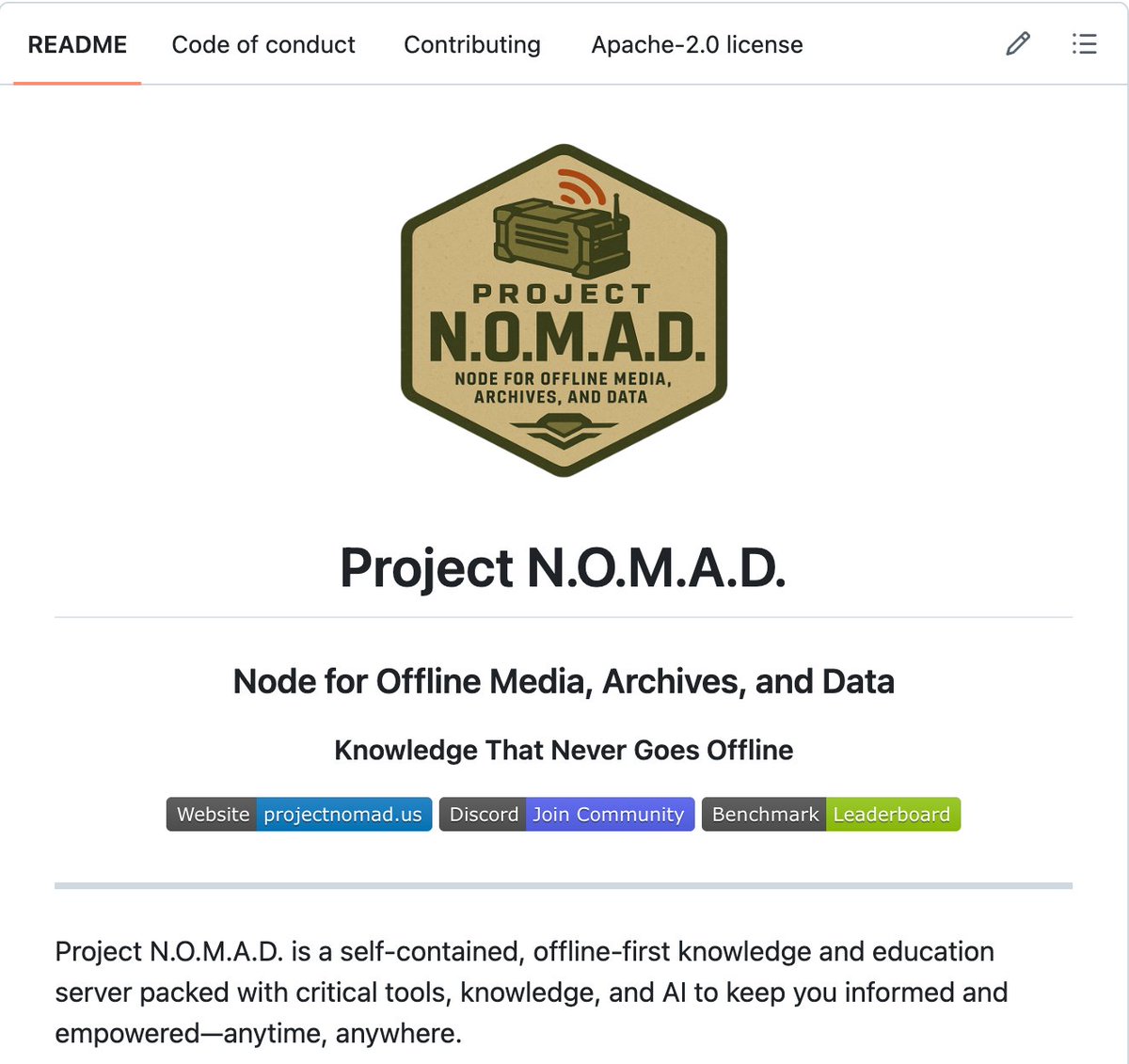
🚨Someone just open sourced a computer that works when the entire internet goes down. It's called Project N.O.M.A.D. A self-contained offline survival server with AI, Wikipedia, maps, medical references, and full education courses. No internet. No cloud. No subscription. It just works. Here's what's packed inside: → A local AI assistant powered by Ollama (works fully offline) → All of Wikipedia, downloadable and searchable → Offline maps of any region you choose → Medical references and survival guides → Full Khan Academy courses with progress tracking → Encryption and data analysis tools via CyberChef → Document upload with semantic search (local RAG) Here's the wildest part: A solar panel, a battery, a mini PC, and a WiFi access point. That's it. That's your entire off-grid knowledge station. 15 to 65 watts of power. Works from a cabin, an RV, a sailboat, or a bunker. Companies sell "prepper drives" with static PDFs for $185. This gives you a full AI brain, an entire encyclopedia, and real courses for free. One command to install. 100% Open Source. Apache 2.0 License.
Nav Toor tweet media
English
594
4K
24.1K
1.1M
Zen⚡️Chu ⛑🏴‍☠️🇺🇸 retweetledi
Laura Love
Laura Love@Panopticonomy·
@eringriffith Oh my.. Delve team are very rapidly, in the past ten minutes taking down pages and news articles they were hosting but I saved this fun one here: web.archive.org/web/2025072214…
English
0
3
5
804
Zen⚡️Chu ⛑🏴‍☠️🇺🇸 retweetledi
Ryan
Ryan@ohryansbelt·
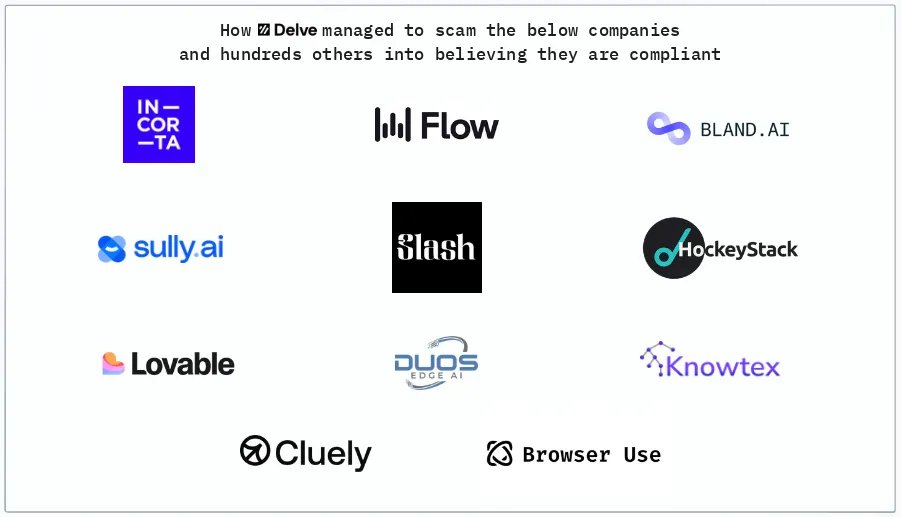
Delve, a YC-backed compliance startup that raised $32 million, has been accused of systematically faking SOC 2, ISO 27001, HIPAA, and GDPR compliance reports for hundreds of clients. According to a detailed Substack investigation by DeepDelver, a leaked Google spreadsheet containing links to hundreds of confidential draft audit reports revealed that Delve generates auditor conclusions before any auditor reviews evidence, uses the same template across 99.8% of reports, and relies on Indian certification mills operating through empty US shells instead of the "US-based CPA firms" they advertise. Here's the breakdown: > 493 out of 494 leaked SOC 2 reports allegedly contain identical boilerplate text, including the same grammatical errors and nonsensical sentences, with only a company name, logo, org chart, and signature swapped in > Auditor conclusions and test procedures are reportedly pre-written in draft reports before clients even provide their company description, which would violate AICPA independence rules requiring auditors to independently design tests and form conclusions > All 259 Type II reports claim zero security incidents, zero personnel changes, zero customer terminations, and zero cyber incidents during the observation period, with identical "unable to test" conclusions across every client > Delve's "US-based auditors" are actually Accorp and Gradient, described as Indian certification mills operating through US shell entities. 99%+ of clients reportedly went through one of these two firms over the past 6 months > The platform allegedly publishes fully populated trust pages claiming vulnerability scanning, pentesting, and data recovery simulations before any compliance work has been done > Delve pre-fabricates board meeting minutes, risk assessments, security incident simulations, and employee evidence that clients can adopt with a single click, according to the author > Most "integrations" are just containers for manual screenshots with no actual API connections. The author describes the platform as a "SOC 2 template pack with a thin SaaS wrapper" > When the leak was exposed, CEO Karun Kaushik emailed clients calling the allegations "falsified claims" from an "AI-generated email" and stated no sensitive data was accessed, while the reports themselves contained private signatures and confidential architecture diagrams > Companies relying on these reports could face criminal liability under HIPAA and fines up to 4% of global revenue under GDPR for compliance violations they believed were resolved > When clients threaten to leave, Delve reportedly pairs them with an external vCISO for manual off-platform work, which the author argues proves their own platform can't deliver real compliance > Delve's sales price dropped from $15,000 to $6,000 with ISO 27001 and a penetration test thrown in when a client mentioned considering a competitor
Ryan tweet media
erin griffith@eringriffith

A detailed and brutal look at the tactics of buzzy AI compliance startup Delve "Delve built a machine designed to make clients complicit without their knowledge, to manufacture plausible deniability while producing exactly the opposite." substack.com/home/post/p-19…

English
399
729
8.2K
5.5M
Zen⚡️Chu ⛑🏴‍☠️🇺🇸 retweetledi
Nikhil Krishnan
Nikhil Krishnan@nikillinit·
I'm refreshing some of the slides in my healthcare 101 ​course​, and one of the things that always surprises me is how many two-way negotiators there are in healthcare. > Pharmaceutical Benefits Managers (PBMs) negotiate on behalf of their health insurance clients, but get rebates from pharma companies that they're negotiating against. > Group Purchasing Organizations (GPOs) for medical devices/supplies negotiate prices on behalf of hospitals, but their adminfee is usually a % of the total order that's paid by...the ​vendors​? > Benefits brokers negotiate on behalf of the employers to get better health insurance rates from carriers, but...get paid commission by the carrier? This dynamic exists in other industries, but I think is particularly prevalent in healthcare because 1) Consolidation means that a handful of two-way negotiators basically negotiate for everyone. It's hard for a new "non conflicted" competitor to come in because they'll lack the negotiating power of the existing player. 2) Because no one knows the prices for anything, it's hard to create accountability for decision makers around specific cost-savings they need to achieve. So might as well just picked the tried-and-true vendor, switching is a ton of work on the decision maker. A bunch of expensive wine, dine, and redlines for internal champions probably helps. 3) The buyer very rarely directly feels the pain of this two way negotiation. Usually the cost ends up getting passed to someone else (e.g. patients or the government) or it's felt indirectly through things like worse benefit design, fewer drugs covered, etc.
Nikhil Krishnan tweet media
English
1
4
16
2.1K
Zen⚡️Chu ⛑🏴‍☠️🇺🇸 retweetledi
Adib
Adib@adibvafa·
Proteins can now talk. Introducing BioReason-Pro, the first reasoning model for protein function. A thread🧵
English
44
251
1.6K
158.6K
Zen⚡️Chu ⛑🏴‍☠️🇺🇸 retweetledi
Christina Farr
Christina Farr@chrissyfarr·
Is "textbook performance" enough for medical AI? The first independent stress test of ChatGPT Health is out in @NatureMedicine. The Good: Near-perfect triage for textbook stroke and anaphylaxis. The Bad: A 51.6% under-triage rate for true emergencies. But there’s a massive elephant in the room: How fair is a safety study without a human control group? More analysis at link in comments.
English
9
14
31
8.1K
Zen⚡️Chu ⛑🏴‍☠️🇺🇸
Amazing interview w @ShivdevRao on where @AbridgeHQ physicians and patients are taking health Ai
This Week in AI@ThisWeeknAI

"Physicians can't complete their daily workload in 24 hours." The math of modern medicine is broken. @ShivdevRao explains how @AbridgeHQ is combating physician burnout by offloading documentation, allowing clinicians to reclaim their time. This Week in AI Episode 5 00:00 Shiv Rao live at LAUNCH Festival 2026 01:20 Rural hospitals & the necessity of AI agents 03:33 Designing an AI intake process for primary care 06:01 Solving The 30-Hour Workday & Clerical Burnout 08:25 Misaligned stakeholders in healthcare 11:50 Patients Prefer AI Models Over Average Clinicians 14:27 Moving past the all-knowing doctor 17:01 Automated notes restore human clinical presence 27:29 Advances In Surgical Robotics & AI Precision @Jason @launchfestival

English
0
0
2
289
Zen⚡️Chu ⛑🏴‍☠️🇺🇸 retweetledi
Haytham Kaafarani
Haytham Kaafarani@hayfarani·
I am a US citizen & Surgeon who took care of the Boston Maraton Bombing victims in 2013. I paid for 7 years to own a small apartment in downtown #Beirut for my 3 kids to enjoy summers there. Today, #Israel reduced my dream home to rubble, with american weapons, paid by my taxes.
English
9K
46.6K
199K
9.2M
Zen⚡️Chu ⛑🏴‍☠️🇺🇸 retweetledi
Eric Topol
Eric Topol@EricTopol·
What if we could engineer T cells in the body, making CAR T vs cancer, autoimmune diseases, and other applications far more practical, much less expensive? A step forward today via genome editing T cells nature.com/articles/d4158… nature.com/articles/s4158…
Eric Topol tweet media
English
10
76
323
25.9K