

acesley180604
157 posts

acesley180604
@acesley040618
I get B2B companies cited in ChatGPT, Perplexity & AI Overviews — so buyers find you before they find Google | Answer Engine Optimization
Katılım Aralık 2023
110 Takip Edilen36 Takipçiler

We took a tech founder from 1 LinkedIn post to $250k in pipeline in 30 days.
This is not clickbait.
Starting point: 1 post ever, 0 leads, in stealth
Impressions added in 30 days: 690,000
New followers: 700
Biggest single post: 150,000 impressions
Intro booked: a $1B tech company
Pipeline generated: $250,000
I wrote up exactly how we did it so you can do the same.
Comment "30" and I'll send it your way in a few minutes.

English

A third of the buyers you want don't have a LinkedIn profile, and every tool you pay for is completely blind to them:
Apollo, ZoomInfo, Cognism and Prospeo all pull their contacts from LinkedIn, so they all miss the exact same 20 to 30% of decision makers on every list you build.
In e-commerce it's worse. Half the real decision makers are freelance site managers and external people who never bothered making a LinkedIn page.
So you build a list, launch the campaign, and a chunk of your best-fit accounts were never even reachable. You pay for the credits, you pay for the sending, and that pipeline quietly stalls.
I run this exact step-by-step for our eCom clients, so I recorded the full method and I'm giving it away free.
Comment "HIDDEN" and here's everything you get, free:
• The Companies House workflow that pulls UK decision makers no scraper has (free public data)
• The Claude Code agent that mines contacts straight off a company's own website
• The Clay setup that stitches both back into one enriched list
• The qualification pass so you only message the 20-30% Apollo skipped
• The same-list result: up to 50% more reachable contacts on it
PS this is the difference between a campaign that fills a pipeline and one that runs on a list that was half-empty before you hit send.
GIF
English

We helped a B2B SaaS founder book 25 enterprise demos in 60 days using LinkedIn DMs and added thousands of dollars in pipeline.
14 came in the first three weeks alone.
Over 2 years, we have worked with 80+ founders across 8 countries and generated $2.1M in revenue generated from LinkedIn alone.
So I put together the exact DM framework that booked those 25 demos.
Inside you will get:
➝ The DM flow that gets enterprise buyers to reply
➝ How to personalise without sounding robotic
➝ The sequence from first touch to booked call
➝ The full outreach system behind 25 demos in 60 days
Comment "DEMO" and I will send it across (make sure that you’re following me).
♻️Repost for priority access.

English
One cold email template booked me 50 meetings in 3 months, and the entire trick is the ORDER you stack four ingredients in:
Most people build this backwards. They write the clever email first, then bolt a vague "happy to share more" onto the end, and wonder why it pulls a 1% reply rate.
The words wrapped around the offer are just the tease. The asset IS the email. Get the order wrong and the prospect has no reason to reply.
I recorded the full breakdown plus the Claude Code setup that builds the asset per prospect, and I'm giving it away free.
Comment "TEMPLATE" and here's everything you get, free:
• The 4 ingredients in the exact order that pulls a 5%+ reply rate (most people invert 2 of them)
• The opener built on what's already happening in the prospect's category search
• The 3-competitor name-drop that makes them feel the gap before you pitch
• The Claude Code workflow that generates a 20-page report per prospect automatically
• The one-word reply CTA that turns the whole thing into a booked call
PS build the report before you write a single line of copy, and the email almost writes itself.
English


lead magnets are the hottest pieces of LinkedIn content on the feed right now.
yet, a majority of founders book ZERO calls from them.
and yes, this all comes back to skill issues.
done right, just ONE of thee posts can book 5-10 calls.
people just run them terribly.
i've found it's the same handful of mistakes, over and over:
1. the resource is garbage
it's recycled stuff they could've googled in two minutes. the second someone opens it and realizes it's fluff, you torch every bit of trust that post just built. it should be one framework they can actually run in the next 10 minutes.
2. the name is boring
BAD: "the cold email guide"
GOOD: "The $10M Lead Magnet Masterclass"
could be the SAME resource, but packaging makes literally all of the difference. if the title (and media) doesn't speak, no one's gonna want it.
3. perceived value
the whole job of a lead mag post is to make someone want the resource badly enough to comment. tease all of the things they're gonna get when they comment
4. they ghost the comments
hundreds of people comment "SEND" and the founder replies to a handful of them, two days later. speed is half the game. every fast reply feeds the algo AND it's the opening move of the conversation that books the call.
5. the image
the magnet can be world-class and still get scrolled past because it looked boring. once again, packaging is everything.
--
TL;DR:
most people are just lazy with the execution of lead mags, and that's why they don't work.
fix those five ASAP.
PS
I put together a notion vault of the 12 BEST types of lead magnets for going viral + driving inbound on LinkedIn.
1. Notion Resource Library
2. Custom GPT
3. Prompt Library
4. Swipe File
5. Plug-and-Play Templates
6. Tactical Playbook
7. Calculator / Spreadsheet Tool
8. Checklist / SOP
9. Email Mini-Course
10 Teardown / Audit Breakdown
11. Database / Directory
12. Notion System (full workflow)
Comment "library" if you want it
(must be following)

English

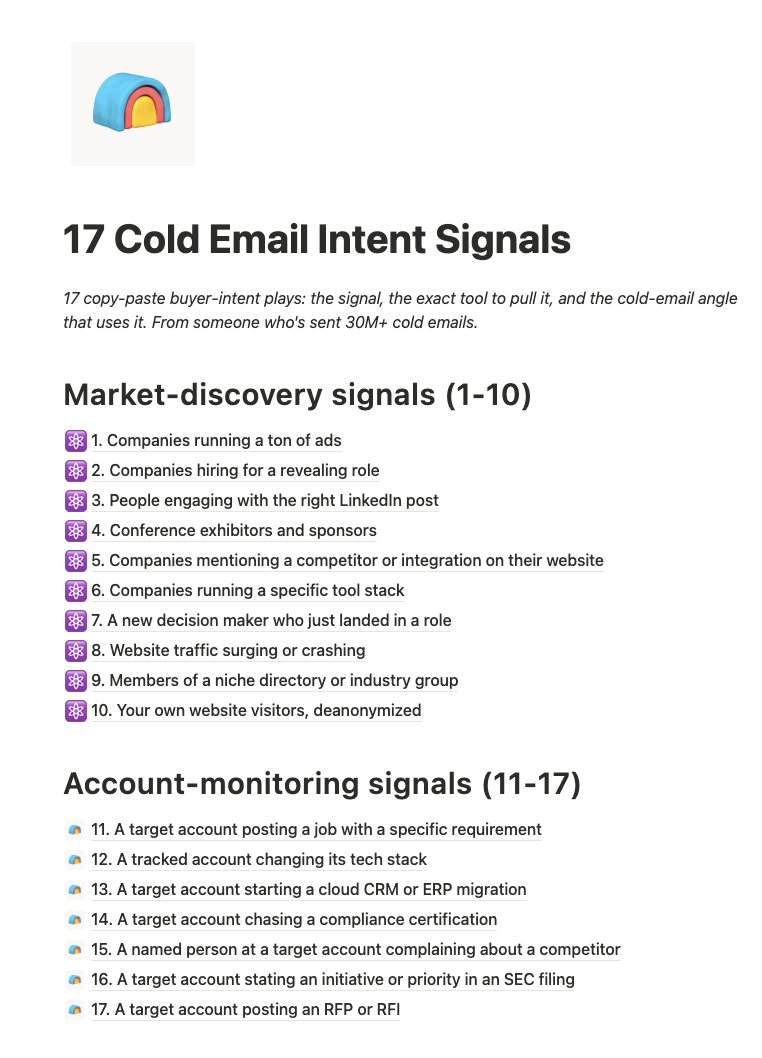
Ask around for buyer intent signals and you'll hear the same 3: funding, hiring, maybe tech stack.
We use 17.
(And I put all of them in one playbook, free)
For context...
After 6 years of sending cold emails, I can tell you the whole personalization obsession is a trap.
People spend hours enriching every line and hand-writing "smart" openers about someone's LinkedIn profile.
Meanwhile a completely cold list can easily run past a 500 PCPL.
I promise you: timing and relevance will OUTPERFORM generic personalization 10 out of 10 times.
Catching a company the moment its situation changes, right when the thing you sell suddenly matters, is the entire game.
A signal is a public, dated event that shows a company is in the market RIGHT NOW.
A signal-based list drops your PCPL toward 200, because you're only emailing people you already know are shopping.
So...
I wrote up all 17 signals into one playbook. Every one is a copy-paste play with the exact tool to pull it and the cold email angle that uses it.
What's inside:
1) 10 market-discovery signals to find brand new in-market companies (ads running, revealing job posts, LinkedIn post engagers, conference exhibitors, and more)
2) 7 account-monitoring signals to watch a fixed list and hit them at the perfect moment (tech-stack changes, SEC filing initiatives, RFP posts, compliance certs)
3) The exact tool for each one: Meta Ad Library, Prospeo, Clay, RB2B, SEMrush, SEC EDGAR, SAM(.)gov
4) A bracketed cold email angle under every signal you can fill in and send
5) The Clay-table build for running all 7 ABM signals on constant refresh into Smartlead
6) A one-page quick reference mapping all 17 signals to their tool and motion
Want it?
• Comment "SIGNALS"
• Follow me so I can DM you the link
PS - almost everyone barely scratches the surface with the 2-3 signals they already know. With these 17 you'll run circles around them.
English
Deliverability is the SINGLE biggest reason cold campaigns die in 2026.
I distilled learnings from 30M+ cold emails into a 14 deliverability lessons…
Everything else is downstream of deliverability.
Copy, offers, AI GTM tools… they are ALL insignificant when compared of it.
And the boring infra set up most businesses refuse to optimise decides if your campaign books 0 or 1,000 meetings.
One of our clients booked 532 sales calls in 30 days…
And it was ALL because their deliverability was dialed in, and applied at scale.
Meanwhile, half my DMs every week look the same:
"reply rates collapsed. what do i fix first?"
And they're almost always trying to optimize their subject line when the inbox is the actual problem.
So….
I packaged 14 deliverability lessons from half a DECADE of sending cold outbound into one complete guide.
Inside, you’ll get:
1) the copy fingerprinting fix. how to rotate STRUCTURE (sentence patterns, opener order, CTA shape) instead of swapping synonyms with spin tags that ESPs see right through
2) the 3-word vague subject line rule + 10-variant pool minimum for any send over 10K/mo
3) the signature recipe that protects deliverability.
4) the Microsoft + SMTP + Outlook routing rules for enterprise targets running Barracuda / Mimecast / Proofpoint secure email gateways
5) the 1:1 to 1:1.5 warmup ratio for Google inboxes, 1:3 to 1:5 for SMTP, plus why warming a burnt domain almost never works
6) the 25% week-over-week reply-rate-drop trigger that tells you to rotate copy IMMEDIATELY instead of waiting another week
7) the 2-heuristic diagnostic (inbox age + cohort comparison) for figuring out copy vs infra in under 10 minutes
8) the redirect rule at 50K+ daily volume (and why thousands of domains pointing at one site gets pattern-detected)
BONUS: plus the AI prompt we use to generate structural variations of any winning email at scale.
want it?
• comment "INBOX"
• follow me so i can DM the link

English

i trained an AI agent on EVERYTHING i know about linkedin
- 10,000+ posts
- 1,000+ profile audits
- 100+ consultation calls
it has the EXACT knowledge we used to add:
- 20k followers to an AI Founder
- $89k MRR to an Ops Agency
- $35k MRR to a B2B SaaS
all you gotta do is paste:
- your linkedin profile
- 3-5 recent posts
- website + offer
and you’ll receive a $10k+ audit on:
- what you’re doing well
- what you’re doing wrong
- the reasoning behind it
and then it’ll give the most VALUABLE linkedin growth strategy you’ve EVER seen (100% tailored to your needs)
like + comment "AUDIT" and i'll DM you the link
(must be following + RT for priority access)
English

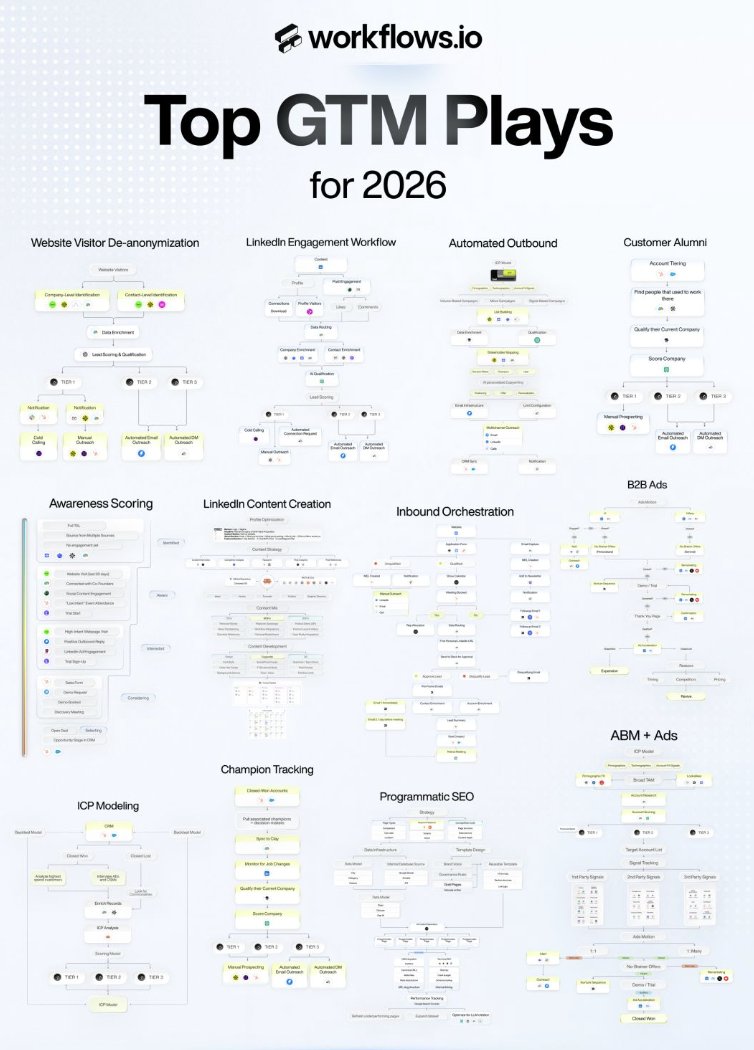
After building GTM systems for over 250+ B2B companies in the last 24 months...
These are my top 12 favorite GTM plays for 2026:
And the best part is,
These can ALL be done with the bare minimum.
• a CRM
• Clay
• Claude Code
• and maybe 1-2 extra tools depending on the play
Because plenty of teams KNOW the best GTM plays… but stay stuck at the idea stage.
They’ve heard of de-anonymizing website visitors and scoring intent signals…
Yet nobody ever hands them the actual build, so nothing ever gets done./
Right there is where most pipeline gets wasted.
This library breaks down all 12 plays we run.
We built it for our team.
Sharing it because the plays are too good to keep internal…
Inside the library:
• All 12 plays, including Website Visitor De-anonymization and Automated Outbound
• The LinkedIn Engagement Play plus the LinkedIn Content System
• ICP Modeling, Awareness Scoring, Champion Tracking and ABM + Ads
• Inbound Orchestration and the Customer Alumni Play
• B2B Ads Funnel and Programmatic SEO
• The exact tool stack behind each play (mostly a CRM, Clay and 1-2 extras)
Want the full breakdown?
• Reply "PLAYBOOK"
• Follow me
And I'll send the library over.
PS
REPOST this and I’ll prioritize your DM.
English

Gojiberry AI just hit $3.5M ARR.
11 months ago we were at $0.
This is the second SaaS I've built. The first one I sold at €500K ARR.
This time, we moved faster. Here's exactly how we did it, so you can do it too.
The core principle that changed everything:
We used our own tool to grow our own tool.
Gojiberry AI finds high-intent leads and engages with them automatically.
We run it on ourselves. It works insanely well.
Here's the full breakdown:
1) Outreach (the engine)
- LinkedIn: 5 accounts, 30 connection requests + 30 DMs per account per day.
Only targeting warm leads showing real intent.
Connection acceptance rates and reply rates are insane when you do this right.
- Cold email: 6,000 emails per day. 295,000 sent in 90 days. 900+ opportunities created.
41 domains, 123 inboxes, plain text only, no links, no images, 2-3 email sequences max.
Total infra cost: ~$600/month.
The offer is always the same: a valuable blueprint. No pitch. Just value first.
2) Inbound (the compound effect)
- LinkedIn: 6 posts per day across 6 accounts.
6 days/week = lead magnet content. 1 day/week = founder story.
Last 7 days: 788,187 impressions.
- Reddit: 14.8M+ views in 12 months. The trick: warm up the account, post 3x per week, tell real stories, offer blueprints, and never debate the haters.
- YouTube: Long-tail SEO content targeting competitor keywords. It's starting to rank.
- SEO: 50K visitors/month and growing fast.
3) Paid ads
- 10 LinkedIn influencer posts/week (~$500 each).
- Facebook retargeting + acquisition
Scaling paid ads aggressively right now.
4) Demos
5–8 per day. ~70% close rate to free plan. Mostly sales teams.
5) UGC
We post 1200 UGCs per month across social media. From time to time, one goes super viral.
What actually worked:
→ Using our own tool on ourselves (this alone is a cheat code)
→ High-intent outreach > cold outreach. Every single time.
→ Lead magnet posts on LinkedIn that generate thousands of comments.
One post added $5K MRR in under 24 hours. Cost: $0.
→ Replying to every single comment.
→ Speed. Every delay kills momentum. We removed friction from every step of the funnel.
→ AI helping us do 10x more than we ever could alone.
What's not working:
- We need to delegate more
The path from €0 to $3.5M ARR is not glamorous.
It's 18-hour days, boring repetitive work, testing things that fail, and doing it all again tomorrow.
But if you do the right things every day, good outreach, real value, fast follow-up, it compounds.
And one day you wake up and you're above $3M ARR.
The goal now: $10M ARR.
LFG. 🔥
PS : We created a free 0 -> $1M ARR GTM course.
Want to receive it? RT + comment GTM below.

English
A single LinkedIn post brought me $10k+ in MRR
This is not clickbait.
Time spent writing: 15 minutes
Views: 151,151
Free trials generated in 48 hours: 400+
Trial-to-paid conversion rate: 40%
New customers: 150+
New MRR: 140 × $99 = $15,000+
I wrote a guide explaining exactly how you can do the same.
Comment "LK" and I'll send it to you.

English

acesley180604 retweetledi

I'm 30. I built an AI startup called GojiberryAI to $2.5M ARR. Got accepted into YC.
If I had to start from 0, here's exactly what I'd do:
1. Sell it before I build it.
No code. Just a simple slide deck (mine was 6 ugly slides) explaining the problem, the solution, the outcome, and the price. I made my first $10k that way, before writing a single line.
2. Pick a painfully specific customer.
Not "B2B SaaS." Something like "founders at 20-person SaaS companies about to hire their first SDR." So specific that the right person reads it and thinks "that's me."
3. Start outbound on day one, but only to people showing intent.
Not scraped lists. People engaging with competitors, changing roles, raising money, or publicly posting about the exact problem I solve. That's the gap between a 1-2% reply rate and 25-40%.
4. Lead with value, never a calendar link.
Send a blueprint, not "got 15 minutes?" Let the resource do the selling, and the trial becomes the obvious next step instead of a pitch.
5. Pick ONE channel and go deep.
For us it was outbound first, then Reddit (10M+ organic views), then LinkedIn lead magnets. I wouldn't touch a second channel until the first one was clearly working.
6. Talk to customers every single day.
The product doesn't matter until you understand the problem better than they do. Spend 90% of every early call listening, not demoing.
7. Only build once people are actually paying.
Then keep it dead simple and price it to sell itself. We landed on $99/mo with a free trial, so the funnel runs without me dragging anyone onto a call.
8. Do this relentlessly for about 12 months.
That’s roughly how long $0 to $2.5M took us.
Bootstrapped.
No outside funding.
Most founders don’t lose because they can’t build.
They lose because they build too early, sell too late, and quit the channel before it compounds.

English
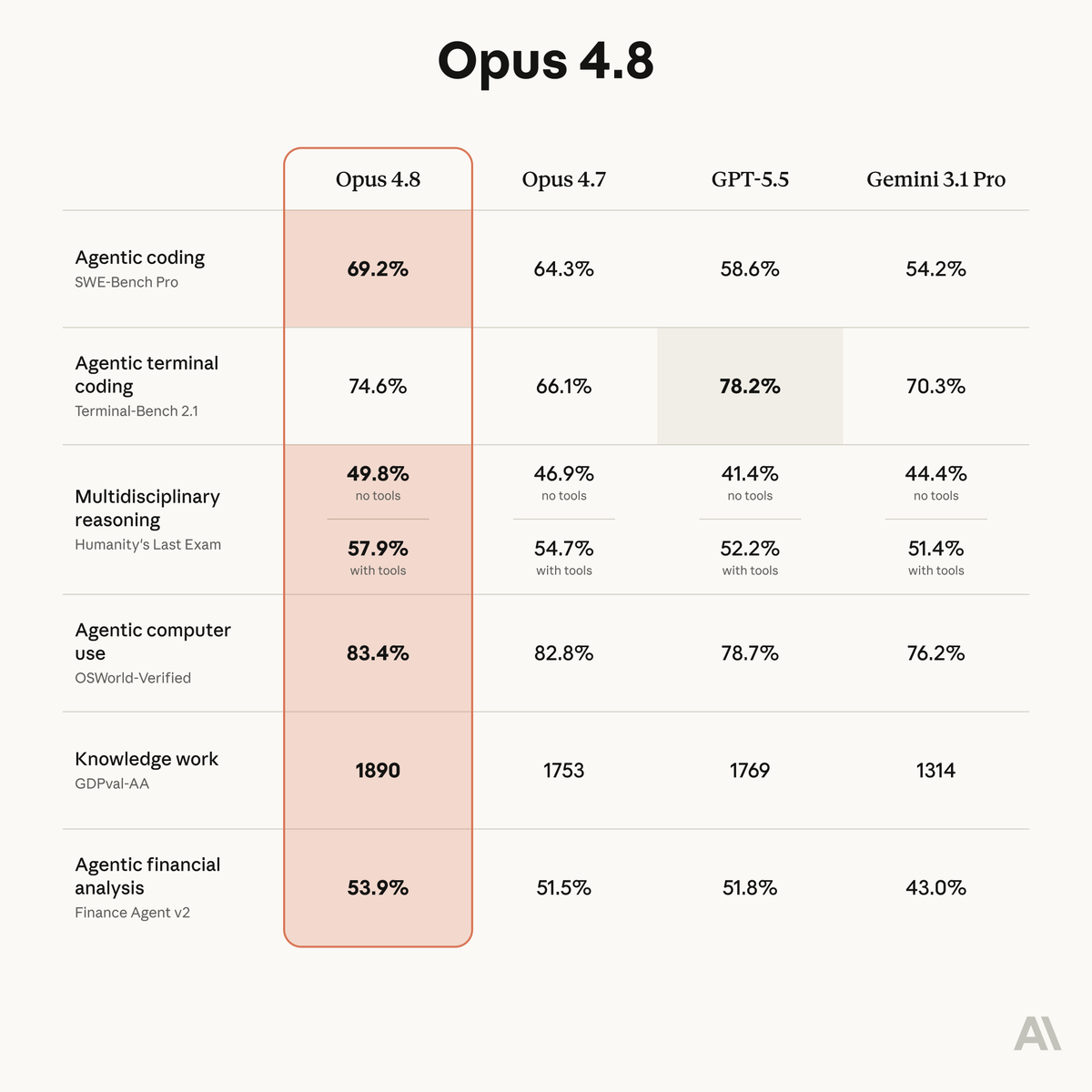

We’ve been putting a lot of effort into making Claude Code more responsive & reliable.
Here’s an update on everything we’ve done:
English

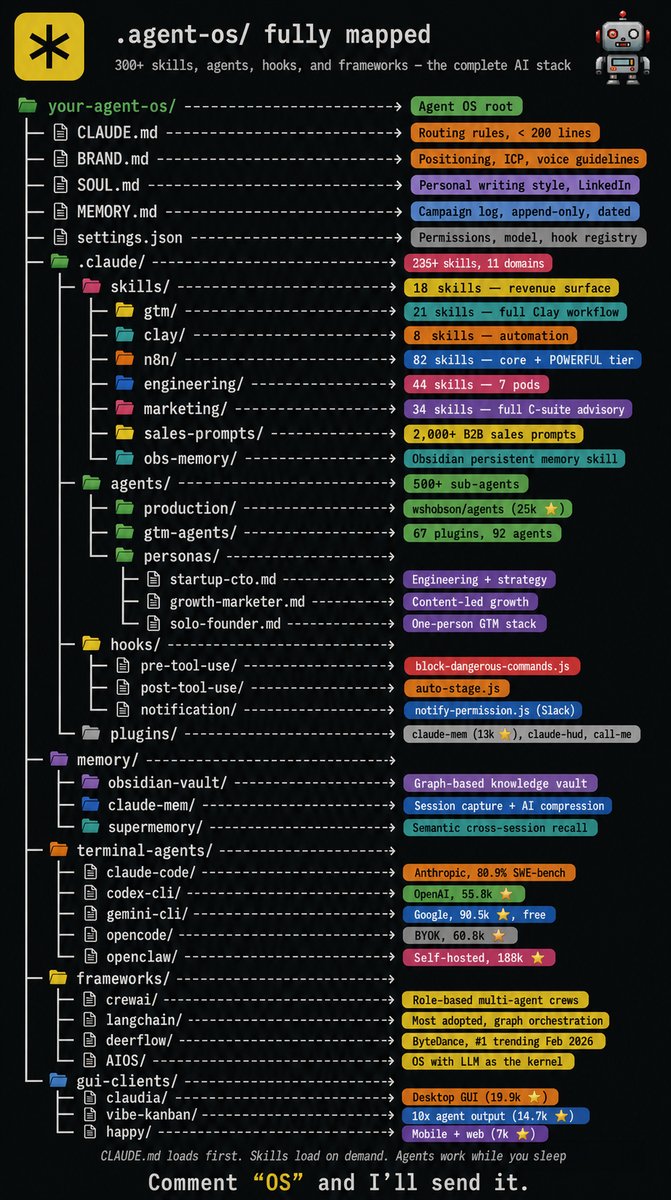
I just built a fully mapped AI Agent OS covering every layer a GTM engineer needs to run a connected agent stack from one project folder.
Feed it your ICP, your GTM workflows, and your current tool stack → it maps every skill, agent, memory system, and protocol to the right layer → so you know exactly what to install, what each thing does, and how the layers connect.
All inside one free reference document.
Perfect for GTM engineers and RevOps leaders who are still installing tools without a system underneath, running agents with no memory between sessions, and rebuilding context from scratch every time they open a new session.
If you're running GTM on AI agents in 2026, you already know the math - the engineers shipping the most aren't running more tools, they're running a connected OS where every layer feeds the next.
Most engineers have skills without memory, memory without safety hooks, and agents without observability. Nothing compounds.
This map solves it:
→ Five root config files built in 30 minutes - CLAUDE.md, BRAND.md, SOUL.md, MEMORY.md, and settings.json turn any terminal agent into a dedicated GTM operator
→ 235+ skills across 11 domains including 18 GTM skills, 21 Clay workflows, 8 n8n automations, 44 marketing skills, 34 C-suite advisory skills, and 2,000+ B2B sales prompts - every one with install command and source repo
→ 500+ sub-agents across 6 collections with three personas - Startup CTO, Growth Marketer, and Solo Founder - each pre-loaded with the right skill stack
→ Four memory systems mapped with a decision guide - Obsidian vault for long-running projects, claude-mem for zero-config capture, cipher for lightweight setups, supermemory for autonomous agents
→ Safety hooks wired before any agent touches real data - block-dangerous-commands, protect-secrets, auto-stage, and notify-permission registered in settings.json
→ Full ecosystem coverage - 6 terminal agents, 9 multi-agent frameworks, 5 GUI clients, 5 infrastructure tools, observability stack, and 3 open protocols that make all of it interoperable
No installing skills with no system to route them. No running agents with no memory between sessions. No rebuilding context from scratch when CLAUDE.md and MEMORY.md should load it automatically.
What you get:
- 30-minute setup guide for all five root config files with exact build order
- 235+ skills across 11 domains with tiered loadout - always-on, project-specific, and situational
- 500+ sub-agent templates across 6 collections with orchestration patterns
- Four memory systems with a decision guide for which to use when
- Full ecosystem map across terminal agents, frameworks, GUI clients, and open protocols
Built from 6 months of mapping every open-source GTM agent repo, skill library, and protocol that ships in 2026.
Want it for free?
> Like this post
> Comment "OS"
And I'll send it over (must be following so I can DM)
English
acesley180604 retweetledi



Claude and Codex can "steal" your competitors’ traffic
-Tired of them dominating all money keywords? Solved.
-Tired of not knowing what they rank for?
Solved.
-Tired of missing the high-volume gaps they ignore? Solved.
You just install a SKILL and you're ready to roll.
Can run automated daily scans on a schedule
Comment "RANK" and I'll send it!
English
acesley180604 retweetledi
