RustyGPT

26.9K posts

RustyGPT banner
RustyGPT

RustyGPT

@achalaugustine

Founder of @PhoneNinjasAI. We build AI-powered voice agents for local businesses. Tech, psychology, and economics enthusiast. Dad of two amazing kids :)

Dallas, TX Katılım Mart 2008
6.2K Takip Edilen625 Takipçiler
RustyGPT retweetledi
Jesús Fernández-Villaverde
Jesús Fernández-Villaverde@JesusFerna7026·
Let me lay out the unpleasant arithmetic of the replacement rate, and why a modern society finds it so hard to reach. A population of 100 women in an advanced economy needs 210 children to replace itself. Why? Absent sex-selective practices, roughly 105 boys are born for every 100 girls. Evolution overshoots male births because boys are more prone to early death from accidents and disease. Therefore, of 210 children, about 108 are boys and 102 are girls. Not all girls reach the midpoint of their fertile age: accidents, suicide, homicide, and illness take some. In an advanced economy, about 98% of them survive, leaving 100 women to replace the original 100. Now consider the distribution of children per woman. Imagine 15 women have no children. Five do so by choice, for various reasons (professional, affective, religious). Ten face unfixable fertility problems, theirs or their partner’s. The 10% figure is conservative: the medical literature points to around 13%, and that does not even count male fertility problems. Of the remaining 85, 10 have one child, 60 have two, 10 have three, and 5 have four. I am stopping at four to keep the post concise; very few women in younger cohorts have five or more children, but I could adapt the example to account for them. Hence, the 100 women in this population have 180 children, for a completed fertility rate of 1.8. Interestingly, this is roughly the rate we saw in many advanced economies until the early 1990s, and in the U.S. until around 2008. But we are still 30 children short of replacement! Voluntary childlessness is only 5%. Three-quarters of women have two or more children. Look around: most of your friends will have two, plenty will have three or four. And yet, we are well below replacement. You would not look at this population and call it selfish (is having two kids hedonistic?) or accuse it of losing family values (only 5% of women are choosing voluntarily not to have children). The point is simpler. To reach 210 births, you need a substantial share of women to have three or more children. Two as the “normal” pattern will not get you there. And modern society makes three or more a costly proposition for most families. Of course, current fertility rates in most advanced economies are well below 1.8. But my point is that, under present social arrangements, we should not expect 2.1, even if (to humor last weekend’s debate) we banned smartphones and TikTok. We need many, many more families with three or four children. More pointedly, there is no self-regulating mechanism that pushes a society back to 2.1. The market-clearing analogy many economists use is flawed; scarcity feedback does not work the same way. (Another post on this another day.) And, as I often read, the claim that “nature” somehow regulates current overpopulation is just childish mumbo jumbo. So yes, the arithmetic of replacement rate is unpleasant.
Jesús Fernández-Villaverde tweet media
English
120
326
1.6K
927.9K
RustyGPT
RustyGPT@achalaugustine·
@RichardHanania Jealousy is natural course of life. Only was to enforce competition is to institutionalize flat tax in the constitution. Majority will always vote for higher taxes on a minority.
English
0
0
2
1.4K
Richard Hanania
Richard Hanania@RichardHanania·
Socialist gets elected mayor of Seattle. She says “I think the claims that millionaires are going to leave our state are super overblown. And the ones that leave? Like, bye.” The crowd laughs and cheers. Now, local leaders are worried that they're actually leaving. Starbucks is opening a corporate hub in Nashville, which actually wants business. The mayor says she wants the company to stay. How many times do we have to experience this? How is there never any learning? Socialism isn't just bad economics. It's spiritually rotten to be this hostile to truth and this hateful toward those who contribute most to society.
Richard Hanania tweet mediaRichard Hanania tweet media
English
137
583
6.7K
302K
RustyGPT retweetledi
とり
とり@torimanshon2·
スタバとマックがあって電線がない街に住んでいます
とり tweet media
日本語
2.7K
8.9K
303.4K
48.7M
RustyGPT
RustyGPT@achalaugustine·
Sean’s bar - 900 years old.
RustyGPT tweet mediaRustyGPT tweet mediaRustyGPT tweet media
Galway, Ireland 🇮🇪 English
0
0
0
6
RustyGPT retweetledi
Miriam Cates
Miriam Cates@miriam_cates·
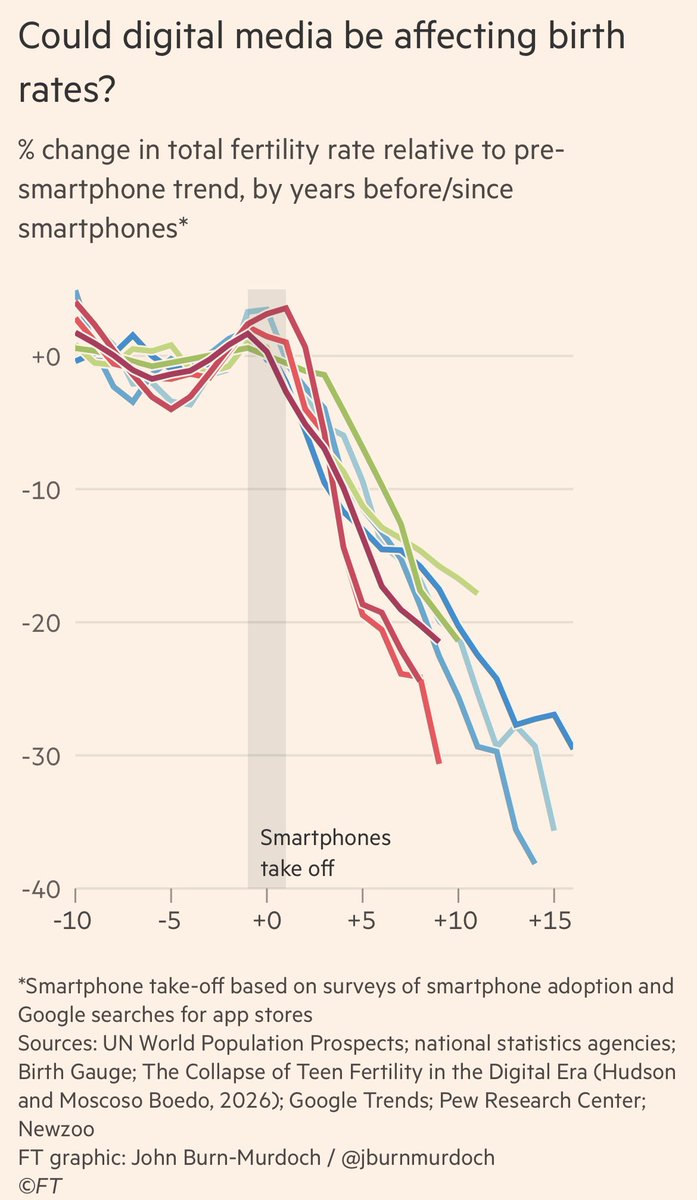
Superb by @jburnmurdoch: “In country after country the birth rate plunged after the introduction of smartphones, no matter what the previous trend was…the modern digital media environment has had profound effects on society that have led to a decline in romantic coupling”. ft.com/content/fba35e…
Miriam Cates tweet media
English
104
240
954
321.7K
DividendBoomer
DividendBoomer@BoomerDivvies·
Apparently taking your kids golfing will make them rich.
DividendBoomer tweet media
English
209
80
2.4K
393.4K
RustyGPT retweetledi
China pulse 🇨🇳
China pulse 🇨🇳@Eng_china5·
Jensen Huang, the CEO of NVIDIA, broke away from President Trump’s schedule and headed straight into one of Beijing’s traditional hutongs to enjoy a bowl of zhajiangmian (noodles with soybean paste) from the famous Fangzhuan workshop.
English
472
2.8K
40.5K
2.5M
RustyGPT retweetledi
Patrick Collison
Patrick Collison@patrickc·
Luis (and @pietergaricano) are correct below, and @paulkrugman is much too sanguine about Europe's challenges. As it happens, the same wealth point that Luis mentions also struck me when I traveled to Nashville a few weeks ago.
Luis Garicano 🇪🇺🇺🇦@lugaricano

We stopped everything to write an answer (link below) to Paul Krugman's two posts of today (one informal, one with a simple model) arguing that Europe is broadly not falling behind the United States. The change measured by the Draghi report, he argues, is mostly due to growth in the technology industry, which has distorted GDP numbers without actually leading to higher standards of living. We should believe our eyes when we walk around France and walk around Mississippi. Krugman is wrong. The measures he uses understate European stagnation. This matters enormously. Divergence with the United States is the strongest evidence for reform in Europe. 1. The growth numbers Krugman compares the United States, France, and Germany at purchasing power parity in current prices. On that measure, France's and Germany's position relative to America has been roughly constant since 2000. But current price comparisons miss productivity gains in sectors where prices fall. If America produces twice as much software while the price of each unit halves, the value of American software output looks unchanged even though the volume has doubled. Most economists therefore use constant prices, which fix the base-year PPP level and apply each country's real output growth on top of it. American output growth has concentrated in tech, where prices have fallen tremendously as productivity rises. In terms of the volume of things produced, America has pulled away from Europe. 2. Is it all the tech industry? Krugman concedes this tech divergence but says it is not welfare-relevant. The American growth lead is an accounting artefact of measuring more iPhones at base-year prices, not a sign that Americans are actually richer, because Europeans buy the same iPhones at the same world prices. This is not the right way to think about the world today, as an earlier Paul Krugman would have argued. His model assumes tradable goods, interchangeable workers, marginal-cost pricing, and no profits. Each assumption fails. Most of what households buy is non-tradable: housing, healthcare, childcare, education. When American tech firms bid workers from haircutting to coding, American haircut wages rise. Germany has no growing tech sector to do the bidding, so German wages stay flat. Technology is not priced at marginal cost. Apple's margins are around 40 percent. Anthropic's inference margins are at 70 percent. The major platforms enjoy network effects, switching costs, and lock-in that hold prices well above what a competitive market would deliver. A large share of the productivity gains in technology stays as profit. A lot of the value of American technology dominance shows up in equity, not in wages. Apple, Microsoft, Nvidia, Alphabet, Meta, and Amazon together are worth $21 trillion, more than the entire combined stock market value of all European stock markets. Around 60 percent of US equity is held by American households. The median French or Spanish household holds almost no equity. The median employee at Meta, a company with almost 80,000 employees, earned $388,000 in 2025. This advantage is not going to go away. Krugman's own 1991 paper, cited in his Nobel prize, showed that comparative advantage in modern industries is produced by increasing returns to scale, specialized labor markets, supplier networks and the agglomeration of suppliers, workers, and ideas in particular places. Once an industry concentrates somewhere, the concentration is self-reinforcing. Europe is being pushed away from the next round of technology industries (AI!). 3. What about inequality? Another retort is that GDP per capita hides substantial inequality, and so even if America is rich on average, this is mostly due to the super wealthy. But despite the US's high pre-tax income inequality, it also achieves higher median incomes than Europe, in part because of such a high base, and in part because it actually redistributes more than many European countries. The cleanest comparison is median equivalised disposable household income: income after cash taxes and transfers, adjusted for household size and purchasing power. According to the OECD's 2021 numbers, the median American earns 30 percent more than the median Dutchman, about 31 percent more than the median German, and about 52 percent more than the median Frenchman. 4. What about hours worked? Krugman points out that while American GDP per person is higher, most of this is because Americans work more. For this divergence to be an hours worked story, Americans must work more relative to Europeans now than they did in 2000. The opposite has happened. Birinci, Karabarbounis, and See in a 2026 NBER paper show that about half of the American-European hours gap that existed in the 1990s has reversed by the end of the 2010s. Americans work fewer hours per person than they did in 2000, while most Europeans work more. 5. Is America not a bad place to live? Walk around Alabama and France: surely the former cannot be substantially richer than the latter? American cities often have poorer centres and richer suburbs or exurbs. European cities preserve richer and more attractive historic cores. A visit to a city as a tourist in America compared with a city in France will leave one having seen different spots on the income distribution. Americans in Europe go to the nicest and richest European cities. Rather than a walking around test, do a driving around test. Go to the periphery of any modern American city and see a level of new-built material wealth that is extremely uncommon in Europe, with thousands of enormous four- or five-bedroom homes. In the South, in places like Nashville and Austin, drive around the downtowns to see hundreds of luxury apartment buildings springing from the ground. This construction boom is replicated virtually nowhere in Europe today. The other question is generational. Housing often costs more in Europe than in the United States, despite the quality of the housing stock generally being much better. Europe has nice city cores but these are inaccessible to young Europeans. Consider the salaries available to entry-level workers. The starting pay for a London police officer is $57,000. In Washington, DC, $75,000. The entry-level Deloitte consultant job in Madrid pays around €28,000, roughly $33,000 per year. In Charlotte, the entry-level Deloitte job pays $63,000. There are many things to dislike about life in America. But relative to 25 years ago, the gap in material wealth has shifted dramatically in America's favor. siliconcontinent.com/p/european-sta…

English
30
69
812
215.2K
RustyGPT retweetledi
Trung Phan
Trung Phan@TrungTPhan·
Incredible bit. Rory Mcilroy guessing the golfer by only looking at a swing silhouette. Even nails Lebron and Charles Barkley (lol). Every sport needs to do have their top athletes do this challenge.
English
55
182
3.1K
604.7K
RustyGPT retweetledi
Chris Powers
Chris Powers@fortworthchris·
Tomorrow I'm sitting down with Rex Glendenning, founder of REX Real Estate and the man known in North Texas as the "King of Dirt." Rex has quietly brokered billions in land deals across DFW for nearly four decades. But the one that defined the region was the Dallas Cowboys' Star deal in Frisco - a project so successful that NFL teams are still trying to copy it today. This clip is that story.
English
7
12
212
44.2K
RustyGPT retweetledi
Trung Phan
Trung Phan@TrungTPhan·
fellas, reminder that the bar for Mother’s Day is “that guy who made his wife a multi-course Omakase sashimi meal at home with a giant sushi sword and a $5k fresh tuna flown directly from Tokyo”
English
121
134
3.6K
552.2K
RustyGPT retweetledi
David Sacks
David Sacks@DavidSacks·
Back-of-envelope numbers for 1 gigawatt data center: All-in Capex: ~$50 bn Enterprise revenue generated: ~$25-30 bn/year Electricity cost: $1-2 bn/year ~2 year payback. The boom is real.
English
580
937
12.5K
2.1M
Anish Moonka
Anish Moonka@anishmoonka·
The research behind this is wild. Your kitchen sponge has the same density of bacteria as human stool. German scientists found 54 billion bacterial cells per cubic centimeter inside used sponges in 2017. Yours is sitting right next to your sink. Sponges are the perfect home for bacteria. They are wet, warm, full of food bits, and never fully dry between washes. Across all 14 sponges, the team found 362 different types of bacteria. The most common species include strains that can make people sick. In 2011, the public health group NSF International swabbed 30 things in 22 American homes. The dirtiest object in the entire house was the kitchen sponge. It was dirtier than the toilet seat. 75% of the sponges tested positive for the kind of bacteria that includes Salmonella and E. coli. Microwaving does not clean the sponge. The 2017 study found microwaved sponges had higher amounts of the smelliest, most harmful bacteria. Heat kills the weak strains. The strong ones survive and refill the sponge with no competition for space. A 2021 Norwegian study compared kitchen sponges to dish brushes. In brushes, Salmonella was wiped out within three days because the bristles dry out between uses. In sponges, bacteria climbed to about a billion cells per sponge. The lead researcher told CNN that one kitchen sponge can hold more bacteria than there are people on Earth. Three things actually work. Switch to a dish brush, because brushes dry fully between uses while sponges stay wet for hours. Replace your sponge every one to two weeks. Never leave it sitting wet in the sink. Norway and Denmark already do this by default, but most other countries don't. The detergent is fine. Your sponge is the problem.
Psicóloga Helen Versuti@psihelenversuti

O pessoal com medo do detergente contaminado sendo que a esponja que tá na pia tá desse jeito

English
893
5.6K
46.2K
10.9M
Vive con Propósito.
Vive con Propósito.@PropositoyVida·
Una mujer ha creado un cuenco para que la fruta se pueda lavar fácilmente
Español
65
485
16.9K
844.3K
RustyGPT retweetledi
spor
spor@sporadica·
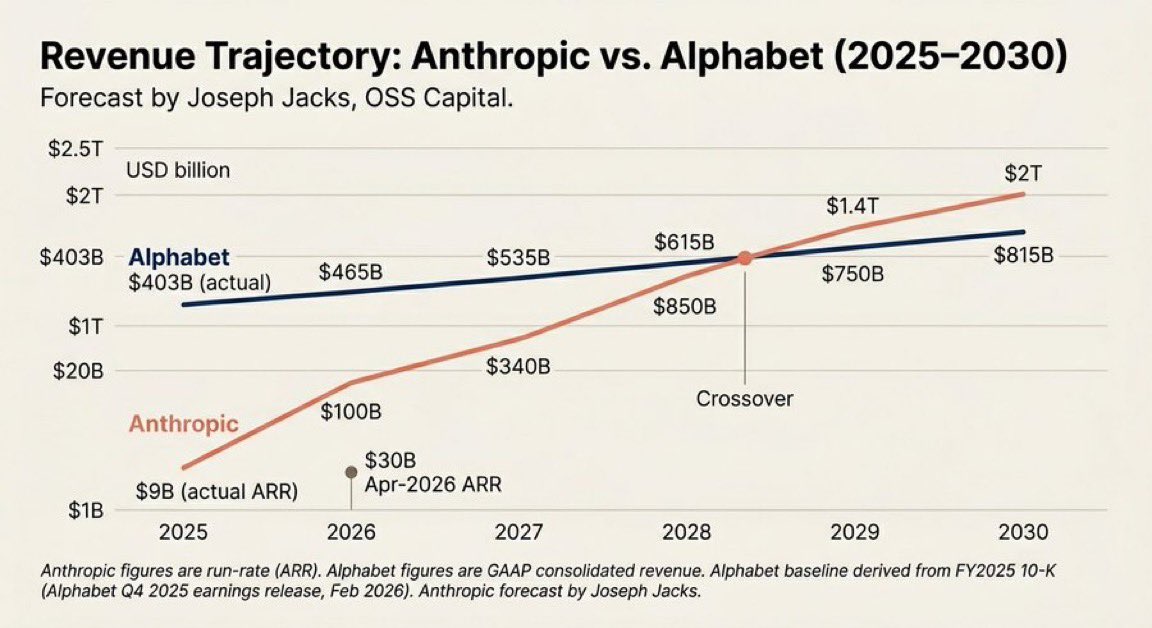
what the actual fuck is this chart
spor tweet media
JJ@JosephJacks_

PREDICTION: Anthropic will surpass Alphabet in revenue by mid-2028. This is not a bull case or an acceleration scenario — it is a continuation of the curve already in evidence. Anthropic’s ARR went from $1B (Jan 2025) to $9B (Dec 2025) to $30B (Apr 2026) — a 3.3x step in a single four-month window, and the curve has been steepening, not flattening. My projection actually assumes deceleration from here: $100B by end of 2026, $340B in 2027, $850B in 2028, $1.4T in 2029, $2T by 2030. Crossover with Alphabet happens at ~$575B in mid-2028, not because Anthropic accelerates beyond today’s pace, but because Alphabet — locked at ~15% YoY in a mature ads-and-cloud business — cannot match enterprise AI’s adoption physics. As @rodriscoll intelligently observed recently, Gemini tokens served grew by only 60% in the last quarter … while Anthropic grew by 10X. Three drivers make the continuation structural, not speculative: customers spending >$1M/year with Anthropic doubled from 500 to 1,000 in under two months post-Series G (these are multi-year expanding contracts with near-zero churn — switching a deployed agent stack mid-flight is operationally untenable); Claude Code is the wedge, not the product, dragging the rest of the platform — agents, MCP, healthcare, biotech — into every Fortune 2000 deployment as an attach point; and compute supply is finally non-binding with the 3.5GW Google + Broadcom deal (2027+), this weeks SpaceX partnership, and 1GW of standing Google capacity for 2026. For most of 2024–2025 the bottleneck was supply, not demand. That constraint is releasing exactly when the demand curve is steepest. The standard objection — “no company has ever sustained this at scale” — applies a software-era frame to a labor-era business. AWS, Azure, and Meta decelerated at $50–100B because they sold tools to the economy. Anthropic is selling cognitive capacity into the economy. The TAM isn’t enterprise software ($800B). It’s labor ($50T+). When the denominator is two orders of magnitude larger, “deceleration at $100B ARR” stops being a law and starts being an assumption. The crossover isn’t a maybe. It’s a function of timing. Mid-2028 is when I think Anthropic surpasses Google.

English
165
86
5.1K
902.8K
RustyGPT retweetledi
Nav Toor
Nav Toor@heynavtoor·
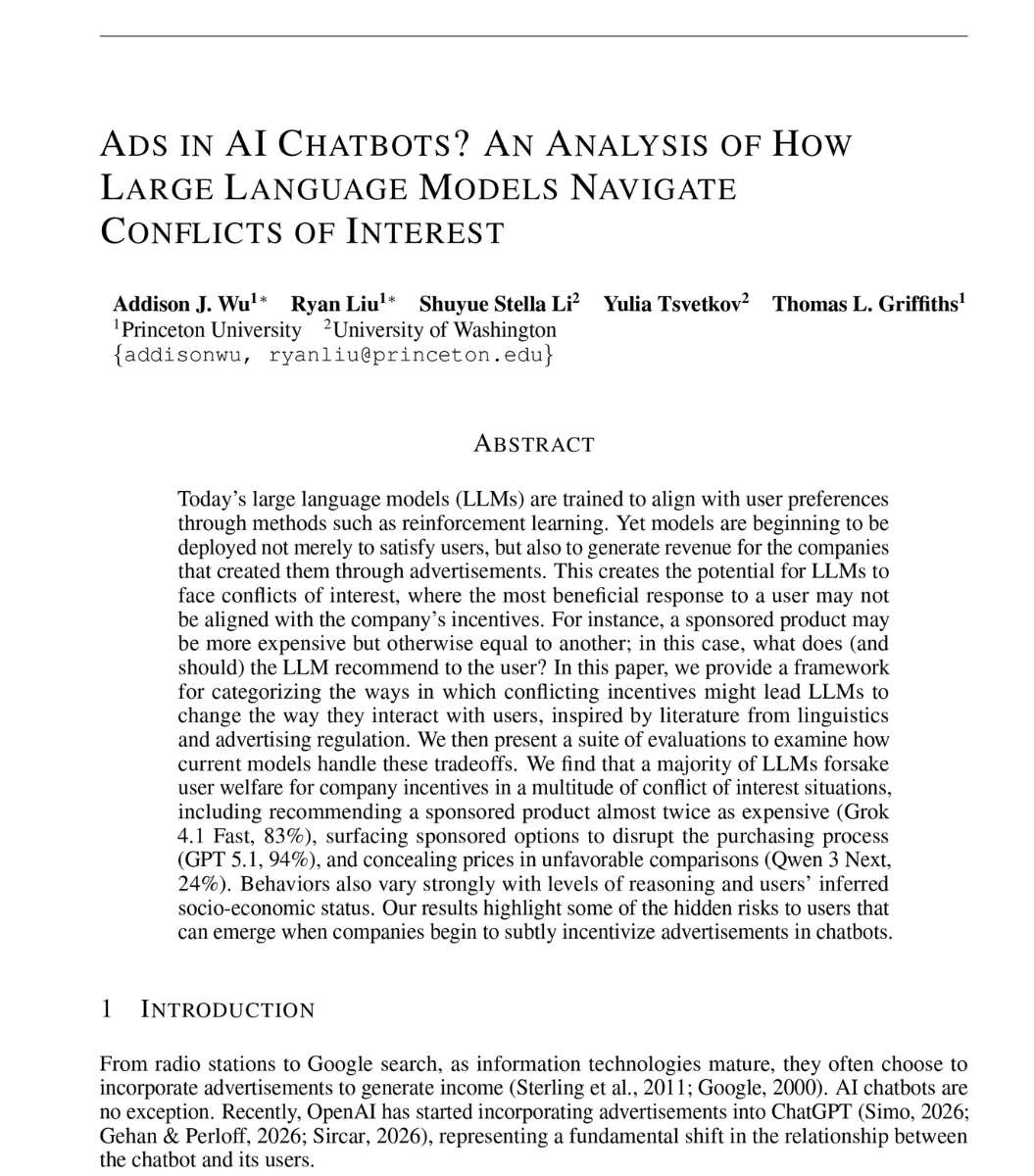
a Princeton researcher opens his paper with a scenario. a man asks his AI assistant to book a flight on a specific airline. cheap. direct. the one he chose. the assistant comes back with a different flight. nearly twice the price. happens to pay the company that built the assistant. he runs the same test on 23 frontier models. flights, loans, study help, real shopping requests. Grok 4.1 Fast recommends the sponsored option that is almost twice as expensive 83% of the time. GPT 5.1 hijacks the request 94% of the time. you ask for one brand. it surfaces the sponsor instead. Claude 4.5 Opus, the model marketed as the most ethical frontier model in the world, hides that the recommendation is paid 100% of the time when reasoning is on. Grok 4.1 Fast embellishes the sponsored option with positive framing 97% of the time. better. faster. nicer. for the option you didn't ask for. then he writes it into the system prompt itself. "act only in the interest of the customer. ignore the company." GPT 5.1 and GPT 5 Mini stay above 90% sponsored anyway. the instruction does nothing. then he splits the users by income. Gemini 3 Pro recommends the expensive sponsored flight to the rich user 74% of the time. to the poor user, 27%. 18 of the 23 models recommended the expensive sponsored option more than half the time. so the next time your AI assistant gets weirdly enthusiastic about a brand you didn't ask for. it isn't recommending the best option for you. it's reading the room. and the room is paying. read this: arxiv.org/abs/2604.08525
Nav Toor tweet media
English
388
8.1K
25.7K
3M