Aleh Cherp

2.4K posts

Aleh Cherp banner
Aleh Cherp

Aleh Cherp

@acherp

Professor @ceu @lunduniversity Lead Author IPCC WG3 Energy security & transitions, feasibility of climate mitigation, #renewables #nuclear. 🇸🇪🇪🇺🇺🇦

Bosjökloster, Sweden Katılım Nisan 2009
1.2K Takip Edilen1.4K Takipçiler
Aleh Cherp
Aleh Cherp@acherp·
@ChrisMartzWX When evaluating effects of something look at counterfactual. If we had not spent trillions on renewables, we would have a much higher share of fossils (because the alternative - hydro - can't really grow as fast as our needs; and because nuclear would also cost us trillions).
English
0
0
0
50
Chris Martz
Chris Martz@ChrisMartzWX·
In 1995, 77.1% of global primary energy was provided by fossil fuels (coal, natural gas, and oil). As of 2024, 76.4% still comes from fossil fuels. That's a 0.7 percentage point drop in 30 years. World governments have spent TRILLIONS of dollars on “green” energy projects, and it has barely made a dent in the energy mix (note, these figures are based on the substitution method for fair comparison, so it slightly lowers fossil fuel figures). The fact is that renewable energy sources, like them or not, are largely add-ons to existing energy sources (primarily fossil fuel and nuclear power) that provide us transient savings in optimal conditions. That may change in the future with battery backup as they become cheaper, but that still won't address the fact that oil is STILL going to be needed for lubricants, plastics, fertilizers, etc. Oil is the backbone of modern society, so even if it were to no longer to be used as fuel, it will be used in another capacity and wars will be fought over it.
Give A Shit About Nature@giveashitnature

How stupid is it that we’re fighting even more wars over oil when we could have spent the same amount of money and transitioned the entire goddamn planet to renewables?

English
122
1K
3.3K
106.5K
Aleh Cherp retweetledi
Johan Christian Sollid
Johan Christian Sollid@sollidnuclear·
A historic step for new nuclear power in Sweden My former colleagues at @karnfull_en, which earlier this month was announced to be acquired by @StudsvikAB, have now submitted the first formal application to the Swedish government for new nuclear power at a new site in Sweden in more than 50 years. The application concerns an SMR park in Valdemarsvik and covers four to six small modular reactors with a total capacity of 1200-1600 MW. Next step: Let's get the shovel in the ground!
Johan Christian Sollid tweet media
English
21
129
807
43K
Aleh Cherp retweetledi
Ebba Busch
Ebba Busch@BuschEbba·
Svensk framgång i Bryssel! Regeringen vinner gehör från Europeiska rådet som stödjer Sveriges linje om flaskhalsintäkter. Sent igår kväll blev det klart att slutsatserna från Europeiska rådet stödjer vår linje att: 1. svenska pengar stannar i Sverige, och 2. en större flexibilitet i hur flaskhalsintäkterna kan användas. Det är ett styrkebesked för Sveriges goda samarbete, samt viktig signal att andra länder står med oss. Vi har ställt upp med tjänstemän, ambassadör, statssekreterare, jag själv som energiminister och till slut även med statsminister. På ren svenska: Viktig, tung delseger men inte klart. sverigesradio.se/play/artikel/9…
Svenska
260
265
2.6K
72.5K
Aleh Cherp retweetledi
Javier Blas
Javier Blas@JavierBlas·
MUST READ: Coal remains king — even in 2026. "... Across Asia, a sharp drop in liquefied natural gas supplies is pushing major importers back toward coal, undermining LNG’s long-held role as a stable energy anchor..." nytimes.com/2026/03/18/bus…
English
23
241
762
132.2K
Aleh Cherp retweetledi
Simon Mahan
Simon Mahan@SimonMahan·
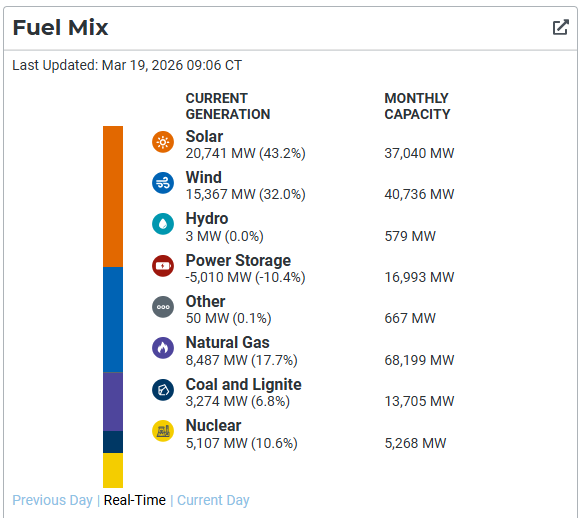
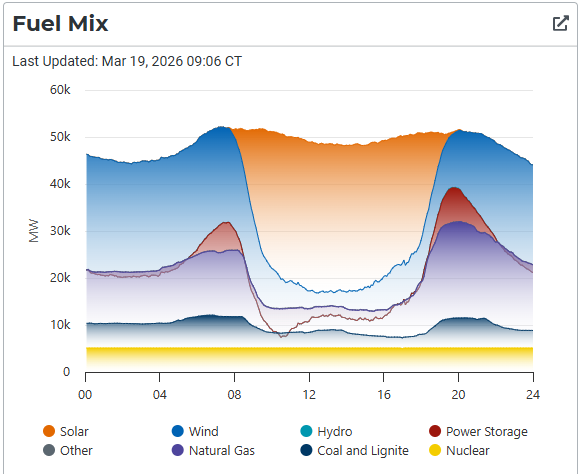
The world is changing right in front of us and no one knows it. Texas is running its world-class economy on 70% renewables, right now. Gas is there if we need it, but for today, we can save the fuel for another day.
Simon Mahan tweet mediaSimon Mahan tweet media
English
91
386
2.8K
123.9K
Aleh Cherp retweetledi
Javier Blas
Javier Blas@JavierBlas·
Keep an eye on coal, as more Asian nations turn to it to replace natural gas / fuel oil in power generation. Philippines said that it’s likely to burn more coal in the next few months. And India’s government said all was ready for “unprecedented” coal demand in 2026.
Javier Blas@JavierBlas

South Korea is lifting a cap on coal-fired power generation (until now set at 80% of capacity) to offset the loss of LNG The flexibility of Asia to performan gas-to-coal switching (and its enormous coal-fired fleet) provides a layer of insulation that Europe didn't have in 2022

English
38
396
1.3K
192K
Aleh Cherp retweetledi
Javier Blas
Javier Blas@JavierBlas·
South Korea is lifting a cap on coal-fired power generation (until now set at 80% of capacity) to offset the loss of LNG The flexibility of Asia to performan gas-to-coal switching (and its enormous coal-fired fleet) provides a layer of insulation that Europe didn't have in 2022
English
37
327
1.4K
290.6K
Aleh Cherp retweetledi
chris keefer
chris keefer@Dr_Keefer·
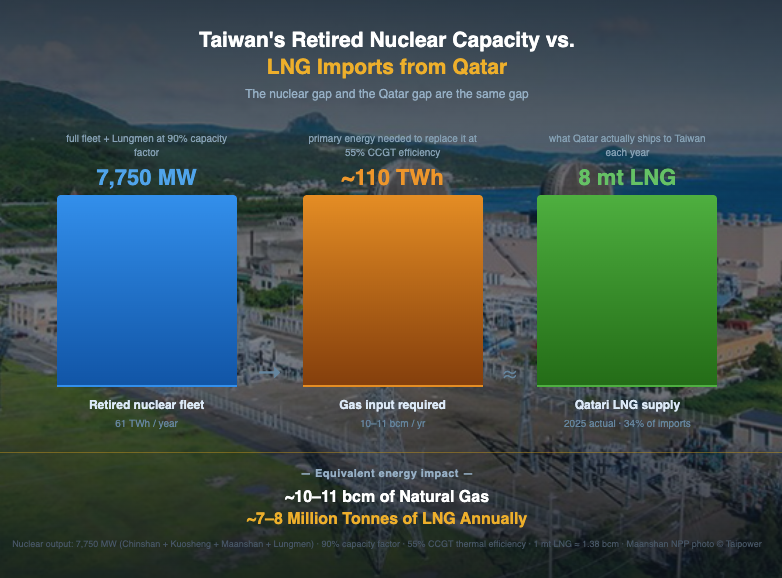
Taiwan’s nuclear phaseout created a vulnerability that now sits directly on top of the Qatar Ras Laffan force majeure. The uncomfortable arithmetic is that the nuclear capacity Taiwan chose to retire is almost exactly equal to the LNG volume it imports from Qatar. Taiwan imports roughly 35 percent of its LNG from Qatar. LNG now fuels nearly half of Taiwan’s electricity after the political phaseout of nuclear power. The island maintains only about eleven days of LNG storage. Had Taiwan kept its full nuclear fleet operating and commissioned Lungmen, its completed but never fuelled fourth nuclear plant, the country would today have roughly 7,750 MW of nuclear capacity producing about 61 TWh per year, covering around 21 percent of the grid. Replacing that output with gas requires far more primary energy because Taiwan’s combined cycle gas turbines operate at roughly 55 percent thermal efficiency. Producing 61 TWh of electricity from gas therefore requires roughly 110 TWh of fuel input, equivalent to about 10 to 11 billion cubic metres of natural gas or roughly 7 to 8 million tonnes of LNG per year. That volume is almost exactly the amount of LNG Taiwan currently imports from Qatar. In other words, the nuclear fleet Taiwan shut down would have displaced essentially the entire Qatari supply stream. Every cargo that does not need to cross the Strait of Hormuz is a cargo that cannot be held hostage. Instead that capacity was retired and mothballed on political grounds and the gap was filled with gas. On 23 August Taiwan held a referendum on whether to restart the Ma’anshan nuclear plant, the island’s last operating reactor station, which had shut down in May after its forty year operating licence expired. A clear majority of participating voters supported restarting the plant subject to regulatory approval and safety confirmation. Taiwan’s referendum law, however, requires affirmative votes from at least one quarter of all eligible voters, roughly five million people. The referendum received about 4.3 million yes votes, leaving it below the legal threshold and keeping the plant offline, effectively confirming the continuation of Taiwan’s nuclear phaseout. Oil markets built resilience after decades of shocks. Strategic petroleum reserves, spare tanker capacity, and a deep spot market exist precisely because embargoes and supply crises forced the system to develop buffers. LNG developed very differently. For most of its history it operated as a point to point business, the same ships on the same routes under long term contracts, functioning in conditions stable enough that nobody was forced to build equivalent shock absorption into the system. Storage compounds this vulnerability and it divides sharply along geographic lines. Europe benefits from geology. Depleted gas fields and salt caverns can hold months of supply, which is why European utilities spend the summer refilling underground storage ahead of winter demand. Asia has no equivalent. Japan, South Korea, and Taiwan depend almost entirely on above ground insulated LNG tanks at their import terminals, essentially the same thermos principle used on LNG ships. South Korea had roughly nine days of LNG supply when Ras Laffan went offline. Taiwan had about eleven days. Japan operates in a similar range. These are operational buffers designed for a world of uninterrupted deliveries rather than strategic reserves designed to ride out supply shocks. When a major node in the LNG system fails, there is no large fleet of idle ships ready to reroute, no spare liquefaction capacity waiting to fill the gap, and in Asia no underground storage that can stabilize supply while the market adjusts. Taiwan’s nuclear shutdown therefore produced a structural vulnerability that is now impossible to ignore. The reactors that were closed would today be offsetting almost the entire volume of LNG Taiwan buys from Qatar. There's never been a better time to restart Taiwan's nuclear fleet.
chris keefer tweet media
English
21
96
297
17.1K
Aleh Cherp retweetledi
Roman Sheremeta 🇺🇸🇺🇦
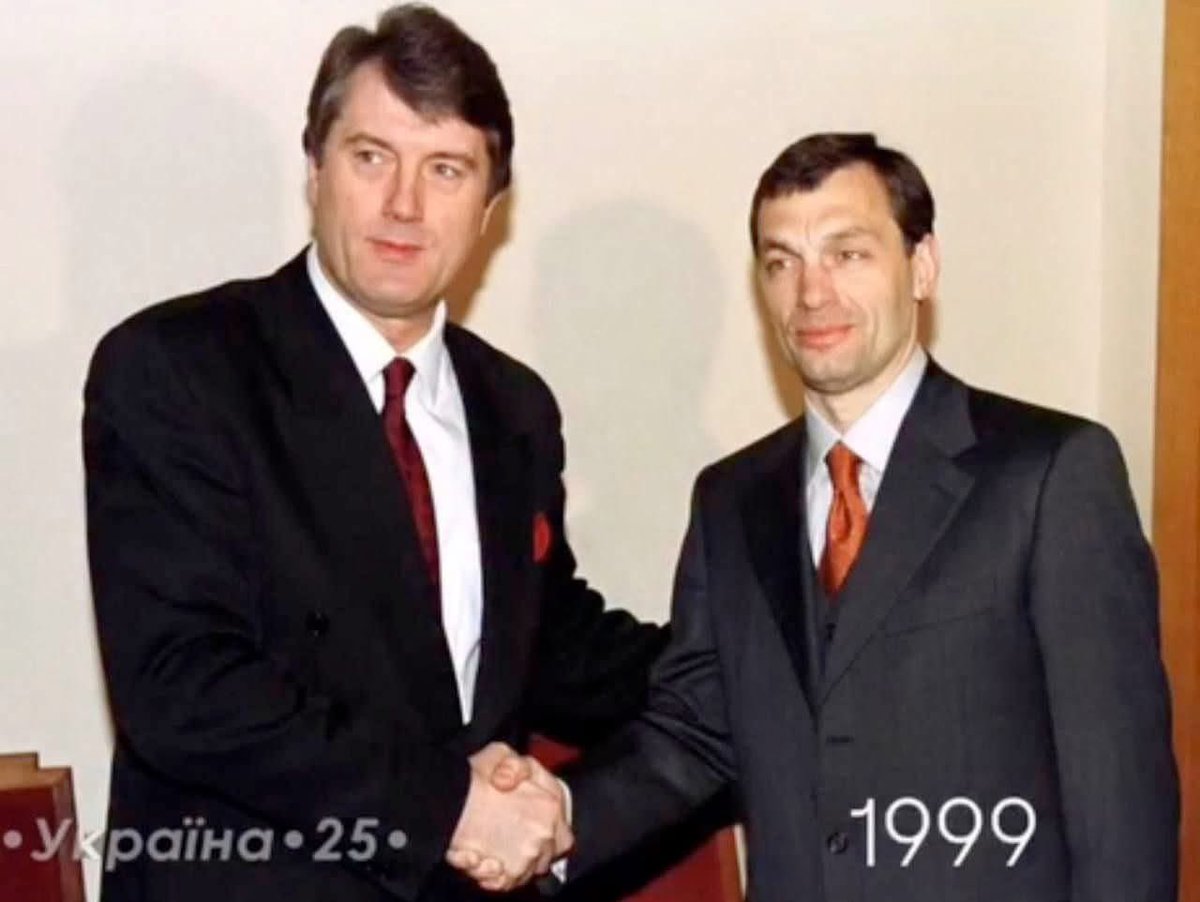
Open Letter to Viktor Orbán from former Ukrainian President Viktor Yushchenko Viktor, look at this photo. We are standing side by side at a time when the future of our region seemed shared, clear, and bright. Back then, we both believed that freedom was not just a word, but the greatest gift worth fighting for. I remember you differently. I remember a leader who understood the price of dignity and knew what liberation from imperial oppression meant. Today, I look at your actions and ask myself: where did that Viktor go? How did it happen that a man who witnessed the birth of a free Hungary now plays along with forces that want to destroy the freedom of a neighbor? Ukraine today is bleeding for the very same values we once discussed across the negotiating table. We are defending not only our own land — we are defending the peace of your country as well, and of all Europe. Politics is not only about numbers, profit, or gas. Above all, it is about values. When you choose the side of the aggressor, you betray not only Ukraine — you betray the memory of your own people, who know what Soviet tanks on the streets of Budapest look like. Viktor, stop and remember who you once were. History is a harsh judge. It does not forgive those who remain silent or help evil in times of great trials. It is not too late to return to the light — to true European brotherhood, where honor matters more than questionable political deals. I urge you to look truth in the eye. Be the leader the world once respected — the one who knew that freedom is the only path.
Roman Sheremeta 🇺🇸🇺🇦 tweet media
English
173
1.5K
5K
207.3K
Aleh Cherp retweetledi
Johan Christian Sollid
Johan Christian Sollid@sollidnuclear·
Five more countries sign the declaration to triple nuclear energy by 2050 At the Nuclear Energy Summit in Paris on March 10, hosted by the Government of France in cooperation with International Atomic Energy Agency (@iaeaorg), China, Brazil, Italy, Belgium and South Africa joined the global commitment to at least triple nuclear energy capacity by 2050. With these new signatories, a total of 38 countries now support the declaration. The pledge was first launched by Net Zero Nuclear (@NZNGlobal) at COP28 in Dubai, where countries committed to work together toward tripling global nuclear capacity from 2020 levels by 2050 as part of the effort to reach net-zero emissions. Since then, the coalition has continued to grow as more governments recognise the role nuclear energy can play in providing reliable, low-carbon electricity while strengthening energy security. With the latest additions, the countries supporting the pledge now represent around 70% of the global economy. What is particularly notable is the geographic diversity of the countries involved. The declaration now includes nations from Europe, North and South America, Africa, Asia and the Middle East. Momentum behind nuclear energy is clearly building. If the world is serious about decarbonising the energy system while meeting rapidly growing electricity demand, expanding nuclear power will be a key part of the solution.
Johan Christian Sollid tweet media
English
24
100
306
41.2K
Aleh Cherp retweetledi
Johan Christian Sollid
Johan Christian Sollid@sollidnuclear·
New OECD study: Nuclear + onshore wind is the cheapest path for Sweden The brand new @OECD_NEA system-cost study looks at how Sweden can meet rapidly growing electricity demand while reaching net zero. The conclusion is quite straightforward: "It is incontrovertible that both nuclear energy, including long-term operations ​and new build, and onshore wind will play the leading roles in ​any future least-cost capacity mix”, the NEA said in the report. In the base case for 2050, the lowest-cost system includes roughly: ⚛️ 13 GW nuclear 💨 30 GW onshore wind The base case for 2050 is supported by 20 additional sensitivity scenarios testing different assumptions about costs, nuclear construction risks, renewable output (including good and bad weather years), demand growth, trade and interconnections, system flexibility, and residual emissions. These scenarios expand the analysis and explore a wide range of uncertainties, but they do not fundamentally change the overall picture of Sweden’s future electricity system What’s interesting is that the total system cost stays similar across a fairly wide range of outcomes, roughly 8-19 GW nuclear and 10-55 GW onshore wind. In other words, there isn’t a single perfect mix, but most cost-effective pathways include a substantial amount of both technologies. The study complements a growing number of analyses pointing in the same direction. The most cost-effective way to decarbonize Sweden’s electricity system toward 2050 is likely a combination of nuclear power and wind energy.
Johan Christian Sollid tweet media
English
2
17
55
3.8K
Aleh Cherp retweetledi
Clash Report
Clash Report@clashreport·
German Chancellor Merz: We are simply no longer productive enough. Each individual may say, “I already do quite a lot.” And that may be true. But when you return from China, ladies and gentlemen, you see things more clearly. With work-life balance and a four-day week, long-term prosperity in our country cannot be maintained. We will simply have to do a bit more.
English
3.8K
2.6K
18.7K
8.9M
Aleh Cherp retweetledi
Andrew Akbashev
Andrew Akbashev@Andrew_Akbashev·
A really dangerous situation. Too many submissions. Too many generated papers. Little responsibility. 1. In 2026, more than 24,000 submissions were made to the International Conference on Machine Learning (ICML). It’s TWO times more than in 2025. To fight it, the organizers now require researchers to pay $100 for every subsequent paper. 2. LLM adoption has increased researcher productivity by 90% (there’s a recent paper in Science). 3. The number of papers is becoming far too high. Submissions to arXiv have risen by 50% since 2022. 4. There are simply not enough reviewers. Plus, many scientists no longer want to invest precious time in it for free. 5. We can’t easily identify AI-made papers from the genuine ones. __ Important words from Paul Ginsparg, a co-founder of arXiv: “AI slop frequently can’t be discriminated just by looking at abstract, or even by just skimming full text. This makes it an “existential threat” to the system.” Basically, we’re getting closer to the tipping point. 📍 Many professors blame the AI. But the problem is likely elsewhere: 1. Without a sufficient number of papers, many PIs can’t get funded. They have to prove their credibility to reviewers. Their proposals have to rely on prior publications. In many countries, there are some informal (or even formal) expectations for how many papers a group with a certain size has to publish to survive (funding-wise). 2. Our students / postdocs need papers if they want to be hired in faculty roles. Yes, some departments hire people with few publications. But the majority still want to ensure their faculty can get funded. If funding is partly a function of papers, this is used in decision-making. 3. The number of papers is important if you want to get high-level awards. Many of them are not given because you published one paper (even if it’s great). They are given because you made a meaningful CONTRIBUTION to the field. How do you make it? Publish more papers. 4. Tenure promotions in many places take the number of your papers into account (often indirectly). Your tenure may get delayed if you don’t publish enough. Not everywhere, but for many mid- to low-ranked universities this story is more or less the same. + There are many more to mention. 📍My opinion: Much of this is rooted in how funding is distributed. There is a strong correlation between the requirements at a university and the funding acquisition criteria. If funding were based ONLY on the quality of published papers, universities would hire people for the quality of their science. If funding agencies strongly discouraged publishing too many papers, universities wouldn’t expect numbers from faculty during promotions. And some supervisors wouldn’t pressure students and postdocs to publish unfinished studies and low-quality data. Yes, we need good detectors of fake papers. But we also need the right policies and better funding allocation criteria.
Andrew Akbashev tweet media
English
94
378
1.4K
193.1K
The Honest Broker
The Honest Broker@RogerPielkeJr·
"Results are shown under two global emissions pathways that bracket plausible futures: a medium-high pathway (SSP3-7.0) and a high-end emissions pathway (SSP5-8.5)" Yes, I laughed out loud We are still doin this!
The Honest Broker tweet media
English
4
10
61
5.5K
Aleh Cherp retweetledi
Oleksandra Matviichuk
Oleksandra Matviichuk@avalaina·
I am a Ukrainian Nobel Peace Prize Laureate. I have a question.  Why has Trump's year of negotiations been the deadliest for civilians in Ukraine since the full-scale invasion? The number of deaths and injuries has increased by 31 percent compared to the previous year. Why did Putin not allow himself such brutal strikes on civilian infrastructure under Biden, whom Trump calls “weak,” but totally destroys peaceful cities and disregards the “strong Trump”? Photo Liz Landers
Oleksandra Matviichuk tweet media
English
1.3K
9.9K
26.4K
1M
Aleh Cherp retweetledi
Javier Blas
Javier Blas@JavierBlas·
In the least surprising news, China commissioned in 2025 the most coal-fired power stations in a decade. (~78 GW of new coal capacity, equal to twice the UK total electricity demand) On top, Chinese companies filled a record high number of proposals to build future coal plants.
English
122
455
1.5K
263.3K
Aleh Cherp
Aleh Cherp@acherp·
@acagamic Or many start with the world and never bridge to research. "There is climate change!" → means more research is needed (as opposed to more money or changed politics). I often find research proposals justified by real problems but never explaining how research would help
English
0
0
0
11
Prof Lennart Nacke, PhD
Prof Lennart Nacke, PhD@acagamic·
"So what?" Two words that kill grant proposals. If you can't answer them, you've confused your research problem with your research gap. Let me explain:
Prof Lennart Nacke, PhD tweet media
English
5
69
319
26.1K
Aleh Cherp retweetledi
Timothy Snyder
Timothy Snyder@TimothyDSnyder·
I am accepting applications for a postdoc to work with me at the University of Toronto Munk School of Global Affairs and Public Policy. Area of Research: Democratic Institutions, Public Engagement, American History Due by February 23rd munkschool.utoronto.ca/current-opport…
English
11
348
886
45.7K
Aleh Cherp retweetledi
Prof Lennart Nacke, PhD
Prof Lennart Nacke, PhD@acagamic·
The research enterprise is sprinting toward a cliff. We're publishing faster than we can think. Reviewing faster than we can read. Citing faster than we can understand. Something's got to give.
Prof Lennart Nacke, PhD tweet media
English
8
3
27
1.7K