

adil meric
31 posts

@Uber_Support @Uber_Brasil urgent help needed! I left my luggage in an Uber in Rio with my passport inside. I’ve already filed a report in the app, but the driver isn’t responding. I’m a tourist and need to fly back to Germany. Can you help me reach him? 🙏
English
adil meric retweetledi

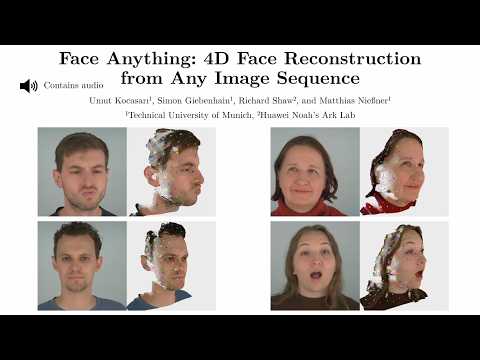
📢Face Anything: 4D Face Reconstruction from Any Image Sequence
Transformer model for 4D face reconstruction and dense tracking:
- predict canonical facial coordinates per pixel
- tracking as reconstruction in canonical space
- geometry + correspondences in one forward pass
Key idea: a shared canonical space across frames
- correspondences as nearest neighbors
- no motion or deformation estimation
Stable geometry and tracking, even under large expressions and viewpoint changes - check out our results!
🌐 kocasariumut.github.io/FaceAnything
▶️ youtu.be/wSGHpAscp0Y
Great work by @UmutKocasa4344, @SGiebenhain, @richard_o_shaw
YouTube
English

Check out @ErkocZiya 's work on planning for scene generation!
Matthias Niessner@MattNiessner
📢WorldAgents: 3D worlds only from 2D image models - without any training! We propose an agentic approach with a Director (VLM) to plan the scene, a Generator (Flux or NanoBanana) for new views, and a Verifier (VLM) for selection / 3D consistency. -> High-fidelity 3D worlds from a single text prompt. What's remarkable: our agents find consistent views from 2D image models to obtain 3D-consistent worlds; this shows that image models contain world priors - agents just need to find them! ziyaerkoc.com/worldagents youtu.be/Mj2FqqhurdI Great work by @ErkocZiya @angelaqdai
English

Infinity-RoPE is accepted to #CVPR2026🎉!
✨In Infinity-RoPE, we extend pretrained autoregressive video models beyond the temporal RoPE limit, enabling the generation of effectively infinite-length videos while maintaining strong responsiveness to action prompts and supporting cinematic scene transitions, all without additional training.
Kudos to the team: @tunahansalih @akaan_akan @kaan_oktay @PINguAR and @fal
🌐 Project Page: infinity-rope.github.io
Hidir Yesiltepe@d_yesiltepe
🎬 2026 will be the year of autoregressive video models. As we wrap up 2025, we ask a critical question: How far can a diffusion model distilled with Self-Forcing on only 5-second, 16-FPS videos be pushed into long-form video generation without any supervision? ✨We introduce Infinity-RoPE, a training-free, plug-and-play relativistic RoPE formulation compatible with any Self-Forcing variant performing self-rollouts. ⏳Infinity-RoPE enables long video generation far beyond the base model’s temporal RoPE limit, supports full action control and dynamic scene changes, including scene cuts, within a single continuous generation stream.
English
adil meric retweetledi
Releasing Echo today is incredibly exciting for me — because it is a critical step for generative AI, enabling the creation of virtual worlds.
Echo is our first world model at SpAItial AI. It turns text or images into explorable 3D environments — spaces you can move through, inspect, and build on. Seeing this work in real time still feels a bit surreal.
My fascination with this goes back a long way: video games, virtual environments, and the idea of capturing the real world in 3D. As a researcher, I spent years working on 3D reconstruction, neural rendering, and scene understanding — all driven by the same question: how do we teach machines to understand the world?
One thing became clear over time: the biggest bottleneck isn’t compute or rendering — it’s 3D worlds themselves. High-quality, consistent environments are expensive to create by hand and don’t scale to the experiences we want to build. In particular, I believe that the ability to generate virtual worlds is ultimately key towards understanding the real world.
That’s why we founded SpAItial AI. We’re building spatial world models that combine geometric understanding with creative generation — models that can generate, edit, and eventually reason about 3D environments.
Echo is just the beginning. For me, this feels like the moment when decades of research finally meet the imagination that got many of us into graphics, games, 3D understanding in the first place.🌍
spaitial.ai
SpAItial AI@SpAItial_AI
🚀 Announcing Echo — our new frontier model for 3D world generation. Echo turns a simple text prompt or image into a fully explorable, 3D-consistent world. Instead of disconnected views, the result is a single, coherent spatial representation you can move through freely. This is part of a bigger shift in AI: from generating pixels and tokens to generating spaces. Echo predicts a geometry-grounded 3D scene at metric scale, meaning every novel view, depth map, and interaction comes from the same underlying world — not independent hallucinations. Once generated, the world is interactive in real time. You control the camera, explore from any angle, and render instantly — even on low-end hardware, directly in the browser. High-quality 3D world exploration is no longer gated by expensive equipment. Under the hood, Echo infers a physically grounded 3D representation and converts it into a renderable format. For our web demo, we use 3D Gaussian Splatting (3DGS) for fast, GPU-friendly rendering — but the representation itself is flexible and can be easily adapted. Why this matters: consistent 3D worlds unlock real workflows — digital twins, 3D design, game environments, robotics simulation, and more. From a single photo or a line of text, Echo builds worlds that are reliable, editable, and spatially faithful. Echo also enables scene editing and restyling. Change materials, remove or add objects, explore design variations — all while preserving global 3D consistency. Editing no longer breaks the world. This is only the beginning. Echo is the foundation for future world models with dynamics, physical reasoning, and richer interaction — environments that don’t just look right, but behave right. Explore the generated worlds on our website and sign up for the closed beta. The era of spatial intelligence starts here. 🌍 #Echo #WorldModels #SpatialAI #3DFoundationModels Check it out: spaitial.ai
English
adil meric retweetledi

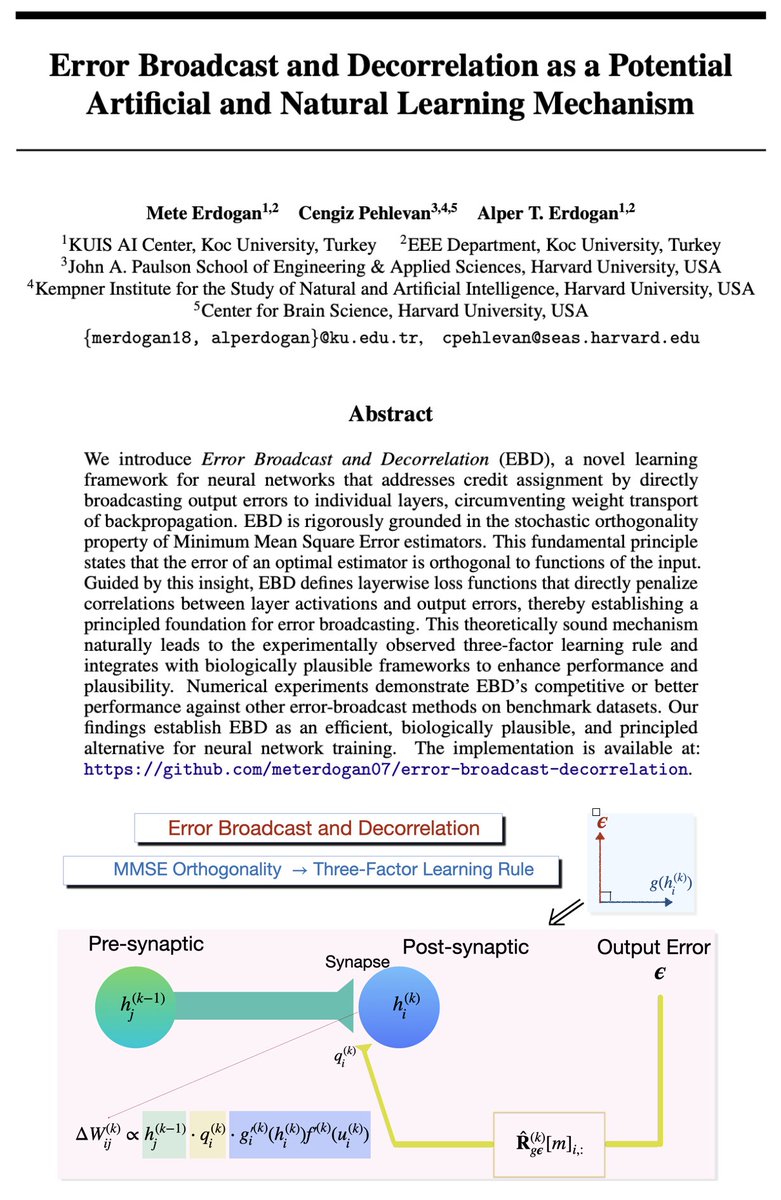
Excited to share that our paper “Error Broadcast and Decorrelation as a Potential Artificial and Natural Learning Mechanism”—with @CPehlevan and @Alper_T_E—was accepted as a #NeurIPS2025 Spotlight! 🎉
Paper:🔗 arxiv.org/pdf/2504.11558
English
@taiyasaki Very cool topics and lineup of speakers! Could we get access to the presentations? Are you planning to share them?
English

Just a few seats left in the GeoFreeNVS workshop at #ICCV2025 (Room: 323 C)
Right now Yin Cui from NVIDIA is presenting Cosmos!
geofreenvs.github.io
Andrea Tagliasacchi 🇨🇦@taiyasaki
Thrilled to announced that at #ICCV2025 we will host the first workshop on 𝐆𝐞𝐨𝐦𝐞𝐭𝐫𝐲-𝐅𝐫𝐞𝐞 𝐍𝐨𝐯𝐞𝐥 𝐕𝐢𝐞𝐰 𝐒𝐲𝐧𝐭𝐡𝐞𝐬𝐢𝐬 𝐚𝐧𝐝 𝐂𝐨𝐧𝐭𝐫𝐨𝐥𝐥𝐚𝐛𝐥𝐞 𝐕𝐢𝐝𝐞𝐨 𝐌𝐨𝐝𝐞𝐥𝐬 geofreenvs.github.io a.k.a. "3D Computer Vision in the era of Video Models" 😅
English
adil meric retweetledi

"The Tower Heist"
A small window is open to recover an ancient scroll.
Created in early access with the fantastic new @Kling_ai 2.5 Turbo model bringing affordable generations with best in class prompt adherence and quality. The range of directed character motions now available to us is incredible!
🔊🔊🎧
English
adil meric retweetledi

Presenting PrEditor3D at #CVPR2025 📢📢
If you'd like to learn more about our work and discuss 3D generation/editing, come visit our poster on Friday, June 13th, in ExHall D between 10:30-12:30 (Poster #44).
Project Page: ziyaerkoc.com/preditor3d
English
Totally agree. Gymnastics, street dance and close human interaction are impossible to generate with any video generation model.
A new bar has been set…
Deedy@deedydas
Make no mistake, Google's new Veo 3 video generatiom model is absolutely exceptional. But gymnastics is still pure nightmare fuel, and is the Turing test for video models!
English
adil meric retweetledi

🌟 Research Update
We introduce FluxSpace, a new method for manipulating the image semantics in rectified flow transformers in a disentangled way!
Shoutout to my collaborator @kavanav2912 and my advisor @PINguAR

English
adil meric retweetledi
🚀 Excited to share our latest work, MotionShop, a training-free approach for motion transfer in video diffusion models! 🎥 Big thanks to my amazing teammates from GEMLAB—@tunahansalih, Connor Dunlop, and @PINguAR—for making this possible! 🙌
🌐 motionshop-diffusion.github.io
English
adil meric retweetledi
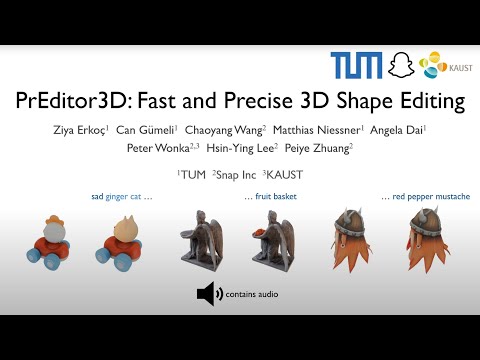
📢📢 𝐏𝐫𝐄𝐝𝐢𝐭𝐨𝐫𝟑𝐃: 𝐅𝐚𝐬𝐭 𝐚𝐧𝐝 𝐏𝐫𝐞𝐜𝐢𝐬𝐞 𝟑𝐃 𝐒𝐡𝐚𝐩𝐞 𝐄𝐝𝐢𝐭𝐢𝐧𝐠 📢📢
We propose a training-free 3D shape editing approach that rapidly and precisely edits the regions intended by the user and keeps the rest as is.
Using a quickly brushed mask and a text prompt, we first apply multi-view editing in the 2D domain and then run our merging algorithm in the 3D feature space to ensure that the edited shape is loyal to the input shape.
Project Page: ziyaerkoc.com/preditor3d/
Video: youtube.com/watch?v=Ty2xXa…
Great work by @ErkocZiya @cangumeli Chaoyang Wang @angelaqdai @peter_wonka @hyjameslee @PeiyeZ
YouTube
English
Introducing the first NeRF-based 3D style transfer method that generalizes across scenes and styles!
Our approach eliminates the time-consuming optimization for each scene or style, making it more efficient than previous NeRF-based methods. Check it out! #GCPR2024
Matthias Niessner@MattNiessner
G3DST: Generalizing 3D Style Transfer with NeRF across Scenes and Styles! Given a style latent, our hypernetwork estimates MLP params that transform aggregated ray features. mericadil.github.io/G3DST/ Great work by our MA student @adilmeric12 U. Kocasari @barbara_roessle #GCPR24
English
adil meric retweetledi
G3DST: Generalizing 3D Style Transfer with NeRF across Scenes and Styles!
Given a style latent, our hypernetwork estimates MLP params that transform aggregated ray features.
mericadil.github.io/G3DST/
Great work by our MA student @adilmeric12
U. Kocasari @barbara_roessle #GCPR24
English
adil meric retweetledi

Thrilled to introduce our latest research at the upcoming #NeurIPS DGM4H workshop this December: “flowVI: Flow Cytometry Variational Inference” 🥳👨💻🧬. Many thanks to @fabian_theis @LM_Koenig @adilmeric12 @HelmholtzMunich. Dive into our full paper 📰: doi.org/10.1101/2023.1…
English
adil meric retweetledi

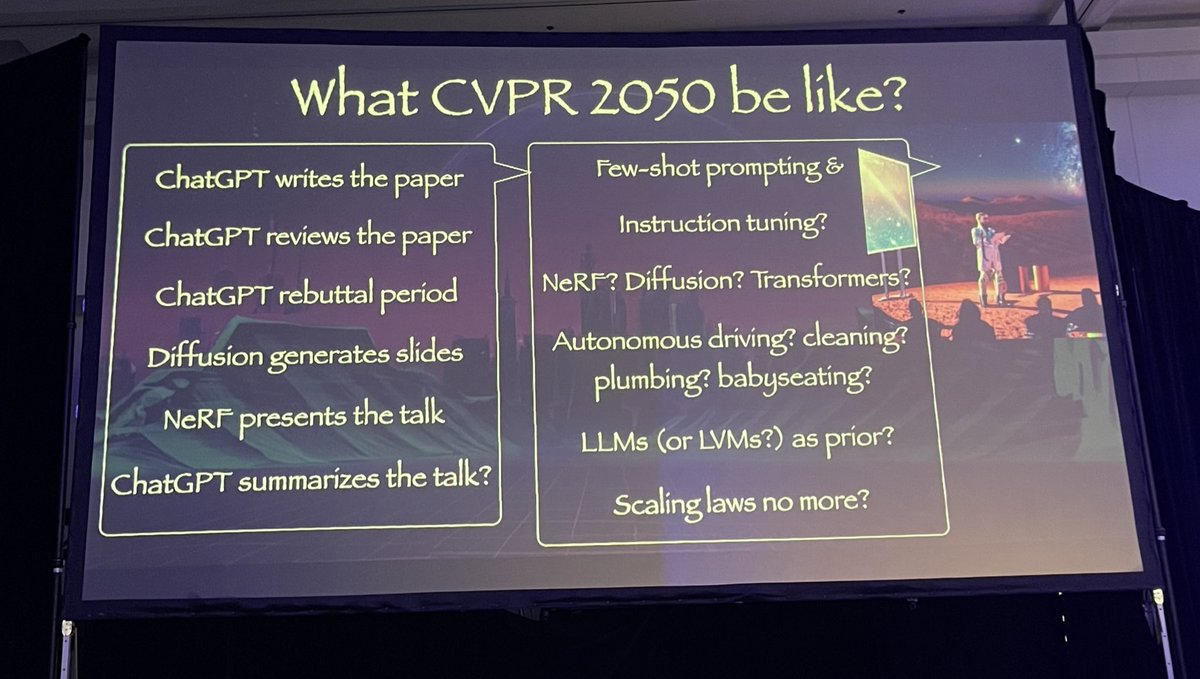
Research summary for the last 3 years...
2021: Replace every CNN with a Transformer
2022: Replace every GAN with diffusion models
2023: Replace every NeRF with Gaussian splatting
English
adil meric retweetledi

adil meric retweetledi

AI generative fill extending famous animal memes by parh0
instagram: instagram.com/p/CtY6smpId81/
English