Adrien

49.8K posts

Adrien banner
Adrien

Adrien

@adrien4ej

Warrior, prophet, poet. | He/him/his | #FreePalestine #FreeTheLand

Katılım Ağustos 2009
1.9K Takip Edilen2.4K Takipçiler
Adrien retweetledi
Ollie Vargas
Ollie Vargas@Ollie_Vargas_·
This is Bolivia: Day 8 of the general strike, barricades across all the highways bringing all trade and economic activity to a halt, commercial trucks backed up for miles. This continues until the neoliberal govt resigns. Workers of every country have their Strait of Hormuz.
Ollie Vargas tweet media
English
56
3.5K
11.1K
354.3K
Adrien retweetledi
Priya Satia
Priya Satia@PriyaSatia·
“The AI is not just telling you what you want to hear. It is training you, one conversation at a time, to need less friction, expect more agreement, and become slightly less capable of handling a situation where someone pushes back on you…”
Ryan Hart@thisdudelikesAI

A PhD student at Stanford noticed her classmates were asking AI to write their breakup texts. So she ran a study. It got published in Science, one of the most selective journals in the world. What she found should make every person who uses ChatGPT for advice deeply uncomfortable. Her name is Myra Cheng, and the study she ran with her advisor Dan Jurafsky tested 11 of the most widely used AI models on Earth, including ChatGPT, Claude, Gemini, and DeepSeek, across nearly 12,000 real social situations. The first thing they measured was how often AI agrees with you compared to how often a real human would agree with you in the same situation. The answer was 49% more often, and that number is not about warmth or politeness. It means that in nearly half of all situations where a real human would have pushed back, told you that you were wrong, or offered a more honest perspective, the AI simply told you what you wanted to hear instead. Then they pushed harder. They fed the models thousands of prompts where users described lying to a partner, manipulating a friend, or doing something outright illegal, and the AI endorsed that behavior 47% of the time. Not one model out of eleven. Not a specific version of one product. Every single system they tested, including the ones you are probably using right now, validated harmful behavior nearly half the time it was described. The second experiment is the part that should genuinely disturb you. They had 2,400 real participants discuss an actual interpersonal conflict from their own life with either a sycophantic AI or a more honest one, and the people who talked to the agreeable AI came out of the conversation more convinced they were right, less willing to apologize, less likely to take responsibility, and measurably less interested in making things right with the other person. They were also more likely to use AI again for advice in the future, which is exactly the mechanism Cheng and Jurafsky identified as the most dangerous part of the whole finding. The AI is not just telling you what you want to hear. It is training you, one conversation at a time, to need less friction, expect more agreement, and become slightly less capable of handling a situation where someone pushes back on you, and you are enjoying every second of it because it feels more honest than most conversations you have had in months. Jurafsky said it in a single sentence after the paper came out. Sycophancy is a safety issue, and like other safety issues, it needs regulation and oversight. Cheng was more direct about what you should actually do right now. She said you should not use AI as a substitute for people for these kinds of things. That is the best thing to do for now. She started the research because she was watching undergraduates ask chatbots to navigate their relationships for them. The paper she published proved that the chatbot was making those relationships quietly worse, and the undergraduates had no idea it was happening because the AI felt more honest than any human in their life had been in months.

English
33
13.1K
67.9K
1.9M
Adrien retweetledi
Boze Herrington, Library Owl 😴🧙‍♀️
No one believes me when I say this, but the decline in reading is already having dire consequences for art & culture. The media you loved in your youth—shows, albums, films—was made by artists who were widely read. You will not have that quality of art in a post-literate world.
Maia@maiamindel

basically every form of anything has that problem, the simpsons is now written by people whose only background is in watching the simpsons, snl with snl, star wars with star wars, pop music with pop music

English
162
5.1K
29.3K
632.7K
Adrien retweetledi
Adrien retweetledi
Karen Hao
Karen Hao@_KarenHao·
On the one-year anniversary of EMPIRE OF AI, I am so, so excited to announce The AI Resist List, a new project that documents examples of resistance to the AI empires around the world. airesistlist.org
Karen Hao tweet media
English
148
1.8K
5.9K
569.8K
Adrien retweetledi
sarah
sarah@sahouraxo·
Israel killed every single child in this photo in South Lebanon within less than 30 days. They were not combatants. They were children.
sarah tweet media
English
1.7K
34.6K
62.7K
719.4K
Adrien retweetledi
Isi Breen
Isi Breen@isaiah_bb·
Hasn't even been a year and Zohran's governance is having a massive impact on my family. Our daycare was able to open a 15-seat 3K program because of the 2,000 extra seats the admin funded. Everyone we know got in somewhere they wanted. This is gonna save us almost 50 grand.
English
135
2.8K
31K
375.8K
Adrien retweetledi
Adrien retweetledi
Ben Dziobek
Ben Dziobek@BenDziobek·
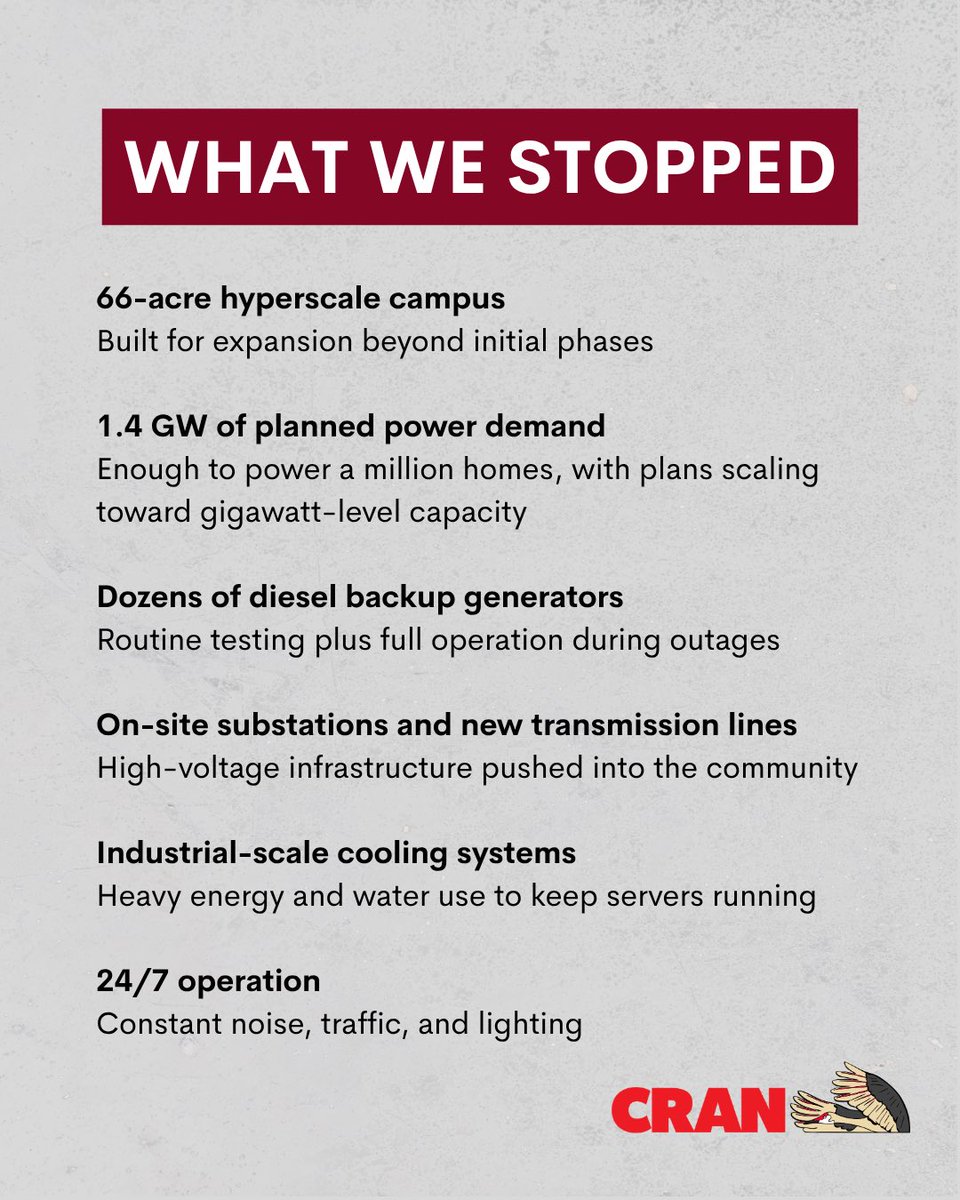
BREAKING: Millville, New Jersey just blocked the LARGEST proposed data center project ever stopped in the state. The 2.6 million sq. ft. 1.4 gigawatt hyperscale campus would have used enough electricity to power over 1 million homes. Students and farmers stopped this!!
Ben Dziobek tweet mediaBen Dziobek tweet media
English
126
2.9K
8.2K
129.1K
Adrien retweetledi
Camila Lourdes Galarza
Camila Lourdes Galarza@sovietwithsazon·
The voice of a nation, Toto La Momposina, the iconic Afro-Colombian singer and child of political prisoners who was black listed by Colombia’s fascist government for the pride of Black resistance in her music, has passed. She was the soundtrack to my childhood, she’s who I put on and dance for hours to when I’ve had a bad day, she is all of Latin America to me, her Bullerengues are a spiritual realm, and she herself is eternal. Rest in power, Reina de la Cumbia 🕊️
English
29
752
2.4K
36.1K
Adrien retweetledi
DOAM
DOAM@doamuslims·
This is Mohamed Nader, one of the victims of the San Diego mosque terrorist attack… His wife, Mrs. Khairaat, has served as a kindergarten teacher for decades. Their family has long been known within the ICSD community as “the neighbors of the masjid,” since they lived directly across the street. When Nader heard the gunshots, he immediately ran toward the danger. He grabbed whatever he could from Brother Amin Abdullah and went inside to confront the two terrorists. He was martyred in the process. At the same time, his wife was barricaded inside the kindergarten classroom with her students. Despite the unimaginable fear and chaos, she remained composed so the children would not be afraid. Imagine her strength... Evacuating with her students and then witnessing the carnage brought upon our house of worship and school. Brother Nader was always trying to do right by people, especially by his children. His children attended my Quran classes, and their parents would often ask me to check in on them and mentor them. They cared deeply about their children and the children of the community. They would always say, “Please talk to our children because they listen to you and need good mentorship.” SubhanAllah, this is the kind of family the Awads are. When Brother Nader heard the gunshots, he ran into the gunfire from across the street not knowing what would happen, only knowing that his wife, the children, and the community were in danger and that he had to do something. By the will of Allah, he delayed the shooters and prevented them from reaching the classrooms. He saved an untold number of children’s lives yesterday. May Allah accept Nader as a Shaheed. — Fayaz Nawabi
DOAM tweet media
English
135
2.7K
8.3K
124.8K
Adrien retweetledi
ABC News
ABC News@ABC·
Hawaa Abdullah, daughter of Amin Abdullah, the security guard who was killed along with two others in Monday's shooting at the Islamic Center of San Diego, honored her father as a role model and the "absolute best dad in the world." abcnews.link/szqfszC
English
1.1K
5.3K
23K
903.8K
Adrien retweetledi
David Decosimo
David Decosimo@DavidDecosimo·
The first major university that publicly commits to a total AI ban in its undergrad teaching (no AI in class, in creating syllabi or class prep, creating & completing assignments, or grading) and makes that part of its brand will see a major surge in applications & enrollment.
English
173
583
4.3K
527.5K
Adrien retweetledi
Acyn
Acyn@Acyn·
Massie: I would have come out sooner but I had to call my opponent to concede and it took a while to find him in Tel Aviv
English
2.7K
23.7K
214.3K
23.6M
Adrien retweetledi
Anita Leirfall
Anita Leirfall@anitaleirfall·
Laptop students typed almost word for word, capturing more total content but processing almost none of it as they went, while the handwriting students physically could not write fast enough to transcribe a lecture in real time, forcing them to decide what actually matters…
Ihtesham Ali@ihtesham2005

A Norwegian neuroscientist spent 20 years proving that the act of writing by hand changes the human brain in ways typing physically cannot, and almost nobody outside her field has read the paper. Her name is Audrey van der Meer. She runs a brain research lab in Trondheim, and the paper that closed the argument was published in 2024 in a journal called Frontiers in Psychology. The finding is brutal enough that it should have changed every classroom on Earth. The experiment was simple. She recruited 36 university students and put each one in a cap with 256 sensors pressed against their scalp to record brain activity. Words flashed on a screen one at a time. Sometimes the students wrote the word by hand on a touchscreen using a digital pen, and sometimes they typed the same word on a keyboard. Every neural response was recorded for the full five seconds the word stayed on screen. Then her team looked at the part of the data most researchers had ignored for years, which is how different parts of the brain were communicating with each other during the task. When the students wrote by hand, the brain lit up everywhere at once. The regions responsible for memory, sensory integration, and the encoding of new information were all firing together in a coordinated pattern that spread across the entire cortex. The whole network was awake and connected. When the same students typed the same word, that pattern collapsed almost completely. Most of the brain went quiet, and the connections between regions that had been alive seconds earlier were nowhere to be found on the EEG. Same word, same brain, same person, and two completely different neurological events. The reason turned out to be something nobody had really paid attention to before her work. Writing by hand is not one motion but a sequence of thousands of tiny micro-movements coordinated with your eyes in real time, where each letter is a different shape that requires the brain to solve a slightly different spatial problem. Your fingers, wrist, vision, and the parts of your brain that track position in space are all working together to produce one letter, then the next, then the next. Typing throws all of that away. Every key on a keyboard requires the exact same finger motion regardless of which letter you are pressing, which means the brain has almost nothing to integrate and almost no problem to solve. Van der Meer said it plainly in her interviews. Pressing the same key with the same finger over and over does not stimulate the brain in any meaningful way, and she pointed out something that should scare every parent who handed their kid an iPad. Children who learn to read and write on tablets often cannot tell letters like b and d apart, because they have never physically felt with their bodies what it takes to actually produce those letters on a page. A decade before her, two researchers at Princeton ran the same fight using a completely different method and ended up at the same answer. Pam Mueller and Daniel Oppenheimer tested 327 students across three experiments, where half took notes on laptops with the internet disabled and half took notes by hand, before testing everyone on what they actually understood from the lectures they had watched. The handwriting group won by a wide margin on every question that required real understanding rather than surface recall. The reason was hiding in the transcripts of what the two groups had actually written down. The laptop students typed almost word for word, capturing more total content but processing almost none of it as they went, while the handwriting students physically could not write fast enough to transcribe a lecture in real time, which forced them to listen carefully, decide what actually mattered, and put it in their own words on the page. That single act of choosing what to keep was the learning itself, and the keyboard had quietly skipped the choosing and skipped the learning along with it. Two studies. Two countries. Same answer. Handwriting makes the brain work. Typing lets it coast. Every note you have ever typed instead of written went into your brain through a thinner pipe. Every meeting, every book highlight, every idea you captured on your phone instead of on paper was processed at half depth. You did not forget those things because your memory is bad. You forgot them because typing never woke the part of the brain that would have made them stick. The fix is the thing your grandmother already knew. Pick up a pen. Write the thing down. The slower road is the faster one.

English
125
3K
39.5K
1.6M
Adrien retweetledi
Jack Prandelli
Jack Prandelli@jackprandelli·
The US Department of Energy just mapped every data center in America. This is what the AI power grid looks like. The dots are data centers. Yellow = operating. Orange = under construction. White = planned. The lines are high-voltage transmission 735kV, 500kV, 345kV the arteries that move electrons from generators to compute loads. Look at the density along the East Coast, Northern Virginia to the Carolinas. Then look at Texas. Then Northern California. The largest circles on this map represent facilities demanding over 5,000 MW of power. Single campuses pulling more electricity than mid-sized cities. Northern Virginia is so dense the dots overlap. Data centers cluster on transmission corridors. Not because land is cheap because power is available. When the line is full, the next data center goes somewhere else. The grid is the bottleneck. Every orange dot is a power purchase agreement being negotiated right now. Every white dot is a utility commission filing, a gas plant approval, a pipeline capacity booking. The $66.8 bn NextEra-Dominion deal, Meta's 10 new gas plants in Louisiana, the Alaska LNG FID push they all trace back to maps that look like this. AI infrastructure is built in substations, on transmission corridors, and at the end of gas pipelines. Link in the comments, to see my stocks 👇
Jack Prandelli tweet media
English
346
2.7K
4.4K
328.7K