Alex Federation

676 posts

Alex Federation banner
Alex Federation

Alex Federation

@afederation

Co-founder, CEO of Talus Bio illuminating the regulome | controlling the genome | drugging the 'undruggable' #proteomics, #teammassspec, #chembio

Seattle, WA Katılım Aralık 2008
416 Takip Edilen549 Takipçiler
Sabitlenmiş Tweet
Alex Federation
Alex Federation@afederation·
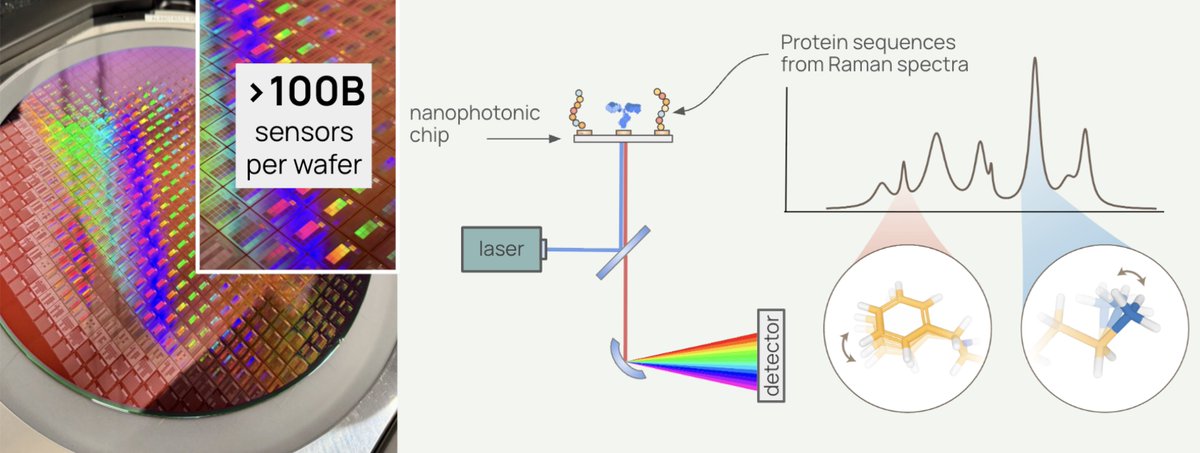
I just ran the first n=1 dynamic regulome experiment. On myself. A 72-hour fast where we tracked all 4,000+ components of the genome regulatory 'software' to see how they respond And over 30% changed, most never mentioned in fasting literature Why does this matter? Well, why do you sometimes wake up feeling like garbage after eight hours of sleep? Your HRV looks fine. You got your morning sunlight. Your bloodwork is normal. Even your genome doesn't have a glaring mutation. The answer lives in the regulome. It's your body’s real-time operating system, interpreting the environment and making decisions It decides how your genome responds to stress, sleep, food, toxins, exercise, and more. Now we can finally read it. Full write-up in the comments. More experiments coming: - Sleep deprivation (new baby incoming) - Ultramarathon recovery - Sauna // ice bath - Alcohol What else do you want to see? Follow along. Subscribe for updates. Apply for access to our tech. We’re just getting started.
Alex Federation tweet media
English
6
1
36
6.3K
Alex Federation retweetledi
Armand
Armand@armandcognetta·
There’s an enormous gap in the longevity field that almost no one is talking about. No existing therapeutic modalities are capable of both systemic distribution and complex transformations. Until we solve this, we won’t solve aging. 🧵
Armand tweet media
English
17
30
118
24.5K
Alex Federation retweetledi
David K. Yang
David K. Yang@davidkmyang·
Nice progress on drugging p53. It’s true that we need to find new targets, but it’s also important to keep expanding the druggable universe with better technologies. Lots of great targets we already know about that are just waiting for the right molecule
NEJM@NEJM

In a phase 1 study of the oral p53 reactivator rezatapopt in heavily pretreated patients with TP53 Y220C–mutated solid tumors, the most common adverse events were nausea and vomiting, and the overall response was 20%. Full PYNNACLE study results: nej.md/3OIQC5P Science behind the Study: Restoring Function to a Variant of p53 in Solid Tumors nej.md/3N0pQW8

English
0
3
15
2.2K
Alex Federation retweetledi
David K. Yang
David K. Yang@davidkmyang·
Seeing several platform biotech companies from the '21 boom roaring back with compelling programs after staying heads down for a few years. Exciting times
English
3
2
54
6.9K
Alex Federation retweetledi
Ethan Perlstein 1-to-N
Ethan Perlstein 1-to-N@eperlste·
Did anyone else notice that the PRV was renewed last week? If you develop a medicine for a rare pediatric disease in the next 3 years, you get a voucher worth $150M+ So why isn’t there an orphan drug gold rush underway?
English
2
4
28
3.1K
Alex Federation
Alex Federation@afederation·
Imagine not having to test transcription factors one-by-one to rejuvenate cells / avoid cancer We'd need an AI trained on real TF activity data that actually understands how this network of 1000s of proteins behaves That’s our bet at Talus Bio. Observe the regulome, learn the rules, then control it.
Bryan Johnson@bryan_johnson

New study: for years Yamanaka factors have driven longevity optimism. They factory reset cellular age, also erase the cellular identity. The drawback is potential cancer. Transcription Factor Perturbations is a new scalpel approach targeting specific rejuvenation levers while keeping the cell's identity. Example breakthrough EZH2: mouse liver age reversal by 8 human-year equivalent by reducing liver fibrosis and fat by 50% and significantly improving glucose tolerance. Study details Transcriptional factors, particularly the Yamanaka factors (OSKM), are key to understanding and potentially reversing aging. OSKM can perform a cellular "factory reset," erasing epigenetic memory and inducing a stem cell-like state. Partial reprogramming with OSKM offers a path to rejuvenation, but its clinical use requires precise temporal and dosage control to prevent dedifferentiation and tumor formation. A recent study established a Transcriptional Rejuvenation Discovery Platform (TRDP) to identify novel transcription factor perturbations capable of driving cellular rejuvenation and reversing aspects of replicative aging in human fibroblasts. The platform was trained on transcriptional shifts between early- and late-passage human cells in culture to identify gene expression and transcription factor changes associated with aging. These changes were ranked computationally to prioritize transcription factors relevant to rejuvenation. The top 200 candidates were screened by parallel overexpression (CRISPRa) or inhibition (CRISPRi), followed by single-cell RNA sequencing to evaluate transcriptional consequences. Rejuvenating factors were identified by their ability to reverse aging-associated gene expression, quantified by a negative correlation score (R₍rej₎). Four were selected for further study: inhibition of STAT3 and ZFX, and activation of EZH2 and E2F3. Findings in human cells (fibroblasts in cell culture) In high-passage cells, all four perturbations induced rejuvenation-associated phenotypes, including increased proliferation (KI67), improved proteasome activity, reduced lysosomal staining, p21 downregulation, and improved mitochondrial function (strongest with EZH2). These effects mirrored in vitro OSKM reprogramming for the measured hallmarks, but without changing cellular identity. DNA methylation clocks remained stable, consistent with the decoupling of senescence and epigenetic aging. Findings in aging mouse livers For in vivo validation, the aging mouse liver was chosen. EZH2 was selected due to its age-associated decline, favorable safety profile over E2F3, and lack of STAT3-like disease-specific liver involvement. Three weeks of liver-specific EZH2 overexpression via AAV8 delivery reversed aging-associated gene expression and phenotypes by an equivalent of roughly eight months of mouse aging, including reductions in steatosis and fibrosis and improvements in glucose tolerance. EZH2 overexpression produced stronger rejuvenation-associated transcriptional changes in vivo than those observed in vitro, particularly affecting inflammatory pathways and age-related loss of cellular identity, including inappropriate activation of muscle and cardiac gene programs in aged liver tissue. In 20-month-old mice, fibrosis and glucose intolerance improved by approximately 50% relative to young mice. Importantly, cellular identity was preserved, no liver damage or histological abnormalities were observed, and comparisons with multiple mouse liver cancer models showed no overlap with cancer-associated transcriptional signatures over the short treatment window. Significance This work introduces a systematic framework for identifying transcriptional factors as potential levers for longevity and rejuvenation. EZH2 emerges as a promising target for further exploration via gene therapy or targeted modulators, based on rejuvenation-associated signatures observed in human fibroblasts and functional rejuvenation of the aging mouse liver without overt damage or cancer-like signals. While the OSKM reprogramming strategy demonstrate the reversibility of aging through global epigenetic resetting, it carries intrinsic risks related to identity destabilization. In contrast, targeted transcription factor perturbations enable the reversal of multiple aging-associated hallmarks without engaging in full or partial reprogramming, suggesting a more precise and potentially safer route to rejuvenation. These distinct approaches collectively indicate that rejuvenation operates across various biological layers, from broad epigenetic resets to targeted transcriptional network recalibration. Limitations The current screening strategy and computational model are biased towards transcription factors effective in replicative aging models of passaged neonatal human dermal fibroblasts, which differ substantially from organismal aging in vivo. While many hallmarks overlap, this model does not fully capture aging in post-mitotic cells or complex tissue and organ environments. The platform uses cellular proliferation and survival in culture as proxies for rejuvenation, whereas in vivo aging is influenced by additional factors such as differentiation state, immune interactions, and intercellular communication. Reliance on proliferative capacity also carries inherent oncogenic risk. Although cancer-associated transcriptional signatures were not observed in this study, longer-term effects cannot be excluded. Finally, liver rejuvenation was demonstrated in a single organ over a short treatment period in mice. The absence of damage or oncogenic signatures cannot be considered a definitive safety signal, and long-term studies, including large-animal and non-human primate models, will be required to establish safety, durability, and systemic relevance.

English
0
1
5
329
Alex Federation
Alex Federation@afederation·
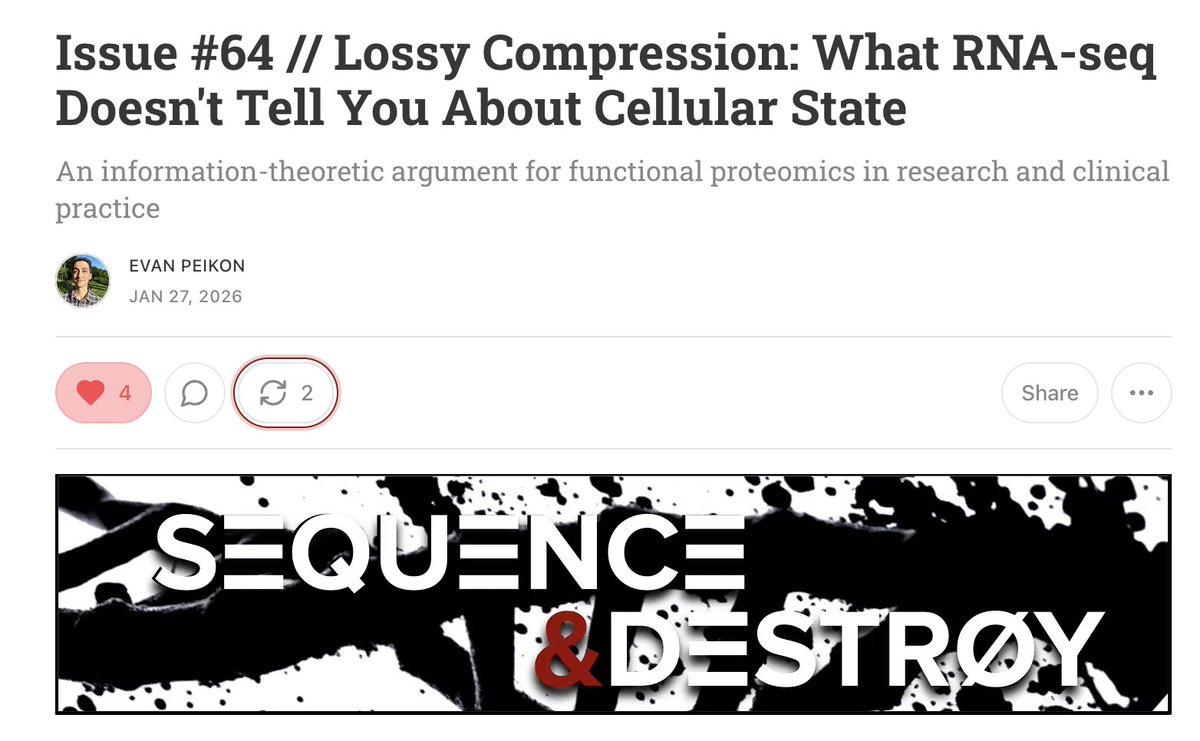
proteomics is closer to biology than RNA-seq functional proteomics is closer to biology than 'regular' proteomics let's build virtual cells with better data
Alex Federation tweet media
English
1
0
1
63
Alex Federation retweetledi
Richard Fuisz
Richard Fuisz@richardfuisz·
Target crowding is a real issue, but centralized subsidy seems like a gift to the subsidized, not a gift to patients. To encourage more novel-target discovery, I’d prefer a “cover song fee” — 5% mandatory royalty back to the first innovator that hits ph2 with a new target. Innovator shouldn’t block new entrants with improved pk/pd like they used to 30 years ago — but innovators deserve to get paid when they lay the groundwork for future cures… even if their specific attempt fails. It’s a risky business we’re in! And it shouldn’t matter how the drugs are made! AI, immunization, spontaneous discovery — however you get there, a drug in patients is a drug we can learn from.
Sam Rodriques@SGRodriques

The Humanity Project People always ask me: if we want to cure all diseases with AI, shouldn't we be building a huge robotic warehouse to run closed loop experiments on mice, human cells, and so on? From a naive outside perspective, this may seem like the obvious thing to do, analogous to what Periodic Labs is doing for materials and what the robotics companies like Physical Intelligence are doing for laundry and so on. The problem is, for most diseases, experiments in cultured cells, mice, and other models are poorly predictive of success in actual humans. If you synthesize a material in the lab and find it has a certain conductivity, then that’s the conductivity; by contrast, if something works in a mouse, you still have to test it in a human, and mouse biology is so poorly predictive of human biology that for some diseases success in mice actually anticorrelates with success in humans. Closed loop reinforcement learning in mice might be a great way to learn how to cure mouse diseases, but the only way to cure human diseases is to run more experiments in humans. To cure all diseases, in other words, what we actually need is a massive, centralized effort to scale up clinical trials testing new AI-generated therapeutic hypotheses. Such an effort would serve several goals: it would identify novel mechanisms for treating diseases; it would train AI systems to understand human biology; and it would build the infrastructure needed to streamline and accelerate clinical trials going forward. Centralization would allow us to minimize duplication, maximize data availability for training, and ensure the resulting infrastructure is shared. An effort of this scale -- which would dwarf the genome project and consume resources similar to the entire NIH budget -- is not just our best chance to cure all diseases. It is also our best chance to remain ahead in biotechnology, where the US is rapidly losing ground to China. I call it the Humanity Project, and I describe it in a new essay, linked below. The first emphasis in the Humanity Project is on novelty. Medicine moves forward when we identify new therapeutic mechanisms -- think GLP-1s, CAR-T cells, and checkpoint inhibitors. Within a few years, AI agents will be as good as or better than humans at proposing novel therapeutic mechanisms. However, testing novel therapeutic mechanisms is risky and rarely pays off, so most biopharmas largely avoid it. Instead, 96% of clinical trials today are aimed at obtaining approval for new drugs that use existing therapeutic mechanisms, rather than testing new ones. If we want to cure all diseases, we need to massively expand the number of clinical trials we run that examine novel hypotheses, both as a way of identifying novel therapeutic mechanisms and as a way of training AI models to better understand human biology. This brings us to the second emphasis of the Humanity Project, which is on scale. The Humanity Project would be a centralized project to run 2000 drug programs testing novel, AI-generated therapeutic hypotheses through clinical proof of concept over 5 years. The Project would cost between $50B and $200B -- equivalent to the amount allocated for the California High Speed Rail, or the 5-year budget for the NIH --, would increase the number of first-in-class drug trials by 400% to 800% over that period, and would benefit from various advantages of AI in proposing and prosecuting clinical trials. In the process, the Project would lay down the infrastructure needed to accelerate and scale future trials run by the private sector, accelerating US biotechnology as a whole. The logistical challenges associated with such a problem are intense. We need better infrastructure to recruit and identify patients; we need to streamline regulation to make it easier to get drugs into patients faster while ensuring safety; we need to scale up and accelerate manufacturing; and we need to plug all of this infrastructure into AI systems that can efficiently integrate information, generate hypotheses and plan experiments, and learn from outcomes. The Humanity Project would work on developing these, and would make the resulting infrastructure available subsequently to accelerate US biotech as a whole. And, importantly, if we are serious about curing all diseases in the coming decades and maintaining US leadership in biotechnology and medicine, there is no alternative. With all the wealth and value set to be created by AI, finding the resources to accelerate medicine in this way should be straightforward. We should begin now. Read the full proposal below.

English
4
3
24
3.7K
Alex Federation
Alex Federation@afederation·
Underrated for sure This is why we're building the biggest dataset ever of transcription factor function and how to change function with small molecules AlphaFold can't even predict Tf structure, we think this is the way
Niko McCarty.@NikoMcCarty

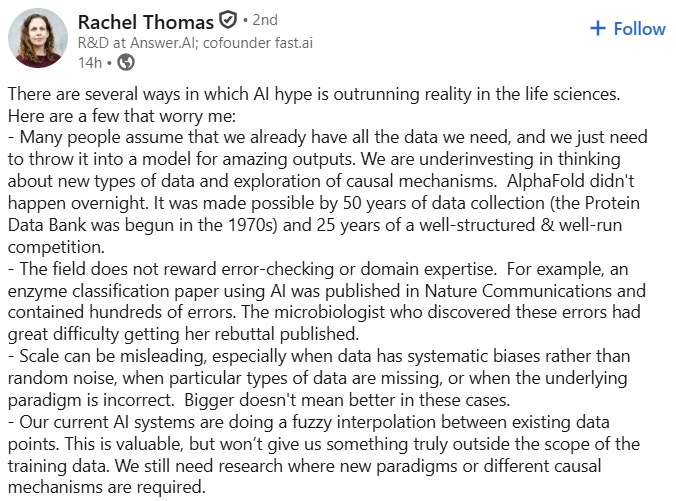
Underrated Ideas in Biotech (#7) AlphaFold predicts a protein's structure solely by looking at its sequence. But structure does not always suggest function. The next frontier is to train a model that can predict any protein's FUNCTION solely from its sequence. This is incredibly important because the most useful tools in biotechnology come from NATURE. The thermostable polymerase used in PCR came from microbes in a Yellowstone geyser. The "repeats" in CRISPR were first identified in extremophilic microbes in Spain. GFP was discovered in a jellyfish. The list goes on. If we had a good model for sequence-to-function prediction, we could send biologists into nature to hunt for proteins with new, useful functions. They could sequence samples from the Arctic and jungles and oceans, upload those data into the model, and then discover lots of useful proteins that could be adapted into tools! This vision is not so far from reality, either. A nonprofit, called The Align Foundation, is already collecting the datasets needed to train this predictive model. The training dataset needs three variables: 1. The amino acid sequences of proteins; 2. Some kind of "quantitative functional score" indicating how well each protein performs in an experiment; 3. A function-definition, aka a detailed description of the experiment used to benchmark what the protein does. (There are many "classes" of protein functions, like antibodies, proteases, transcription factors, and so on.) Align is collecting millions of datapoints. They have scaled up a lot, and are now routinely collecting hundreds of thousands of data points in a single experiment, at a cost of ~$0.05 per protein. Say Align wanted to collect data on antibiotic resistance proteins. They would take antibiotic resistance genes, mutate them to make thousands of variants, and insert those sequences (with unique 'barcodes') into living cells. Next, they'd expose the cells to an antibiotic. Cells with functional proteins survive; many others die. Some variants will do 'OK,' but those cells grow slowly. By sequencing the barcodes, they can quantify the population of each variant, and thus figure out which proteins are REALLY GOOD, JUST OKAY, or fail entirely. Given these data, the next step is to train a model that predicts whether a given protein variant will be good or bad at defending a cell against antibiotics. The model will be good at doing this for antibiotic resistance proteins, but not much else! Align's goal, then, is to do these assays for proteins with many different functions and then "merge" them to build a model that can generalize across proteins. "As the dataset grows and more islands are sampled [they write], the models will become more generalized and capable of predicting the function of protein sequences that are increasingly distant from those that have been...measured." I hope this works. It would legitimately be one of the greatest unlocks for biotech progress more broadly.

English
0
0
0
139
alex rubinsteyn
alex rubinsteyn@iskander·
Did @OpenAI safety filter change? Very mundane experimental planning stopped working today
alex rubinsteyn tweet media
English
5
0
10
2.6K
Alex Federation retweetledi
Martin Borch Jensen
Martin Borch Jensen@MartinBJensen·
The recent breakthroughs from @nablabio & @chaidiscovery emphasize a split in early biotech strategy. For the specific range of problems that antibodies address, making the binder, is becoming trivial. This forces a choice between 'fast but competitive' and 'AI intractable'. 🧵
English
4
11
92
13.8K
Alex Federation retweetledi
Nabla Bio
Nabla Bio@nablabio·
Today we’re thrilled to announce JAM-2 — the first AI model capable of generating drug-quality antibodies straight from the computer, with industry-leading success rates. > Drug-like affinities: Picomolar to single-digit nanomolar antibody binders for half of 26 targets while testing <45 designs each. > Unlocking hard targets: Up to 11% success rate for direct on-cell GPCR binders; top antibody hits in the single-digit nanomolar range. > Unprecedented epitope breadth: JAM-2 routinely designed antibodies that hit 30–70% of user-defined epitopes, now enabling intentional design of biology — not chance discovery. > Drug-like developability: Over 50% of antibody designs passed core industry developability criteria with zero optimization. > Massive leverage: A four-person team prosecuted 16 targets in parallel in < 1 month. JAM-2 is the first de novo antibody design capability ready for front-line use in drug discovery, matching or surpassing traditional discovery approaches. We’re already deploying JAM-2 with multiple large pharma partners and seeing excellent results. If you’re interested in partnering on molecule development or accessing JAM-2, contact bd@nabla.bio. Read more in our whitepaper (link below)
English
21
111
493
199.3K
Alex Federation retweetledi
lada
lada@ladanuzhna·
I am excited to announce what I’ve been working on for the past 2 years. General Control is a mandate to develop programmable therapies that make durable, reversible adjustments to gene expression - epigenetically activating or silencing multiple targets at once. In the past 16 months, we: - Achieved a technical leap in epigenetic editing by engineering an editor library that outperforms leading published systems on potency and durability - Launched a multi-target partnership with Novo Nordisk - Generated animal data for 3 different programs and developed a lead we are now ready to translate to the clinic - Raised 5.5M pre-seed from @age1vc @fiftyyears @tmrohan @mollyfmielke and others
English
94
150
1.4K
299.8K
Alex Federation retweetledi
Sanju Sinha
Sanju Sinha@Sanjusinha7·
Most current drug discovery efforts is structure-based eg. create small molecules or antibodies that best binds X. However, a drug may not drive its efficacy from its strongest binder. Taking a step away from structure-paradigm, we reason that if a CRISPR knockout of a gene mimics a drug's effects across cancer cell lines, that gene is likely the drug's target. This was done in @EytanRuppin in collaboration with @anideshpandelab and @BenDavidLab Using this principle, we integrated drug and crispr profiles from 1000s of drugs to find their context specific targets (different cancers or when known target is not expressed but drug is yet killing cancer cells). We call this tool DeepTarget. We show that this approach outperforms current structure based methods (AF3, RF, Chai) to find drug's target in a genome-wide search, when we had no information on what the target might be. We benchmarked in eight gold-standard drug-target pairs. It took us months to get this benchmarks (we hope this benchmark helps the field) We present two experimentally validated cases and pls see the paper for this (link at the end). An intriguing observation is that we had many cases where we have many small molecules targeting the same gene (eg. EGFR) and we found that small molecules with higher predicted target specificity show greater clinical advancement. Very happy to hear your feedback. Here's the free access link: nature.com/articles/s4169…
Sanju Sinha tweet mediaSanju Sinha tweet mediaSanju Sinha tweet mediaSanju Sinha tweet media
English
9
52
204
46.8K