

manu
24 posts

What has pissed me off the most; the consecutive massive mandates that people of this country gave Mr. Narendra Modi, he could have done something massive, something spectacular for people, instead, he squandered it by chasing personal glory, regressive garbage sub-ideologies, making his 'friends' happy and now, he has destroyed our economy. There was a time when India, irrespective of what economical upheavals ravaged the outside world, was safe. Our people were growing at a steady, organic rate; that cushioning has been wiped out now. I am quite confident that the last two days of fear-mongering will turn around and bite Modi Government where it hurts them the most... electoral losses. People will remember this. They defenitely will. I am betting on it.
English

Don’t give your gold.
This is not because of any shortage or exchange issues - RBI has issued gold bond without securing the gold. The bonds are coming to collect - RBI doesn’t have the gold or the money.
ji selavu pantaru.
deivenki@catchvp
I think Modi government will eventually ask for Household gold..
English

He came to power by promising to erase corruption in India. Twelve years into it, rate him out of 10 on eliminating corruption.
English
@vijayshekhar All based on cheap availability of labor and inertia designed over millennia of people not been able to crossover to non-manual jobs.
English

I bet you've never looked at household “micro services” like this before.
From IT services to unpacking suitcases, India’s service market is quite unique. x.com/CNBCTV18News/s…
English
@Nithin0dha Investing in India feels like the line from hotel California
Song “You can check out any time you like, but you can never leave!” The process of moving money in is a click of a button but moving out requires paper and ink.
English

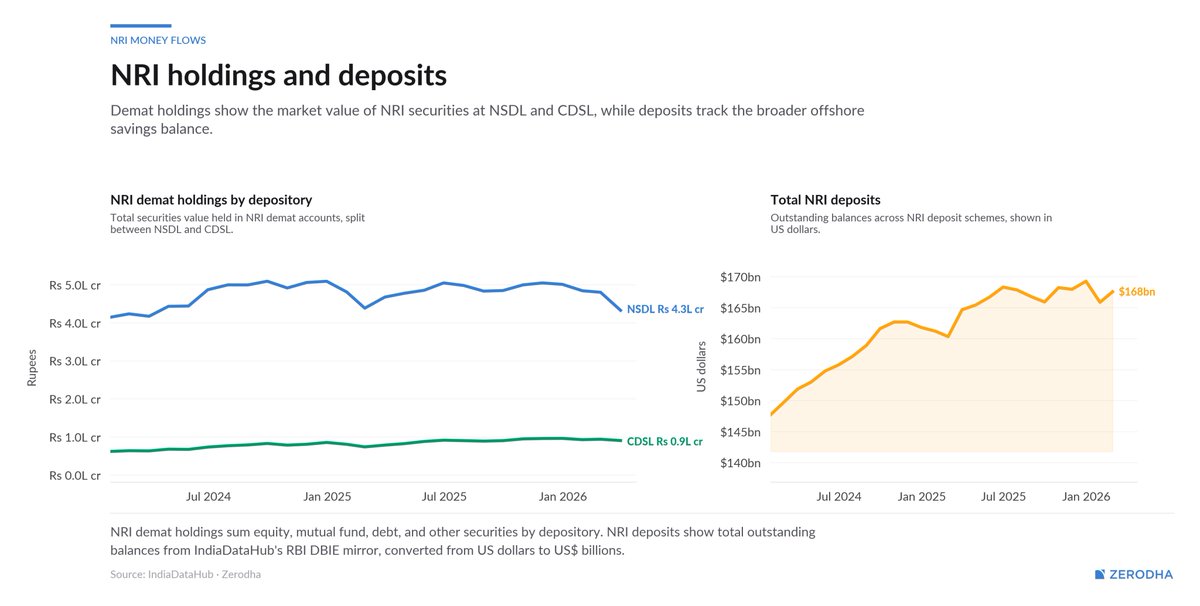
One thing that feels under-discussed in all the conversations about attracting foreign capital into India is the Indian diaspora.
There is a large population of NRIs who are emotionally and financially interested in investing in India. But today, for many of them, the process of opening accounts, completing documentation, and actually investing in Indian markets is still far more painful than it needs to be.
Making life easier for NRIs could be one of the lowest-hanging fruits for attracting long-term capital into India.
This is something we’ve been focusing on heavily at @zerodha as well. Over the last year or so, we’ve made several changes to make investing as seamless as possible for NRIs. But there are still many frictions that exist because of regulatory and compliance requirements.
Hopefully, SEBI and the government look at this more closely and think about how to make it easier for NRIs to bring money into India and participate in Indian markets. For a country trying to attract global capital, the Indian diaspora seems like the most obvious place to start.
English
@RoshanKrRaii So, using citizens as shields and defense in war is justified according to you? Delusional justification. So, Iran is saying I won’t leave straight of Hormuz but sacrifice my own citizens and you are clapping?
English

BREAKING : THIS IS COURAGE PERSONIFIED 👏🔥
Iranians 🇮🇷 have started forming human chain around bridges and power-plants after Trump 🇺🇸 threatened to destroy them.
I have never seen a civilisation this brave, & that orange clown thinks he can finish it.
English
@HustleBitch_ Yes, driving used to be pleasure 6 months ago. Now with FSD, it’s a chore. Useless chore which humans have been doing ineffectively for a century now. Time to hand it over to a better and efficient and safe machine. Tesla FSD is a game changer @elonmusk
English

🚨 THIS MAN JUST SHOWED WHAT HIS TESLA DOES EVERY MORNING — PEOPLE CAN’T BELIEVE THIS IS REAL
A man films his normal morning routine with his Tesla… and it barely looks like driving anymore.
He unplugs the car.
Gets inside.
Types a destination.
Then he taps “Start Self Driving.”
The Tesla drives itself out of his garage, navigates through traffic, arrives at the destination, finds an open parking spot, and parks itself.
He never touches the wheel.
No steering.
No pedals.
No gas stations.
By the time he steps out, the car already has another software update waiting.
Now the clip is blowing up because people say this doesn’t even feel like owning a car anymore.
It feels like having a robot chauffeur.
Are we watching the moment humans stopped driving… and most people don’t even realize it yet?
English
@chamath I think the model will be similar to vending machines management - local maintenance, battery recharging while machines are on auto pilot making money. Do you think this will be a consolidated industry like uber for taxis or small scale like vending machines owned small players?
English


Today’s military strikes on Iran — carried out by the United States and Israel — mark a catastrophic escalation in an illegal war of aggression. Bombing cities. Killing civilians. Opening a new theater of war. Americans do not want this. They do not want another war in pursuit of regime change. They want relief from the affordability crisis. They want peace.
I am focused on making sure that every New Yorker is safe. I have been in contact with our Police Commissioner and emergency management officials. We are taking proactive steps, including increasing coordination across agencies and enhancing patrols of sensitive locations out of an abundance of caution.
Additionally, I want to speak directly to Iranian New Yorkers: you are part of the fabric of this city — you are our neighbors, small business owners, students, artists, workers, and community leaders. You will be safe here.
English
@shanaka86 This is BS. IBM is moving towards quantum computing. The Cobol modernization is a not new. It has been achieved using many other techniques and even LLMs. Just solving this problem again will not move banks away from Mainframes. In fact Mainframes already runs Java.
English

A blog post just wiped $30 billion off IBM in a single afternoon.
Not a product launch. Not an earnings miss. Not a competitor undercutting on price.
A five-minute blog post explaining that Claude can read COBOL.
IBM dropped 13%. Worst single-day loss since October 2000. Twenty-five years of stock resilience ended by one AI company publishing a capability update.
Here’s what happened:
95% of ATM transactions in America run on COBOL. Hundreds of billions of lines power banking, airlines, and government systems. The developers who built them retired decades ago. The knowledge left with them. Finding engineers who can even read COBOL gets harder every quarter.
IBM’s moat was never the technology. It was the fact that nobody else could understand it. Entire consulting empires existed because the code was too old, too tangled, and too critical to touch. Companies paid IBM billions because the alternative was catastrophic system failure.
Then Anthropic published a blog post saying Claude Code can map dependencies across thousands of lines of COBOL, document workflows, identify migration risks, and translate legacy logic into modern languages. Modernization in quarters instead of years.
The market heard: the priesthood just lost its monopoly on the sacred language.
And this isn’t the first time. Last week Anthropic announced Claude Code Security for vulnerability scanning. CrowdStrike dropped. Okta dropped. Cloudflare dropped. One company is serially destroying legacy moats with blog posts.
Now here’s where it gets surreal.
This same company, on the same day, also published evidence that three Chinese AI labs ran 24,000 fake accounts and 16 million exchanges to steal Claude’s capabilities. DeepSeek used it to build censorship tools. MiniMax pivoted within 24 hours when a new model dropped, redirecting half its traffic to steal the latest version.
And yesterday, the Pentagon summoned this same company’s CEO for what officials called a “sh*t-or-get-off-the-pot meeting,” threatening to blacklist them like Huawei for refusing to let the military use Claude without safety restrictions.
Three stories. One company. Twenty-four hours.
The company destroying legacy moats faster than the market can reprice them is simultaneously being threatened by its own government and looted by foreign competitors.
Anthropic is valued at $380 billion. Its CEO says a 12-month delay in AI would make him bankrupt. The Pentagon wants to designate it a supply chain risk. Chinese labs are running industrial espionage against it. And it just proved it can vaporize $30 billion in market cap with a Monday morning blog post.
Whatever you think about AI disruption, IBM’s stock just settled the argument.
Full institutional analysis on my Substack.
open.substack.com/pub/shanakaans…

English

This is what Claude has to say about Bitcoin
→ This is the weakest post-halving rally in history
→ The average ETF cost basis is $84,099
→ Spot ETF holdings are only 5% below peak holdings despite a 46% price crash
→ Businesses acquired 1,400 BTC/day in 2025
→ 1 year outlook: $100K-$150K (55%) driven by FED cuts and ETF flows resuming
The main point is that buying at any price below $70K will look great in hindsight when Bitcoin is above $200K.
Claude generated an 18-page institutional report on Bitcoin.
To be honest, this was an amazing read.

English
manu retweetledi

There are a lot of people who claim that Bitcoin doesn't have any value.
Not only does the market disagree with them, considering you can trade one in the market for $67,000, or 100 Bitcoin for $6,700,000...
They fundamentally misunderstand that VALUE is subjective and a lot of the VALUE is derived from UTILITY.
For Bitcoin to have no value, it would have no utility.
Which is incorrect. These are the ways Bitcoin has utility:
You can hold and transfer value without asking permission from a bank, government, or corporation.
Custody is native. If you control the keys, you control the asset.
No account freezes, no capital controls, no gatekeepers.
Fixed supply of 21 million, enforced by code and global consensus.
No discretionary issuance, no bailouts, no monetary “emergency powers”.
Predictable issuance schedule removes policy risk entirely.
Transfers value across borders in minutes, not days.
No reliance on correspondent banking, SWIFT, or FX intermediaries.
Settlement finality without counterparty risk.
Inflation resistance, fiat loses purchasing power by design.
Bitcoin’s supply cannot respond to political pressure or debt cycles.
Acts as a long-term hedge against currency debasement, not short-term volatility.
First digital asset you can truly own, not a claim on someone else.
Cannot be duplicated, censored, or revoked if secured properly.
Functions more like digital land than digital cash.
Converts stranded, wasted, or excess energy into a globally liquid asset.
Incentivizes grid stability and renewable overbuild.
Turns energy into money without geography.
Provides an escape hatch from fragile banking systems.
Functions during capital controls, bank failures, and currency crises.
Always on, always accessible.
No issuer, no CEO, no jurisdiction.
Anyone can build on top of it without permission.
Serves as a politically neutral foundation for global value transfer.
Bitcoin’s real utility is simple and brutal.
It separates money from the state.
It converts trust from institutions into mathematics.
It lets individuals store and move value without reliance on anyone else.
Everything else, price, volatility, narratives, cycles, is downstream from that.
English

BREAKING: U.S. Treasury Secretary says Iranian leadership is wiring money out of the country "like crazy"
English




CEOs of early stage startups: the most dangerous employees are the “good” ones. The “bad” ones are easy to weed out while the “great” ones clearly stand out.
It’s the good employees who you feel complacent about and don’t really move towards making a change. While good employees are an important part of teams at larger companies, I’m not sure that good employees are a fit for early stage startups. Every employee needs to be great or gone.
This is a controversial topic. But the downturn has reduced the number of open roles at most startups, and so it’s important to have the very best person you can in every role.
Don’t settle for good.
English