Macro Liquidity by Sunil Reddy@Macrobysunil
🚨 Most investors in India won’t notice this, but it quietly changes what “Gold ETF” means.
This is NOT a broad India-level shift.
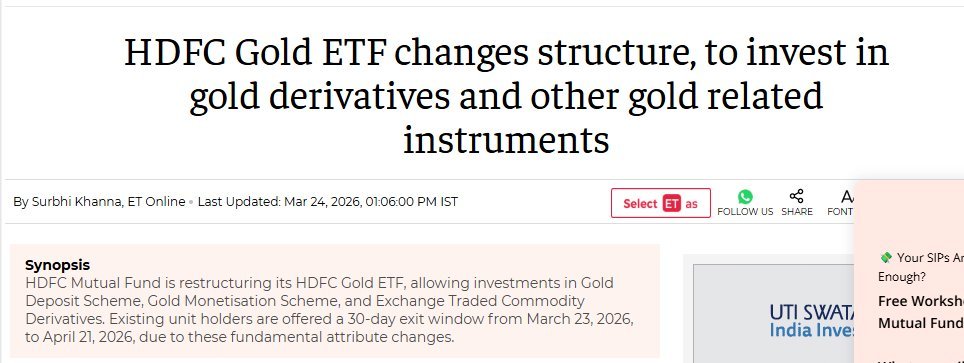
This is HDFC Asset Management Company modifying the structure of its Gold ETF.
And it matters.
From April 22, 2026, the fund is no longer restricted to being almost entirely physically backed.
It can now:
• Allocate to gold derivatives
• Use financial gold instruments (GMS, GDS, etc.)
• Introduce non-physical exposure into the portfolio
👉 With a key change:
Up to 50% of the ETF can be in non-physical gold exposure
Not mandatory, but allowed.
Let’s be clear on what just happened:
Earlier:
Gold ETF = vault gold + minimal cash
Now:
Gold ETF = vault gold + optional paper layer
That’s a structural shift.
This doesn’t mean:
❌ Physical gold is gone
❌ ETFs will instantly become 50% paper
But it DOES mean:
👉 The purity of “physical backing” is no longer guaranteed by structure
It now depends on fund manager decisions
Why this matters:
• More derivatives = potential tracking differences
• More financial exposure = counterparty & liquidity risk
• Over time = possibility of increased “paper gold” in the system
This is exactly how global gold markets evolved.
Slowly. Quietly. Then structurally.
And here’s the most important takeaway:
If you are holding Gold ETFs assuming:
“I own physical gold exposure”
You now need to verify:
• % of actual physical gold
• % of derivatives / financial instruments
• Consistency of tracking vs spot gold
Because going forward:
Not all Gold ETFs will be the same.
Not all “gold exposure” will be physical.
And the difference will matter most…
when it matters the most.
The label stays Gold ETF.
The structure is now flexible.