

akiporo yopudia
4K posts


@nakasyou0 @akiporo @nukko431 マイクラのバージョンによりますがJava版はMOD、Bedrock版は/wsコマンドなどを使ってマイクラ外からリアルタイムにワールドを操作できるので、できます!
日本語
akiporo yopudia retweetledi

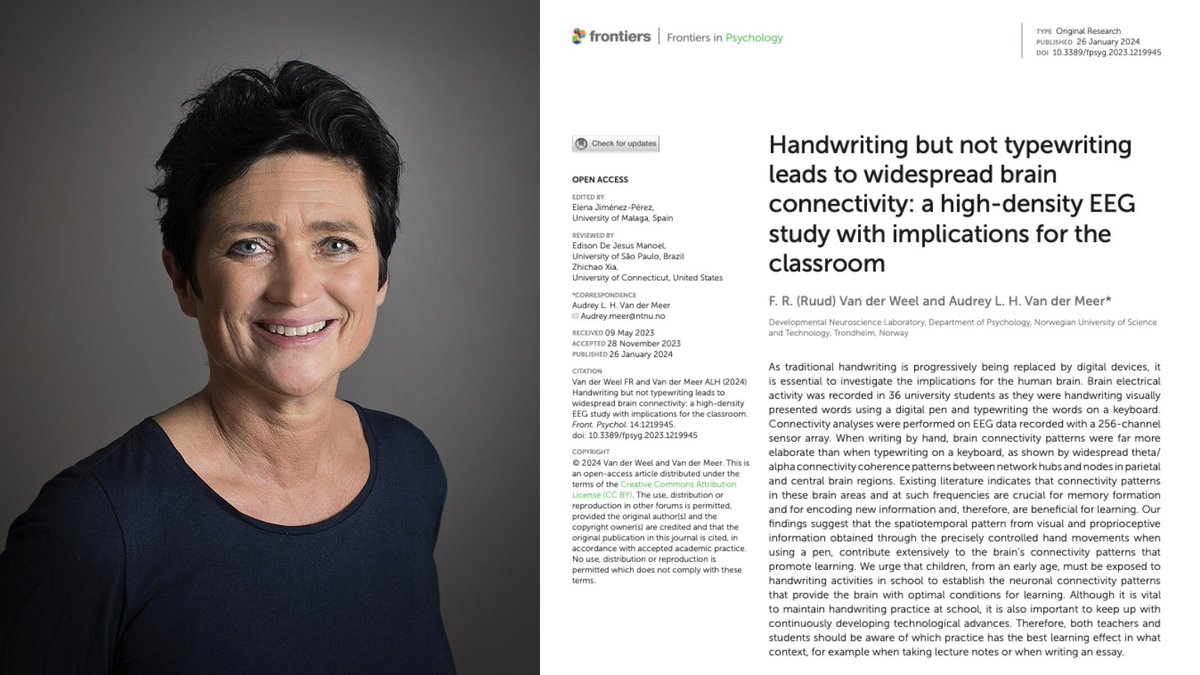
A Norwegian neuroscientist spent 20 years proving that the act of writing by hand changes the human brain in ways typing physically cannot, and almost nobody outside her field has read the paper.
Her name is Audrey van der Meer.
She runs a brain research lab in Trondheim, and the paper that closed the argument was published in 2024 in a journal called Frontiers in Psychology. The finding is brutal enough that it should have changed every classroom on Earth.
The experiment was simple. She recruited 36 university students and put each one in a cap with 256 sensors pressed against their scalp to record brain activity. Words flashed on a screen one at a time.
Sometimes the students wrote the word by hand on a touchscreen using a digital pen, and sometimes they typed the same word on a keyboard. Every neural response was recorded for the full five seconds the word stayed on screen.
Then her team looked at the part of the data most researchers had ignored for years, which is how different parts of the brain were communicating with each other during the task.
When the students wrote by hand, the brain lit up everywhere at once.
The regions responsible for memory, sensory integration, and the encoding of new information were all firing together in a coordinated pattern that spread across the entire cortex. The whole network was awake and connected.
When the same students typed the same word, that pattern collapsed almost completely.
Most of the brain went quiet, and the connections between regions that had been alive seconds earlier were nowhere to be found on the EEG.
Same word, same brain, same person, and two completely different neurological events.
The reason turned out to be something nobody had really paid attention to before her work. Writing by hand is not one motion but a sequence of thousands of tiny micro-movements coordinated with your eyes in real time, where each letter is a different shape that requires the brain to solve a slightly different spatial problem.
Your fingers, wrist, vision, and the parts of your brain that track position in space are all working together to produce one letter, then the next, then the next.
Typing throws all of that away. Every key on a keyboard requires the exact same finger motion regardless of which letter you are pressing, which means the brain has almost nothing to integrate and almost no problem to solve.
Van der Meer said it plainly in her interviews.
Pressing the same key with the same finger over and over does not stimulate the brain in any meaningful way, and she pointed out something that should scare every parent who handed their kid an iPad.
Children who learn to read and write on tablets often cannot tell letters like b and d apart, because they have never physically felt with their bodies what it takes to actually produce those letters on a page.
A decade before her, two researchers at Princeton ran the same fight using a completely different method and ended up at the same answer. Pam Mueller and Daniel Oppenheimer tested 327 students across three experiments, where half took notes on laptops with the internet disabled and half took notes by hand, before testing everyone on what they actually understood from the lectures they had watched.
The handwriting group won by a wide margin on every question that required real understanding rather than surface recall.
The reason was hiding in the transcripts of what the two groups had actually written down.
The laptop students typed almost word for word, capturing more total content but processing almost none of it as they went, while the handwriting students physically could not write fast enough to transcribe a lecture in real time, which forced them to listen carefully, decide what actually mattered, and put it in their own words on the page.
That single act of choosing what to keep was the learning itself, and the keyboard had quietly skipped the choosing and skipped the learning along with it.
Two studies. Two countries. Same answer.
Handwriting makes the brain work. Typing lets it coast.
Every note you have ever typed instead of written went into your brain through a thinner pipe. Every meeting, every book highlight, every idea you captured on your phone instead of on paper was processed at half depth.
You did not forget those things because your memory is bad. You forgot them because typing never woke the part of the brain that would have made them stick.
The fix is the thing your grandmother already knew.
Pick up a pen. Write the thing down. The slower road is the faster one.
English

@nukko431 まず、Scratch を AI に再実装させます。次に、この TypeScript で Scratch を記述するライブラリを使用して Scratch プロジェクトを編集させます
github.com/pnsk-lab/hikka…
日本語
akiporo yopudia retweetledi

❗️🚨 BREAKING: Researchers used Mythos Preview to find the first public macOS kernel memory corruption exploit on Apple's M5 silicon, they give a glimpse into Mythos say it’s really powerful.
Apple spent five years and an estimated several billion dollars building Memory Integrity Enforcement (MIE), the hardware-assisted memory safety system built around ARM's MTE. It was the flagship security feature of the M5 and A19, designed specifically to kill the entire memory corruption bug class.
Researchers from Calif built a working exploit in five days.
According to Apple's own research, MIE disrupts every public exploit chain against modern iOS, including the recently leaked Coruna and Darksword kits. Calif walked into Apple Park this week and handed over the report in person.
Full 55-page technical report drops after Apple patches the vulnerability.


English


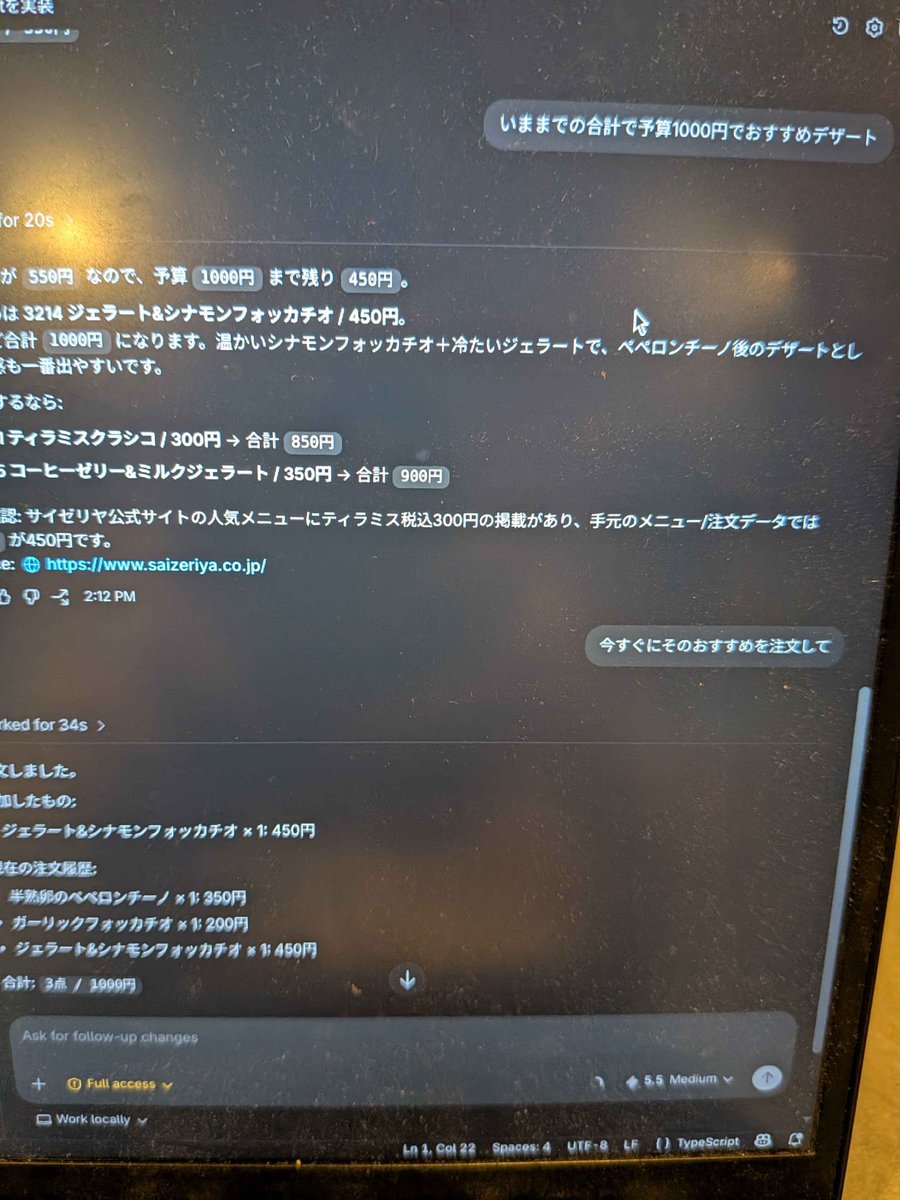
代替クライアントアプリで注文に成功したのと、サイゼリヤ cli を作ることによっておすすめデザートを Codex に注文させることに成功した!会計は代替クライアントでやった


nakasyou@nakasyou0
サイゼリヤのサードパーティークライアントができたので試しに行く
日本語
akiporo yopudia retweetledi

Because we get asked a lot.
The Technological Republic, in brief.
1. Silicon Valley owes a moral debt to the country that made its rise possible. The engineering elite of Silicon Valley has an affirmative obligation to participate in the defense of the nation.
2. We must rebel against the tyranny of the apps. Is the iPhone our greatest creative if not crowning achievement as a civilization? The object has changed our lives, but it may also now be limiting and constraining our sense of the possible.
3. Free email is not enough. The decadence of a culture or civilization, and indeed its ruling class, will be forgiven only if that culture is capable of delivering economic growth and security for the public.
4. The limits of soft power, of soaring rhetoric alone, have been exposed. The ability of free and democratic societies to prevail requires something more than moral appeal. It requires hard power, and hard power in this century will be built on software.
5. The question is not whether A.I. weapons will be built; it is who will build them and for what purpose. Our adversaries will not pause to indulge in theatrical debates about the merits of developing technologies with critical military and national security applications. They will proceed.
6. National service should be a universal duty. We should, as a society, seriously consider moving away from an all-volunteer force and only fight the next war if everyone shares in the risk and the cost.
7. If a U.S. Marine asks for a better rifle, we should build it; and the same goes for software. We should as a country be capable of continuing a debate about the appropriateness of military action abroad while remaining unflinching in our commitment to those we have asked to step into harm’s way.
8. Public servants need not be our priests. Any business that compensated its employees in the way that the federal government compensates public servants would struggle to survive.
9. We should show far more grace towards those who have subjected themselves to public life. The eradication of any space for forgiveness—a jettisoning of any tolerance for the complexities and contradictions of the human psyche—may leave us with a cast of characters at the helm we will grow to regret.
10. The psychologization of modern politics is leading us astray. Those who look to the political arena to nourish their soul and sense of self, who rely too heavily on their internal life finding expression in people they may never meet, will be left disappointed.
11. Our society has grown too eager to hasten, and is often gleeful at, the demise of its enemies. The vanquishing of an opponent is a moment to pause, not rejoice.
12. The atomic age is ending. One age of deterrence, the atomic age, is ending, and a new era of deterrence built on A.I. is set to begin.
13. No other country in the history of the world has advanced progressive values more than this one. The United States is far from perfect. But it is easy to forget how much more opportunity exists in this country for those who are not hereditary elites than in any other nation on the planet.
14. American power has made possible an extraordinarily long peace. Too many have forgotten or perhaps take for granted that nearly a century of some version of peace has prevailed in the world without a great power military conflict. At least three generations — billions of people and their children and now grandchildren — have never known a world war.
15. The postwar neutering of Germany and Japan must be undone. The defanging of Germany was an overcorrection for which Europe is now paying a heavy price. A similar and highly theatrical commitment to Japanese pacifism will, if maintained, also threaten to shift the balance of power in Asia.
16. We should applaud those who attempt to build where the market has failed to act. The culture almost snickers at Musk’s interest in grand narrative, as if billionaires ought to simply stay in their lane of enriching themselves . . . . Any curiosity or genuine interest in the value of what he has created is essentially dismissed, or perhaps lurks from beneath a thinly veiled scorn.
17. Silicon Valley must play a role in addressing violent crime. Many politicians across the United States have essentially shrugged when it comes to violent crime, abandoning any serious efforts to address the problem or take on any risk with their constituencies or donors in coming up with solutions and experiments in what should be a desperate bid to save lives.
18. The ruthless exposure of the private lives of public figures drives far too much talent away from government service. The public arena—and the shallow and petty assaults against those who dare to do something other than enrich themselves—has become so unforgiving that the republic is left with a significant roster of ineffectual, empty vessels whose ambition one would forgive if there were any genuine belief structure lurking within.
19. The caution in public life that we unwittingly encourage is corrosive. Those who say nothing wrong often say nothing much at all.
20. The pervasive intolerance of religious belief in certain circles must be resisted. The elite’s intolerance of religious belief is perhaps one of the most telling signs that its political project constitutes a less open intellectual movement than many within it would claim.
21. Some cultures have produced vital advances; others remain dysfunctional and regressive. All cultures are now equal. Criticism and value judgments are forbidden. Yet this new dogma glosses over the fact that certain cultures and indeed subcultures . . . have produced wonders. Others have proven middling, and worse, regressive and harmful.
22. We must resist the shallow temptation of a vacant and hollow pluralism. We, in America and more broadly the West, have for the past half century resisted defining national cultures in the name of inclusivity. But inclusion into what?
Excerpts from the #1 New York Times Bestseller The Technological Republic: Hard Power, Soft Belief, and the Future of the West, by Alexander C. Karp & Nicholas W. Zamiska
techrepublicbook.com
English
akiporo yopudia retweetledi

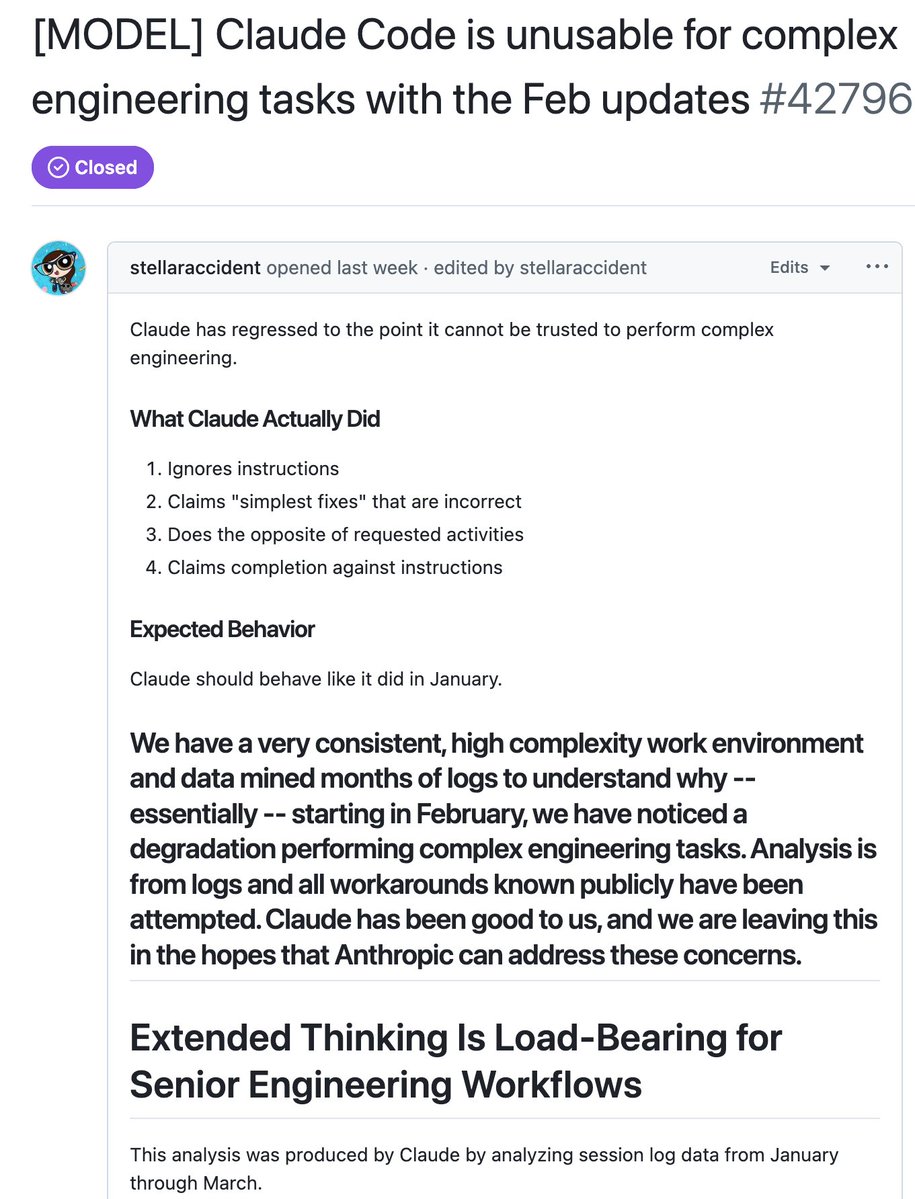
AMD Senior AI Director confirms Claude has been nerfed. She analyzed Claude's session logs from Janurary to March:
> median thinking dropped from ~2,200 to ~600 chars
> API requests went up 80x from Feb to Mar. less thinking and failed attempts meaning more retries, burning more tokens, and spending more on tokens
> reads-per-edit dropped from 6.6x → 2.0x. model stops researching code before touching it.
> model tried to bail out or ask "should i continue" 173 times in 17 days (0 times before March 8).
> self-contradiction in reasoning ("oh wait, actually...") tripled.
> conventions like CLAUDE.md get ignored because there's less thinking budget to cross-check edits
> 5pm and 7pm PST are the worst hours, late night is significantly better. this means the thinking allocation is most likely GPU-load-sensitive.
English
akiporo yopudia retweetledi

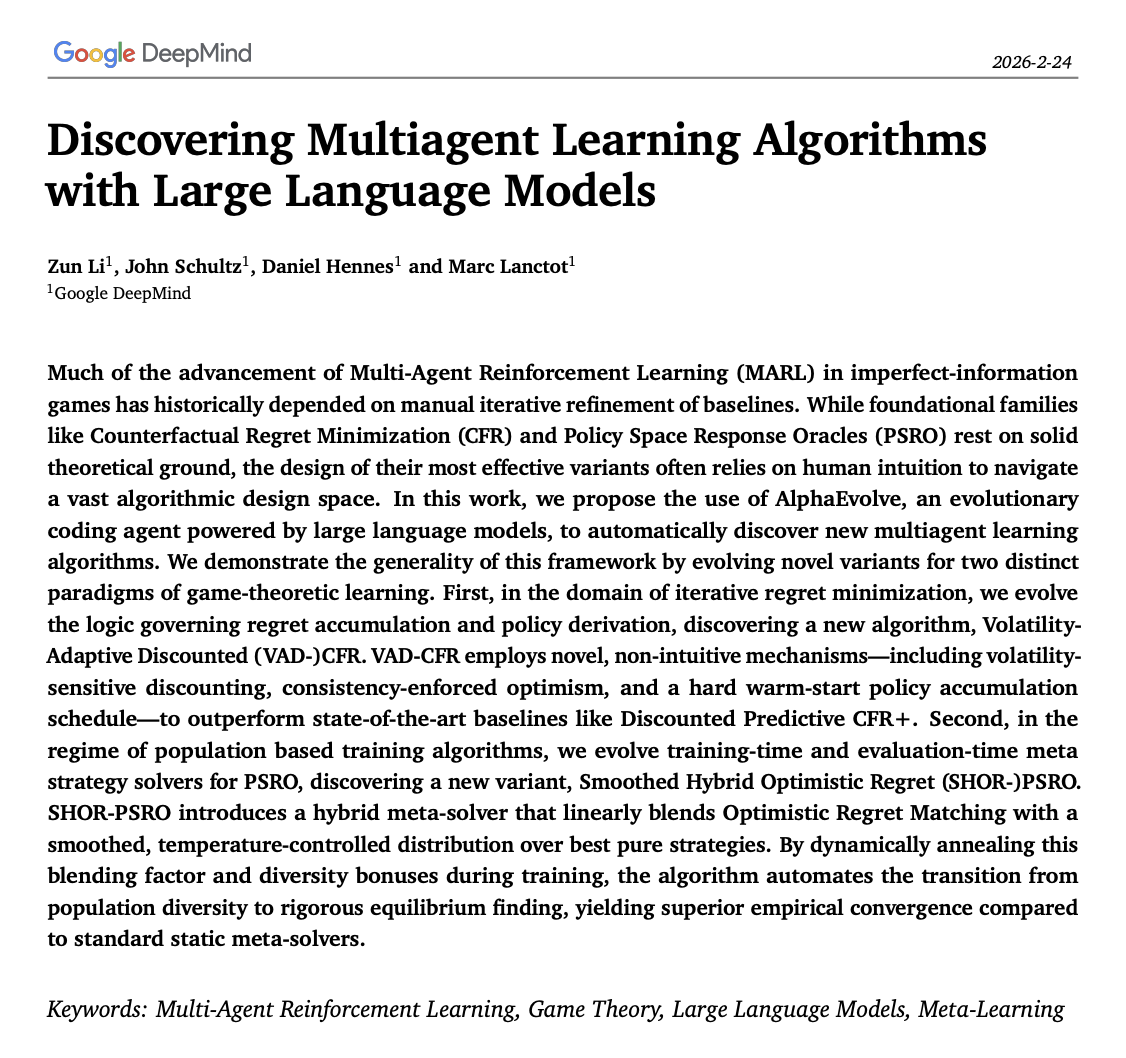
🚨 BREAKING: Google DeepMind just built an AI that writes better AI algorithms than human scientists.
And it’s evolving them entirely on its own.
In a newly published paper, they introduce AlphaEvolve. It’s a system that doesn't just tweak basic hyperparameters.. it gives an LLM access to the actual source code of complex multi-agent learning systems.
They treated the python code like a genome. and they told the AI to mutate it.
The results are staggering.
The AI invented completely novel, non-intuitive mathematical mechanisms that human researchers had never even thought of.
Here is exactly why this changes everything:
- Semantic code evolution: Old school genetic programming just threw random code mutations at a wall until something compiled. this LLM agent actually reads the existing algorithm, reasons about the logic, and writes semantically meaningful upgrades in python.
- Non-human intuition: the agent discovered new algorithms (like VAD-CFR and SHOR-PSRO) that use weird, non-intuitive mathematical mechanisms that human researchers completely missed.
- State-of-the-art results: the AI-written algorithms didn't just work.. they empirically outperformed the best human-designed baselines in complex game-theory environments.
We are officially watching recursive AI self-improvement happen live in front of us..
Human intuition used to be the bottleneck for finding algorithmic breakthroughs. Now, you just point an LLM at a codebase, give it an objective, and let it autonomously evolve the math.
English
akiporo yopudia retweetledi

Model Context Protocol (MCP) lets Gemini CLI connect to your databases, cloud services, and local files without custom integrations for every tool!
Watch this week’s livestream to see how it works → goo.gle/4aNxCf0
English
akiporo yopudia retweetledi

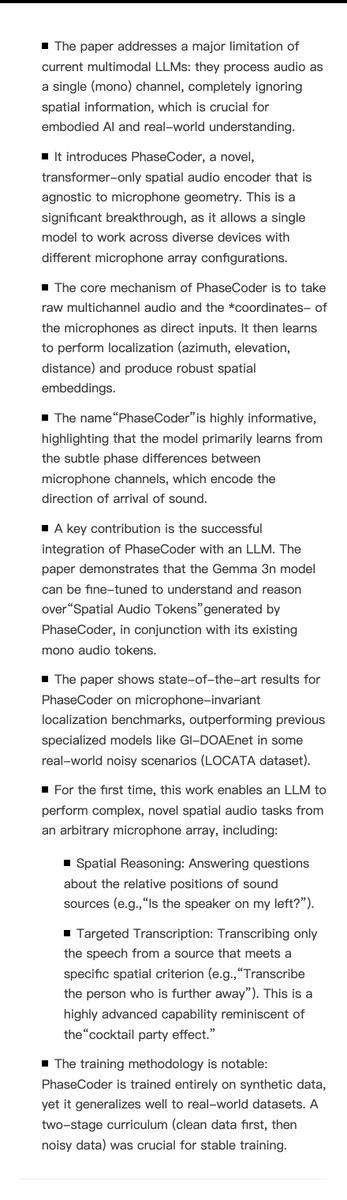
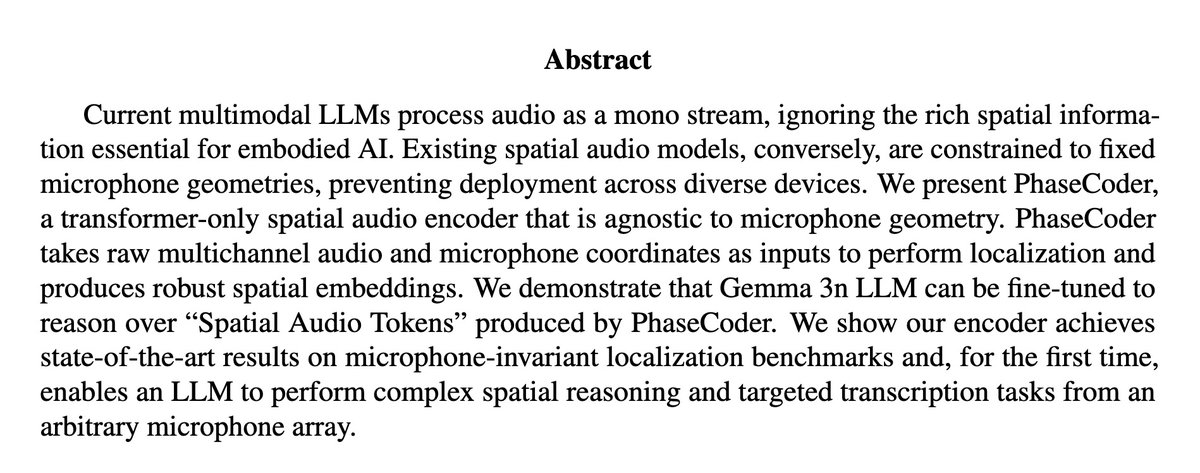
[AS] PhaseCoder: Microphone Geometry-Agnostic Spatial Audio Understanding for Multimodal LLMs
A Dementyev, W Zulfikar, S Hersek, P Getreuer... [Google DeepMind & Google AR] (2026)
arxiv.org/abs/2601.21124


English
akiporo yopudia retweetledi

akiporo yopudia retweetledi

Thrilled to launch Project Genie, an experimental prototype of the world's most advanced world model. Create entire playable worlds to explore in real-time just from a simple text prompt - kind of mindblowing really! Available to Ultra subs in the US for now - have fun exploring!
English
akiporo yopudia retweetledi

New Anthropic Research: Disempowerment patterns in real-world AI assistant interactions.
As AI becomes embedded in daily life, one risk is it can distort rather than inform—shaping beliefs, values, or actions in ways users may later regret.
Read more: anthropic.com/research/disem…
English
akiporo yopudia retweetledi

@PostgreSQL has long powered core @OpenAI products like ChatGPT and the API. Over the past year, our production load grew 10× and keeps rising. Today we run a single primary with nearly 50 read replicas in production, delivering low double-digit millisecond p99 client-side latency and five-nines availability. In our latest OpenAI Engineering blog, we unpack the optimizations we made to to scale @Azure PostgreSQL to millions of queries per second for more than 800M ChatGPT users. Check out the full post here: openai.com/index/scaling-…
English

I still haven't gotten used to having to use /clear in the part number. #claudecode
English