Ekram

3K posts

Ekram banner
Ekram

Ekram

@alelahee

Incoming @xAI | prev - eval research @ Edison Scientific

San Francisco, CA Katılım Kasım 2016
7.5K Takip Edilen743 Takipçiler
Ekram retweetledi
Matthew Dabit
Matthew Dabit@MattDabit·
The roadmap at @xai has me fired up. The internal things I've been enjoying are on another level. The team is always iterating. #Grok #xAI #wewillwin
English
33
13
401
9.1K
Ekram
Ekram@alelahee·
@vrn21_ CFBR. Small feedback, your resume should not exceed 2 page at all. Best of Luck!
English
2
0
7
4.1K
K V Varun Krishnan
K V Varun Krishnan@vrn21_·
I just got laid off — apparently working 7pm to 7am still wasn’t enough. Times haven’t been great lately, but every reset sharpens the stack I've previously built rl envs + infra at Verita and hud (YC W25) stacks: Python, Rust, TS, Docker, AWS DM if you want an engineer who delivers! #buildinpublic #ycombinator #yc
English
46
21
392
57.1K
Kasif
Kasif@md_kasif_uddin·
Who do you think will win the AI race ?
Kasif tweet media
English
248
16
371
37.9K
Andrew M. Dai
Andrew M. Dai@AndrewDai·
After almost 12 years in Brain/DeepMind, I’ve finally decided to take the leap. My cofounders: @yinfeiy, Seth and I have kicked-off @ElorianAI. The first multimodal reasoning lab founded and led by former LLM pretraining, data and multimodal leads. youtu.be/YlvfNpOMeOY?si… (1/n)
YouTube video
YouTube
English
82
76
808
341.4K
Ekram retweetledi
Ao Qu
Ao Qu@ao_qu18465·
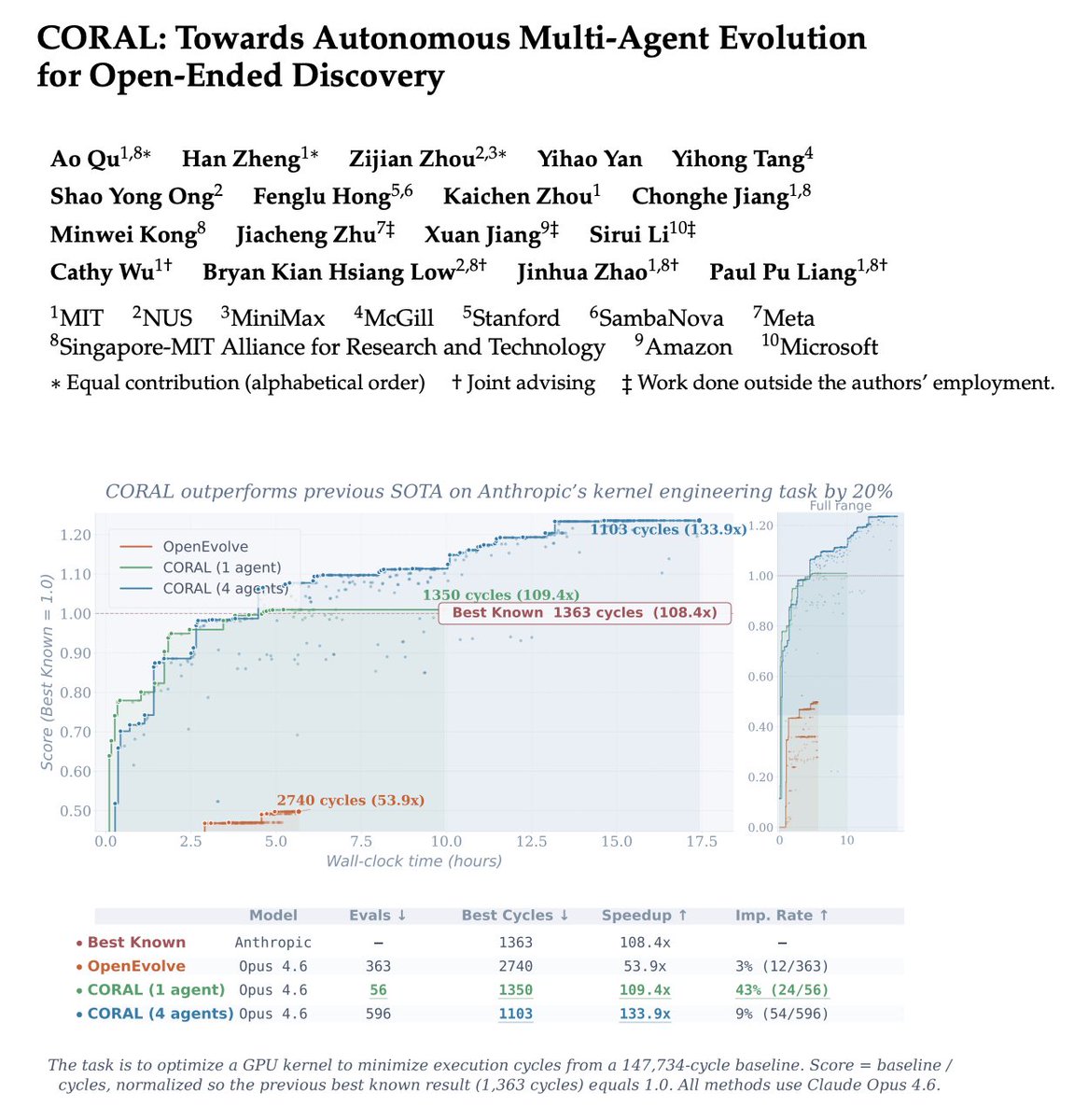
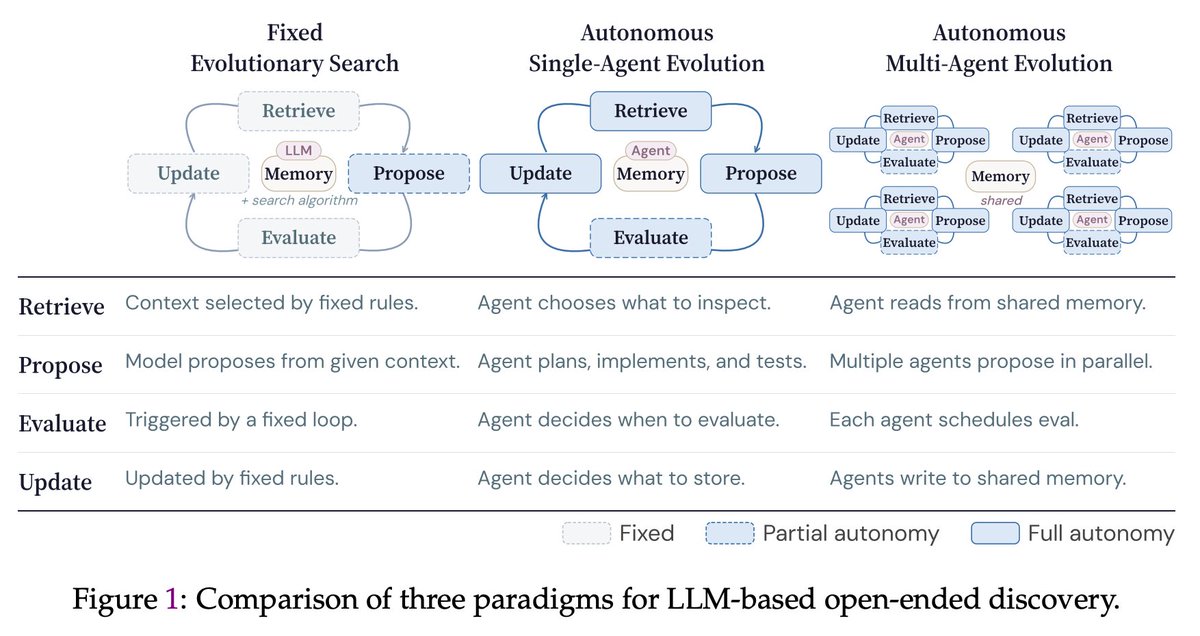
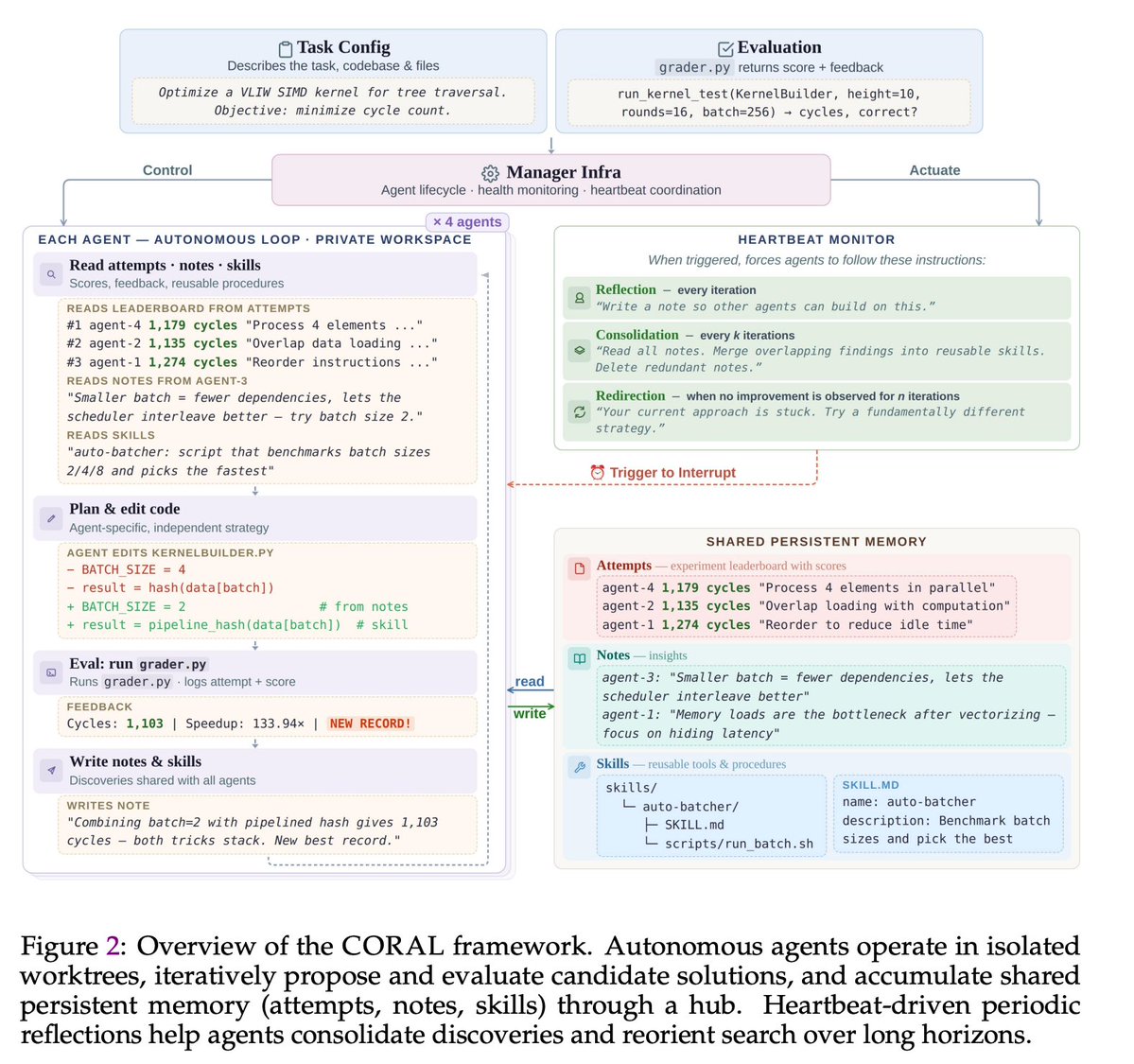
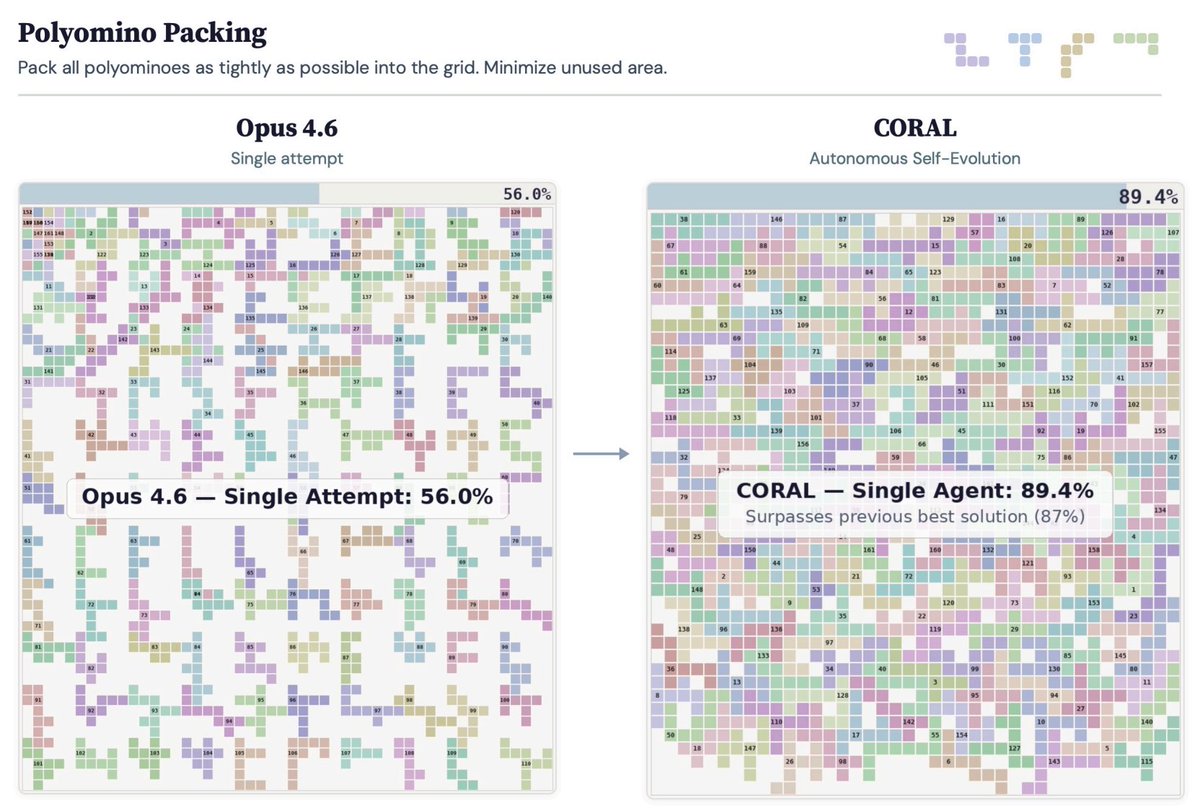
🚀 The era of autonomous multi-agent discovery has begun. Most “self-evolving” scientific discovery frameworks are still tightly constrained: LLMs often just perform one-step mutations inside fixed evolutionary search loops. But that is not real autonomy. Agents still cannot truly decide: 🔍 what to explore 🧠 what knowledge to store ♻️ which past attempts to reuse 🧪 when to test With CORAL, we ask: ❓ What happens if we give agents much more autonomy to explore the scientific frontier? 💡 Our answer: A single autonomous agent already outperforms fixed evolutionary search. But the bigger leap comes when multiple autonomous agents form a research community: 🤝 They explore different directions 🧠 accumulate reusable knowledge and skills 💬 communicate with each other 🌍 and push the frontier together We introduce CORAL, the first framework for autonomous multi-agent evolution for open-ended discovery. 🥇 Across 10+ tasks in algorithmic discovery, system optimization, and kernel engineering from Frontier-CS, ADRS, AlphaEvolve, etc, CORAL achieves SOTA and improves search efficiency by 3–10× over prior fixed evolutionary-search frameworks. 🔬 Why does autonomy help? Our analysis shows two main reasons: 🧪 Local verification: agents run local tests before expensive evaluations, which is especially powerful for coding tasks. ♻️ Knowledge reuse: on knowledge-intensive tasks like polyominoes and kernel engineering, agents create and reuse knowledge artifacts at far higher rates than on simple tuning/search tasks like circle packing. ✨ Even more exciting: Over 50% of multi-agent breakthroughs come from building on other agents’ discoveries. Multi-agent exploration is also far more diverse than single-agent search. We believe CORAL opens up an exciting new space for automated discovery systems. 📬 If you are interested in collaborating, let’s talk. 📄 Paper: arxiv.org/abs/2604.01658… 💻 Code: github.com/Human-Agent-So… 💡AlphaXiv: alphaxiv.org/abs/2604.01658 #agentic #llms #selfevolvingagent #multiagent #autoresearch #alphaevolve
Ao Qu tweet mediaAo Qu tweet mediaAo Qu tweet mediaAo Qu tweet media
English
17
74
458
38.5K
Ekram retweetledi
Michael Hla
Michael Hla@hla_michael·
I trained an LLM from scratch on pre-1900 text to see if it could come up with quantum mechanics and relativity. While the model is too small to do meaningful reasoning, it has glimpses of intuition. When given observations from past landmark experiments, the model can declare that “light is made up of definite quantities of energy” and even suggest that gravity and acceleration are locally equivalent. I’m releasing the dataset + models and leave this as an open problem to the research community. I also include what this project has taught me about intelligence in a mini essay linked below. 🧵(1/n)
English
116
260
2K
306.7K
Ching-An Cheng
Ching-An Cheng@chinganc_rl·
Looking for Google research student researcher (PhD student) to work on LLM and agent related learning. Preferred background: RL/game theory, agentic system, LLM training. Candidate will work closely with me and @allenainie Email me if you are interested. 😀
English
12
27
279
49.2K
Ekram
Ekram@alelahee·
At least six previous works, ranging from Highway Networks 2015 to DeepCrossAttention and MUDDFormer (early 2025), have investigated the fundamental concept—replacing fixed residual accumulation with learned, input-dependent aggregation of previous layer outputs. In 2023, MRLA introduced the particular application of query-based cross-layer attention retrieval. and MUDDFormer described depth-wise dynamic aggregation as depth-wise self-attention.Although the high-level framing ("Introducing Attention Residuals") somewhat overstates the novelty of the underlying principle, the paper's transparency regarding its related work is praiseworthy.
English
0
0
0
43
Ali Behrouz
Ali Behrouz@behrouz_ali·
This paper is the same as the DeepCrossAttention (DCA) method from more than a year ago: arxiv.org/abs/2502.06785. As far as I understood, here there is no innovation to be excited about, and yet surprisingly there is no citation and discussion about DCA! The level of redundancy in LLM research and then the hype on X is getting worse and worse! DeepCrossAttention is built based on the intuition that depth-wise cross-attention allows for richer interactions between layers at different depths. DCA further provides both empirical and theoretical results to support this approach.
Kimi.ai@Kimi_Moonshot

Introducing 𝑨𝒕𝒕𝒆𝒏𝒕𝒊𝒐𝒏 𝑹𝒆𝒔𝒊𝒅𝒖𝒂𝒍𝒔: Rethinking depth-wise aggregation. Residual connections have long relied on fixed, uniform accumulation. Inspired by the duality of time and depth, we introduce Attention Residuals, replacing standard depth-wise recurrence with learned, input-dependent attention over preceding layers. 🔹 Enables networks to selectively retrieve past representations, naturally mitigating dilution and hidden-state growth. 🔹 Introduces Block AttnRes, partitioning layers into compressed blocks to make cross-layer attention practical at scale. 🔹 Serves as an efficient drop-in replacement, demonstrating a 1.25x compute advantage with negligible (<2%) inference latency overhead. 🔹 Validated on the Kimi Linear architecture (48B total, 3B activated parameters), delivering consistent downstream performance gains. 🔗Full report: github.com/MoonshotAI/Att…

English
34
92
1K
226.4K
Ekram
Ekram@alelahee·
At least six previous works, ranging from Highway Networks 2015 to DeepCrossAttention and MUDDFormer (early 2025), have investigated the fundamental concept—replacing fixed residual accumulation with learned, input-dependent aggregation of previous layer outputs. In 2023, MRLA introduced the particular application of query-based cross-layer attention retrieval. and MUDDFormer described depth-wise dynamic aggregation as depth-wise self-attention.Although the high-level framing ("Introducing Attention Residuals") somewhat overstates the novelty of the underlying principle, the paper's transparency regarding its related work is praiseworthy.
Ali Behrouz@behrouz_ali

This paper is the same as the DeepCrossAttention (DCA) method from more than a year ago: arxiv.org/abs/2502.06785. As far as I understood, here there is no innovation to be excited about, and yet surprisingly there is no citation and discussion about DCA! The level of redundancy in LLM research and then the hype on X is getting worse and worse! DeepCrossAttention is built based on the intuition that depth-wise cross-attention allows for richer interactions between layers at different depths. DCA further provides both empirical and theoretical results to support this approach.


English
0
0
0
243
ellen livia ᯅ 🇺🇸🇮🇩
Starting an AI Researcher group chat. The space is growing fast! Comment “literature review” to join.
English
862
28
748
57.9K
Josh Woodward
Josh Woodward@joshwoodward·
I've been at @Google since I was an intern, and there's never been a more exciting time. The place is pulsating. We're hiring :) @GeminiApp or @GoogleAIStudio: goo.gle/applyhere @GoogleLabs: goo.gle/googlelabsjobs
News from Google@NewsFromGoogle

Google was just named #1 in the @FastCompany 2026 World’s Most Innovative Companies list. 🎉 Google is also ranked #1 in their Artificial Intelligence category. See the full story. fastcompany.com/most-innovativ…

English
100
130
1.9K
335.9K
Ekram
Ekram@alelahee·
@ashertrockman Hi I’m currently on Google Student Researcher team matching loop. I’m super interested. DMed.
English
0
0
1
881
Adithya S K
Adithya S K@adithya_s_k·
I will be giving a talk at @lossfunk this Friday, Feb 6 evening Will be talking about Building frontier multimodal multilingual models > How we are tackling this at @cognitivelab_ai using synthetic data > How we trained our latest model (Netraemebd) to hit SOTA > What actually worked on real world data vs benchmarks > How we optimized research and ablation workflows with Claude Code on limited compute making the whole process to be as efficient as possible (ps : our data, training and eval pipelines are set up in a way I can prompt on my phone to start a new training ablation run) So if you are in bangalore and are interested in the topic do register, would love to connect after the talk as well luma.com/l6g02w9g
English
8
8
179
13.2K
Ekram
Ekram@alelahee·
Hey @TheGregYang during the school in a research project we built world largest tick/lyme disease related semantic search engine around ~100-200k papers abstract . Just in case if you want to know about anything about tick/lyme diseases here is the link : data.tickbase.net
English
0
0
2
92
Greg Yang
Greg Yang@TheGregYang·
spiderman started with a spider bite guess I'm the tickman now
English
41
6
412
13.2K
Ekram retweetledi
Andrew Côté
Andrew Côté@Andercot·
It just seems implausible this is what we are made of, essentially, nanotechnology about a billion years beyond anything we can design or make ourselves.
English
1.7K
6.7K
53.4K
8.6M
Logan Kilpatrick
Logan Kilpatrick@OfficialLoganK·
I am hiring a couple of interns to join the Google AI Studio team across product, AI eng, vibe coding, developer experience, etc. Send me a DM with things you have built if you’re interested!
English
412
284
5.6K
478.8K
Ayush Jaiswal
Ayush Jaiswal@ayushjaiswal·
🚨 We're hiring native language speakers to mentor Grok Helping AI to learn our language better is a very fulfilling thing to do. We're currently looking to onboard native speakers of the following languages: → Russian → Arabic → Mandarin → Indonesian → Hindi → Bengali If you know nothing about training the models, this is one of the most incredible ways to learn about AI. At the same time, help Grok sound like your neighbour. If you're interested, you can sign up using the link here: form.typeform.com/to/CVPbVkxw
English
375
284
2.7K
495.5K
Ekram retweetledi
Sam Rodriques
Sam Rodriques@SGRodriques·
Science is too slow. At Edison, we are integrating AI Scientists into the full stack of research, from basic discovery to clinical trials. We want cures for all diseases by mid-century. We have raised a $70M seed to get started. Join us. We need cracked software engineers who want to work on finding cures rather than selling ads and generating slop. If you’re reading this, you’re probably a candidate. We need brilliant AI researchers who want to figure out how AI will accelerate real-world science. We need scientists and researchers with deep expertise in biology, biotech, and pharma who want to figure out how to integrate AI deeply into scientific workflows, from ideation to experimentation, and how to measure success or failure. We need extraordinarily talented generalist operators across BD, sales, product management, and partnerships who can focus on getting our tools into the hands of pharmaceutical companies. If any of these roles sound like you, get in touch. We are also expanding access to our platform. Our goal is to accelerate science writ large. To that end, we will continue to give academics and students 650 credits/mo indefinitely. I can’t promise we’ll keep this up forever, but we will try. Kosmos will still cost 200 credits, and the other agents (Analysis, Literature, etc.) will cost 1 or 2 credits. All paid users will have access to our regular agents, like our Analysis agent, Literature agent, and so on, for free via the UI. API access will still be paid, and users without a paid subscription will continue to get 10 credits per month for those agents. Our $200/mo subscription for 650 credits/mo is staying in place for now, but might be phased out at our next major product update. Along the lines of accelerating science, we’re also doing a major release of PaperQA today, our flagship open source literature agent, as part of our commitment to open science. In the short run, expect major improvements to Kosmos, including the ability to automatically access data, the ability to steer its exploration, and the ability to converse directly with its world model. In the long run, expect exponentially increasing rates of scientific discoveries, in biology and elsewhere. Our round is led by Triatomic Capital, Spark Capital, and a major US institutional biotech investor. We are also joined in this round by existing investors Pillar VC and Susa Ventures, two exceptional early-stage funds who backed us at founding, along with Striker Venture Partners, Hawktail VC, Olive VC, and a host of exceptional angels that includes famous AI researchers, the CEOs of multiple frontier AI labs, and leadership of major biotech and pharma companies.
Sam Rodriques tweet media
English
133
171
1.5K
242K