
Alex Michael

1.3K posts

Alex Michael banner
Alex Michael

Alex Michael

@alexgmichael

writes @ A Questionable Life guests and partnerships @ How I Write podcast co-founder @ NoKnot Lacrosse 2x Askew Elementary Spelling Bee champ

Katılım Ekim 2011
258 Takip Edilen437 Takipçiler
Alex Michael retweetledi

David Perell
David Perell@david_perell·
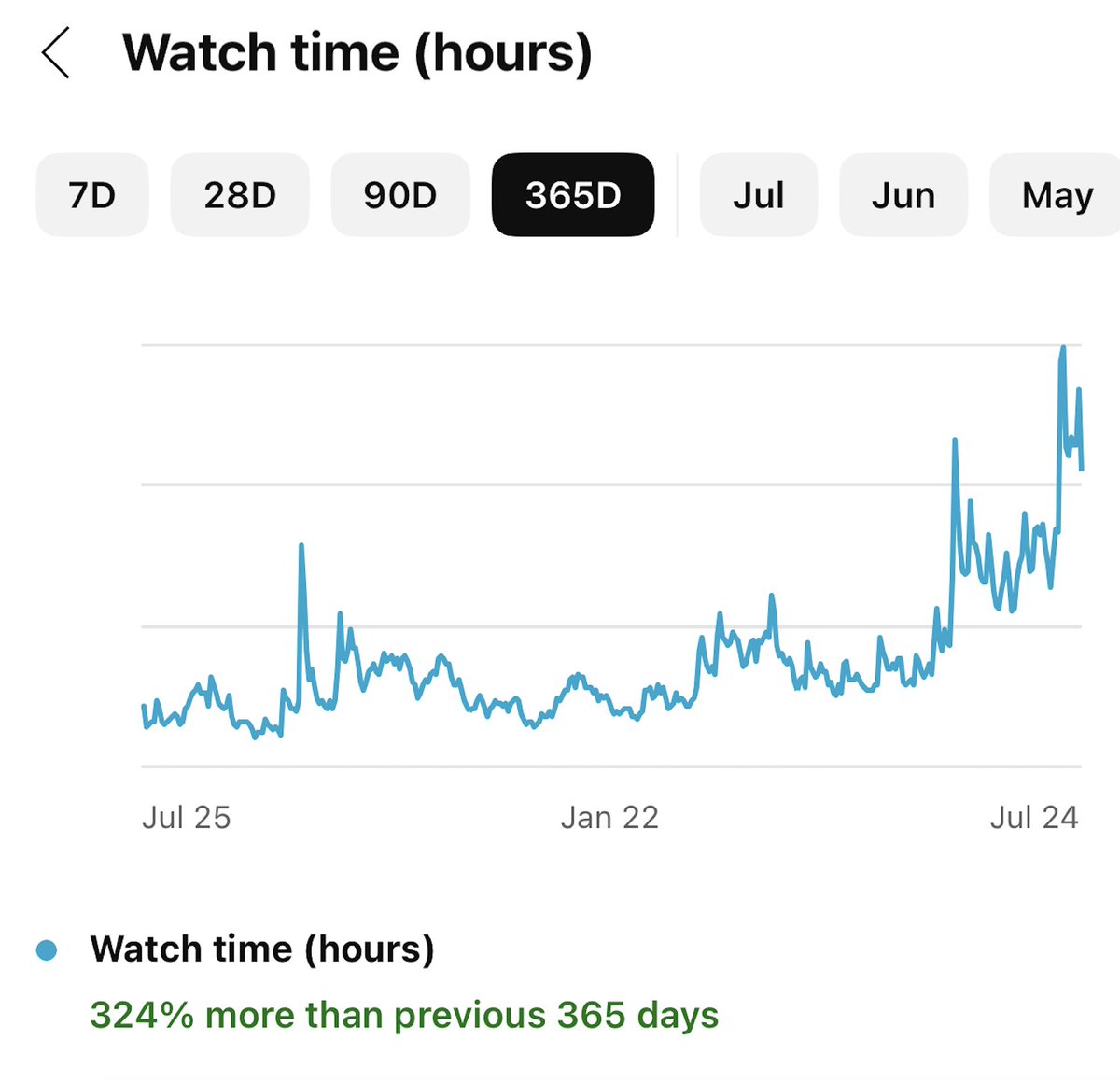
I have one sponsorship spot left for my show! The ideal partner wants to work together long-term and get consistent exposure to an insanely high-value audience (57% say they make purchasing decisions for their company, and 34% are current, former, or aspiring startup founders). The show continues to grow like crazy (watch time is up 256% year-over-year!) If you’re interested, email me at hello@perell.com.
David Perell@david_perell

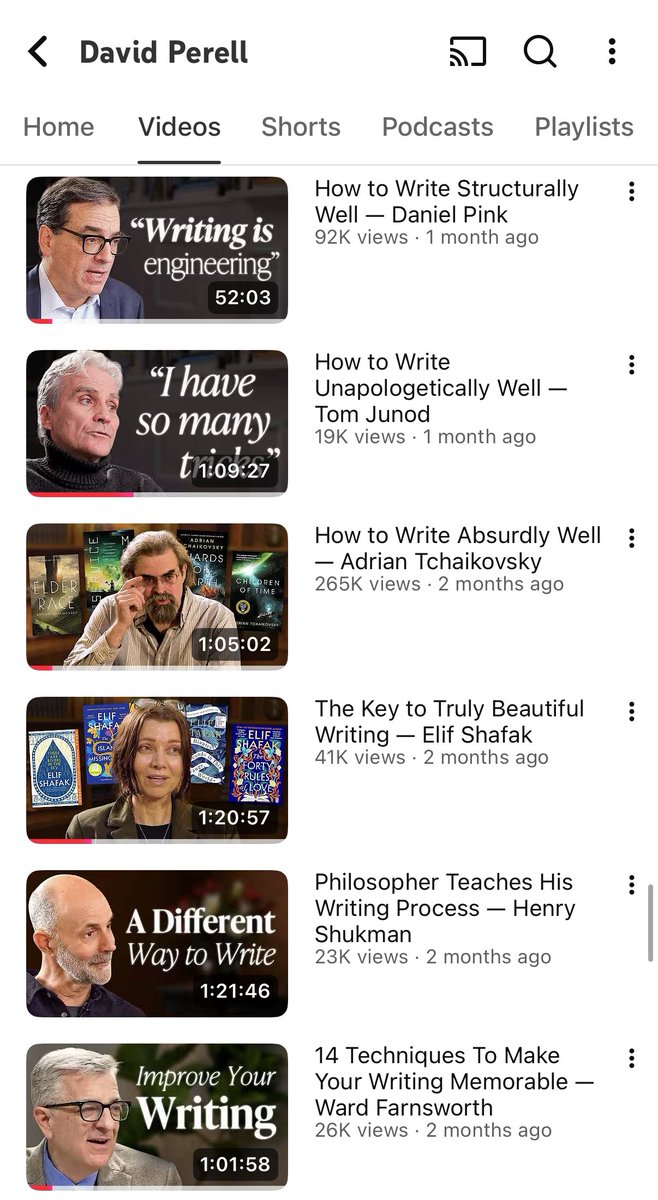
How I Write has hit the exponential growth curve, so it's time to start having sponsors. A few of our recent episodes have hit more than 100,000 views on YouTube and the guest quality is still on the up-and-up. If you want to sponsor it, shoot me an email: hello@perell.com What's unique about How I Write is the kinds of people you'd reach. To the best of my knowledge, it's the world's largest writing-focused interview show and it obviously attracts people who are serious about the craft of writing. If that's your jam, reach out to me!

English
3
5
28
8.7K
Alex Michael retweetledi
David Perell
David Perell@david_perell·
How I Write's been on an exponential growth curve over the past few months, which has me thinking about where to take the show. Instead of riffing on these things solo, I want to hear from you. So I've created a place where you can tell me how you want How I Write to evolve. Who should I interview? Should I focus on tactical interviews or philosophical ones? My team and I are meeting next week to jam on what's next, and if you want to have a say in that conversation, this is the best way to do that. Here's the link: form.typeform.com/to/cnu5gUqM
David Perell tweet mediaDavid Perell tweet media
English
23
7
109
12.9K
David Perell
David Perell@david_perell·
How I Write costs a small fortune to run, and Mercury made it possible for me to fly to London to record this interview in-person. I'll be honest: I hate Business Stuff, and when I started doing the show, just the thought of dealing with Bank Stuff filled me with dread. But Mercury's made it easy. Their platform is intuitive while also feeling secure, and they have all kinds of little features that've made running a global team way less painful than I thought it'd be. They're worth a look if you run a digitally-native business.
English
4
1
18
6.5K
David Perell
David Perell@david_perell·
Bill Browder has the craziest life story of anybody I've interviewed so far. He wrote a book called Red Notice, which was literally everywhere a decade ago. His story begins in the mid-90s, when he saw an opportunity to invest in Russia after the fall of communism. He raised $25 million, and in the next 18 months, he'd turned that initial pool of capital into more than $1 billion. Fast forward ten years. He's just landed in Moscow on a flight from London. It's his 261st time making the trip, and he gets detained in the airport. Why? He doesn't know. But he's scared, so he liquidates his assets in Russia and scrambles to get his people out of the country. Then he hires an investigator to look into it, who digs and digs until he's eventually captured, imprisoned, and ultimately killed. In response, Bill stops being an investor and shifts his attention to avenging this wrong. That's the backstory for Red Notice, and this conversation is all about how he wrote the book. Timestamps: 2:49 How to write a page turner 8:43 Bill's writing outlines 23:01 Why write books? 28:45 Bringing a place to life 34:15 Finding the truth 41:02 Writing a cliffhanger 46:22 What makes for a good ending? I've shared the full conversation below. If you'd rather watch on YouTube, or listen on Apple / Spotify, check out the reply links.
English
26
34
237
54.7K
Alex Michael retweetledi
Jason Fried
Jason Fried@jasonfried·
THE BIG REGRESSION My folks are in town visiting us for a couple months so we rented them a house nearby. It’s new construction. No one has lived in it yet. It’s amped up with state of the art systems. The ones with touchscreens of various sizes, IoT appliances, and interfaces that try too hard. And it’s terrible. What a regression. The lights are powered by Control4. And require a demo to understand how to use the switches, understand which ones control what, and to be sure not to hit THAT ONE because it’ll turn off all the lights in the house when you didn’t mean to. Worse. The TV is the latest Samsung which has a baffling UI just to watch CNN. My parents aren’t idiots, but definitely feel like they’re missing something obvious. They aren’t — TVs have simply gotten worse. You don’t turn them on anymore, you boot them up. The Miele dishwasher is hidden flush with the counters. That part is fine, but here’s what isn’t: It wouldn’t even operate the first time without connecting it to an app. This meant another call to the house manager to have them install an app they didn’t know they needed either. An app to clean some peanut butter off a plate? For serious? Worse. Thermostats... Nest would have been an upgrade, but these other propriety ones from some other company trying to be nest-like are baffling. Round touchscreens that take you into a dark labyrinth of options just to be sure it’s set at 68. Or is it 68 now? Or is that what we want it at, but it’s at 72? Wait... What? Which number is this? Worse. The alarm system is essentially a 10” iPad bolted to the wall that has the fucking weather forecast on it. And it’s bright! I’m sure there’s a way to turn that off, but then the screen would be so barren that it would be filled with the news instead. Why can’t the alarm panel just be an alarm panel? Worse. And the lag. Lag everywhere. Everything feels a beat or two behind. Everything. Lag is the giveaway that the system is working too hard for too little. Real-time must be the hardest problem. Now look... I’m no luddite. But this experience is close to conversion therapy. Tech can make things better, but I simply can’t see in these cases. I’ve heard the pitches too — you can set up scenes and one button can change EVERYTHING. Not buying it. It actually feels primitive, like we haven’t figured out how to make things easy yet. That some breakthrough will eventually come when you can simply knock a switch up or down and it’ll all makes sense. But that's at least 20 years down the road. It’s really the contrast that makes it alarming. We just got back from a vacation in Montana. Rented a house there. They did have a fancy TV — seems those can’t be avoided these days — but everything else was old school and clear. Physical up/down light switches in the right places. Appliances without the internet. Buttons with depth and physically-confirmed state change rather than surfaces that don’t obviously register your choice. More traditional round rotating Honeywell thermostats that are just clear and obvious. No tours, no instructions, no questions, no fearing you’re going to do something wrong, no wondering how something works. Useful and universally clear. That’s human, that’s modern.
English
582
834
8.5K
1.7M
Alex Michael retweetledi
Golden State Warriors
Golden State Warriors@warriors·
From undrafted to undeniable. Pat Spencer's story is just getting started 👏
English
59
384
4.7K
203.3K
Alex Michael retweetledi
David Perell
David Perell@david_perell·
Update: We've brought on a few killer sponsors and are looking for one last one to fill our roster. How I Write continues to grow, and we have some insane guests lined up in the coming months. Send me an email or DM if you think there’s a fit. hello@perell.com
David Perell@david_perell

How I Write has hit the exponential growth curve, so it's time to start having sponsors. A few of our recent episodes have hit more than 100,000 views on YouTube and the guest quality is still on the up-and-up. If you want to sponsor it, shoot me an email: hello@perell.com What's unique about How I Write is the kinds of people you'd reach. To the best of my knowledge, it's the world's largest writing-focused interview show and it obviously attracts people who are serious about the craft of writing. If that's your jam, reach out to me!

English
7
6
85
28.4K
Alex Michael retweetledi
The Cultural Tutor
The Cultural Tutor@culturaltutor·
I’ve made a short film. Look at the things around you: doors, bins, staircases, furniture, railings, doorhandles, windows. Do you like how they look, or not? Modern design has become boring, but it doesn’t have to be this way. The word “beautiful” is overused. We don’t need “beautiful” lamps, bus stops, and water fountains – we just need lamps, bus stops, and water fountains that are interesting, that actually mean something. Or, at the very least, not boring. Because the aesthetics of architecture and urban design aren’t just a bonus; they totally change how we think, feel, and behave. Boring environments make us more stressed and less productive; they erode our sense of community; they make us sadder, less trusting, and lonelier. A boring world is one where we spend even more time online and where our addictions are even harder to battle. The Problem There is global, widespread dissatisfaction with how the world looks. In this film, and the series it will lead to, we want to investigate that feeling and give it a voice. The point isn’t that we should return to the past or get rid of modernism. It’s about learning from the past in order to improve the present, and about giving the public what they very clearly want, which isn’t the eradication of modernism but the co-existence of modernism AND traditionalism. Just look where tourists go, where they take their photos, and that tells you everything you need to know about what most people find interesting or beautiful. And look at where people go on holiday. It’s always to cities filled with old architecture and design, with churches and mosques and palaces, with charming little alleyways and stone staircases and wrought-iron railings. Of the world’s fifty most visited buildings, only four were made in the 20th century, and they’re all museums or memorials. There’s a reason why posts about this go viral online all the time. Regardless of why the change happened, it is clearly the case that we no longer make things how we used to. People are rightly confused by the fact that old lamp posts (to take the example we focus on in the film) are usually so pretty, while modern ones are usually so boring. Some people say this is just an example of survivorship bias… and they’re mostly correct. But that’s the whole point! Saying old buildings are usually prettier than modern buildings is not to say that architecture used to be better, or that the past was better. It is simply to say that certain kinds of buildings, because they have been preserved, are good examples of what people like most. In which case... shouldn't we try to design at least some buildings in a way that we know people like? A Unifying Cause Everybody, from all sides of the political spectrum and all backgrounds, stands to benefit from a world that is designed more thoughtfully and imaginatively. The world could be such a colourful, meaningful, and thrilling place! So this isn’t about left versus right or conservatism versus progressivism; it’s about making our world a more interesting and meaningful place to live in. This should be a unifying cause, because everybody loses out when our homes and cities are badly designed. I want this film to unite people who think they’re on opposite sides, and to create a consensus that we need to change our approach to how we design our buildings and the objects – benches, bus stops, bins, lamp posts, aircon units – that fill our cities. The Importance of Details We are incredibly rich and have a sprawling choice of shows to stream, phones to buy, or shoes to wear… but everything feels more and more generic all the time. If you want to understand a society, don’t listen to what it says about itself – look at what it creates. You can learn everything about the Victorians – the good and the bad – just by looking at their lamp posts. And what do the ordinary details of the modern world say about us? That we are technologically advanced, very efficient… and care more about making money, about making things as quickly and cheaply as possible, than making our world an enjoyable place to actually live in. It’s important to learn about why and how things have changed, but that’s for another time. The first step is establishing that the public aren’t happy with modern architecture and design, and that something needs to be done. But what we need isn’t a total revival of so-called ‘traditionalism’; the truth is that traditionalism and modernism can (and should) co-exist. The trouble right now is that we only have one, and that people are tired of it. The Power of Noticing But this film (and the series it will, all being well, lead to) is about more than the specific argument it presents. Above all it’s about a way of seeing the world around us, a way of noticing and thinking. “How you do anything is how you do everything.” That is probably true, and it also applies to whole societies, not just individuals; a single doorbell implies everything else about the whole socio-economic and political system that gave rise to its creation. And, beyond being merely “useful”, the ability to notice details makes the world a richer place to live in, and life a richer thing to lead. This is what the film is about, more than anything: the power and joy of noticing. A Bigger Project This short film is just the beginning. We want to make a full series about the history of art and architecture, both for their own sake and also to see what we can learn about life in the twenty-first century and how to improve it. To keep updated you can join our email list over at our website, linked in the reply below. Final Words You can watch the film here on X, or over on YouTube, also linked in the reply below. So… this is where the dream begins, the dream of a new series and the dream of a more charming, more interesting, more meaningful modern world. Spread the word.
English
337
1.2K
7.6K
2.7M
Alex Michael retweetledi
Chairman Birb Bernanke
Chairman Birb Bernanke@Bonecondor·
I truly believe this lack of structural friction when it comes to basically every type of dopamine-frying pleasure on earth is a huge part of why gen z is Like That
lord crunkington III 🇵🇭@postcrunk

can't believe millennials had to smoke out of soda cans and apples then blow it all into a toilet paper roll filled with dryer sheets while gen z can just pull out a weed pen and hit it in the middle of target

English
34
290
5.6K
212.7K
Alex Michael retweetledi
Sherry
Sherry@SchrodingrsBrat·
There’s a population of talented creatives who are unheard of because they understand things past the confidence threshold (after which the more you know the more you realize you don’t know about it) so the only people talking and writing about a subject are the loud, confident, commercially driven individuals who only know half (or less) about the thing. It’s not that the lightning-in-a-bottle creative doesn’t want to make money or are too bohemian, edgy, or dumb to figure out a way to do so, it’s that they know that the thing their talent is geared towards, in its entirety, is so grand and beautiful that to try to put any of it into human language feels impossible, and to dumb it down or democratize it in anyway feels blasphemous. It’s not that they believe capitalism is bad or whatever but because any attempt to put what they understand into a marketable, public, perceivable form hurts their soul knowing it won’t be even damn close to the truth
English
48
103
833
38.4K
Alex Michael retweetledi
David Perell
David Perell@david_perell·
How I Write has hit the exponential growth curve, so it's time to start having sponsors. A few of our recent episodes have hit more than 100,000 views on YouTube and the guest quality is still on the up-and-up. If you want to sponsor it, shoot me an email: hello@perell.com What's unique about How I Write is the kinds of people you'd reach. To the best of my knowledge, it's the world's largest writing-focused interview show and it obviously attracts people who are serious about the craft of writing. If that's your jam, reach out to me!
David Perell tweet mediaDavid Perell tweet media
English
33
10
352
74.4K
Alex Michael retweetledi
Mortal UP® w/ Brian Brawdy
Mortal UP® w/ Brian Brawdy@brianbrawdy·
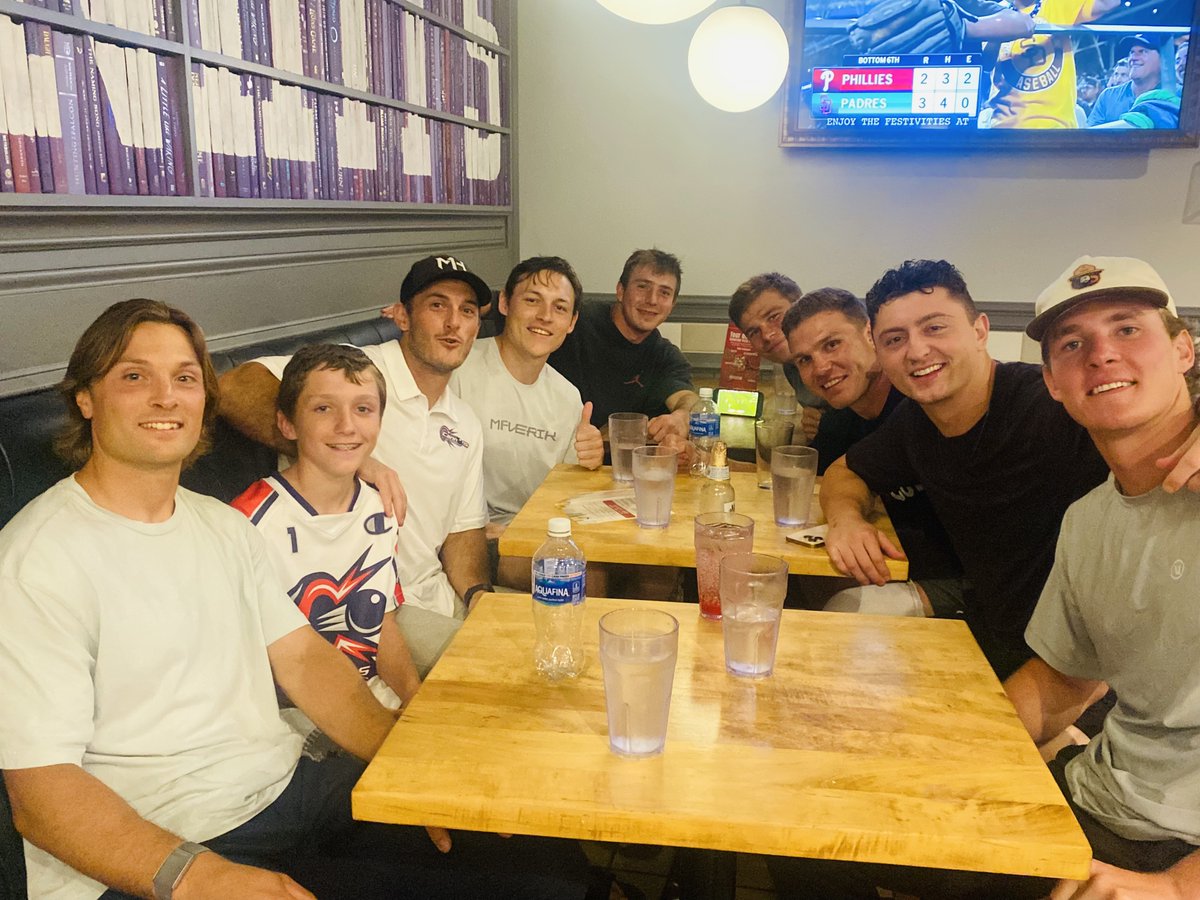
A quick shout out to @PaulRabil of the @PremierLacrosse about the @PLLCannons. After a recent match, we made our way to a favorite restaurant near closing; it was empty except for a table of young men. One of them, @MarcusHolman1, called out to my son (a @ResoluteLAX team member), "Nice Jersey!" (He had just purchased it at the game to replace the blue one Marcus autographed a couple of years back). Over the next few moments, those at the table invited Blyden to join them, and each signed his new purchase. @ChefBoy_RD_ (Ryan Drenner), @ZacTucci, @asher_nolting, Matt Campbell, Colin Kirst, Connor Kirst, Mic Kelly, and Alexander Vardaro created for him a moment he will NEVER forget. Their infectious graciousness and motivational demeanor will last equally as long. Paul, this is how role models should roll, and a small reason your league is exploding. All the absolute BEST!
Mortal UP® w/ Brian Brawdy tweet media
English
6
20
262
32.9K
Dan Arestia
Dan Arestia@danarestia·
Friday Sticks In is up! We're talking: - Olympic Lacrosse schedule and format - Dox Aitken back on the field - Covering stuff fairly - CJ Kirst pro debut - Previewing all four PLL games this weekend open.spotify.com/episode/06WyCv…
English
4
2
7
1.8K
Alex Michael retweetledi
Lauren Wilford
Lauren Wilford@lauren_wilford·
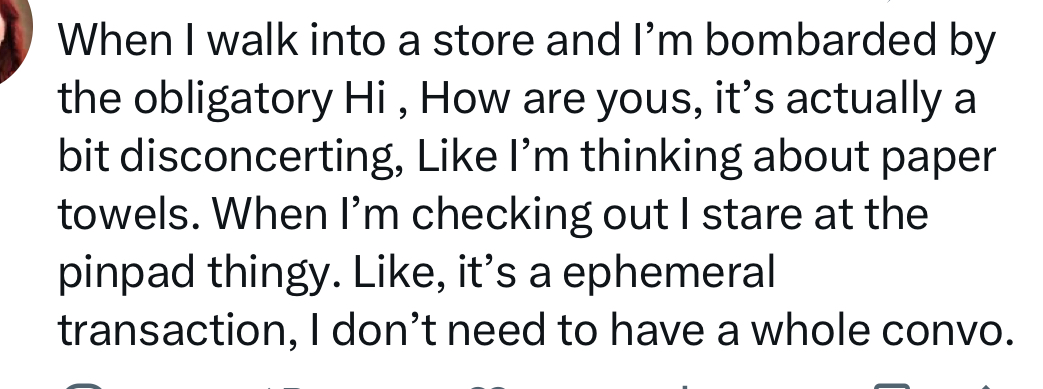
Have gotten comments from gen z questioning the point of the American greeting ritual. I used to feel the same way in my first service jobs. I thought it was "fake," performative, extractive, "emotional labor" (though we didn't have that phrase). Here's how I changed my mind
Lauren Wilford tweet media
Lauren Wilford@lauren_wilford

in general, gen z culture doesn’t have a norm for greeting/acknowledging people they don’t already know. Their custom is headphones/eyes down until engagement is required. It’s a “don’t speak unless spoken to” culture. This of course feels dehumanizing to anyone older

English
75
271
4.5K
440.9K
Alex Michael retweetledi
Lauren Wilford
Lauren Wilford@lauren_wilford·
It took me a long, slow time to put together that "putting one another at ease" is the collective project of a society, and that everyone has their part to play. And when it comes from a place of mutual generosity, it really does feel good. It allows for real connection
English
5
153
1.7K
36.6K
Alex Michael retweetledi
David Perell
David Perell@david_perell·
Ezra Klein: Writers who outsource their research to AI operate on a flawed model of how the mind works.
English
85
445
2.6K
1.4M
Alex Michael retweetledi
Riva
Riva@rivatez·
@david_perell a note from 2021, on soap:
Riva tweet media
English
11
59
486
28.1K