t.ab.algo🌶️

5.5K posts

t.ab.algo🌶️ banner
t.ab.algo🌶️

t.ab.algo🌶️

@algotabasco

Patiently waiting for the crypto market to mature. Stop chasing prices. Let's talk about fundamental blockchain technology.

Katılım Şubat 2021
880 Takip Edilen1.3K Takipçiler
t.ab.algo🌶️ retweetledi
cloudz
cloudz@AlgoCloudz·
@AlgoFoundation is no longer a Non-Profit
English
8
13
73
3.4K
t.ab.algo🌶️ retweetledi
JP Richardson
JP Richardson@jprichardson·
Today, the @NYSE announced its plans for a tokenized securities platform. @Exodus was the first U.S. public company to tokenize our stock 4 years ago, launching $EXOD on @algorand in 2021 and expanding to @solana last year. Here’s what onchain equity actually unlocks and why this is a big deal.
English
18
55
289
14.6K
t.ab.algo🌶️ retweetledi
Algorand Foundation
Algorand Foundation@AlgoFoundation·
Confidential. Quantum secure. On Algorand. With falcon_verify and HermesVault’s zero-knowledge design, users can now create private, post-quantum-ready accounts. Built through deep collaboration between @Algorand and @AlgoFoundation 🔐 Read the technical brief below.
Algorand Foundation tweet media
English
43
232
638
138.1K
𝔇𝔦𝔤𝔤𝔰
𝔇𝔦𝔤𝔤𝔰@WamDiggity·
@algotabasco I love Algorand dearly. However it is apart of my own personal ethos that I do not support vampires, and Staci and gang are indeed vampires. The World Chess thing about made me flip a table tbh.
English
1
0
5
349
𝔇𝔦𝔤𝔤𝔰
𝔇𝔦𝔤𝔤𝔰@WamDiggity·
Well $ALGO it’s been fun. It’s been a long a bumpy ride. For a while I was vocal, for longer a spectator, but I’ve officially sold out of my entire $ALGO bag. I don’t think the foundation has the best interest of Algorand at heart and I think they will never stop cooking our bags, and Silvio’s great work. Thank you and love you Algo community.
English
25
5
74
3.8K
t.ab.algo🌶️ retweetledi
Algorand Watcher
Algorand Watcher@AFWalletWatcher·
Good morning @AlgoFoundation , it was stated none of your reserve accounts would receive node incentives. This account labeled for “Ecosystem Support” opted into node incentives and has received around 50~ block rewards per hour for the past 6 hours~ Thank you! #Algorand #Algofam
Algorand Watcher@AFWalletWatcher

Foundation Wallet Activity: Foundation: Ecosystem Support 67 (MKZIWVBDBZV7UK6XQY3DFLYSBLSJWCDHDJWK3JAHWCFMNJOH4ZXQSMOUCE) performed an uncrawled application call or key registration transaction. Pera Link: explorer.perawallet.app/tx/SIHSZEFZQ3V… #Algofam #Algorand Created and Hosted by @atsoc93

English
20
23
105
14.4K
t.ab.algo🌶️ retweetledi
bankon.algo
bankon.algo@BOAlgorand·
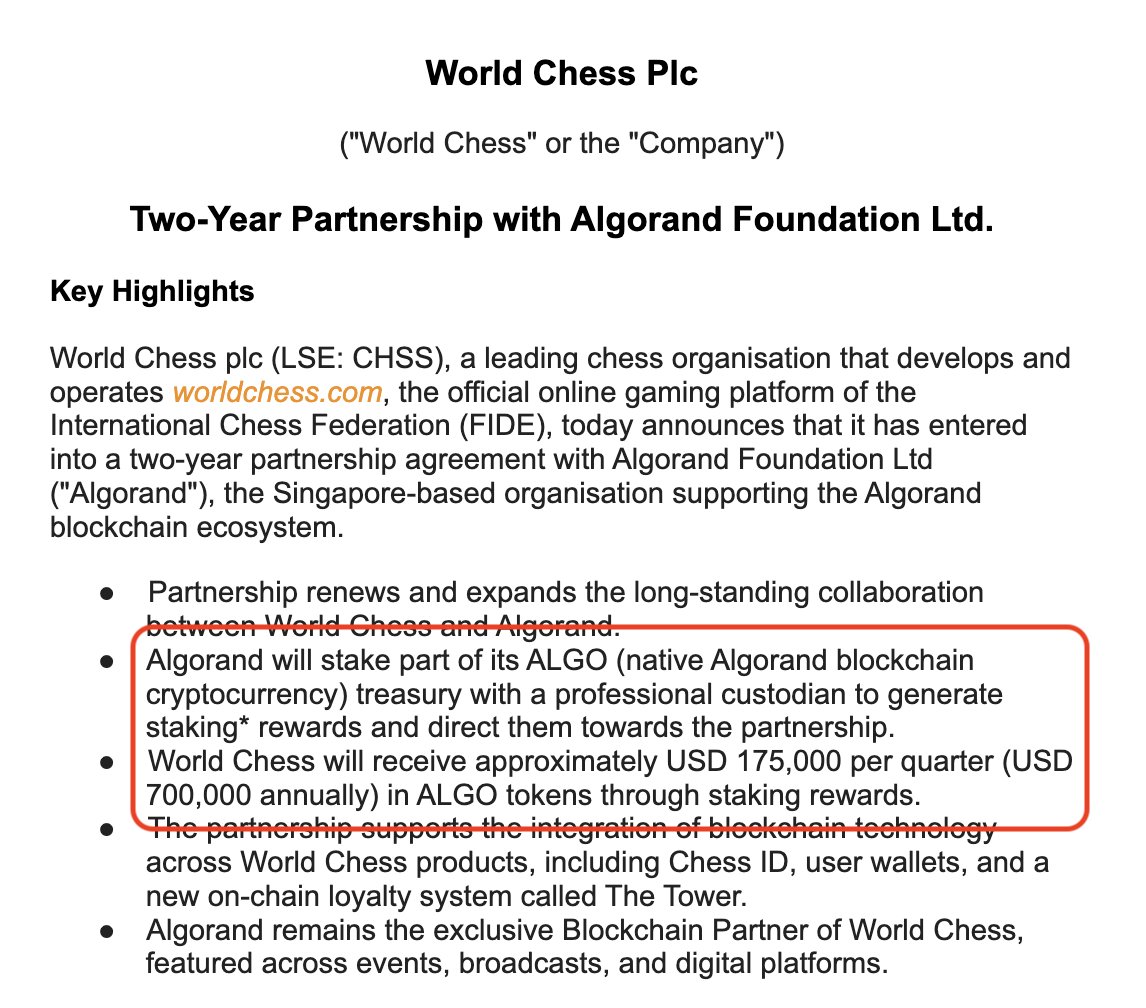
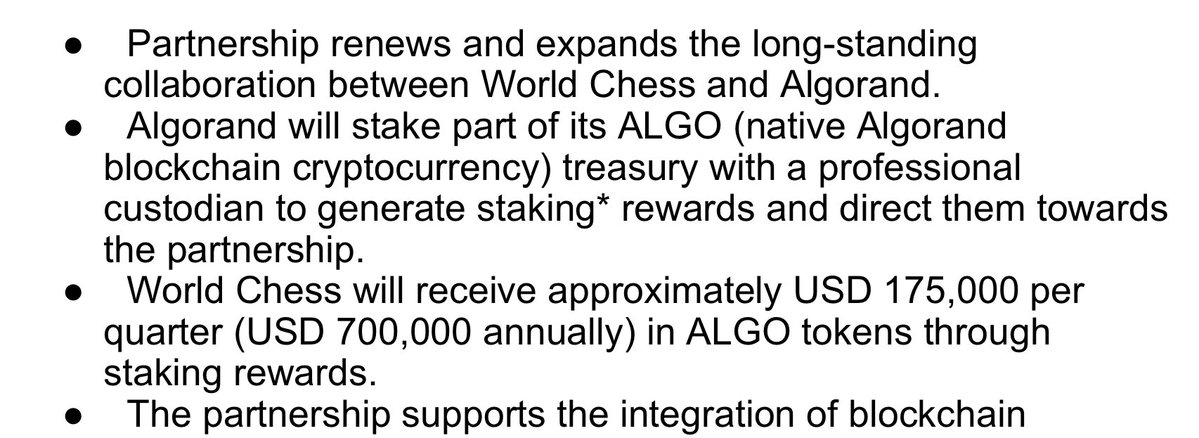
So instead of paying world chess out of the treasury for the partnership, the foundation decided to allocate tokens to consensus and pay world chess outta node rewards, effectively clawback the allocation and decreasing the apr of all node runners.
bankon.algo tweet media
Algorand Foundation@AlgoFoundation

Our partnership with @theworldchess is renewed and stronger than ever. Together, we’re driving innovation in loyalty and identity in sports, starting with The Tower, a fully on-chain chess loyalty program built on Algorand’s Intermezzo. Read more below 👇

English
13
10
58
4.2K
t.ab.algo🌶️ retweetledi
trillion
trillion@trillion_io·
This is not a great deal at all! World Chess get... 1⃣ A player management system built for FREE by @AlgoFoundation devs using cutting-edge, best-in-class blockchain technology 2⃣ That clearly not being interesting enough, @AlgoFoundation are making it more exciting by paying them $700,000/yr for the privilege ($60,000/mth) 3⃣ As a final kick in the nuts, how is this being paid for? By raiding the finite cookie jar of consensus rewards, bringing a significant number of @AlgoFoundation $ALGO online and thereby reducing the return to the thousands of #algofam node runners that make Algorand secure and decentralised. 4⃣ In return for...a bit of obscure brand visibility and a case study...what other guarantees were secured as part of this deal?
trillion tweet media
English
38
22
116
55.4K
t.ab.algo🌶️
t.ab.algo🌶️@algotabasco·
@gabrielkuettel @SecScottBessent Curious if US focused development is truly happening. For years, we’ve seen expansion efforts lean heavily toward Europe, with little visible progress in the US. Any concrete signs of this shift like partnerships?
English
0
0
0
57
gabe.algo 🇺🇸 🦅
gabe.algo 🇺🇸 🦅@gabrielkuettel·
We love our Jerry don’t we folks? +1 for focusing on the USA. 🦅🇺🇸 Treasury Secretary @SecScottBessent has effectively decided that the world’s reserve currency will run on stablecoins. U.S. tech companies like Circle and Stripe are replacing incumbents and building payment infrastructure on blockchain. By the way, Shopify’s pilot with Coinbase and Stripe uses crypto as the default checkout experience. This current cycle won’t be just a “bull market” but a technological revolution on a global scale -- electronic peer-to-peer cash, as Satoshi Nakamoto promised years ago. And it should run on Algorand so that this new form of digital cash is fast, reliable, and above all, decentralized. U.S. focused developments are happening at @AlgoFoundation. I hope to see much more!
Jerry Chu 🍊@PMDBT

Saw a lot of pretty negative posts about $algo on my timeline the last few days. A lot of the anger seems to be directed at various people in the foundation. Obviously no one is perfect, but for the most part from my interactions with people at the foundation, I don't think the hate is really justified. Thanks to the growth of Lofty over the years, I've been privy to some off the record conversations. It's not my place to share the exact content, but I figure I'd at least list some things I think are done well and things that I think haven't been done well. I have criticisms of my own too, but I'd like to think they're constructive and much of what's listed below has been provided as feedback to various foundation members in the past. (the list is not in any particular order) - DEX incentives are silly. It'll always look like you have growth and product market fit, when your customers figure out that you're paying them $1 for every $99 cents they pay you. It's not sustainable and the moment the incentives stop, you'll see participation massively drop. The people and users you attract with things like this tend to be mercenary and will leave as soon as they stop receiving free money. The exception here is the main pair ALGO/USDC, which I think the foundation to should help seed and provide liquidity for. - NFT markets are not doing that well overall, just take a look at Opensea's volume relative to their peak in 2021 as well as the prices of things like the Bored Apes. As a result, it's not surprising to see the foundation not wanting to subsidize this. If the inflows are already low on the largest chains with the most blue chip projects, it's unlikely that this ecosystem is what will bring massive amounts of new users to the chain. The community will need to figure out something that they can sustain and grow here on their own. Lofty processes a lot of transactions, but our cost for an Algo node is only about $250/month and our entire infrastructure cost on AWS is ~$2,700-$3,200. So, it's definitely doable to build and sustain something here without outside funding. - In general, people should treat grants/funding requests from the foundation as if they're raising money from VCs. The common advice is to always raise/pitch from a position of strength, meaning fast and large growth. Asking for money to prevent your business from going under is not the best way to raise. No investor wants to be left holding the bag, and the foundation is no exception. Lofty has received money on multiple occasions from the foundation over the years. I've often had to pitch the same request multiple times before it was accepted. Each time, I would go back to the team there and show that Lofty doesn't require the foundation to survive and that despite not receiving the support initially, we continued to grow. The reason they should support us is because it helps with their strategy to grow the chain, especially with new users who aren't already caught in crypto bag holding contests. And yes, we provide the data to support our narrative. - A lot of criticism about Staci specifically, but she had to come on a burning ship and try to put the fire out, then sail the ship to the promised land. This is hardly an easy task. I would argue she's done mostly well on putting out the fire. If what was said to me in the past were true, then I can say many of you are worshipping the wrong person and also blaming the wrong person. This is all because one person is choosing to act with high integrity and not revealing a lot stuff, because while revealing it would vindicate the person, they know it's not helpful to the ecosystem and it certainly won't help the token price. I will leave it at that and no I won't elaborate further. - I think having two organizations, tech and foundation, is ineffective. It's like Rome splitting the empire in half or a kitchen with two chefs. I hope this can be figured out at some point. The main benefit of this at the time was for "regulations", but the reality was that the SEC still named ALGO has a security, so we don't really see any of the benefits, but we do see all of the drawbacks. - The foundation has been too dovish on the regulatory front imo. The main point of having tradfi bankers should be to use their connections in traditional finance and government to influence said parties to drive outcomes that are beneficial for Algorand, but instead we saw ALGO get delisted from Robinhood in the US as an example. They recently hired a former prosecutor to try and fix all this, which is a great step, but I think they should have done this years ago. What did the Ethereum foundation do when the SEC tried to go after ETH? They sued them back! If you have power and influence, then it's your job to use it to drive the outcome you want. Otherwise, use the money to purchase said power and influence effectively, because it matters a lot. - Fees are too low. The point of a high throughput blockchain is to help facilitate a bunch of transactions quickly. You need the transaction cost to be cheap, but it doesn't have to be so cheap that it's virtually free. At that point, you might as well make it free. At the current price, it costs about $0.00017 USD to send a single transaction. That's right, it's around 100th of a penny. Let's say you 10x this fee, it will be $0.0017, so it's now a 10th of a penny. That's still pretty cheap. What if you 100x the fee? It's now roughly 1 cent USD. If mainstream adoption is truly what people care about, then I can confidently tell you that no actual user will care about paying 1 cent extra to solve a problem they have. Think about it, the wire fee charged by RBC in Canada is $45 CAD. Imagine telling someone it's 1 cent instead. Credit card fees to the merchants range from 2 to 3%. Imagine telling someone that they can pay 1 cent instead and that's a 100x growth on current fee rates. The point is, if you have product market fit, you can pass on these fees to your users (it's what we do at Lofty) and they won't care, because it's cheap enough. I'm pretty sure the foundation is subsidizing the staking rewards? (please correct me if I'm wrong). If that's the case, then imagine what those rewards would be if fees were 100x what they are currently? Maybe the new staking APY will be high enough to attract new buyers, because hey, who doesn't want to make more money? This is how you can shift the fundamentals of supply and demand on $algo. Otherwise, if you always try to compete on being the cheapest, the natural conclusion is a race to 0. At that point, you'll always need to be subsidized by someone or something. Not a great place for a decentralized self-sustaining network to be. - This one will be controversial, but I don't think focusing on Europe is the right move. Their governments move super slow and always over regulate things. The last 10 years of economic data also suggest the region lagging behind. I think it's smarter to focus on the USA and Asia as a whole. This is why as a whole, I'm never bullish about any pilot programs with European companies or the government. - The only way for a utility chain's tokens that are capped in supply to grow in price from fundamentals is for that chain to be used for an extremely large amounts of transactions. The point of high throughput chains was so that modern payments can run on it, replacing the credit card networks. Imagine processing trillions of transactions all costing a tiny bit of algo. Those algos need to be bought from the market and with a capped supply, what do you think happens? But if you want to be the top technical solution to a problem, you need to focus on capturing Silicon Valley mind share. There is just no way around this. Solana's team did an incredible job at this. The end result is that they're always the first solution or a top solution rolled out by tech giants when it comes to payments. Stripe is in the process of replacing the card networks and guess what? You can now accept USDC and pay with USDC on Stripe through the Solana network, but not the Algorand network. I think the team should focus the vast majority of their efforts here, because it's better to be late than never. - Most RWAs do not need to run on the blockchain at all and if they did, most of the intermediaries and issuers would prefer to run them on private blockchains. Existing highly illiquid peer to peer markets are the exception to this, which is why we focused on real estate. There are other non real estate markets that would be good for this too, but any RWA that doesn't fall within this narrow classification isn't actually bullish, at least long-term. It's especially not bullish if their transaction costs are subsidized. It answers the question of why there are so many transactions, but token prices never go up? It's because the people doing those transactions aren't forced to purchase algos from the market, which tie into a few points I made above. That's all for now. Happy fathers day to those that have children! I'm off to go play with my son boy now :)

English
4
13
105
3.7K
t.ab.algo🌶️
t.ab.algo🌶️@algotabasco·
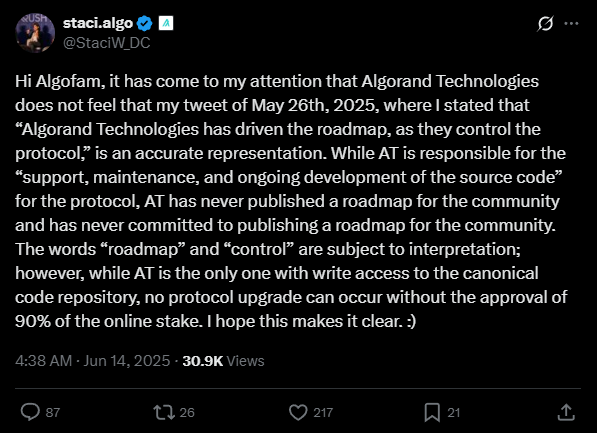
I think Dr. Micali has officially ditched us. Despite his years of absence, I was still hopeful that he was still involved with #Algorand Technologies, working on core engineering principles, but wow... Honestly, I'm losing faith in my original investment thesis. $algo
t.ab.algo🌶️ tweet media
Algorand Foundation@AlgoFoundation

“Fiat chain is a separate technology from Algorand. However, while Fiat chain would benefit all blockchain networks, it could be particularly beneficial to Algorand.” Read the latest interview from Algorand founder Silvio Micali, conducted by @Rachelwolf00 for @cryptonews cryptonews.com/news/fiat-chai…

English
2
0
11
2.2K
t.ab.algo🌶️ retweetledi
urtho.algo
urtho.algo@Urthoo·
@russiabot420 hmm , I only see growing number of customers at @AlgoNode_io, more API requests, top RPC providers interested in adding or expaning Algorand RPC offering. And on top of it all - 1300 new API subscriptions from Bolt hackathon. Looking forward to the roadmap and integrations.
English
5
37
126
9.4K
t.ab.algo🌶️ retweetledi
Jerry Chu 🍊
Jerry Chu 🍊@PMDBT·
Saw a lot of pretty negative posts about $algo on my timeline the last few days. A lot of the anger seems to be directed at various people in the foundation. Obviously no one is perfect, but for the most part from my interactions with people at the foundation, I don't think the hate is really justified. Thanks to the growth of Lofty over the years, I've been privy to some off the record conversations. It's not my place to share the exact content, but I figure I'd at least list some things I think are done well and things that I think haven't been done well. I have criticisms of my own too, but I'd like to think they're constructive and much of what's listed below has been provided as feedback to various foundation members in the past. (the list is not in any particular order) - DEX incentives are silly. It'll always look like you have growth and product market fit, when your customers figure out that you're paying them $1 for every $99 cents they pay you. It's not sustainable and the moment the incentives stop, you'll see participation massively drop. The people and users you attract with things like this tend to be mercenary and will leave as soon as they stop receiving free money. The exception here is the main pair ALGO/USDC, which I think the foundation to should help seed and provide liquidity for. - NFT markets are not doing that well overall, just take a look at Opensea's volume relative to their peak in 2021 as well as the prices of things like the Bored Apes. As a result, it's not surprising to see the foundation not wanting to subsidize this. If the inflows are already low on the largest chains with the most blue chip projects, it's unlikely that this ecosystem is what will bring massive amounts of new users to the chain. The community will need to figure out something that they can sustain and grow here on their own. Lofty processes a lot of transactions, but our cost for an Algo node is only about $250/month and our entire infrastructure cost on AWS is ~$2,700-$3,200. So, it's definitely doable to build and sustain something here without outside funding. - In general, people should treat grants/funding requests from the foundation as if they're raising money from VCs. The common advice is to always raise/pitch from a position of strength, meaning fast and large growth. Asking for money to prevent your business from going under is not the best way to raise. No investor wants to be left holding the bag, and the foundation is no exception. Lofty has received money on multiple occasions from the foundation over the years. I've often had to pitch the same request multiple times before it was accepted. Each time, I would go back to the team there and show that Lofty doesn't require the foundation to survive and that despite not receiving the support initially, we continued to grow. The reason they should support us is because it helps with their strategy to grow the chain, especially with new users who aren't already caught in crypto bag holding contests. And yes, we provide the data to support our narrative. - A lot of criticism about Staci specifically, but she had to come on a burning ship and try to put the fire out, then sail the ship to the promised land. This is hardly an easy task. I would argue she's done mostly well on putting out the fire. If what was said to me in the past were true, then I can say many of you are worshipping the wrong person and also blaming the wrong person. This is all because one person is choosing to act with high integrity and not revealing a lot stuff, because while revealing it would vindicate the person, they know it's not helpful to the ecosystem and it certainly won't help the token price. I will leave it at that and no I won't elaborate further. - I think having two organizations, tech and foundation, is ineffective. It's like Rome splitting the empire in half or a kitchen with two chefs. I hope this can be figured out at some point. The main benefit of this at the time was for "regulations", but the reality was that the SEC still named ALGO has a security, so we don't really see any of the benefits, but we do see all of the drawbacks. - The foundation has been too dovish on the regulatory front imo. The main point of having tradfi bankers should be to use their connections in traditional finance and government to influence said parties to drive outcomes that are beneficial for Algorand, but instead we saw ALGO get delisted from Robinhood in the US as an example. They recently hired a former prosecutor to try and fix all this, which is a great step, but I think they should have done this years ago. What did the Ethereum foundation do when the SEC tried to go after ETH? They sued them back! If you have power and influence, then it's your job to use it to drive the outcome you want. Otherwise, use the money to purchase said power and influence effectively, because it matters a lot. - Fees are too low. The point of a high throughput blockchain is to help facilitate a bunch of transactions quickly. You need the transaction cost to be cheap, but it doesn't have to be so cheap that it's virtually free. At that point, you might as well make it free. At the current price, it costs about $0.00017 USD to send a single transaction. That's right, it's around 100th of a penny. Let's say you 10x this fee, it will be $0.0017, so it's now a 10th of a penny. That's still pretty cheap. What if you 100x the fee? It's now roughly 1 cent USD. If mainstream adoption is truly what people care about, then I can confidently tell you that no actual user will care about paying 1 cent extra to solve a problem they have. Think about it, the wire fee charged by RBC in Canada is $45 CAD. Imagine telling someone it's 1 cent instead. Credit card fees to the merchants range from 2 to 3%. Imagine telling someone that they can pay 1 cent instead and that's a 100x growth on current fee rates. The point is, if you have product market fit, you can pass on these fees to your users (it's what we do at Lofty) and they won't care, because it's cheap enough. I'm pretty sure the foundation is subsidizing the staking rewards? (please correct me if I'm wrong). If that's the case, then imagine what those rewards would be if fees were 100x what they are currently? Maybe the new staking APY will be high enough to attract new buyers, because hey, who doesn't want to make more money? This is how you can shift the fundamentals of supply and demand on $algo. Otherwise, if you always try to compete on being the cheapest, the natural conclusion is a race to 0. At that point, you'll always need to be subsidized by someone or something. Not a great place for a decentralized self-sustaining network to be. - This one will be controversial, but I don't think focusing on Europe is the right move. Their governments move super slow and always over regulate things. The last 10 years of economic data also suggest the region lagging behind. I think it's smarter to focus on the USA and Asia as a whole. This is why as a whole, I'm never bullish about any pilot programs with European companies or the government. - The only way for a utility chain's tokens that are capped in supply to grow in price from fundamentals is for that chain to be used for an extremely large amounts of transactions. The point of high throughput chains was so that modern payments can run on it, replacing the credit card networks. Imagine processing trillions of transactions all costing a tiny bit of algo. Those algos need to be bought from the market and with a capped supply, what do you think happens? But if you want to be the top technical solution to a problem, you need to focus on capturing Silicon Valley mind share. There is just no way around this. Solana's team did an incredible job at this. The end result is that they're always the first solution or a top solution rolled out by tech giants when it comes to payments. Stripe is in the process of replacing the card networks and guess what? You can now accept USDC and pay with USDC on Stripe through the Solana network, but not the Algorand network. I think the team should focus the vast majority of their efforts here, because it's better to be late than never. - Most RWAs do not need to run on the blockchain at all and if they did, most of the intermediaries and issuers would prefer to run them on private blockchains. Existing highly illiquid peer to peer markets are the exception to this, which is why we focused on real estate. There are other non real estate markets that would be good for this too, but any RWA that doesn't fall within this narrow classification isn't actually bullish, at least long-term. It's especially not bullish if their transaction costs are subsidized. It answers the question of why there are so many transactions, but token prices never go up? It's because the people doing those transactions aren't forced to purchase algos from the market, which tie into a few points I made above. That's all for now. Happy fathers day to those that have children! I'm off to go play with my son boy now :)
English
63
123
494
31.6K
t.ab.algo🌶️
t.ab.algo🌶️@algotabasco·
@prob_fishing While I dislike the Foundation dumping large amounts of $ALGO on the market as much as others, there is part of me that think if they have to eventually sell their treasuries, they should do so during a bear market, not when prices are rising, as it will act as a resistance.
English
2
0
1
113