
Mæhæmad
1.5K posts


Mæhæmad
@alkaitagi
Software Engineer
Dagestan, Caucasus Katılım Haziran 2017
222 Takip Edilen1.1K Takipçiler


@SeadogDriftwood Indeed. I sincerely hope that this is merely foundation. I'm visiting the villages now, inviting the folk to participate in the crowdsourcing. We've lost much, but there's still much to be won.
English
@alkaitagi I also hope that this dictionary will be expanded upon as further ethnographic and linguistic research unveils more of the tapestry that is the Kaitag language. May its richness provide ongoing nourishment and strength!
English

@avzaagzonunaada I've been thinking about that just recently. I have two questions:
1. Why taa marbuta is consistently pronounced in the Arabic loans across I think all of the Dagestani languages.
2. In Kaitag there's a single word that breaks this "law". What are the possible conclusions?
English
I always love these Arabic loans where final t is kept, long lost in Arabic itself.
Turkish devlet ‘state’, Hindi daulat ‘wealth’, Georgian dovlati ‘affluence’ ← Persian dawlat ← Arabic dawlaᵗ
Vefa T.@32nd_guessing
We really were the prototype huh
English

Does anyone here know of a language outside of the northeastern Caucasus that refers to maize as "hajj-wheat"?
English
@avzaagzonunaada Wow, yes, that's the bit I've skipped, but our custom too specifies that we shouldn't call the snakes *specifically at night*.
English
@alkaitagi My grandma always says that we shouldn’t say the snake word at night.
English
The #Circassian for ‘snake’ is блэ /bɮʲɜ/.
It derives from the verb блэн /bɮʲɜn/ ‘plait, string together’, taboo-replacing the original Proto-Abkhaz-Adyghe word for ‘snake’ which was probably */mat(ʼ)/, cf. Abkhaz а́-маҭ /ɐ́-mɐt/, Ubykh /äˑ-ntʼɜ́/ (< *mtʼɜ?).
Justin R. Leung 梁路明@justin_r_leung
蛇年大吉!Happy Year of the Snake! Here are different ways the Chinese languages have landed on naming the slithery creature 🧵 The most common name is 蛇, attested in the oracle bones as 它. (The etymology of this word is uncertain; see en.wiktionary.org/wiki/%E8%9B%87) /1
Català
@avzaagzonunaada I wonder what was the cause of their taboo.
We too have both the native цьецье /ˈtsʼetsʼe/ and the Arabic loan мялъум /mælˈʔum/. The latter is actually more common; it was believed calling snakes by their "real" name makes them multiply.
English
There is also attested Ubykh /pɘtrɘ́pɬ/ for a species of non-venomous snake where the last element /°pɬ/ reminds one of Circassian блэ /bɮʲɜ/, but I haven’t the slightest clue what the rest of the constituent parts would mean in that case.
English
@avzaagzonunaada We have цьерҡ /tsʼerq/ for "leopard". Could be cognate with the Nakh?
English
The Digoron for ‘lion’ is comaq. Iron #Ossetic rather uses lom, a borrowing from Georgian lomi — a Eurafrican Wanderwort for ‘lion’ covering languages from Somali to English.
The closest thing I can find to Digoron comaq is Ingush c̓oq̓ ‘tiger’, Chechen c̓oq̓berg ‘leopard’.
English

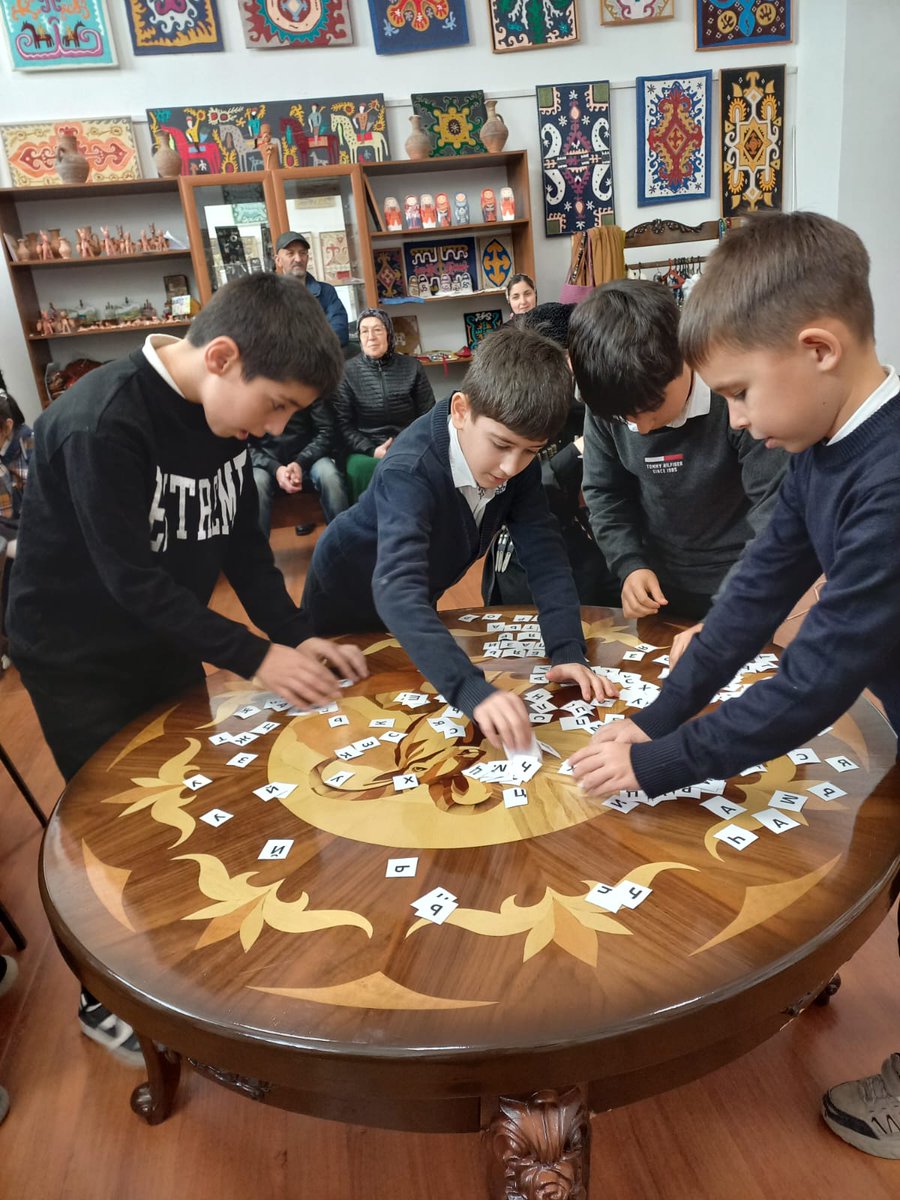


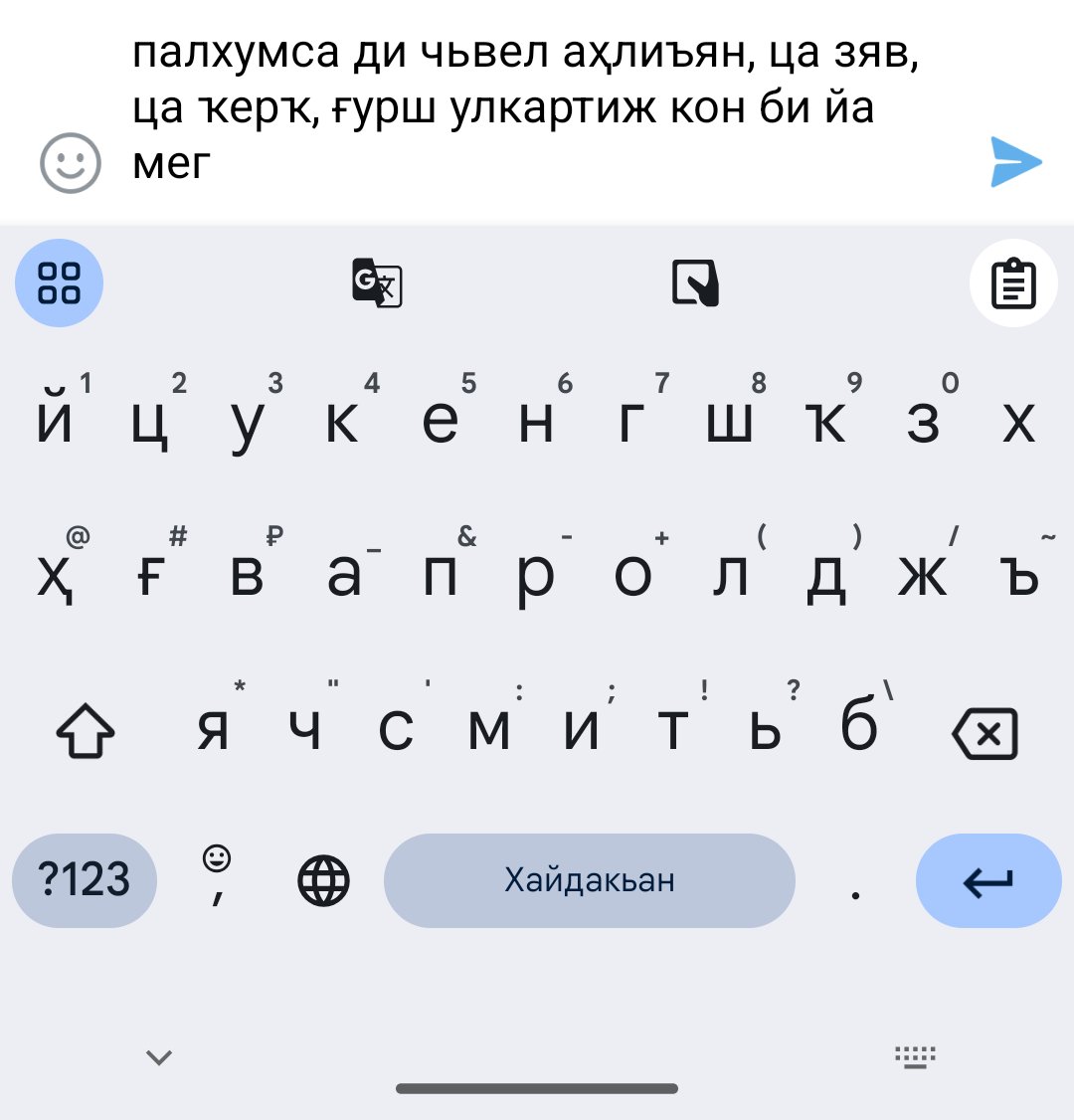
And huge thanks to @iseeaswell and the folks at Gboard for their technological support! Creating a script is no easy task and they helped us realize our vision. x.com/alkaitagi/stat…
Mæhæmad@alkaitagi
This little maneuver's cost us 10 months. But actually 86 years.
English

@avzaagzonunaada In the first years, say 20-30-40s, the Avar dictionaries were spelling "school" the way the speakers pronounce it: "ushkul", even though it was the recent loanwords from Russian. But later the local institutions officially changed the spelling to exactly match Russian: "shkola".
English
@avzaagzonunaada It was absolutely the case. Recently I've been reading some bits about the construction of the Dagestani literal norms. You can see over the years how the formal norms were more and more infiltrated with the un-adapted Russian lexicon and even logic.
English
Smeets, in his study on Circassian, praises the Soviet language policy saying it was (among) the best in the world. As did Krauss speaking for Yupik & Aleut in the USSR vis-à-vis Alaska & Canada. But Smeets also put in a little caveat saying that the Soviet goal may have ...
English

@tlimafov It's the same for all of us, really. Except for Abkhaz and now Kaitag.
Even those with relatively "simple" phonetics like Ossetian or Kumyk suffer from Soviet legacy. And frankly I'm not sure what can be done now.
In my case we were just "lucky" to be left behind in the XX c.
English
@NeilPHauer Implemented by Chechen Republic's Academy of Science it's fully official now. Well, at least the academic article says so.
English
@alkaitagi That's super interesting and now I'm thinking of my Chechen teacher having to change all his worksheets)) What organization was it that made the change? I never understood who has authority to make these kinds of reforms in languages
English
I'm also extremely proud how the project utilized the best practices from all over the North Caucasian orthographies.
• Marking ejectives by <ь> is inspired by Ossetian: пь, ть, чь, ць, кь, ҡь — pʼ, tʼ, tʃʼ, tsʼ, kʼ, qʼ.
• It also denotes /h/ in the different contexts, ...
Mæhæmad@alkaitagi
It's also, I believe, the first instance of a principally new script being created in North Caucasus since the Soviet literal push and establishment of the Dagestani and other alphabets in 1938. Incidentally the same year Kaitags were started being... Let's say deconstructed.
English
@bot6296293293 Correct, that was my design decision. Their phonemic context are mutually exclusive as /h/ occurs only on word-start, syllable-end, intervocalic, and after sonorants. No exceptions.
The trick works in Circassian too albeit with glottal stop.
English

@alkaitagi am i reading this right? are they using the soft sign (sorry, no access to russian keyboard rn) for both ejectives and [h]? is that not confusing?
English