Andrew Wilkinson@awilkinson
I think I found a Picasso at a garage sale.
But not the kind you’d think…
Lately I’ve been thinking about how to capture some of the upside of this AI boom in my stock portfolio.
But it’s hard. I’m a value investor.
The idea of paying 30x earnings for NVIDIA almost physically pains me.
Here are a few of the trade ideas I’ve sketched out:
Self-driving vehicles: self-driving is already here, it's just not evenly distributed. I use it 90% of the time in my Tesla and it's phenomenal. Between their robotaxis are coming later this year and Waymo rolling out to more cities, it seems like an obvious assumption that in the next ten years most cars will be self-driving. Trades I've considered: Long Tesla for robotaxi and Optimus upside, short Uber/Lyft as their networks become obsolete. Risk: rollout could take longer than anticipated due to huge capital costs and regulation, Uber/Lyft could pivot.
Compute and inference: The obvious plays - buy NVIDIA, ASML, and TSMC. Great companies but expensive multiples and premiums. Years of excess demand. Risk: geopolitical conflict in Taiwan, moat erosion as China and other competitors innovate.
Frontier models: You can buy secondary in Anthropic, x.AI or OpenAI, but the valuations are huge, positions are difficult to come by, and you're also betting on a winner (this is notoriously hard to predict). Risk: the value doesn’t end up accruing to any of them/models become commoditized.
Google: Another play is simply to buy Google, which owns DeepMind/Gemini and has a massive data moat. Risk: the innovator's dilemma, bungled AI rollout, ads/search business gets decimated by ChatGPT.
SoftBank: The final idea I've considered is buying Softbank. It holds some OpenAI and other AI businesses, is investing in data centers via Stargate, owns 90% of ARM (whose chip designs are a small part of many critical AI components and GPUs), and is trading for roughly ⅓ of NAV. Risk: volatility/debt, as Masayoshi Son is known for wild bets.
While these are all interesting potential options, I recently found an investment that offers a particularly interesting risk/reward...
Last month, I got a call from my friend @kashramki, a value investor based in Toronto.
We had gotten to know one another over a decade ago, when he worked at BCI, a large pension fund in my hometown. Since then, he had gone on to lead dozens of multi-hundred-million and even billion-dollar investments into infrastructure deals (mostly pipelines, datacenters, and renewable energy).
He told me he was doing something radical:
"I'm selling my entire personal portfolio and putting it all into one stock."
When a smart investor says that, I lean in.
I was surprised. Kash is a highly conservative and thoughtful guy and I'd never seen him be so "all in" on something.
Usually I was the one telling him about my latest hare-brained investment while he crossed his arms and scratched his head, telling me about the litany of ways it could go wrong.
He went on to tell me about a company called IREN.
Public market investors have boxes in their minds. When they look at a company, they sort it into a box labeled "Good," for later research, or "Bad," which they discard immediately.
Like expert poker players dispassionately folding hands, they have trained themselves to instantly dismiss any stock that comes with certain toxic labels - red flags that trigger an immediate 'pass'.
Words like:
- IPO
- Cannabis
- Biotech
- and the dreaded Bitcoin
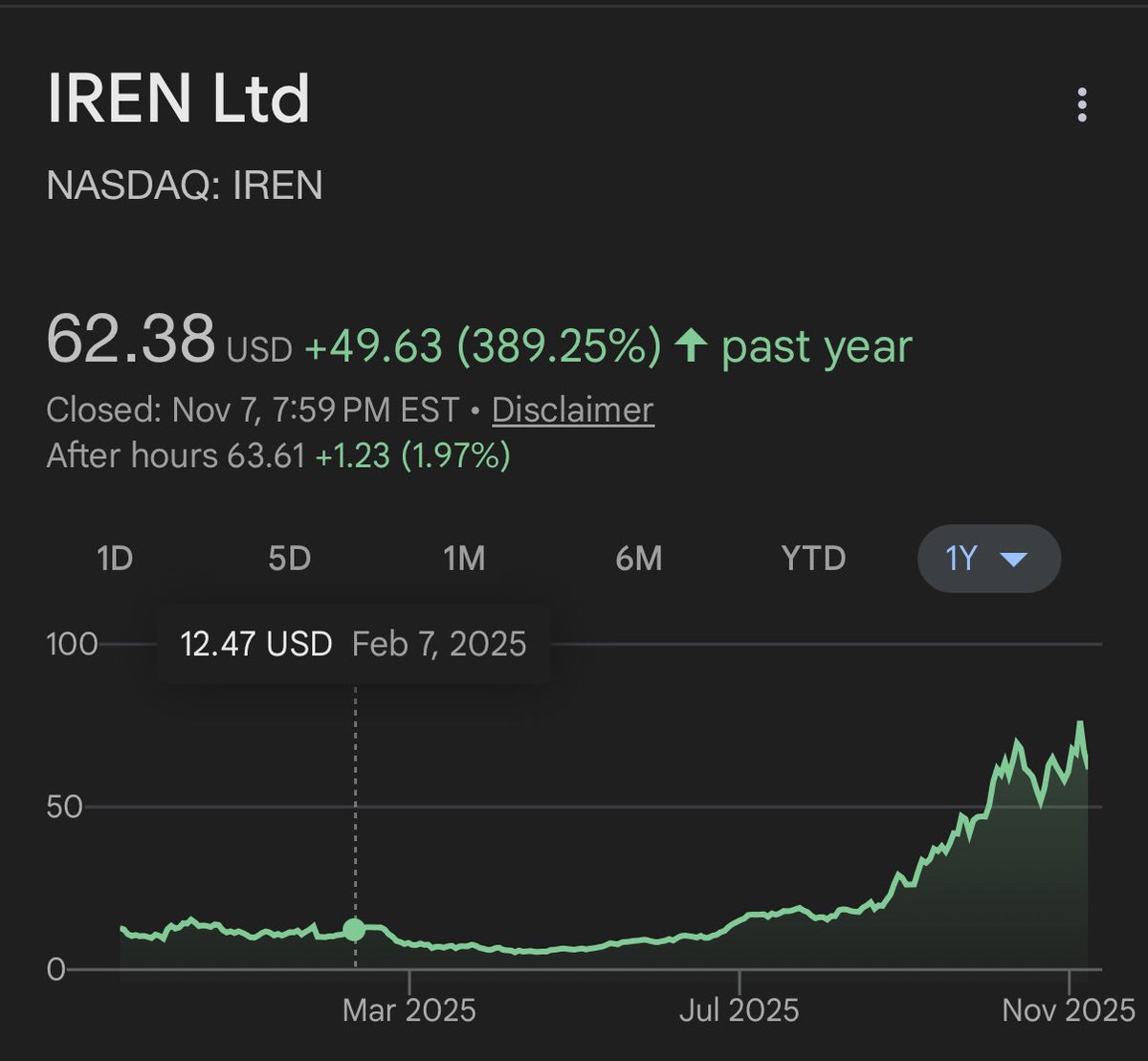
IREN is one of these stocks.
And when he explained it, I realized that Kash had found the public market equivalent of a Picasso at a garage sale.
Here’s the backstory he gave me:
In 2018, @danroberts0101 and his brother Will, both infrastructure bankers from Australia, started IREN ($IREN). Their thesis was simple: demand for energy and compute would grow significantly in the coming decades.
They acquired a series of large, high power datacenter sites located near renewable energy plants.
Their first few were in British Columbia, and they went on to acquire two massive sites in Texas, which are coming online in the next year or so.
To date, they've been using the BC-based datacenters to mine Bitcoin. But they are far from Bitcoin bulls.
Every Bitcoin they mine is immediately sold for a profit. They hold near zero Bitcoin long term and are simply doing arbitrage, making hundreds of millions of dollars from Bitcoin sales each year.
The stock is currently trading at a market cap of around $2.3 billion with no debt. That is an illustrative adjusted 2024 run-rate EBITDA multiple of ~4.6x based on disclosures from the company (from page 16 of management's November 2024 presentation: illustrative 2024 EBITDA at ~$435m at $90k/Bitcoin).
As of today, Bitcoin is at $99,480, so we can assume that number is a little higher.
Their growth plans for this year, if executed as planned, could result in an even lower forward multiple. In the range of ~2.5-4x.
Ok, so it's a potentially cheap stock (CC: @dirtcheapstocks). But how does this relate to AI?
Two key things fuel AI: energy and compute.
Both are in limited supply. We've all seen nuclear, semiconductor, and datacenter stocks go parabolic over the last year. That is because AI will require an almost unimaginable amount of energy and computation.
Training AI models requires huge clusters of chips, typically Nvidia GPUs, and generally requires them to be in one location.
These huge datacenters are already in thin supply and take time to build and permit. They are heavily regulated.
IREN's new Texas facilities are significantly larger than industry averages in both land size and power capacity. For context, their Childress facility alone (750MW) is nearly four times larger than what is considered a normal modern data center (200MW), and their Sweetwater Texas site is almost double that at 1.4GW.
I believe that IREN trades at a low multiple for two reasons:
1. They are investing massive amounts of capex in building out their two huge Texas datacenters (coming online in 2025/26) and those earnings haven't hit the P&L yet.
2. They are dismissed and miscategorized as a Bitcoin miner. Others are starting to wake up to this (see: Softbank/Cipher).
If we simply value IREN as a traditional datacenter business and compare it to similar companies, we'd expect this business to generate datacenter free cash flow of ~$2 billion a year from their Sweetwater, TX 1.4GW site that is primed for AI compute starting April 2026.
That is ~$2 billion per year from this one additional site.
Added to its existing earnings, that's more than what the entire company is worth today.
If we apply industry multiples to their long-term projected earnings (once the Texas sites come online), the math becomes almost laughably compelling.
Using typical free cash flow multiples in the datacenter space, that gets you an enterprise value of ~$20-40 billion. 10 to 20 times where the company is currently trading. And that’s without valuing their Bitcoin business, which could be worth several billion on its own.
And yes, I just heard you yell “BUT WHAT ABOUT DEEPSEEK???” through a mouthful of potato chips.
Many point to DeepSeek's claimed $6M model training costs as evidence that compute demands might be cooling.
While they've achieved big efficiency gains, this isn't the paradigm shift some claim it to be. As Anthropic's CEO Dario Amodei explained in a recent blog post, we've historically seen a ~4x per year decrease in AI training costs.
DeepSeek's improvements are roughly on this expected curve, not dramatically below it.
But more importantly, these efficiency gains don't reduce total compute demand—they get immediately reinvested into training even more sophisticated models. The path to AGI and ASI will still require massive amounts of compute, both for training increasingly complex models and handling the explosion in inference demands as AI applications proliferate.
There’s a reason that Microsoft, Meta, and Google recently (post DeepSeek) announced they would collectively spend $220 BILLION on capital expenditures this year. The large majority of which will be spent on AI infrastructure.
Back to IREN…
So, we have a well-run company with no debt, ample cash flow generation, in an industry with huge excess demand, and a dirt cheap valuation.
This is my kind of garage sale Picasso!
As my friend @mohnishpabrai describes his favorite type of investment:
“Heads I win, tails I don’t lose much."
This feels like one of those.
Even if I’m completely wrong, and AI compute isn’t the hot commodity I’m anticipating, the underlying datacenters should still be valuable. Even before AI came onto the scene, the US datacenter market was expected to grow at 9-10% CAGR through 2030.
But, if AI does play out in a big way, those same datacenters could become Crown Jewels that could spit off huge amounts of cash from training and inference compute. Toll roads en route to the AI revolution.
So, all this is to say, I bought the stock.
A relatively small position for me. A few % of my portfolio mixed with a few other bets on frontier models, Google, and semiconductors.
Of course, like all investments, this has risk.
Here are a few of the best arguments for why IREN doesn’t pan out as I’m anticipating:
• They could dilute shareholders excessively.
• They could fail to capture the AI datacenter opportunities by favouring their past strategy of bitcoin mining, all in the hopes that bitcoin goes to the moon. With an 18-month payback period on their bitcoin hardware, the case for growing their bitcoin operations is very compelling, but it is only as sound a strategy as the price of bitcoin itself. And who knows what it will do tomorrow?
• Will they find a highly creditworthy counterparty for their mega-site in Texas? They could fail to demonstrate to the hyperscaler community that they have sufficient construction or operating experience to build and manage a large AI datacenter, especially in the middle-of-nowhere-Texas, where highly skilled datacenter operators are scarce.
• Bitcoin prices could drop to the point where mining is no longer profitable (around $30,000)—although I would argue the datacenters themselves are still valuable in this scenario. If you wanted to get clever, you could buy puts on a Bitcoin ETF to cover this scenario.
But overall, I think it offers a good risk/reward. I believe the underlying datacenter assets are valuable even if AI plays out very differently than expected.
I welcome any thoughts and critiques :-)
Is this a Picasso or a cheap reproduction? Roast me!
Important Disclaimers:
IREN stock is volatile. It swings around a lot, so if you buy, buckle up and be ready to hold for a few years. The value here depends on management delivering on their planned expansion.
I'm just a guy on the internet sharing thoughts. Not a financial advisor, and this definitely isn't investment advice. Yes, I have met with IREN's IR team, but everything I've shared comes from public sources - SEC filings, presentations, and public statements. Reality might look very different from the scenarios discussed.
Datacenters and crypto are wild markets with plenty that could go wrong - competitive pressures, regulations, market swings, geopolitics, you name it.
I own IREN shares and some of the other stuff mentioned here. Might trade them anytime. Could make me biased.
Do your own research, talk to actual financial advisors, and don't bet the farm. Past performance doesn't predict the future.