
Aritra

242 posts

Aritra banner
Aritra

Aritra

@aritrabanik

FacultyCS@NISER | Algorithm Researcher | Atheist | Loner | Gourmet | Stardust

Pale blue dot Katılım Ekim 2009
422 Takip Edilen221 Takipçiler
Aritra retweetledi
Adam Butler
Adam Butler@GestaltU·
Fun fact: The 1998 paper that introduced Google and PageRank to the world ends with this acknowledgment: "Supported by the National Science Foundation under Cooperative Agreement IRI-9411306. Funding also provided by DARPA and NASA." Sergey Brin was on an NSF Graduate Fellowship. Larry Page was a PhD student on the grant. Google—now worth $2 trillion—exists because American taxpayers funded "the Stanford Integrated Digital Library Project." Not a startup garage myth. A government grant. Every time someone says public research funding "picks winners and losers" or "crowds out private innovation," remember: the most dominant technology company of the 21st century was incubated entirely with public money, inside a public university, by researchers on federal fellowships and grants. The private sector didn't see it coming. VCs passed. The government funded it anyway—not because it would become Google, but because fundamental research into information retrieval seemed worth understanding. That's the point. You can't predict which grants will change the world. You fund the science and let researchers explore. The internet (DARPA). GPS (DoD). Touchscreens (CIA/NSF). mRNA vaccines (NIH). Google (NSF/DARPA/NASA). Public investment in basic research isn't wasteful spending. It's the seed corn of the entire modern economy.
English
215
3.5K
13.8K
959.7K
Aritra retweetledi
Raj Kunkolienkar
Raj Kunkolienkar@kunksed·
I was in fifth grade when I learned to read my parents' silence. They were talking in the kitchen, late at night, in that particular hush that parents use when they think children are asleep. I caught fragments. Bombay. Tests. Something about a doctor. The next morning, everything was normal. Chai, school, the shop. But I had heard the frequency shift. It was 2004. My father was 39. We had just moved out of the room behind our kirana store—a chawl on the outskirts of Panaji—into a proper apartment. Our first EMI. Things were looking up in the way they do for Indian middle-class families who have spent years looking at the same ceiling: slowly, carefully, one calculated risk at a time. Then the diagnosis. Stage 3 follicular lymphoma. I didn't know what lymphoma meant. There was no internet to tell me, no Google to spiral into. Cancer was a word from movies—something that happened to people in cities, in dramatic hospital scenes with violins. Not to shopkeepers in Goa. Not to fathers who opened shutters at 7 AM and counted change at night. They kept me in the dark. The logic was simple: don't disturb the boy's studies. So I went to school. I came home. I did homework. And in the margins of this ordinary life, my father was taking buses to Mumbai for chemotherapy. I still don't fully understand how he did it. A biopsy, then a bus. Chemo, then the overnight journey back. Tata Memorial to Kadamba bus stand. The same man who winced when he cut his finger slicing onions was now traveling eight hours each way with poison in his veins, because what else was there to do? Goa didn't have the facilities. We didn't have the money for flights or hotels. So he sat on buses, probably in pain I can't imagine, probably next to someone complaining about the AC being too cold. My mother ran the shop. Not "helped out"—ran it. Wholesale orders, inventory, customers, credit books, all while her husband was in the jaws of something that might kill him. New scans kept showing the cancer spreading. The word "spreading" did a lot of work in those days. And I? I was a child. Which means I was selfish in the way only children can be—not out of cruelty, but out of not knowing. My father was alive and not going bald like he did so I assumed things were now fine. I was still in the dark. I remember crying for days because I wanted a geared cycle. All my friends had them. The fancy ones with the grip shifters. I needed it for school, I argued. I needed it because everyone else had one. I remember my parents' faces when I wouldn't let it go—that particular exhaustion of people who cannot explain why they're saying no, because the explanation would break something. Every rupee mattered. I didn't know that yet. I didn't know that they were borrowing money from friends, from family, sometimes from customers at the shop—the same aunties who haggled over soap prices were quietly lending us cash to keep my father alive. That's the thing about the Indian middle class: the safety net is made of relationships. Of people who've known you long enough to trust you'll pay them back, eventually. No paperwork. Just faith, and shame, and gratitude all mixed together. My father then spent 40 days in Mumbai for radiation. He stayed with my aging grandparents in a small flat while I finished my exams and my mother kept the shop open. I don't know what those 40 days were like for him. He never talked about it. Men of that generation don't. They just endure, and then they come home, and life continues as if nothing happened. The magnitude of what was happening to my family didn't hit me until years later. No health insurance, of course—it was unheard of for people like us. The treatment, the travel, the lost income from the shop, the interest on loans that weren't from banks. It drained us completely. Not metaphorically. Actually. The kind of drained where you stop going to movies. Where eating out becomes a memory. Where "vacation" is a word other families use. Miraculously—and I use that word carefully—things stabilized. By 2007, the cancer was in remission. Whether it was the radiation, the medication, or the wheatgrass cow dung milk ayurvedic concoctions my mother sourced from god-knows-where, I don't know. Probably all of it. Probably none of it. Cancer does what cancer does, and we tell ourselves stories about why. But remission doesn't mean freedom. It means waiting. It means every annual checkup is a held breath. It means the knife never really leaves—it just hangs higher for a while. It took us until 2015 to recover financially. Eleven years. A whole decade of my adolescence spent in the aftermath of something that happened in three months. That's the part nobody tells you about illness: the medical crisis has a timeline, but the financial crater doesn't. It just sits there, and you fill it in slowly, one repaid loan at a time, one favor returned, one customer you finally pay back. In 2012, I got admits to colleges abroad. Good ones. The kind of opportunity that I'd dream about for my children. My mother sat me down and gently suggested I reconsider. She didn't say "we can't afford it." She said: "What if it comes back?" The knife, always dangling. She was right to think it. I knew she was right. So I gave the BITSAT, got into BITS Pilani with a generous scholarship from the Goa government, and made it through. It was the practical choice. The safe choice. The choice you make when you've learned that life can pivot on a diagnosis. It did come back. In 2022, the lymphoma transformed—DLBCL this time, more aggressive—and everything we'd feared for eighteen years arrived all at once. My father went through treatment again. CAR-T therapy, a clinical trial. Brief remission. Then not. He passed in 2023. But the thing I think about now, the thing that connects that fifth-grade boy crying about a cycle to the man I became: when it came back, I was ready. Not emotionally—you're never ready for that. But financially. I could go all out. Best doctors. Best facilities. No borrowed money from customers. No buses to Mumbai. When the bill came, I could pay it. The CAR-T didn't work. Cancer won anyway. But I sleep at night. I sleep because I know I did everything that could be done. There's no version of me lying awake wondering: what if I'd had more? What if I could have afforded that other treatment? That guilt would have eaten me alive. It would have been worse than grief. I think about this when people ask me why I care so much about money. Why I write about financial security. Why I'm building what I'm building. It's not ambition. It's not greed. It's not even wisdom. It's trauma response. The boy who cried about a geared cycle grew up to understand something about money that no finance book teaches: it's not about the stuff. It's about what happens when the phone rings and someone says the word "biopsy." It's about having options when you have no good choices. It's about not borrowing from the aunty who buys soap from your shop. My father ran a kirana store. He woke up early. He counted change at night. He took buses to chemo because that's what was available to him. He never complained. He came home and opened the shop the next day. I don't know what he would think about me writing this. He wasn't the type to share. But I think he'd understand why I'm sharing it: because somewhere, there's a family in a small town, getting a diagnosis, doing the math, realizing the numbers don't work. I want them to know they're not alone. And I want the version of me that comes after them—the child who doesn't fully understand yet—to grow up in a world where this story is a little less common. That's all. Now go, get some insurance and take your parents out for dinner while they're still around.
Raj Kunkolienkar tweet media
Loop@LoopHealthHQ

💚1M members milestone giveaway! Quote tweet with your story of the medical incident in your family that changed your perspective on life, health, and finances. We're doing this to raise awareness around preventive healthcare. 3 air purifiers for stories picked at random.

English
450
788
6.7K
605.7K
Aritra
Aritra@aritrabanik·
🚀 ACM India invites proposals for IndiCS 2025! IndiCS supports focused, small-group research seminars that foster deep discussions and collaboration in computer science. 📅 Deadline: 31 Dec 2025 🔗 Details: india.acm.org/research/indics
English
0
0
0
28
Aritra
Aritra@aritrabanik·
🎉Excited to share that our paper “Learning with Structure: Computing Consistent Subsets on Structurally-Regular Graphs” has been accepted for oral presentation at AAAI-26 We explore how graph structure can make learning more efficient. #AAAI2026 #AI #MachineLearning #GraphTheory
English
0
0
2
391
Aritra retweetledi
ACM India
ACM India@Indiaacm·
🐛 “Bugs beware! Sibling love is my ultimate firewall. Happy Bhai Dooj! #ACMIndia #DebugTogether
ACM India tweet media
English
0
1
2
129
Aritra
Aritra@aritrabanik·
Aritra tweet media
ZXX
0
0
2
464
Aritra
Aritra@aritrabanik·
📣 Have a PhD student who cracked open a new frontier in CS? Nominate them for the ACM India Doctoral Dissertation Award 2025 💰 ₹2L + global recognition 🗓 Deadline: August 31 awards.acm.org/india-doctoral…
English
0
0
1
66
Aritra
Aritra@aritrabanik·
📢 Call for Proposals: ACM India IndiCS Seminars IndiCS fosters focused, interactive research seminars in CS across India. Submit your proposal for the next edition! 🗓 Deadline: July 31, 2025 🔗 india.acm.org/research/indics #ACMIndia #CSResearch
English
0
4
9
2.1K
Ponnurangam Kumaraguru “PK”
5 selfies 🤳(see pics), 4 campus visits 🏫, 15 Council members, 100s of students / faculty 👥 interactions, walks 🚶‍♀️, badminton 🏸 and hours of deep discussions on how to improve the quality of students, faculty, industry = 1.5 days of @Indiaacm Council meeting. #VPGiri #ProfGiri
Ponnurangam Kumaraguru “PK” tweet media
English
1
0
9
517
Aritra
Aritra@aritrabanik·
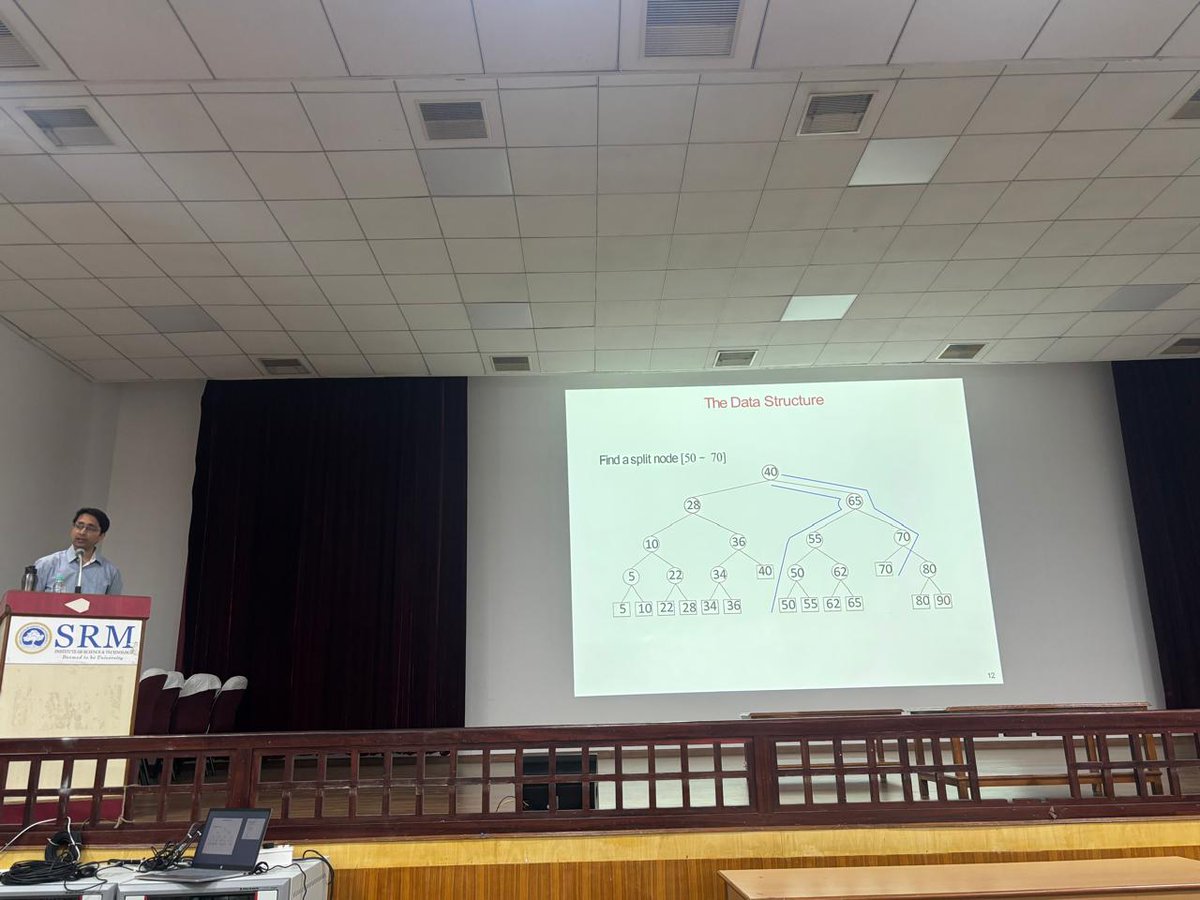
Fine-grained and Parameterized Complexity Today (FPcT) @NUSingapore
Aritra tweet media
English
0
0
9
155
Aritra retweetledi
NISER
NISER@niser_official·
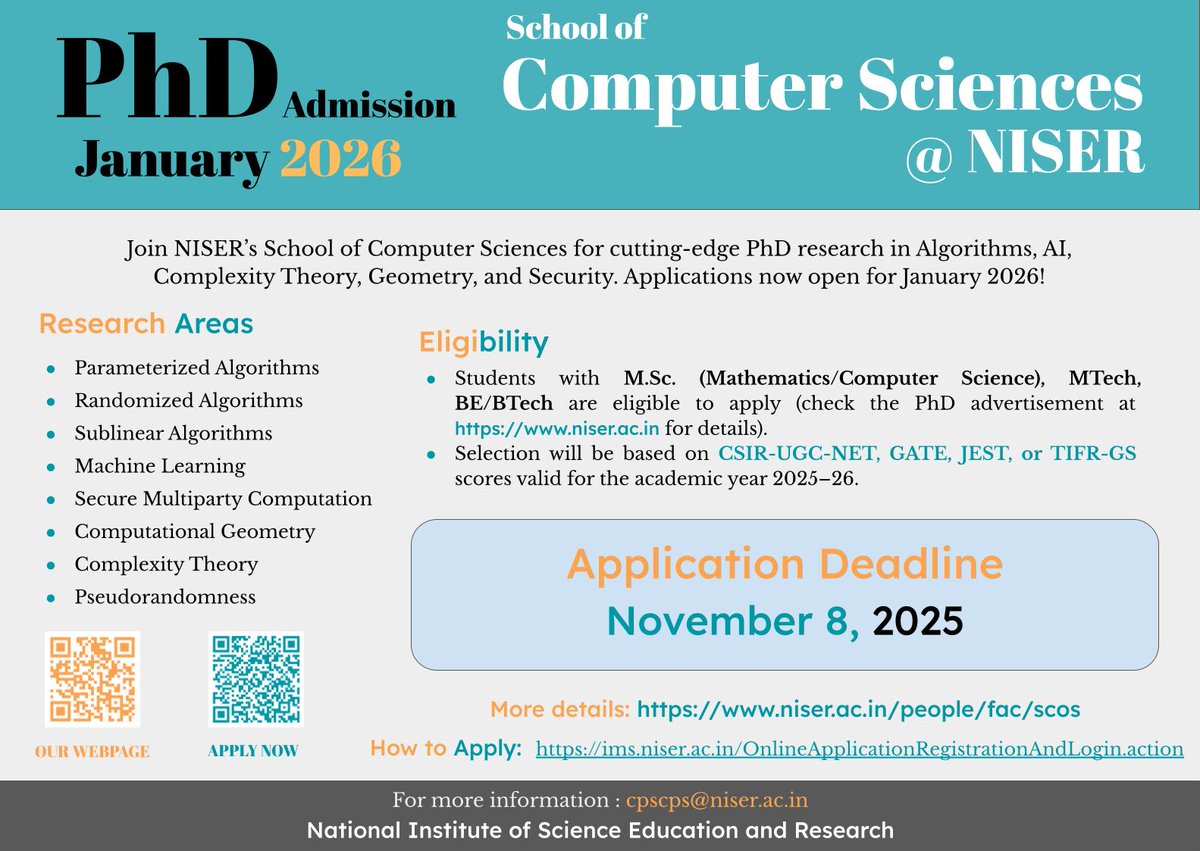
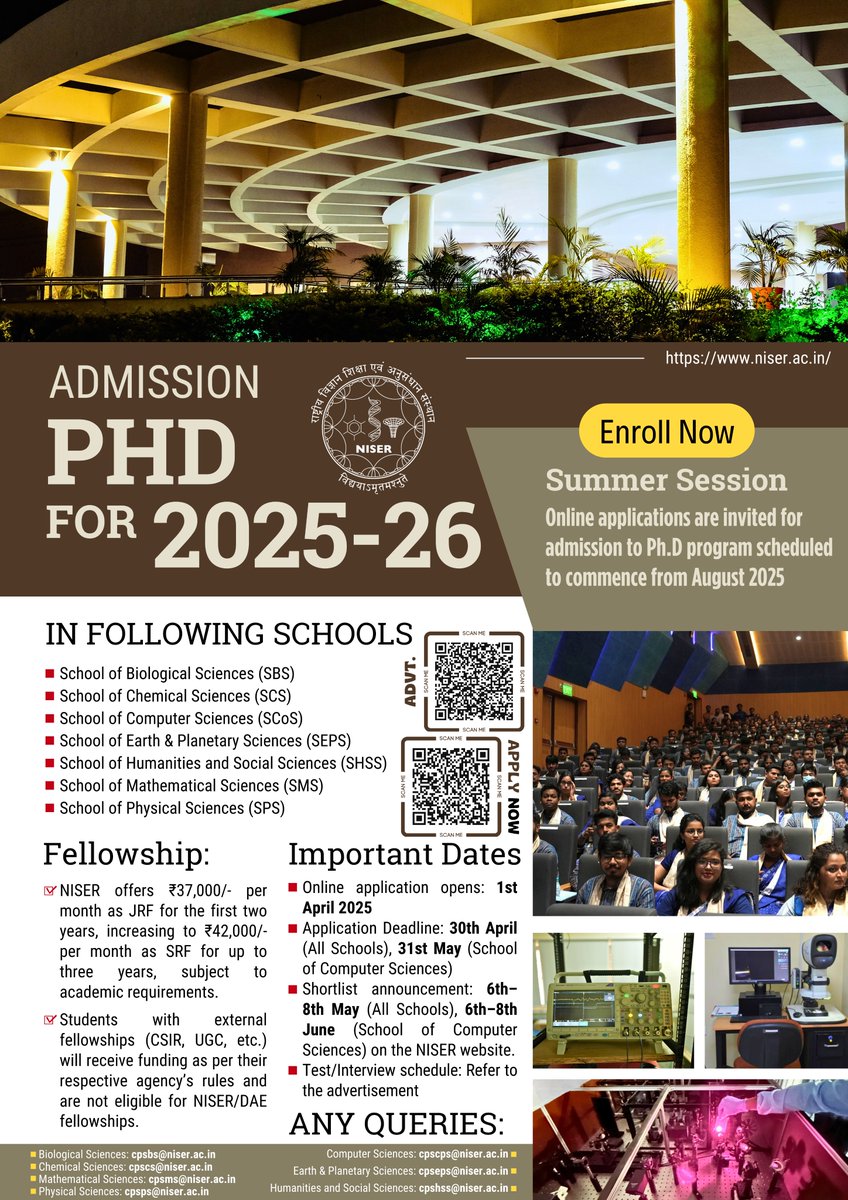
Online applications are invited for admission to the Ph.D. program (2025–26 Summer Session) at @niser_official, scheduled to commence in August 2025 across various schools. For more details, visit: tinyurl.com/2p9cj64e Apply by April 30, 2025 at: tinyurl.com/mr36ejzm
NISER tweet media
English
0
14
42
3.2K
Aritra
Aritra@aritrabanik·
'Adolescence' rocked me to my core. 🤯 The young actor's performance was absolutely mind-blowing . Can't believe this was his first-ever role. ⭐️⭐️⭐️⭐️⭐️ #Netflix #Adolescence #MustWatch
Aritra tweet media
English
0
0
5
226
Aritra retweetledi
ACM India
ACM India@Indiaacm·
🎙️ Call for Speakers: ACM India Eminent Speaker Program (ESP) Nominations for the February 2025 Round close on Feb 1, 2025. 💡 Benefits: ACM-sponsored travel, 2-year term, & a platform to engage widely. 🔗 Details & apply: india.acm.org/education/lear… #ACMIndia #EminentSpeakerProgram
ACM India tweet media
English
0
1
2
201
Aritra retweetledi
ACM India
ACM India@Indiaacm·
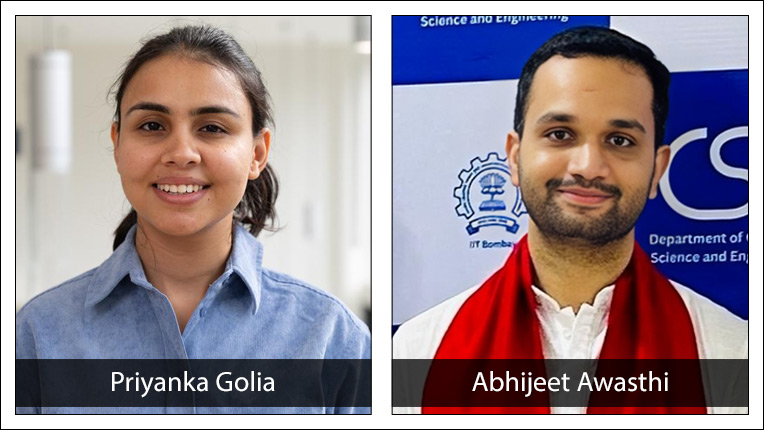
🎉✨ Congratulations to the ACM India 2024 Doctoral Dissertation Award winners!🏆 🏅 Winner: Priyanka Golia for her groundbreaking work on Boolean functional synthesis (Manthan) 👏 Honorable Mention: Abhijeet Awasthi for pioneering data-efficient NLP methods. #ACMIndia #Research
ACM India tweet media
English
1
3
31
13.5K