
Armin Bazarjani retweetledi
Armin Bazarjani
92 posts


Armin Bazarjani
@arminbazza
PhD Student @USC
Los Angeles, CA Katılım Ağustos 2021
105 Takip Edilen49 Takipçiler

Armin Bazarjani retweetledi

What can brains teach machines & machines teach brains?
We launch the first of a three-part special issue series on neuroscience & AI, featuring reviews on embodied intelligence and the schema spectrum, plus Q&As w/ leaders in the field. hubs.li/Q04ksJl-0

English
Armin Bazarjani retweetledi

For over a decade, we’ve accepted that end-to-end backprop is the only way to train deep networks. But holding the entire network in memory all at once is why AI training is hitting a resource wall.
We found a new way to break the network into blocks and train them independently. The trick? Treating the network’s forward pass like a diffusion model denoising a signal.
This reinterpretation slashes the memory needed to train deep models. In our #ICLR2026 paper (arxiv.org/abs/2506.14202), we matched end-to-end performance across ViTs, DiTs, and LLMs. We did this while training just one isolated block at a time.
Sakana AI@SakanaAILabs
Introducing DiffusionBlocks: Block-wise Neural Network Training via Diffusion Interpretation pub.sakana.ai/diffusionblocks What if we didn’t have to hold an entire neural network in memory to train it? Standard neural net training optimizes all parameters jointly. As a result, the memory required during training grows linearly with the depth of the network. In our #ICLR2026 paper, we propose DiffusionBlocks, a principled framework to train networks one block at a time, drastically reducing memory requirements while matching end-to-end performance. With DiffusionBlocks, we split the network into blocks and train them one at a time, so you only need memory for a single block. How? We explicitly assign each block a role: to move the representation a little closer to the target than the block before it did. That role turns out to be precisely what a diffusion model does, step by step. Each block only needs to optimize its own objective and can be trained independently. We validated this across five different architectures: • ViT • DiT • Masked diffusion • Autoregressive transformers • Recurrent-depth transformers In each case, performance is competitive with end-to-end training while using a fraction of the memory. This perspective also extends naturally to recurrent-depth (Looped) transformers, which apply the same network iteratively and normally require expensive backpropagation through time (BPTT). Viewed through DiffusionBlocks, we can replace those multiple iterations with a single forward pass during training. Read our paper and code, to learn more. Paper: arxiv.org/abs/2506.14202 GitHub: github.com/SakanaAI/Diffu… 🐟
English
Armin Bazarjani retweetledi

Where, exactly, does learning happen in the brain?
Out now @Nature , we identify a synaptic locus of birdsong learning and show that the circuit can be tuned to make birds learn faster, but at a cost.🧵 #neuroscience
nature.com/articles/s4158…
Open link: rdcu.be/fiyrS
English
Armin Bazarjani retweetledi

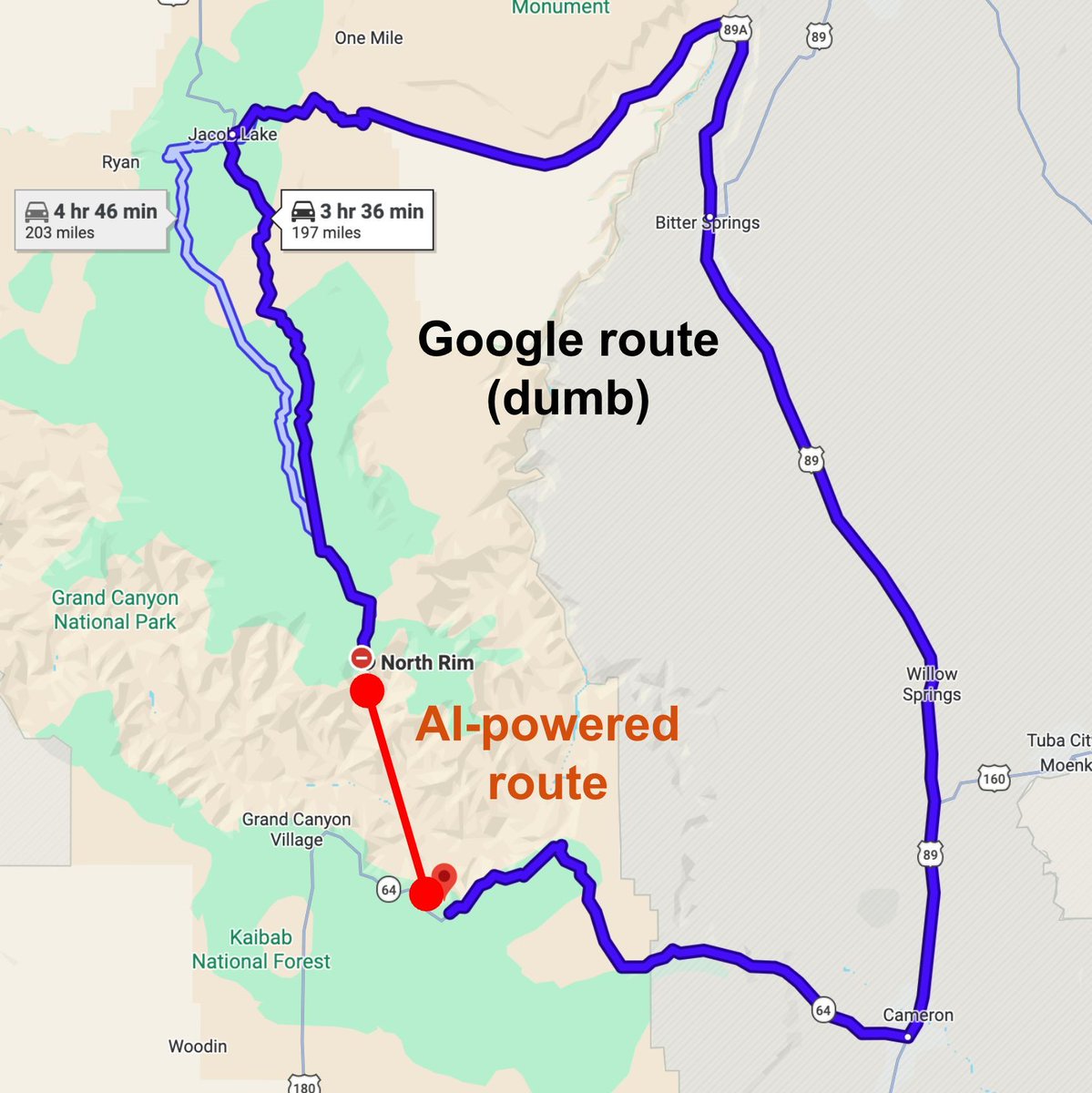
AI just saved me ~4 hours of driving on my vacation
i was planning a trip to the Grand Canyon and noticed the driving route was incredibly inefficient
i spun up a few claude code agents and used agentic ai to find this faster route
it will take me just a few minutes to drive, compared to 4 hours
if anyone has contacts at the US government lmk - happy to relay this to them
English
Armin Bazarjani retweetledi

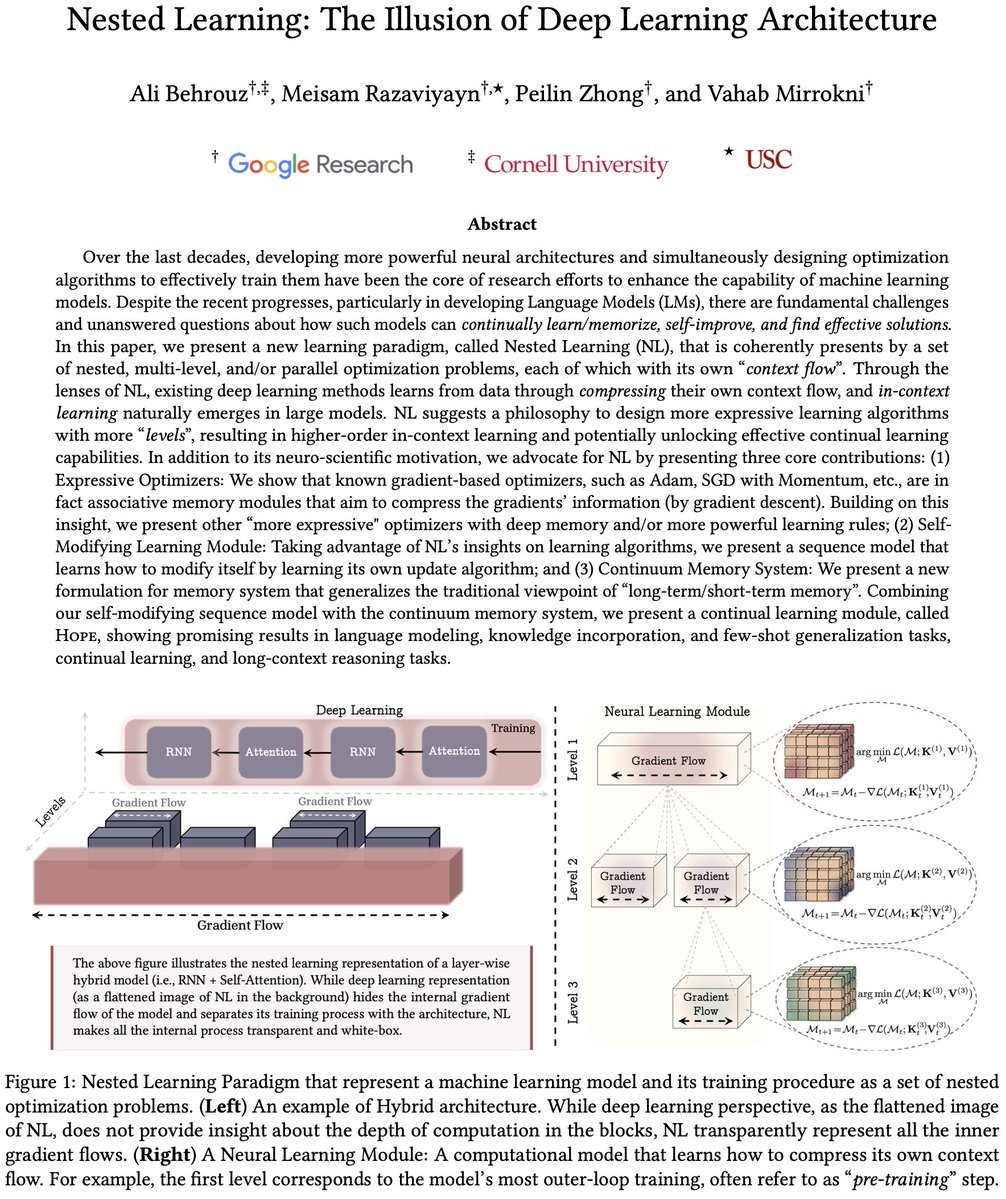
We keep scaling model parameters by increasing width and stacking more layers, but what if the truly missing axes for continual learning are compression and stacking the learning process?
Excited to share the full version of Nested Learning, a new paradigm for continual learning and machine learning in general.
Paper: nestedlearning.net/paper
English
Armin Bazarjani retweetledi

BREAKING - IRAN UPDATE
HRANA’s latest numbers.
Reminder: HRANA death confirmations take time as they go through multiple layers of confirmation.
Total confirmed fatalities: 3,919
Deaths under investigation: 8,949
Total: 12,868
Protesters: 3,685
Children under 18: 25
Military and regime forces: 178
Non-protesting civilians: 31
Severely injured: 2,109
Arrested: 24,669
Broadcast forced confessions: 145 cases
English
Armin Bazarjani retweetledi


Armin Bazarjani retweetledi
UPDATE on IRAN
HRANA’s latest numbers.
This is absolutely horrific.
Reminder: HRANA death confirmations take time as they go through multiple layers of confirmation.
Confirmed fatalities: 3,308 people
Deaths under investigation: 4,382 cases
Protesters: 3,097
Children under 18: 22
Military and regime forces: 166
Non-protesting civilians: 23
Severely injured: 2,107 people
Arrested individuals: 24,266 people
Broadcast forced confessions: 132 cases
English
Armin Bazarjani retweetledi

In this study, Piray shows a problem of low statistical power in many studies that use Bayesian model selection with computational modelling in psychology and neuroscience.
nature.com/articles/s4156…
English
Armin Bazarjani retweetledi

Excited to introduce Dreamer 4, an agent that learns to solve complex control tasks entirely inside of its scalable world model! 🌎🤖
Dreamer 4 pushes the frontier of world model accuracy, speed, and learning complex tasks from offline datasets.
co-led with @wilson1yan
English
Armin Bazarjani retweetledi

Check out our new paper in @Nature “Goal specific hippocampal inhibition gates learning”: nature.com/articles/s4158…
By @NuriJeong, Xiao Zheng, Abby Paulson, @StephmPrince and colleagues.

English
Armin Bazarjani retweetledi

New paper with @nathanieldaw in Nature Communications: an RL model that builds a successor map compositionally: it plans as well as the best models, and links components of the map used for planning to neural codes in the medial entorhinal cortex.
rdcu.be/eAofi
English
English

New review on computational approaches to studying human planning out now in @TrendsCognSci! Really enjoyed having the opportunity to write something broader about the field with the help of @evanrussek @marcelomattar @weijima01 and @cocosci_lab cell.com/trends/cogniti…
English

Humans and animals can rapidly learn in new environments. What computations support this? We study the mechanisms of in-context reinforcement learning in transformers, and propose how episodic memory can support rapid learning. Work w/ @KanakaRajanPhD: arxiv.org/abs/2506.19686
English
Armin Bazarjani retweetledi

📢 I'm happy to share the preprint: _Reward-Aware Proto-Representations in Reinforcement Learning_ ‼️
My PhD student, Hon Tik Tse, led this work, and my MSc student, Siddarth Chandrasekar, assisted us.
arxiv.org/abs/2505.16217
Basically, it's the SR with rewards. See below 👇

English
Armin Bazarjani retweetledi

Here's my favourite scenario from autonomous driving in Tokyo last week! 🇯🇵
English
Armin Bazarjani retweetledi


Armin Bazarjani retweetledi

Much of the field obsesses over end-to-end learning. But strong generalization requires compositionality: building modular, reusable abstractions, and reassembling them on the fly when faced with novelty.
The models of the future won't be just pipes, they will be Lego castles.
English
Armin Bazarjani retweetledi
A model of compositional state spaces in the #hippocampus shows latent learning and rapid generalisation, and predicts the emergence of place responses in replay – which is discovered empirically in an existing dataset
@BakermansJJW
nature.com/articles/s4159…
English