

allan farley
34.9K posts

allan farley
@asfarley
Freelance writer/journalist/editor. 2016 Dionisio Group Best Journalist/Writer Award. Baseball scout.
Katılım Nisan 2011
2.2K Takip Edilen941 Takipçiler

Guessing this is why some of them call him "Dumb McNamara"
DOW Rapid Response@DOWResponse
.@SECWAR "Under President Trump, we have built a different type of department. The Pentagon is no longer run by bureaucrats. Instead, it’s led by combat-tested veterans and world-class business leaders who are running the department like a business."
English
@TheBreakdownAB Simply call him a separatist to his face at every turn until he denies it.
English


@AdamKinzinger @AntiToxicPeople I got the memo. I need to RSVP pronto. Mass slaughter, then meet at Carly’s house for tacos, chips and lemonade.
English

@MondoABx Corus Entertainment chose not to disclose to its listeners that My Premier My Province is a paid political advertisement. Shame on them.
English

Alberta taxpayers paying for Danielle to gaslight us.
"So taxpayers are footing the bill for “Your Province, Your Premier” to the tune of almost $10,000 a month, and what we’re paying for can be broken down into 3 categories, The On Air Host, On Air Promotion and agency fees."
The Breakdown@TheBreakdownAB
Scoop! After years of the UCP making it out that there was no specific budget for "Your Province, Your Premier", it turns out that Albertans are paying A LOT! Like almost $10,000 a month a LOT! #abpoli #ableg #cdnpoli open.substack.com/pub/thebreakdo…
English
@dieworkwear Like the Tate bros, rapists prefer a slim, form hugging fit.
English

No, I don't think so. I think Conor McGregor's tailoring is best understood in the context of how labor has been deskilled for almost 200 years.
Let me explain.
Before the mid-19th century, most men who were not manual laborers wore bespoke clothes. In other words, their clothes were made specifically for them, typically by women working in the home or by bespoke tailors.
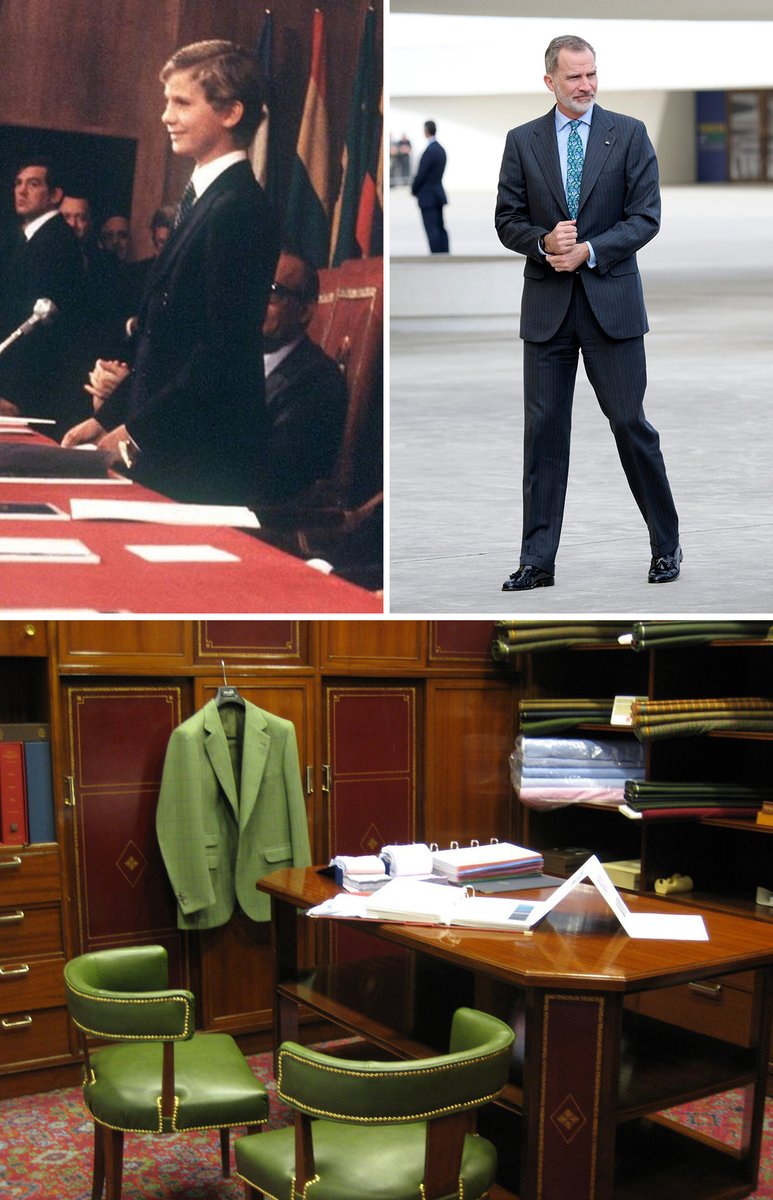
This is how the King of Spain gets his clothes. When he was 11 years old, his father brought him to see a bespoke tailor in Madrid named Jaime Gallo. Gallo made the King's clothes using traditional methods: he measured the King's body and then used those measurements to draft a paper pattern from scratch. This pattern, which serves as the garment's architectural blueprint, is used to mark and cut the cloth. The pieces are then roughly basted together into a wearable fitting garment. When the King tries on this garment, the tailor takes notes on what needs to be changed, deconstructs the garment, and makes the necessary adjustment. This process repeats three times — basted, forward, and final fitting — with each step bringing the garment to its final form.
This is partly why the King's clothes fit so beautifully: they were made by a skilled tailor and refined through multiple fittings. More important, however, is Gallo's technical skill. To be sure, not all tailors are so skilled, which is why I don't recommend going to just any random tailor.
Gallo continued making clothes for the King until his own death in 2015. In the first slide, you can see three photos: two of the King wearing Gallo's tailoring at different periods of his life, and a meeting desk at Sastreria Jaime Gallo (Gallo's workshop).
Most people today don't wear bespoke clothes. Instead, they wear ready-made clothes produced by manufacturers and sold by brands and retailers. The shrunken silhouette we see today was principally shaped in the early 2000s by three designers: Raf Simons, Hedi Slimane, and Thom Browne.
These men were not rebelling against classic tailoring, which has not been culturally relevant since the late 1960s. Instead, they were rebelling against the oversized tailoring of the '80s and '90s, which was also created by designers (such as Armani). In the 2012 documentary "Antifashion," Simons explains that he felt oversized silhouettes were "too American" and "macho" (think Arnold Schwarzenegger). He wanted something that felt younger, more European, and made for thin, effete bodies.
Slimane echoed this sentiment in a separate interview, saying that he felt bullied as a teen for not being very muscular, so he intentionally wanted to design things that felt more androgynous. He rejected the idea that every man needed to feel big and macho.
Whatever you want to say about the shrunken suit trend, there were no technical issues with the original versions. Along the top row of the second slide, you can see two suits by Slimane and Browne. Notice that there's no puckering or pulling. The collar hugs the neck. I also think the clothes look pretty good on the models. This is largely because there are still people with technical knowledge working at this stage.
The problems arise once those designs slide further away from such people. On the bottom row of the second slide, we can see Lionel Messi wearing a Thom Browne suit. IMO, it doesn't fit him as well as the model above him because he's a more muscular build. The original slim suits work best on thin figures with shoulders broader than the hips. Once you put these clothes on different figures, they can look egg-shaped.
This mismatch can happen for all sorts of reasons. The people involved in selling or styling clothes today often lack technical skills: editors, writers, stylists, salespeople, marketers, and such. The designer was already one step removed from the tailor (a technical person), but at least they can work with a pattern maker (another technical person). Many people today are another step removed from that technical layer.
Conor McGregor's clothes are from his own line, August McGregor, which he created with David August. Although David August works in custom clothing, he's not a tailor. He measures clients and sends those measurements to an overseas factory, where garments are produced by people who never meet the wearer. Conor's role is simply to market the product. He's a built-in influencer for the brand.
There was a recent Wall Street Journal article about the emergence of "muscle suits," which is to say, very bulky guys wearing slim-fit tailoring. IMO, this can only emerge from the history we talked about. As more people lack technical skills and more layers or barriers exist between them and people with technical skills, the garment can look more distorted or strange.
On the final slide, we see a video from Brimble and Clark, an custom tailoring company mentioned in the WSJ article. Like those from August McGregor, these are made-to-measure clothes produced in distant factories, though they use more stretch blends.
Someone once told me that the owner of Brimble and Clark holds a ceremony when he delivers a suit to you. When you come into the shop to pick up your suit, a painting is mechanically lowered to reveal a collection of tiny knives. The company owner takes one of the tiny knives, sews it behind your lapel, and then ceremoniously puts the jacket on you. Then it's time for your own private photoshoot, where you get to pose around Chesterfield field couches while wearing your jacket concealing a tiny knife. The purpose, of course, is simply to make the wearer feel good. The business person understands something important: how a customer feels is more important than whether the product is good.
This is essentially the system we have today. The company owner, salesperson, fitter, customer, writer, and influencer often possess little technical knowledge. The remaining expertise is concentrated among pattern makers and garment workers at the very end of the supply chain.
I think about this sometimes when I read about AI, as I think it represents yet another step towards the deskilling of labor. Perhaps one day, someone who knows how to draw with pen and paper will look at an AI-generated image and recognize certain distortions that many have come to accept. But AI is outside my area of expertise, so I'll leave that discussion to others.


Muhammad Lucman@mlucman_
@dieworkwear Do you think conner’s type of style is a “anti” movement against the traditional/relaxed fit style and therefore makes sense why people went that way?
English
@Tony__Clark @sunn_time @DevinDVote We know where he stands. Instead of asking, simply call him a separatist to his face at every turn until he denies it.
English

Dreeshen refuses to answer how he'll vote on the separation question. Says he’s “proud” we’re having that vote in October.
Weak sauce, Minister @DevinDVote. You're a minister of the Crown. Albertans deserve to know where you stand.
#ableg
Devin Dreeshen@DevinDVote
Tune in to hear about another milestone on the Deerfoot.
English
@abbylabar_ @MLBNetwork Watching right now - Red Sox Orioles highlights.
English

Let’s have a full week of QP! We’re rolling all night on @MLBNetwork just like the Red Sox have been rolling through 14 straight #QuickPitch

English


@jaketapper No one will watch your crappy program. Do your job and go find Mitch McConnell. And report on the sickly, deranged president, too.
English

“Ben Sasse is Going Home: Lessons on Life and Death” premieres Sunday, July 26 at 8pm ET/PT and will be available to stream the following day at CNN.com/watch and on the CNN app for CNN streaming subscribers.

English
@TheBreakdownAB Why didn’t AM770 tell the listeners that it was a taxpayer funded show? Corus Entertainment has some culpability in the hoodwink.
English

Scoop!
After years of the UCP making it out that there was no specific budget for "Your Province, Your Premier", it turns out that Albertans are paying A LOT!
Like almost $10,000 a month a LOT!
#abpoli #ableg #cdnpoli
podcasts.apple.com/ca/podcast/the…
English
@FarhanLaljiTSN @CFLonTSN It would be nice if someone actually knew the overtime rules.
English

Disappointing for #Redblacks fans to have to go through this. They lost the game early in 3rd qtr when they couldn’t convert on 3 cracks from the 1. Then an end zone int on the next series. Let #Bombers hang around & got burned. @CFLonTSN
TSN@TSN_Sports
THE BOMBERS SHUT DOWN OTTAWA'S 2PT ATTEMPT AND WIN IN OVERTIME! 😤 What a shootout from these two teams! #CFL
English
@OrevaZSN I worked at a car dealership as a salesman. My boss allowed us one ‘go fuck yourself’ or reasonable facsimile per month, with permission granted first. I only used it once. Told husband and obnoxious wife to get the fuck out of my office and get the fuck off this car lot.
English
@LWillson_82 Now if only your network’s directors would quit missing live action play because of a ridiculous need to show every replay.
English

Tip of the cap to the board of Governors and CFL commissioner! They put their necks on the line to make the league better and it’s showing!
TSN@TSN_Sports
WIDE LEFT! TI-CATS WIN! 🤯 LIRIM HAJRULLAHU MISSES THE GAME WINNER AND THE TIGER-CATS WIN DUE TO THE ABSENCE OF THE ROUGE 🐅 #CFL
English
allan farley retweetledi

Sheeba has now been at the shelter 525 days 💔
Bio: 24Petconnect.com/DetailsMain/PP…
Town of Hempstead Animal Shelter, Wantagh, New York (Long Island.) Email: adoption@hempsteadny.gov
#Dogs #NewYork #LongIsland #AdoptDontShop
English
allan farley retweetledi
Storm has now been at the shelter 503 days 💔
Bio: 24Petconnect.com/DetailsMain/PP…
Town of Hempstead Animal Shelter, Wantagh, New York (Long Island.) Email: adoption@hempsteadny.gov
#Dogs #NewYork #LongIsland #AdoptDontShop
English
allan farley retweetledi

Welcome Lanceleaf – the cutest little Westie with the biggest grin.
More about Lanceleaf: f.mtr.cool/svemoxxlev
English
English

Alex and Geddy are having way too much and so are the fans. Night two on Saturday at the United Center and another great show from Rush in Chicago.

English
@TrueFactsStated I was 10 when I snuck into Janis Joplin in 1970. Bought my first ticket in 1973 to The Guess Who and Freddie King.
English

1978 Jackson Brown in Portland, Maine. My first concert. What was yours?
Staff Sergeant Johnson@Colonel_Myway
When I have a bad day... I circle back to this song and share it... When I wake up the next day my friends have lifted me up... I wish you my kind of Big ❤️ success...
English