ashhanai

514 posts

ashhanai

ashhanai

@ashhanai

@genericmoney || prev builder @pwndao || ERC5646 || permissionless protocols maxi

Katılım Şubat 2013
1.3K Takip Edilen374 Takipçiler
ashhanai retweetledi

Ignas | DeFi
Ignas | DeFi@DefiIgnas·
Teams lining up one after another to contribute to the rsETH recovery is one of the most wholesome moments in DeFi. Reminds you what this space can actually do when it matters.
English
35
26
355
9.4K
David Wong
David Wong@cryptodavidw·
I'm a zk guy, scare me with one word
English
165
3
132
27.9K
ashhanai
ashhanai@ashhanai·
@hasufl I guess it’s time to start distinguishing between Defi and ImDefi (immutable Defi). Kudos to @LiquityProtocol
English
0
0
0
4
Hasu⚡️🤖
Hasu⚡️🤖@hasufl·
Every Defi protocol should have: 1. Circuit breakers for deposit and withdrawals, and possibly other internal operations as well 2. Timelocks for any change 3. Security councils that can shut down protocols immediately We don't need insurance, we need to do start doing the ffcking basics correctly. It's too early for this space to drive without any training wheels. I beg you, sacrifice a tiny bit of UX to gain a lot of peace of mind. The worst possible UX is losing your user's money.
English
74
88
876
182.8K
Vladimir S. | Officer's Notes
Vladimir S. | Officer's Notes@officer_secret·
Here is a aWETH redemption protocol allowing ETH lenders on Aave to swap into wstETH or weETH. Even if user has debt against ETH, he can swap collateral to wstETH or weETH and the debt will remain the same. It will significantly reduce systematic risk for Aave, users, and DeFi as a whole. Initial capacity is $1 Billion ETH. fluid.io/lite/aave-v3/e…
English
12
13
97
12.8K
ETHPrague
ETHPrague@EthPrague·
🎉 We’re excited to announce ETHPrague 2026 🎉 Celebrating our 5th anniversary in a very special venue! 🗓️ 8-10 May 2026 📍 Obecní dům Join us for three days of hackathon and conference, uniting builders, researchers, and dreamers to foster Ethereum culture. Stay tuned for updates and get ready for an extraordinary experience in Prague ✨
English
37
57
299
60.1K
ashhanai retweetledi
Generic.Money
Generic.Money@genericmoney·
GUSD is now live on @tempo A payments-first blockchain needs a payments-first stablecoin. Built on the new TIP-20 standard, it delivers best-in-class risk-adjusted yield via native reward distribution. Up next: confidential payments.
Tempo@tempo

Tempo Mainnet is live! Starting today, anyone can build on Tempo through our public RPC endpoints. Alongside mainnet, we’re introducing the Machine Payments Protocol, an open standard for machine payments.

English
17
4
23
6.9K
ashhanai retweetledi
Mario Havel
Mario Havel@TMIYChao·
@Ethereum community crowdloan is 100% funded with 45 individual contributors and 13 hours to go. Thank you so much everyone, BORDEL 2.0 awaits
Mario Havel tweet media
English
11
7
71
4.4K
ashhanai retweetledi
Generic.Money
Generic.Money@genericmoney·
$3 million in crisp generic onchain dollars $GUSD.
Generic.Money tweet media
English
2
4
12
1.4K
ashhanai retweetledi
Aragon.eth 🦅
Aragon.eth 🦅@AragonProject·
As protocols become a new layer of global financial infrastructure, jurisdictions that sustain the capacity to build secure open systems will help determine which standards shape the future. The EPAA outlines principles to advance policy goals while enabling protocol builders.
Aragon.eth 🦅 tweet media
English
10
16
56
8.2K
ashhanai retweetledi
vitalik.eth
vitalik.eth@VitalikButerin·
This is a good post on the impact of surveillance in Iran: myprivacy.blog/the-digital-ir… It's worth reading. IMO one mistake that freedom advocates often make is that we talk about privacy violation and surveillance as "dystopian", using the word as a semantic stop sign: we know it means "bad", we nod along, and don't really go further to clarify why it's bad. I worry that this approach is long-run unhealthy: when we criticize various companies and countries for being "dystopian" and stop there, then to someone who's not already in the same memeplex, it sounds like we're basically criticizing companies and countries for not complying with our culture's aesthetic preferences. Which is ... duh, companies and countries are *supposed* to not comply with each other's aesthetic preferences, that's the whole point of the "pluralism" thing. What the above article makes clear so well is that "dystopian" surveillance is not bad because it's "dystopian", it's bad because it makes a concrete property of the world worse: the power balance between individual and state. Surveillance enables an outcome where basically everyone other than police and security forces has no opportunity whatsoever to challenge the political status quo without being punished. This means an outcome where a political regime can remain in power forever, without satisfying more than a very small coalition of people who have the eyes and the guns (now drones). The Dictator's Handbook talks about "large coalition" and "small coalition" governments; large coalition governments are the ones that are more pro-human, because they, well, have to keep a large coalition happy. Small coalition ones are the really nasty ones. Here is the near-term dark outcome of dictatorship + automated warfare + surveillance: a regime can literally survive with a coalition of size 1, because an army of all-seeing eyes and robots can defeat the entire populace in battle if needed. In Iran, we see what *just* dictatorship with surveillance can do, once you add automated police, you get to the unholy trifecta. I don't know of a good solution to this. Privacy technology, as well as more work on censorship-resistant internet (I think we should strive for at least basic-quality internet, eg. 1 Mbps, being a global human right outside the domain of nation-state sovereignty), can help somewhat to reduce the possibility of total government control. But what else? --- BTW one implicit frame in the article I take some issue with is framing Iran + Russia + China as the unique antagonists (both in surveillance they do internally, and in the technology they export to other countries). They do a lot of dystopian shit of both types. However, Israeli and US tech companies, and undoubtedly tech companies from other Western nations, also do a lot of dystopian shit. Perhaps one key difference between the surveillance described above, and the Western type, is: * The surveillance in the above article is about exercising *great control over a medium area*: you can see everything, but it requires active participation of the government of the territory being surveilled. * The Israeli / US / Western flavor is about exercising *medium control over a great area*: there are more limits to how much they can do, but their surveillance is global: they know what people are doing even in countries and territories they have no presence in. The distinction is not absolute: Israeli surveillance backstops a lot of its human rights abuse in Palestine, US surveillance reinforces ICE abuses (see the recent article about Homeland Security demanding social media firms reveal names of anti-ICE protesters), etc, and "transnational repression" is done by anti-Western countries. But *on average*, the above seems to be the pattern. The two are differently scary. The former for the reasons I described above. The latter because it allows global projection of power: a politician or civil servant in one country now has to worry about being blackmailed, droned or otherwise attacked from other countries. The USA has shown willingness to go after individual EU officials, ICC officials (see recent articles on both), and others. Ultimately, I suspect that even democratic governments will want more privacy to protect themselves, and we will have to have deep conversations about what "democratic accountability" means: how can a civil servant be accountable to the people, but not accountable to foreign spooks? My high-level frame is: privacy generally helps whoever is weaker. "Weaker" does not mean "moral": sometimes the weaker side is criminal. But in the 21st century, we are at serious risk of stronger factions using modern technologies to establish unbreakable lock-in to power. And so on average, reducing the gradient of power, giving the weak a fighting chance, is something that the world desperately needs.
English
305
201
1.3K
125.8K
ashhanai retweetledi
Generic.Money
Generic.Money@genericmoney·
$1 million in crisp generic onchain dollars.
Generic.Money tweet media
English
2
3
17
2K
ashhanai retweetledi
DefiLlama.com
DefiLlama.com@DefiLlama·
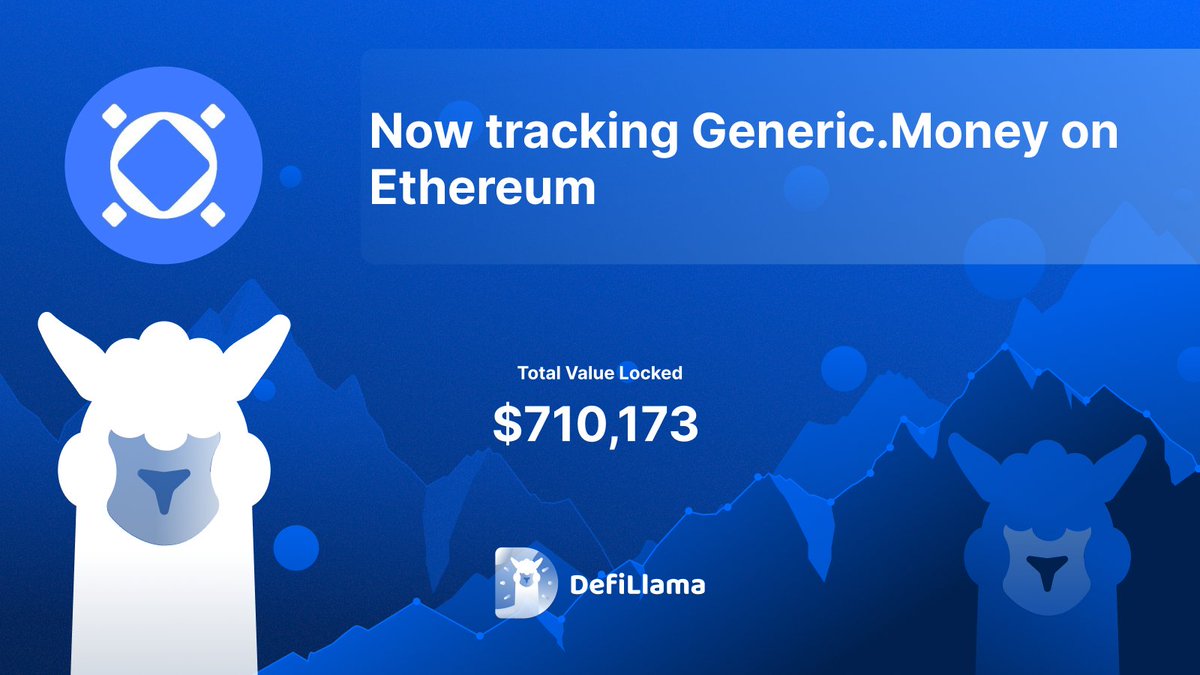
Now tracking @genericmoney on @ethereum Generic provides stablecoin-as-a-service that delivers users risk-adjusted onchain yield and payments-ready privacy without the overhead and cost of offchain issuers
DefiLlama.com tweet media
English
2
3
14
3K
ashhanai retweetledi
Status Network
Status Network@StatusL2·
Got stables sitting idle? deposit USDS / USDC / USDT into Status Network pre-deposit vaults and earn: > KARMA > liquid rewards in SNT & LINEA > Generic Protocol points > Status Network native apps points > and more ⤵︎
Status Network@StatusL2

GUSD pre-deposit vault is now open! this is the final asset to be onboarded before Status Network mainnet (targeting end of Q1 2026) your last opportunity to seed liquidity early and earn rewards and liquid yield on the first gasless, privacy-focused L2 powered by native yield full breakdown ↓ bit.ly/3NtQpmA

English
5
5
23
1.5K
ashhanai
ashhanai@ashhanai·
The best defense is… math
English
0
0
0
20
ashhanai
ashhanai@ashhanai·
> DEVS in the ancient Roman sense, where the letter V was used to represent the U sound. Is my new favorite devs meme
vitalik.eth@VitalikButerin

I no longer agree with this previous tweet of mine - since 2017, I have become a much more willing connoisseur of mountains. It's worth explaining why. x.com/VitalikButerin… First, the original context. That tweet was in a debate with Ian Grigg, who argued that blockchains should track the order of transactions, but not the state (eg. user balances, smart contract code and storage): > The messages are logged, but the state (e.g., UTXO) is implied, which means it is constructed by the computer internally, and then (can be) thrown away. I was heavily against this philosophy, because it would imply that users have no way to get the state other than either (i) running a node that processed every transaction in all of history, or (ii) trusting someone else. In blockchains that commit to the state in the block header (like Ethereum), you can simply prove any value in the state with a Merkle branch. This is conditional on the honest majority assumption: if >= 50% of the consensus participants are honest, then the chain with the most PoW (or PoS) support will be valid, and so the state root will be correct. Trusting an honest majority is far better than trusting a single RPC provider. Not trusting at all (by personally verifying every transaction in the chain) is theoretically ideal, but it's a computation load infeasible for regular users, unless we take the (even worse) tradeoff of keeping blockchain capacity so low that most people cannot even use the chain. Now, what has changed since then? The biggest thing is of course ZK-SNARKs. We now have a technology that lets you verify the correctness of the chain, without literally re-executing every transaction. WE INVENTED THE THING THAT GETS YOU THE BENEFITS WITHOUT THE COSTS! This is like if someone from the future teleported back into US healthcare debates in 2008, and demonstrated a clearly working pill that anyone could make for $15 that cured all diseases. Like, yes, if we have that pill, we should get the government fully out of healthcare, let people make the pill and sell it at Walgreens, and healthcare becomes super affordable so everyone is happy. ZK-SNARKs are literally like that but for the block size war. (With two asterisks for block building centralization and data bandwidth, but that's a separate topic) With better technology, we should raise our expectations, and revisit tradeoffs that we made grudgingly in a previous era. But also, I have actually changed my mind on some of the underlying issues. In 2017, I was thinking about blockchains in terms of academic assumptions - what is okay to rely on honest majority for, when we are ok with 1-of-N trust assumption, etc. If a construction gave better properties under known-acceptable assumptions, I would eagerly embrace it. On a raw subconscious level, I don't think I was sufficiently appreciative of the fact that _in the real world, lots of things break_. Sometimes the p2p network goes down. Sometimes the p2p network has 20x the latency you expected - anyone who has played WoW can attest to long spans of time when the latency spiked up from its usual ~200ms to 1000-5000ms. Sometimes a third party service you've been relying on for years shuts down, and there isn't a good alternative. If the alternative is that you personally go through a github repo and figure out how to PERSONALLY RUN A SERVER, lots of people will give up and never figure it out and end up permanently losing access to their money. Sometimes mining or staking gets concentrated to the point where 51% attacks are very easy to imagine, and you almost have to game-theoretically analyze consensus security as though 75% of miners or stakers are controlled by one single agent. Sometimes, as we saw with tornado cash, intermediaries all start censoring some application, and your *only* option becomes to directly use the chain. If we are making a self-sovereign blockchain to last through the ages, THE ANSWER TO THE ABOVE CONUNDRUMS CANNOT ALWAYS BE "CALL THE DEVS". If it is, the devs themselves become the point of centralization - they become DEVS in the ancient Roman sense, where the letter V was used to represent the U sound. The Mountain Man's cabin is not meant as the replacement lifestyle for everyone. It is meant as the safe place to retreat to when things go wrong. It is also meant as the universal BATNA ("Best Alternative to a Negotiated Agreement") - the alternative option that improves your well-being not just in the case when you end up needing it, but also because knowledge of it existing motivates third parties to give you better terms. This is like how Bittorrent existing is an important check on the power of music and video streaming platforms, driving them to offer customers better terms. We do not need to start living every day in the Mountain Man's cabin. But part of maintaining the infinite garden of Ethereum is certainly keeping the cabin well-maintained.

English
0
0
1
46
ashhanai retweetledi
Generic.Money
Generic.Money@genericmoney·
The pioneering GUSD vault for @StatusL2 pre-deposits is open! Deposit USDC/USDT/USDS now to earn juicy rewards & upon Status's launch, see it transform into GUSD liquidity, fuelling the network's economic engine. This is what "native yield-funded networks" look like in practice
Status Network@StatusL2

GUSD pre-deposit vault is now open! this is the final asset to be onboarded before Status Network mainnet (targeting end of Q1 2026) your last opportunity to seed liquidity early and earn rewards and liquid yield on the first gasless, privacy-focused L2 powered by native yield full breakdown ↓ bit.ly/3NtQpmA

English
7
13
25
2.5K
ashhanai
ashhanai@ashhanai·
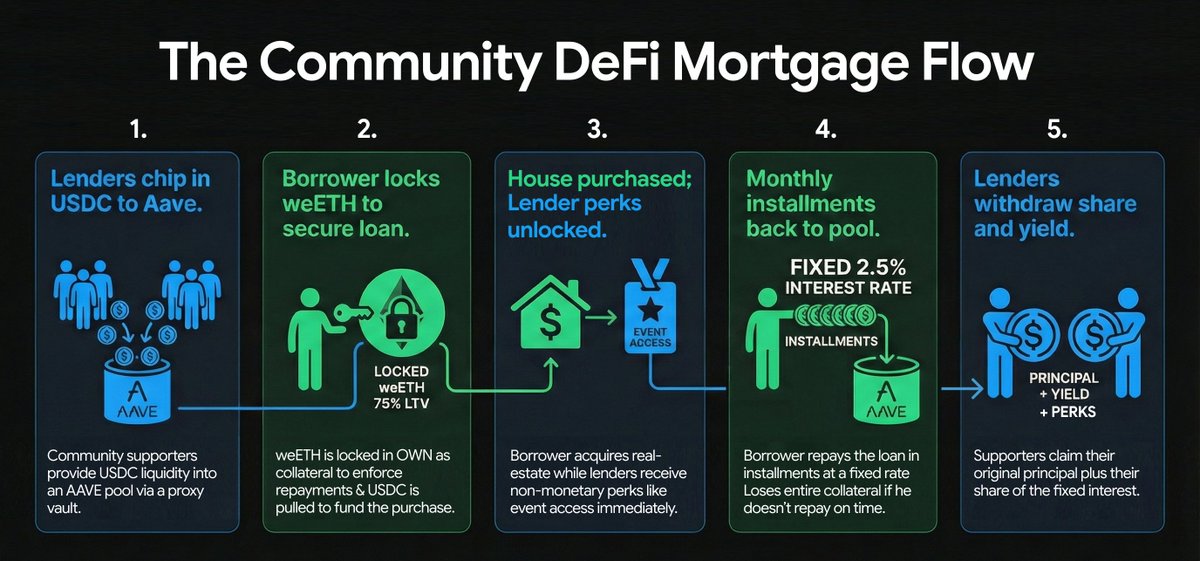
@josefje Afaik, installments are held in OWN, not Aave.
English
0
0
0
26