
Ashit Vora
4.8K posts


Ashit Vora
@ashitvora
Co-founder, RaftLabs - on-demand product teams for agencies & SaaS founders | @USC Alumni
Katılım Ağustos 2008
93 Takip Edilen942 Takipçiler
@lydiahallie Don't you think, it's your moral responsibility to compensate users who got charged for extra credits or whose usage was consumed because of bugs on your end? You are confessing the mistakes on your part but doing nothing except saying sorry.
English

Thank you to everyone who spent time sending us feedback and reports. We've investigated and we're sorry this has been a bad experience.
Here's what we found:
Lydia Hallie ✨@lydiahallie
We're aware people are hitting usage limits in Claude Code way faster than expected. Actively investigating, will share more when we have an update!
English

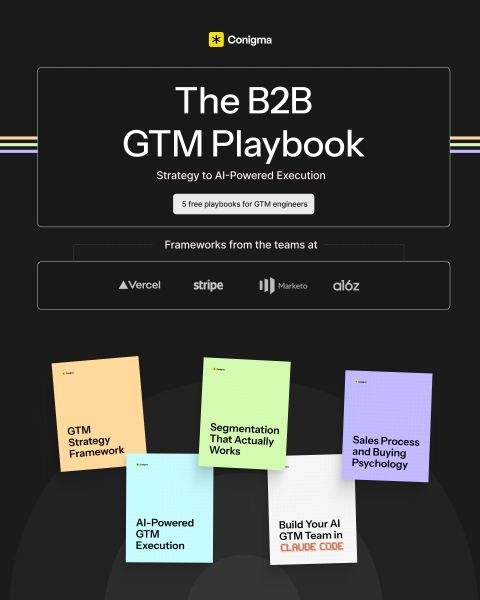
A two-person GTM team at a Series B SaaS company closed $2.4M in pipeline in one quarter.
No SDRs. No demand gen agency. No paid ads.
Signal-based outreach. Intent scoring. AI-sequenced follow-up. Automated reporting.
Two GTM engineers running the whole motion - for one quarter.
I pulled it apart.
Compared it to every system we've built across the GTM teams we've worked with.
Then asked myself one question:
If I had to reverse engineer this from scratch - what would it actually look like?
Turns out the architecture isn't that complicated.
I mapped the whole thing into a step-by-step playbook you can upload directly to any LLM.
It walks you through building your own version from GTM strategy to fully AI-powered execution.
Comment "GTM" and I'll send it over.
English

We offered $5,000 to whichever employee got the most engagement on LinkedIn in a single quarter.
$2,500 for second.
$1,500 for third.
Plus $500 for anyone who published 20+ times.
The result: 24 employees published 581 posts in 85 days. 43,000+ reactions. 28,000+ comments. 34,000+ new followers.
27 new clients signed. $153,000 in new MRR.
I remember one guy from our team had less than 1,000 followers when the competition started. Today? 10,000+ followers.
The total prize pool cost us about $15K. The return was $153K per month. Every month. Recurring.
People need a reason to do things that aren't in their job description.
Cash works.
English
Ashit Vora retweetledi

I never use plan mode.
The main reason this was added to codex is for claude-pilled people who struggle with changing their habits.
just talk with your agent.
Anthony Kroeger@kr0der
slowly starting to use plan mode a LOT less nowadays i realised whenever i use plan mode, it generates a gigantic plan and then i dont read it and hit build out of laziness having a meaningful conversation with the AI agent to discuss implementation feels a lot easier 🤔
English

THIS HACK SAVES YOU 2 HOURS OF DEAD TIME ON CLAUDE CODE EVERY DAY
if you're on a Max plan you know the pain. you start working at 8:30 AM, hit the limit by 11, and you're stuck until 1 PM. two hours of nothing.
here's the fix:
your 5-hour usage window starts when you send your first message, floored to the clock hour.
so if you send a throwaway "hi" using Haiku at 6 AM before your workday, the window anchors to 6-11 AM instead of 8 AM-1 PM.
by 11 AM when you'd normally be locked out, you get a fresh window instead.
this guy automated it with a GitHub Actions cron job that sends the message every morning automatically.
works on any plan. Pro, Max 5x, Max 20x.
fork the repo, add your OAuth token, set the cron, done.
or if you want it even simpler, you can do the same thing with Claude's built-in scheduled tasks

English
@phuctm97 They could do that.
The USP is not the tool but the model behind it.
English

At this point, Anthropic should just open-source Claude Code, put a non-commercial license on it.
Problem solved. No one to blame. No one to sue. And the Internet gets a little more wholesome.
English
Ashit Vora retweetledi

I don't think people understand what this actually means.
Every application on earth can now build an agent that teaches ITSELF how to use the application through the UI.
Not through API integrations. Not through documentation. Through the actual interface, the same way a human learns.
Here's the loop:
You define what success looks like (an eval). You point Claude at your application via Computer usage. Claude tries to complete the task through the UI. It fails. It writes what it learned to a skill file. It tries again. Recursively. Hundreds of times.
This is Karpathy's auto-research method applied to software usage.
Let me make this concrete.
I built a company called CoinLedger — crypto tax software, ~1 million users. The product is powerful but complicated. Users have to import wallets, classify transactions, handle edge cases, and generate accurate tax reports. The learning curve is our single biggest challenge.
With Claude computer use, I can hand it public wallet addresses and CSV files and say: use CoinLedger to produce an accurate capital gains report with no errors.
Claude opens the app. Navigates the import flow. Hits an error. Documents the failure. Adjusts. Tries again.
Each cycle produces better skill files. Each skill file captures how to properly use a specific part of the app. After enough iterations, Claude has built a complete agent harness — a set of instructions that lets it use CoinLedger as well as our best power user.
Then I ship that agent to every user who struggles with the platform.
The biggest friction in a million-user product, solved by an AI that grinded through the learning curve so humans don't have to.
Now multiply this across every complex application. Every SaaS product with a steep onboarding curve. Every enterprise tool where 90% of users touch 10% of features.
The first applications that build these recursive agent harnesses will compound in ways their competitors can't catch.
Claude@claudeai
Computer use is now in Claude Code. Claude can open your apps, click through your UI, and test what it built, right from the CLI. Now in research preview on Pro and Max plans.
English
Ashit Vora retweetledi
saying "hello" to Claude on the Pro plan now costs 2% of your entire session usage
one message. "hello, how are you?" that's it.
this is why people are mass migrating to Codex right now because its literally impossible to reach limits
anthropic needs to fix this before they lose the crazy amount of developers they just gained
English
Ashit Vora retweetledi

I wanted to share a bunch of my favorite hidden and under-utilized features in Claude Code. I'll focus on the ones I use the most.
Here goes.
English
@NTanjore @law_ninja Yes. Of course.
But the source of info for India kanoon, Taxmann, etc is also official court records. Right?
They can access and use/publish them, others can as well. No?
English

That can happen only when the scc online, indiakanoon, taxmann etc colloborate with ai. Ai can only cite case laws available on public domain, or hallucinate to produce one. Taxmann.ai is now available with access to its entire data base. Ai is as good as the prompts u give, just like what it used to be for computers GIGO!
English

Indian law firms run on MS Word, WhatsApp, and memory. AI hasn't touched them. Yet.
India has 1.5 million registered advocates.
Most of them run their practice out of a single room, a shared chamber, or a small 3-person office.
Ask any lawyer in Tis Hazari, City Civil Court Mumbai, or a district court in Patna if they use AI in their practice.
Most will say yes. They mean they asked ChatGPT to summarize a judgment
once. Or wrote some mails with gemini.
That is not automation. That is not a workflow. That changes nothing about how
the practice actually runs.
Real AI deployment, the kind where a client intake form auto-populates a case file, where hearing dates trigger automatic reminders, where a standard contract gets drafted in 3 minutes not 3 hours, that is essentially at zero in Indian law firms below 20 people.
Not 7%. Not 2%. Essentially zero.
Why this is the biggest untapped market in Indian legal right now:
India's large law firms are moving fast. Trilegal, AZB, Cyril Amarchand. AI for contract review, due diligence, legal research. They have technology budgets.
They have AI teams.
Their smaller counterparts? Still on Word templates from 2014. Still maintaining case diaries in physical notebooks. Still calling clients manually to remind them of hearing dates.
The gap between large firm and small firm on AI is not a technology problem.
It is a deployment problem.
The tools exist. Contract drafting with Claude. Case management with AI-integrated tools. Client communication via WhatsApp automation. Document review with GPT-4. Most under Rs 5,000 a month.
What doesn't exist is a person who walks into the law firm, understands the workflows, and builds it.
That person is the Legal AI Workflow Architect.
What this person actually does:
Real example.
A litigation lawyer in Saket District Court handles 150 active matters. Each matter needs:
- Hearing date tracked and reminded to client
- Case documents organized and retrievable
- Client billing updated after each appearance
- Drafts prepared for next hearing
- Court fee calculations done
Currently: one overworked clerk. Dates missed. Clients calling constantly. Bills sent late or not at all.
A Legal AI Workflow Architect builds this in 4 weeks:
- WhatsApp bot that sends hearing reminders automatically
- Document folder structure auto-created on new matter intake
- Billing tracker updated after each court date
- Standard draft templates pre-filled from case details
- Court fee calculator integrated into the intake form
Cost to the lawyer: Rs 15-20,000 one-time. Rs 2,000 per month to maintain.
Value to the lawyer: 2 hours saved per day. One less clerk needed. Zero missed dates. Clients who feel looked after.
This is not complicated. It is not being done because nobody is walking in to do it.
The junior lawyer crisis and the small firm gap are the same story.
Entry-level hiring at top law firms: collapsing. AI is doing the contract review, the legal research, the painful due diligence, the first draft. The work that used to go to a fresh LLB graduate.
712 lawyers have already been sanctioned globally for AI hallucinations in court filings. The ones who used AI carelessly. Not the ones who deployed it properly.
Large firms are cutting junior headcount. The work isn't disappearing. It is being done differently.
But 1.4 million small practitioners have no automation at all. They are drowning in admin. They are losing clients to better-organized competitors. They are billing less than they should because they cannot track their own time.
The same disruption that shrinks the large firm associate pool creates the legal AI deployment market. These are not separate events. They are the same event, viewed from different angles.
The skill set is learnable. In months, not years.
You do not need to be a technologist. You need to understand legal workflows and know how to connect tools.
Legal process mapping: if you have worked in any law firm, you already know this
- One automation platform like n8n or Make: 3-4 weeks
- Prompt engineering for legal drafting: 2 weeks
- API basics, connecting tools: 3-4 weeks
Three months of focused learning. Then you walk into one solo practitioner or small firm with a painful manual process and you fix it.
India has 1.5 million lawyers. The ones who learn to deploy AI into legal workflows will not just survive what is coming. They will own the future.
If you are struggling to get a good job or internship in law, just learn how to do it. Your legal career will be unstoppable.
English

This is the most annoying thing in Claude Code.
Hiding raw text when you paste more than 4 lines. Terrible UX decision.

English
@dani_avila7 Have you seen any quality difference between code written by Opus vs Sonnet?
English

Did you know about the opusplan model in Claude Code?
/model opusplan
It's a hybrid alias that automatically uses Opus in plan mode for complex reasoning, then switches to Sonnet for execution.
Best of both worlds: Opus thinks, Sonnet builds
English
@CasJam What has worked the best for me is Time Blocking.
I usually have time blocked for things to do so the first thing I do is to look at the calendar and see what's the plan for the day. Of course, I have 3 hrs set aside to learn about what's new that's happening in the industry.
English

How do you plan and prioritize your day and week?
What's your system? Not your favorite tool.
English
Ashit Vora retweetledi


English
Last month we welcomed 100,000 new @TallyForms users 🤯
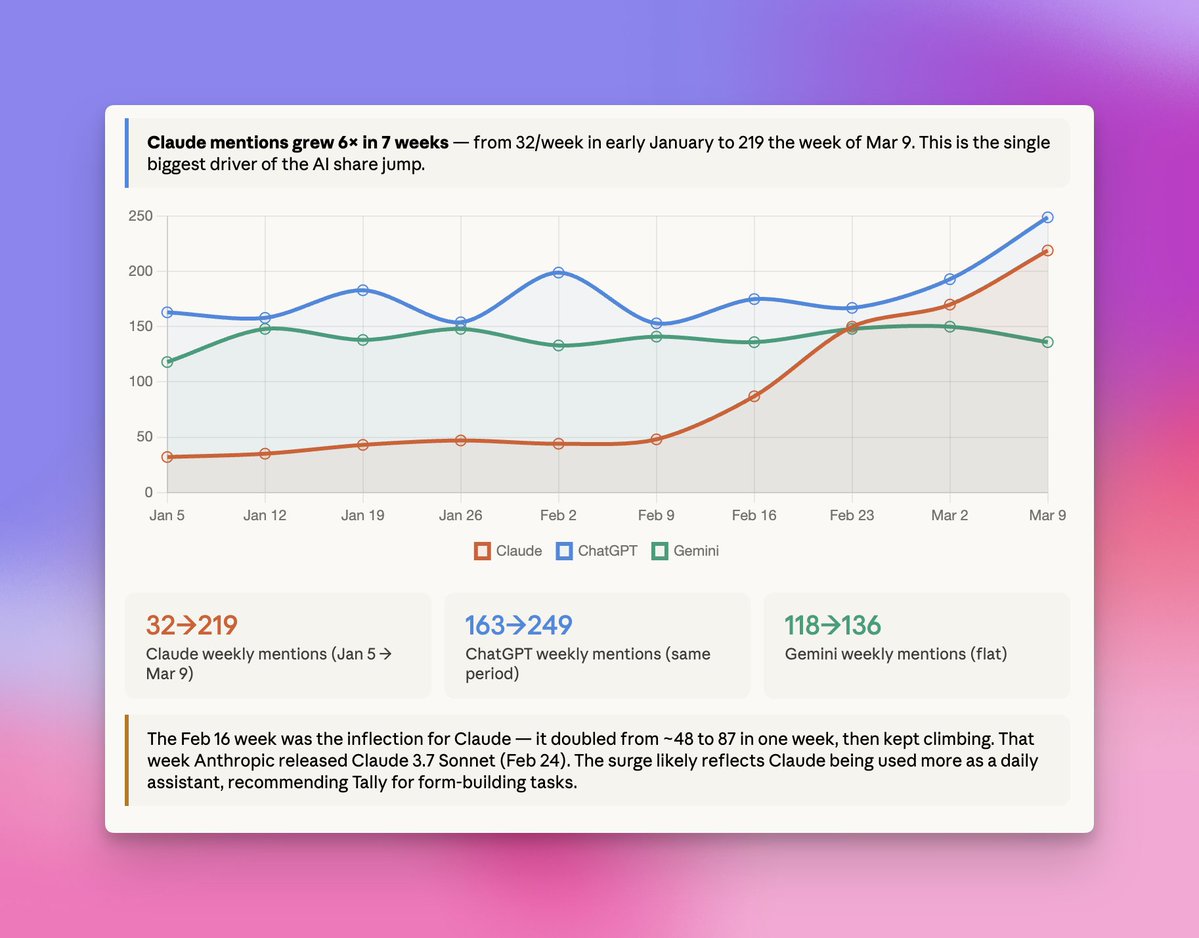
And once again, AI became our #1 acquisition channel, driving 35% of new signups.
One thing that stood out: new users discovering Tally via @claudeai.
In our onboarding survey, mentions of Claude as the discovery source grew 6x in just 7 weeks.
Gemini is starting to rise too, but Claude is clearly driving the biggest jump right now.
English