
Andric

27.4K posts

Andric banner
Andric

Andric

@astralwave

Indie software dev and designer. On a quest to build software that's pragmatic, ergonomic, and collaborative. Building https://t.co/gvSRnhHcF2 with @ideosyncretic

Katılım Ocak 2009
1.8K Takip Edilen2.6K Takipçiler
Andric
Andric@astralwave·
I’m excited for the agentic revolution remaking software as we know it. The argument for user-configurable or user-extensible software has always been a bit flawed, because it assumes that if someone finds off-the-shelf software distasteful, or disrespectful of their needs, then the answer is to make tweaks atop that software. But software expresses affordances and conceptual models that are tightly coupled to a data model, API semantics, and architectural capabilities. Which means if said software is wrongly-opinionated for a use case, it’s unlikely that making userland tweaks or extensions will help much. When agents become users that consume APIs directly, software that’s designed in a fashion disrespectful of their users’ goals, needs, or mental models will become more intolerable. Any hard limitation of those APIs or underlying data models will become more stark. When users’ experiences with software used to be mediated by UIs alone, it’s always a bit opaque as to how that software can evolve or be modified to work differently in a way that more closely matches your goals or the way you think. In that world, a different UI seemed to be the answer. But at the end of the day, poorly-made software is hamstrung by its fundamental design at the system level. The UI can only express what the system is designed for. Competition between software tools will become much more perfect, when these design flaws are quickly discovered, as agents run into a wall with an API that can’t express the user’s intent.
Karri Saarinen@karrisaarinen

x.com/i/article/2034…

English
0
0
4
361
Andric
Andric@astralwave·
And to your original question: the way plan mode and sub-agents work, you will naturally move work from your initial request which is some coarse-grained intent that you express in natural language for what to change or fix, to a specific plan that breaks down how that intent should be achieved I know plan mode and sub-agents have been part of Claude Code for some time, so it’s not a new way of working, but it’s particularly well-executed in Codex (especially the UI in the macOS app!) I’ve also setup Agentation which helps me annotate UI elements and better instruct agents what I want fixed
English
0
0
0
13
Andric
Andric@astralwave·
The main Codex agent becomes an orchestrator when you tell it to spin off multiple agents. This is how I’m using sub-agents in the Codex macOS app: 1. Go into plan mode 2. Say what I want to achieve. Say I want it to spin up multiple sub agents to explore the codebase in parallel, and that the plan should also include how we can utilize sub agents that work on a parallelizable sequence of work to prevent conflicts. 3. The agent asks a few questions, a plan is produced, if I’m not happy, I ask for changes 4. When the plan is done I switch out of plan mode and ask it to commit it as a Markdown file to my codebase’s plans folder 5. Once the commit is done, the agent goes and begins implementation. Because of what I said in (1), the plan will include steps for how to utilize subagents: which subagents need to be created, what they should work on, and in what order. I have a few lines of instructions in AGENTS.md to tell it to commit the plan to a plans folder before implementing, so (4) and (5) is automated as soon as I ask it to proceed to implementation And I also have a skill for how I like my commits written, that I created with the help of the built-in skill creator skill. I haven’t wrapped up my preference for planning parallelizable work in a reusable skill yet, but I probably will do so. Right now I just tell it.
English
1
0
1
33
Andric
Andric@astralwave·
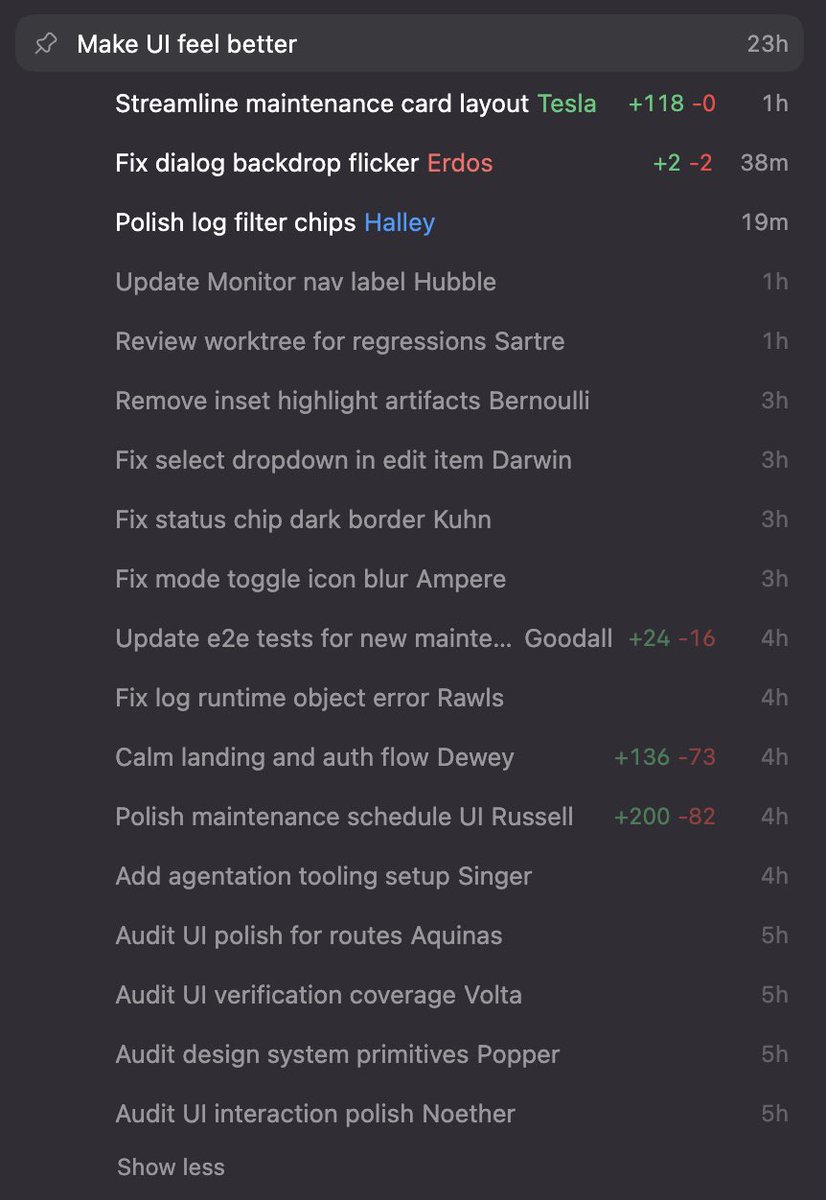
Codex sub-agents are such a treat to use I love how you can steer each one individually Makes it possible to start with a coarse ask, have the agent break up the work into small orthogonal parts, then deep dive into each one It’s also super cute that each sub-agent gets a name like “Erdos”, “Halley”, “Hubble”, etc: it’s a small detail but it makes it possible to refer to them easily!
Andric tweet media
English
1
0
3
729
Andric
Andric@astralwave·
Folks like to compare Anthropic to Apple but I think OpenAI has more of that Apple design DNA. The Codex macOS app such a treat to use with a ton of little design details. They ship new workflow features more slowly compared to Anthropic, but they do it more thoughtfully and usually with a considered UX Anthropic UX feels more like Microsoft in this case: drawers chock full of stuff, lots of it powerful, but they aren’t necessarily well thought out from a usability perspective
Andric@astralwave

Codex sub-agents are such a treat to use I love how you can steer each one individually Makes it possible to start with a coarse ask, have the agent break up the work into small orthogonal parts, then deep dive into each one It’s also super cute that each sub-agent gets a name like “Erdos”, “Halley”, “Hubble”, etc: it’s a small detail but it makes it possible to refer to them easily!

English
0
0
3
558
Andric
Andric@astralwave·
@odysseus0z True, there’s no clear winner yet
English
0
0
2
49
George
George@odysseus0z·
@astralwave Haha that’s the second piece. Unsolved in the sense that there’s no Postgres/React equivalent. All three of these take different approaches and have different tradeoffs.
English
1
0
2
74
George
George@odysseus0z·
Google spent thirteen years and three products trying to ship reactive subscriptions + a real data model + standard SQL. They still can't deliver all three. Wrote about why. (do people here still read non-AI stuff?
George@odysseus0z

x.com/i/article/2032…

English
1
2
23
4.6K
Andric
Andric@astralwave·
> The hard part is figuring out what to build and understanding users well enough to know what they actually need. It's selling an idea to skeptical stakeholders. It's making good decisions with incomplete information. It's maintaining momentum through the long middle of a project when the initial excitement has faded and the finish line isn't yet visible. So… product management?
English
0
0
0
325
Andric
Andric@astralwave·
I think people are making too much of a big fuss over “taste” and how that’s a comparative advantage for humans over AI models I think “taste” is simply an act of prediction over learned patterns of human preferences (I go into detail more in the article) Corollary of this: AI models can pattern match over a larger dataset of human preferences than any single human will ever be able to, and will win out over humans every time. Humans only have an advantage over AI models insomuch as much of these human preferences are still tacit and granular and difficult to put into words Anyone who’s tried to prompt an AI model for a song, an image, or a video exactly to taste will know how difficult it is to explicitly state what your preferences are. But recommender algorithms are already better at recommending and curating content than human curators, using proxy signals like likes, views, etc Perhaps it’s a matter of time before someone cracks the code of how to infer a user’s preferences (without explicit prompting) for creation (not just curation) When that happens, there’s no need for a middleman human to make creative decisions. The end-consumer can simply ask for what they want, and the AI models will provide it, to taste.
Andric@astralwave

x.com/i/article/2024…

English
0
0
3
398
andyrewlee
andyrewlee@andyrewlee·
no components fit. i might be asking too much from convex. to get the figma experience, i have to turn off convex realtime and bring my own websocket server. for example doing cursor this way youtube.com/watch?v=Tx_YIN… feels hacky and the experience isn't great. bunch of db writes for a ephemeral cursor effect.
YouTube video
YouTube
English
1
0
0
73
Jamie Turner
Jamie Turner@jamwt·
What crazy new thing should @convex build this year? I don't mean like OLAP or selectable data residency or improved auth because those are already happening. Different idea? Reply with what I missed.
English
64
1
69
20.5K
Andric
Andric@astralwave·
@dreetje @tana_inc @openclaw How’d you get the Tana MCP to work with it? It seems OpenClaw doesn’t really have MCP support
English
1
0
0
106
André Foeken
André Foeken@dreetje·
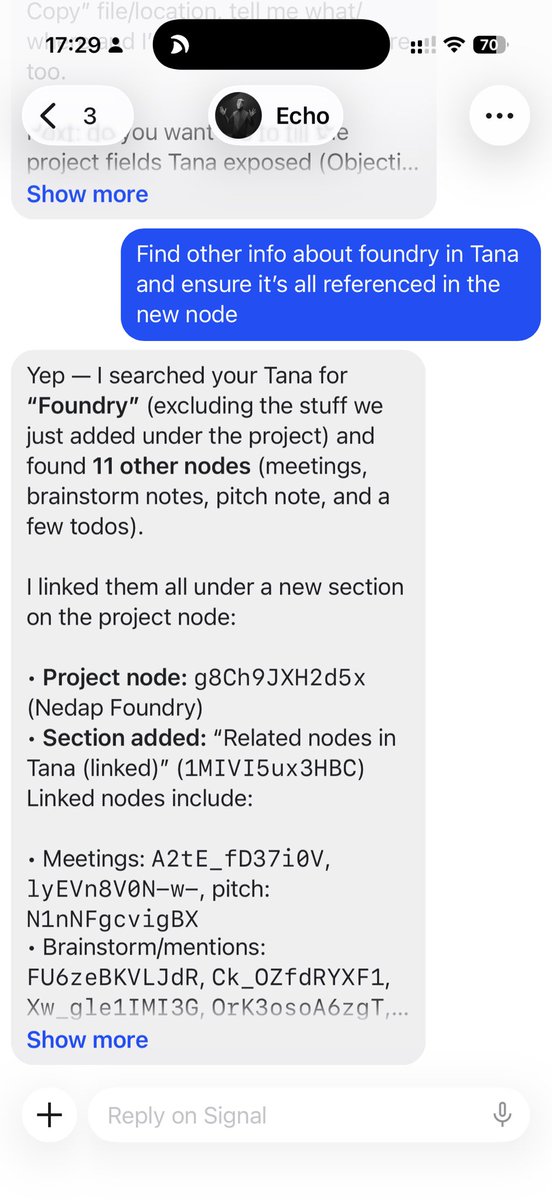
Last week @tana_inc released their full api and MCP server. Now my @openclaw has access to all my notes and todos. A cool use-case: trawl my @tana_inc and find missing links.
André Foeken tweet media
English
1
1
15
1.2K
Andric
Andric@astralwave·
Hmm I don’t think it needs to be in a remote VPS that’s exposed to the public internet for that to happen It’s just that people are blindly following tutorials to deploy it to a public-facing VPS, without having the knowhow to harden it against attackers Which isn’t a vulnerability with Clawdbot per se, although of course they can add a layer of defense And there are still potential issues with something like this when it comes to prompt injection attacks but as for what the article describes, if you deploy it on a local machine or a remote machine and put it behind a private network using Cloudflare Tunnels or Tailscale (which is best practice for deploying any private web service), it won’t be exposed to the Web for attackers
English
0
0
0
18
Wes Bos
Wes Bos@wesbos·
Clawdbot haters are missing the point Hardcore users are very quickly figuring out the useful parts of what one agent that can do anything. Lots is crap, but some very useful workflows will come from this The other is that clawdbot itself is a massive app gen’d by AI with a CRACKED dev at the reigns. We’re witnessing a new type of workflow here. Again, that might not be good. But let them cook and spend their money to figure it out
shirish@shiri_shh

Clawdbot has the same hype as Rabbit R1. it was all over my feed back then called a brilliant product. game changer thing Clawdbot feels very familiar right now.

English
84
22
473
149.7K
Andric
Andric@astralwave·
@rachelnabors @wesbos Pretty easy to setup in a local machine (I set it up in an unused mini PC that was running Ubuntu). No need to expose anything to the public internet unless you want to access the web UI. Even when running locally, the existing setup with Telegram just works.
English
1
0
0
35
Andric
Andric@astralwave·
This is beyond cool. Designs collocated with your codebase! Visual designs are a huge part of spec’ing out a UI If specs should be collocated with the code so that agents always have the context of what they’re building or maintaining, then it makes sense for the design files to be collocated with it too
Tom Krcha@tomkrcha

Excited to launch Pencil INFINITE DESIGN CANVAS for Claude Code > Superfast WebGL canvas, fully editable, running parallel design agents > Runs locally with Claude Code → turn designs into code > Design files live in your git repo → Open json-based .pen format

English
0
0
2
607
Andric
Andric@astralwave·
@ashpreetbedi Is it a missing layer or just not yet turnkey? Seems like @convex, @vercel, @Cloudflare, @triggerdotdev, @e2b are all trying to build it but not any of them are currently turnkey. Stuff like streaming to the browser, resumability, durable workflows, and isolated sandboxes.
English
1
0
7
1.2K
Andric
Andric@astralwave·
@eyad_khrais “if you have a hierarchy system of files, keeping these at thievery top is how you can get these to work for every task / feature that you decide to build out” What did you mean by “thievery top”? Seems like a typo
English
1
0
1
19.5K